By H.E. Roné de Beauvoir
Founder, Dignifi-Global™
Special Envoy for Digital Inclusion and AI Governance
The true measure of global leadership in 2026 will not be found in the strength of a border; it will be found in the unwavering commitment to human flourishing. You likely recognize that the principle of non refoulement is the foundational bedrock of this commitment, yet the 1951 Refugee Convention faces unprecedented pressure from shifting political tides. We understand the weight of this responsibility. It’s difficult to bridge the gap between rigid international mandates and the fluid realities of institutional compliance when the stakes are measured in human lives.
At Dignifi-Global, we believe people are not problems to be managed; they are lives to be honored. This article empowers you to master the legal, ethical, and technological dimensions of non refoulement to build resilient policy frameworks for the coming decade. We’ll explore how to integrate ethical AI into aid delivery through a dignity-first lens, ensuring that technology serves to restore rather than replace human rights. By centering our methodology on the three-part cadence to touch, heal, and inspire, you’ll gain a strategic framework for governance that honors every individual. We’re moving beyond process-heavy consulting toward a future of partnership over dependency and accountability over indifference.
“The principle of non-refoulement is more than a legal standard — it is a reflection of whether our global systems are built to protect human dignity or disregard it.”
— H.E. Roné de Beauvoir
Key Takeaways
-
Understand why the principle of non refoulement serves as the sacred shield of international law, binding nations to a moral and legal commitment to protect the vulnerable from return to danger.
-
Navigate the digital frontier by learning to mitigate "Algorithmic Refoulement," ensuring that AI and biometric data sharing honor human dignity rather than compromising it.
-
Master a resilience-first framework to audit your aid policies, shifting your institutional focus from managing processes to honoring the flourishing of human lives.
-
Bridge the intersection of global legal conventions and customary law to build a governance model that remains steadfast in the face of 2026’s complex humanitarian challenges.
-
Embrace a dignity-first leadership style that seeks to touch, heal, and inspire, moving beyond traditional relief toward true global inclusion and systemic restoration.
Table of Contents
-
The Sacred Shield: Defining Non-Refoulement in a Globalized Era
-
The Foundational Pillars: Legal Frameworks and Moral Imperatives
-
The Digital Frontier: Non-Refoulement in the Age of AI and Digital Identity
-
Operationalizing Protection: Building Resilience-First Policy Frameworks
-
Beyond Relief: Dignifi-Global™ and the Future of Humanitarian Governance
The Sacred Shield: Defining Non-Refoulement in a Globalized Era
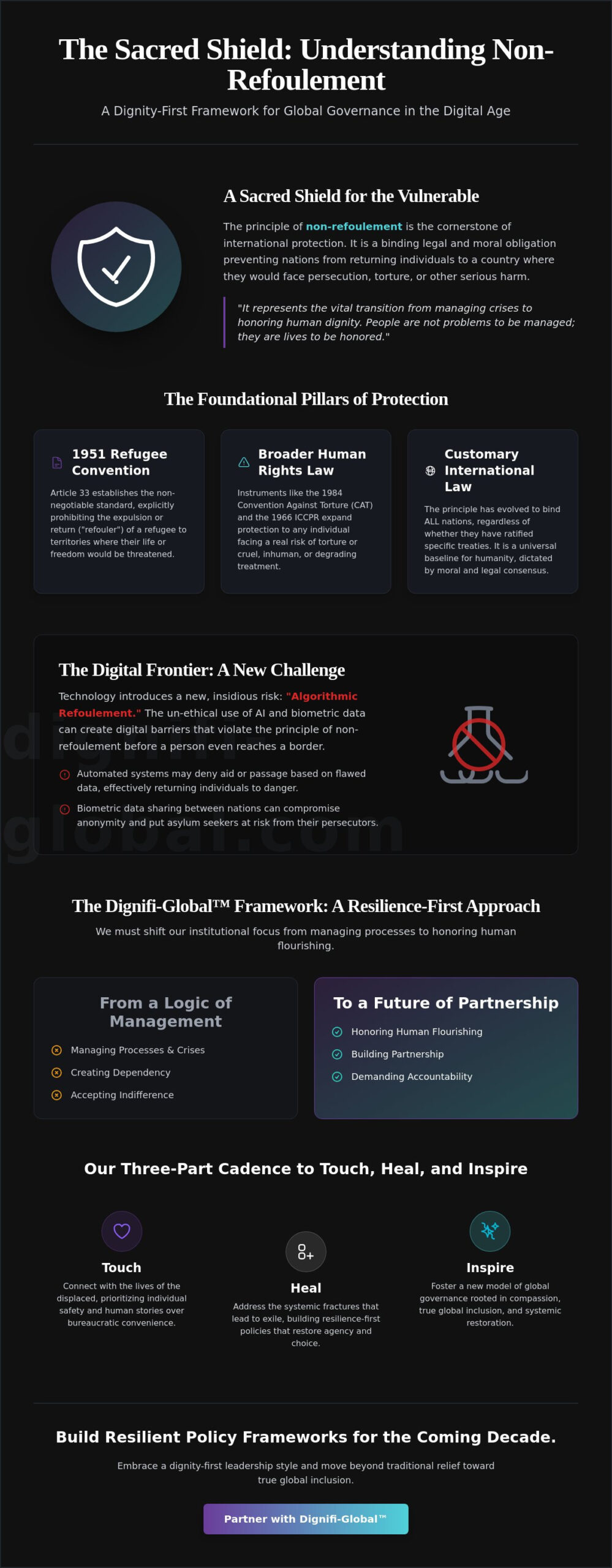
The Principle of Non-refoulement serves as the foundational pillar of international protection. It is the cornerstone that prevents states from expelling or returning individuals to places where their freedom or lives face the shadow of persecution. This isn’t merely a technicality of border control; it is a sacred shield. At Dignifi-Global, we believe that non refoulement represents the vital transition from managing crises to honoring human dignity. Our methodology seeks to touch the lives of the displaced, heal the systemic fractures that lead to exile, and inspire a global governance model rooted in compassion. We don’t view people as problems to be managed; they are lives to be honored.
Historical Origins: From the Holocaust to the 1951 Convention
The legal weight of this principle crystallized following the devastation of the Second World War. The 1951 Refugee Convention, specifically Article 33, established this prohibition as a non-negotiable standard for the international community. This legal anchor was a direct response to the horrors of the 20th century, where millions were denied sanctuary. Today, with 146 states party to the 1951 Convention or its 1967 Protocol, the mandate remains clear. We must never return a person to the hands of their persecutors. This boundary is absolute because the value of a human life is absolute. It was the collective recognition of 1945 that necessitated this moral boundary, ensuring that the failures of the past would not dictate the architecture of the future.
The Dignity-First Perspective on Human Rights
True institutional resilience doesn’t come from rigid borders but from ethical adherence. When we shift our focus from "refugee status" to the inherent worth of the human person, we begin to build systems that allow for genuine flourishing. Non refoulement is the baseline for this transformation. It ensures that the dignity-first approach is not just a slogan but a lived reality for those at the intersection of conflict and hope. This principle requires us to look beyond the administrative processing of migrants and instead see the potential for restoration.
-
Centering the Person: We prioritize the individual’s safety over bureaucratic convenience.
-
Restoring Agency: Protection is the first step toward a person regaining their voice.
-
Bridging Gaps: Ethical adherence creates a more stable, predictable international order.
By upholding this principle, nations demonstrate a commitment to a future where safety is a foundational right, not a conditional privilege. It’s a choice to lead with wisdom and long-term perspective. When a state honors this obligation, it isn’t just following a rule; it’s participating in the preservation of global humanity. This is how we move from a world of dependency to one of partnership and mutual respect.
The Foundational Pillars: Legal Frameworks and Moral Imperatives
The legal architecture of non refoulement isn’t just a collection of treaties; it’s a moral commitment to the sanctity of life. It bridges the 1951 Refugee Convention with the 1984 Convention Against Torture (CAT) and the 1966 International Covenant on Civil and Political Rights (ICCPR). Together, these instruments form a shield that transcends borders. This principle has evolved into customary international law, meaning it binds every nation on earth, including the 40+ states that haven’t formally ratified the 1951 Convention. It’s a universal baseline that ensures human worth isn’t dictated by geography.
Critics often suggest that national security necessitates the power to expel individuals at will. This perspective views people as problems to be managed; however, we believe they are lives to be honored. The law doesn’t force a choice between safety and compassion. Instead, it demands that security measures don’t violate the absolute prohibition of return to danger. While the 1951 Convention focuses on "refugees" fleeing persecution, the broader human rights framework protects any individual facing a real risk of torture or irreparable harm. This ensures that protection is a right, not a bureaucratic privilege.
Absolute vs. Qualified Rights: Navigating Legal Nuance
In the context of torture, non-refoulement is considered non-derogable. This means states can’t suspend it, even during public emergencies or conflict. While Article 33 of the 1951 Convention contains limited exceptions for national security, these are rarely applicable in 2026 because the CAT provides an absolute prohibition with no exceptions. As we move toward a digital future, AI regulatory standards must align with these legal absolutes to prevent automated systems from making life-and-death decisions without ethical oversight. Our methodology seeks to touch the vulnerable, heal broken processes, and inspire systemic integrity.
Regional Interpretations: From the EU to the AU
Regional frameworks often provide more expansive protections than global treaties. The 1969 OAU Convention in Africa and the 1984 Cartagena Declaration in Latin America widened the scope to include those fleeing generalized violence or internal strife. In Europe, the European Court of Human Rights (ECHR) has set a high bar against collective expulsions, centering the individual’s right to an effective remedy. Access to territory and non-refoulement must remain the operational heartbeat of any humane migration strategy. To build a future where every person flourishes, we invite you to explore our vision for ethical policy leadership and global accountability.
The Digital Frontier: Non-Refoulement in the Age of AI and Digital Identity
The evolution of global migration has shifted from physical fences to lines of code. We stand at a crossroads where the sacred duty of protection meets the cold efficiency of automation. This transition introduces the grave risk of Algorithmic Refoulement, a phenomenon where biased automated systems mistakenly categorize vulnerable individuals as ineligible for protection. When artificial intelligence relies on flawed data proxies like regional accents, specific travel patterns, or historical data from biased sources, it risks triggering the illegal return of those fleeing persecution. This violation of non refoulement happens in milliseconds, often hidden behind the opaque logic of proprietary software. We must recognize that technology should serve to honor life, not to automate its rejection.
The intersection of technology and human rights represents the most significant governance challenge of the 2020s. Biometric data sharing within humanitarian frameworks, while intended to streamline aid, can inadvertently become a roadmap for pursuers if not governed by strict ethical standards. Our mission is to ensure that digital tools remain a sanctuary for the displaced, rather than a surveillance net that compromises their safety.
Algorithmic Bias and Border Governance
Automated decision-making systems lack the capacity for empathy. They often fail to account for the nuance of individual asylum claims, leading to "proxy-based" exclusions that bypass the spirit of international law. Human-in-the-Loop protocols are a moral necessity in border AI, ensuring that no machine has the final word on a human being’s right to safety. By centering human judgment, we protect the foundational principle of non refoulement against the errors of unmonitored code. Contextual AI Governance is the intentional framework that subjects every automated decision to the scrutiny of human empathy and legal accountability.
Digital Identity System Design for Protection
A well-executed digital identity system design acts as a Sovereign Shield for the displaced. Rather than relying on centralized databases that can be weaponized by hostile regimes, we advocate for decentralized, sovereign ID models. These systems give refugees absolute control over their own biometric and biographical data, allowing them to share only what’s necessary for survival.
Dignifi-Global™ plays a pivotal role in this transformation by designing secure, inclusive identity frameworks that facilitate financial access without compromising security. Our approach follows a rhythmic commitment to the human spirit: we Touch the lives of the marginalized, Heal the fractures in global governance, and Inspire a future where identity is a tool for flourishing. We operate with the firm conviction that people are not problems to be managed; they are lives to be honored. By implementing a dignity-first approach to technology, we ensure that the digital identity of a refugee remains a bridge to a new life, not a tool for their return to danger.
Operationalizing Protection: Building Resilience-First Policy Frameworks
To honor the foundational principle of non refoulement, global institutions must move beyond reactive measures. We must build policy frameworks that don’t just provide temporary relief but foster long-term resilience. This shift requires a departure from the 20th-century model of dependency; it demands a partnership where the displaced person is an active participant in their own flourishing. By centering accountability and transparency, we transform governance from a bureaucratic hurdle into a shield for human rights. Our methodology follows a three-part cadence: we touch the lives of the vulnerable, heal the systemic fractures that expose them to risk, and inspire a new era of inclusive policy leadership.
The Dignity-First Policy Audit
Institutions must conduct rigorous audits to ensure their aid policies don’t inadvertently facilitate non refoulement violations. This process begins with a granular assessment of data-sharing agreements. According to the 2023 UNHCR Global Trends report, over 110 million people remain forcibly displaced, making data security a matter of life and death. Organizations should adopt "Privacy by Design" by encrypting biometric data and ensuring it’s never accessible to third-party governments that could use it for persecution. Use this checklist for AI-driven aid:
-
Identify if predictive algorithms create "exclusion zones" for specific ethnicities.
-
Verify that automated decision-making includes a human-in-the-loop for all asylum-related queries.
-
Audit data storage locations to ensure they reside in jurisdictions with robust human rights protections.
Centering the Human Person in Data Systems
Technology is a tool, not a savior. Governance must always precede technology in humanitarian interventions. When we collect data at the point of arrival, we aren’t just processing a case; we’re honoring a life. Best practices suggest that data collection should be voluntary, transparent, and focused on immediate needs rather than long-term surveillance. By linking these policy frameworks to the UN Sustainable Development Goals, specifically Goal 16 for peace and justice, we bridge the gap between local action and global responsibility. The 2022 World Bank report on forced displacement highlights that 76% of refugees are in protracted situations, proving that our systems must be built for decades, not days. We don’t view people as problems to be managed; they’re lives to be honored through stable, ethical governance.
The path to global stability begins with policies that protect the most vulnerable without compromise. Explore how Dignifi-Global bridges the gap between strategic policy and human dignity.
Beyond Relief: Dignifi-Global™ and the Future of Humanitarian Governance
Dignifi-Global™ exists at the intersection of technological progress and human rights. We believe that technology should honor every life; it shouldn’t just track them. The current global crisis, with over 110 million individuals forcibly displaced as of 2024, requires more than just efficient logistics. It demands a fundamental shift in how we perceive the vulnerable. People aren’t problems to be managed; they’re lives to be honored. This conviction drives our vision for a world where every individual’s dignity is the starting point for policy, not an afterthought of administration.
Our "Touch, Heal, Inspire" framework serves as the heartbeat of modern governance. We touch the lives of the marginalized through inclusive design. We heal systemic fractures by restoring trust in global institutions. We inspire a future where no one is left behind. This methodology transforms the legal obligation of non refoulement from a defensive barrier into a proactive commitment to human flourishing. By centering the person, we move beyond the cold, clinical language of strategic advisory into a realm of moral responsibility.
Consulting for a Globalized World
As we approach 2026, the complexity of global migration requires institutional resilience that traditional, process-heavy consulting can’t provide. Dignifi-Global™ assists organizations in modernizing humanitarian aid frameworks to meet these challenges. We replace dependency-based models with dignity-first systems. We invite visionary leaders to partner with us in building inclusive financial systems. These systems provide the unbanked with more than just a digital footprint; they provide a foundational path to economic agency and restored identity. Governance must be about partnership, not just oversight.
The 2026 Roadmap for Policy Leadership
The next decade of humanitarian resilience will be defined by how we center dignity in AI and Digital ID systems. Ethical governance isn’t optional anymore. It’s the foundational requirement for any technology that touches human life. Our roadmap for the next ten years prioritizes accountability and the protection of human rights over mere technical efficiency. We’re building a legacy of protection that respects the spirit of non refoulement while embracing the possibilities of the digital age. This is the moment for leaders to choose a path that honors humanity at every intersection of policy and practice.
Take the lead in ethical innovation. Partner with Dignifi-Global™ to design your ethical governance roadmap and ensure your institution stands as a pillar of global dignity.
Honoring the Future of Global Protection
The protection of the vulnerable isn’t a modern luxury; it’s a foundational requirement of the 1951 Refugee Convention that defines our collective morality. As we navigate the complexities of AI and digital identity, we must ensure that the principle of non refoulement remains an unbreakable shield against the risks of automated exclusion. We’ve moved beyond mere relief to a new era where technology must serve the soul. Our systems shouldn’t just process data. They must honor the inherent worth of every human life. Our philosophy remains clear: people aren’t problems to be managed; they’re lives to be honored.
Leadership in this digital frontier requires a shift from managing processes to restoring human dignity. Led by Her Excellency Roné de Beauvoir, Dignifi-Global stands at the intersection of AI policy and humanitarian resilience. We’ve pioneered the Dignity-First governance model to bridge the gap between technological advancement and ethical responsibility. It’s time to Touch, Heal, and Inspire the world through systems that prioritize partnership over dependency. Design your institution’s ethical AI and digital identity roadmap with Dignifi-Global™. Together, we’ll build a future where every individual is seen, protected, and empowered to flourish.
Frequently Asked Questions
What is the simplest definition of non-refoulement?
Non-refoulement is the fundamental legal and moral prohibition that prevents states from returning individuals to territories where their life or freedom is threatened. It’s not a mere administrative rule; it’s a commitment to honoring the inherent dignity of every human being. Under Article 33 of the 1951 Refugee Convention, this principle ensures that safety is a right rather than a privilege. We must treat people as lives to be honored, not problems to be managed.
Is the principle of non-refoulement legally binding for all countries?
Yes, the principle is legally binding for all nations. This is because it’s recognized as customary international law. While 146 countries have formally signed the 1951 Refugee Convention or its 1967 Protocol, the obligation transcends specific treaties. It’s a foundational pillar of global governance that requires every state to protect individuals from harm. This creates a universal standard of accountability that centers human flourishing above political convenience or temporary administrative borders.
Can a country ever legally return a refugee under non-refoulement?
A state may only return a refugee under extremely narrow exceptions defined in Article 33(2) of the 1951 Convention, specifically when the individual poses a documented threat to national security. These exceptions are rare and require rigorous legal scrutiny to prevent the erosion of human rights. We must remember that security isn’t found in exclusion, but in the integrity of our shared moral frameworks. True safety comes from partnership over dependency and honoring the vulnerable.
How does artificial intelligence impact the principle of non-refoulement?
Artificial intelligence impacts non refoulement by introducing automated risk assessment tools that can either enhance protection or perpetuate systemic bias. When 60 percent of border technologies lack transparent ethical oversight, the risk of digital errors leading to illegal returns increases. We must center people, not processes, ensuring that algorithmic decisions don’t bypass the human need for sanctuary. Our methodology aims to touch, heal, and inspire through the ethical governance of these emerging technologies.
What is the difference between non-refoulement and political asylum?
Non-refoulement is the specific obligation not to return a person to danger, while political asylum is the broader legal status granted by a state allowing them to remain. Think of it as the difference between stopping a harm and providing a home. While non refoulement acts as an immediate shield, asylum offers the long-term flourishing that comes from full legal recognition. It’s a shift from mere survival to the restoration of a person’s place in society.
What happens if a state violates the principle of non-refoulement?
States that violate this principle face international legal challenges and condemnation from bodies like the UN Committee Against Torture. In 2012, the Hirsi Jamaa and Others v. Italy case demonstrated that maritime pushbacks are illegal under international law. Accountability isn’t just about punishment; it’s about restoring the broken trust between a state and the global community. When states fail, we must work to bridge the gap between existing policies and ethical responsibility.
How does digital identity help in upholding non-refoulement?
Digital identity helps uphold this principle by providing displaced individuals with portable, verifiable proof of their status and history. Since 1 billion people globally lack official identification, secure digital credentials prevent the invisibility that often leads to wrongful deportation. This technology serves to touch, heal, and inspire by ensuring that a person’s rights are recognized across every border. It’s a dignity-first approach that ensures no one is lost in the cracks of broken systems.
Why is non-refoulement considered a ‘peremptory norm’ (jus cogens)?
Non-refoulement is considered a peremptory norm because it represents a moral and legal consensus from which no nation is permitted to deviate. It’s a foundational truth that sits at the heart of international law. By treating this principle as jus cogens, the global community acknowledges that certain human rights are non-negotiable. This standard ensures that we’re centering the human person in every legal framework, moving toward a future where global dignity is a shared reality.
About the Author
H.E. Roné de Beauvoir is the founder of Dignifi-Global™, a policy and thought leadership platform focused on artificial intelligence, digital identity, and financial inclusion. Her work centers on developing human-centered frameworks that align technological advancement with dignity, accountability, and global access.
She is the author of multiple policy papers addressing AI governance, digital identity systems, and inclusive infrastructure for the unbanked, contributing to global discussions on digital sovereignty and the future of equitable systems.