H.E. Roné de Beauvoir
Diplomatic Envoy | Peace Ambassador
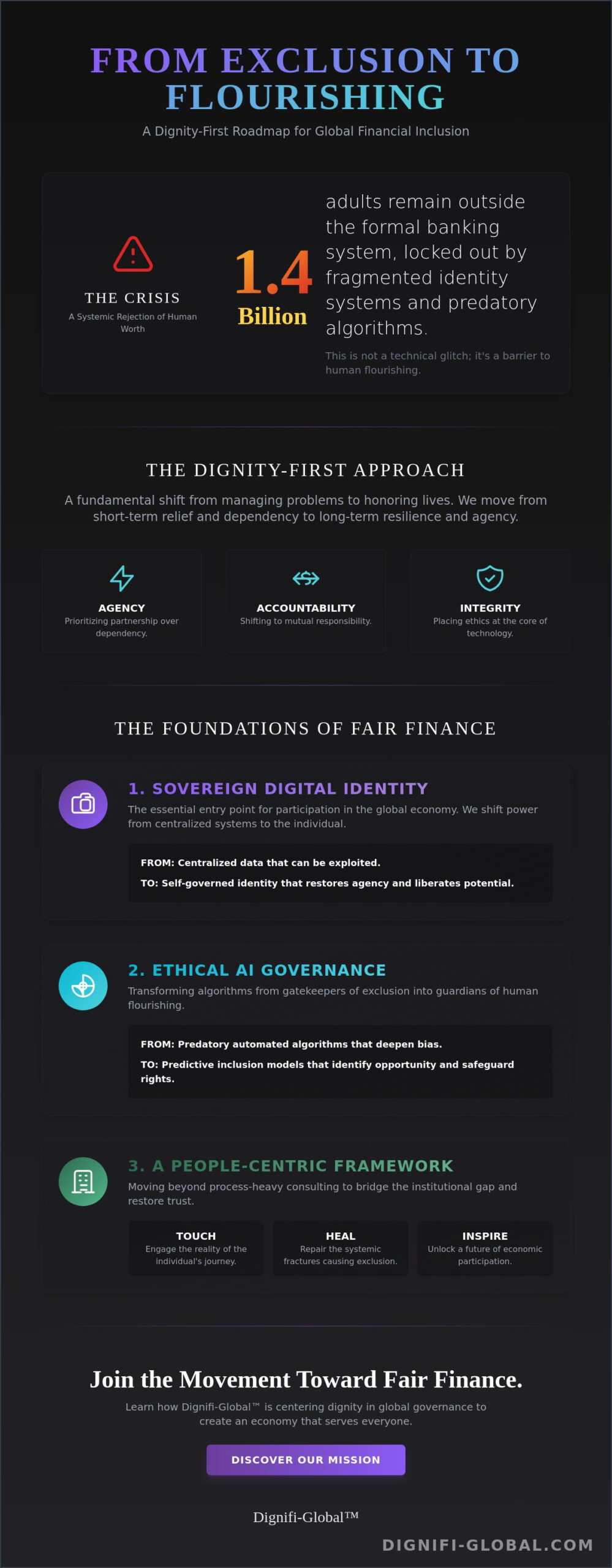
What if the tools intended to connect us are the very mechanisms keeping 1.4 billion adults outside the gates of economic participation? By 2026, the persistence of fragmented identity systems and biased algorithms won’t be seen as a technical glitch; it’ll be recognized as a systemic rejection of human worth. You likely recognize that our current financial architecture often fosters dependency rather than true resilience. We believe that the path toward fair finance starts with a fundamental shift in perspective. People aren’t problems to be managed; they’re lives to be honored.
In this exploration, you’ll discover how the intersection of digital identity and ethical AI governance is transforming financial systems from exclusionary mechanisms into foundations for human flourishing. We’re moving beyond the cold, clinical language of strategy to offer a dignity-first roadmap for global inclusion. This framework outlines how ethical AI models and sustainable institutional governance can bridge the gap between exclusion and opportunity. We’ll examine the specific steps needed to touch, heal, and inspire a global economy that finally centers on the individual.
"Fair finance is not achieved through access alone — it requires systems that are designed with accountability, equity, and human dignity at their core."
— H.E. Roné de Beauvoir
Key Takeaways
-
Learn how a "Dignity-First" approach transforms financial systems into mechanisms of mutual accountability that honor human lives rather than just managing transactions.
-
Discover why sovereign digital identity serves as the foundational infrastructure for true inclusion, ensuring individual agency replaces the risks of centralized systems.
-
Explore the shift from predatory automated algorithms to predictive inclusion models that utilize ethical AI governance as a guardian of human flourishing.
-
Master a strategic five-step roadmap for institutional modernization that centers on fair finance by moving beyond process-heavy consulting toward people-centric advisory.
-
Understand how to integrate the "Touch, Heal, Inspire" framework into global governance to bridge the institutional gap and restore trust in global financial structures.
Table of Contents
-
Beyond Transactions: Redefining Fair Finance for a Digital Age
-
Digital Identity: The Foundational Infrastructure of Fairness
-
Ethical AI Governance: Guardrails Against Algorithmic Exclusion
-
Strategic Implementation: Bridging the Institutional Inclusion Gap
Beyond Transactions: Redefining Fair Finance for a Digital Age
By 2026, the global perception of fair finance has evolved beyond the narrow confines of affordable lending. It’s no longer just about the cost of capital; it’s about a system of mutual accountability that recognizes the inherent value of every participant. This shift centers on a dignity-first approach. We’ve moved past the era of managing problems to a new paradigm of honoring lives. In this model, the financial system serves the person, not the other way around. We don’t view individuals as data points to be processed, but as contributors to a shared prosperity.
The Touch, Heal, Inspire methodology serves as the heartbeat of this systemic redesign. We touch the reality of the individual’s journey, heal the systemic fractures that caused exclusion, and inspire a future where economic participation is a gateway to human potential. This isn’t a clinical process; it’s a humanitarian mission grounded in moral responsibility. It requires us to look at the intersection of technology and human rights with a steady, visionary gaze.
The Moral Imperative of Financial Inclusion
Access to financial inclusion is a foundational human right in our globalized economy. When 1.4 billion adults remain outside the formal banking system, as recorded in recent World Bank Global Findex data, the cost isn’t just felt by the individual. Systemic barriers erode institutional resilience and stifle global growth. We must reject outdated dependency structures that treat the marginalized as charity cases. Instead, we embrace partnership-based models that recognize the agency of every human being. This is how we restore trust between institutions and the people they are meant to serve.
Moving from Relief to Resilience
Sustainable resilience requires governance to precede technology. While digital tools provide the mechanism for change, ethical governance provides the purpose. Inclusive financial systems do more than help individuals; they strengthen the entire global economic fabric by creating a broader base of stability and innovation. This transition replaces short-term relief with long-term resilience, ensuring that the architecture of our economy is built on solid ground. Fair finance is an architecture of human flourishing.
-
Accountability: Shifting from one-way transactions to mutual responsibility.
-
Agency: Prioritizing partnership over dependency structures.
-
Integrity: Placing ethical governance at the center of all digital initiatives.
Digital Identity: The Foundational Infrastructure of Fairness
Digital identity serves as the essential entry point for all fair finance initiatives. It is not merely a technical requirement; it is a fundamental act of recognition that validates a person’s existence within the global economy. Traditional centralized ID systems often aggregate power in the hands of a few, creating vulnerabilities where data can be exploited or withheld. We advocate for a shift toward sovereign digital identity, which restores agency to the individual. This model ensures that people own their data, rather than being owned by it. By centering the person instead of the process, we move away from cold, clinical data collection and toward a system that honors human worth. Organizations like the Consumer Financial Protection Bureau highlight that consumer rights and transparency are the bedrock of any equitable financial landscape. When identity is secure and self-governed, it becomes a tool for liberation rather than a mechanism for surveillance.
Sovereign Identity for Global Inclusion
The World Bank reported in 2021 that 1.4 billion adults remain unbanked, largely due to a lack of verifiable documentation. Sovereign identity provides the foundational infrastructure to bridge this divide. This technology is particularly vital in the context of the Palermo Protocol (2000), which seeks to prevent, suppress, and punish trafficking in persons. Secure digital IDs allow vulnerable populations to prove their identity without relying on physical documents that can be stolen or confiscated by exploiters. By providing a permanent, portable record of identity, we can effectively disrupt the cycles of human trafficking. This approach does more than just facilitate transactions; it protects the sanctity of the individual. Our methodology seeks to Touch the lives of the marginalized, Heal the fractures in our social systems, and Inspire a new standard for global ethics.
Bridging the Gap for Refugees and Displaced Persons
For the 108.4 million people forcibly displaced worldwide as of 2023, digital identity is a lifeline for financial reintegration. The principle of non-refoulement, established in the 1951 Refugee Convention, must extend to data protection. Financial access should never come at the cost of safety. Digital identity allows refugees to carry their credit histories and credentials across borders, facilitating a transition from temporary humanitarian aid to permanent financial participation. A "dignity-first" framework ensures that displaced persons are not viewed as problems to be managed, but as lives to be honored. This transition is essential for long-term flourishing and systemic stability. Our commitment to restoring agency through policy leadership ensures that the intersection of technology and human rights remains a space of hope and accountability. By honoring the journey of the displaced, we build a more resilient and inclusive global community.
Ethical AI Governance: Guardrails Against Algorithmic Exclusion
Artificial intelligence acts as a double-edged sword in the pursuit of fair finance. While it offers the speed required for global scale, it also risks codifying historical biases into digital stone. We’re witnessing a necessary transition from predatory automated systems, which often penalized the vulnerable, to predictive inclusion models that recognize latent potential. This shift requires contextual intelligence. Policy design cannot rely on raw data alone; it must understand the lived realities of the individuals behind the numbers. Governance provides the only viable solution to the "black box" problem in credit scoring, transforming opaque algorithms into transparent pathways for human flourishing. By centering the individual, we ensure that technology serves to bridge gaps rather than widen them.
Modernizing Policy Frameworks for AI
Global financial institutions must adopt regulatory standards that prioritize accountability over mere efficiency. Operationalizing AI governance requires moving beyond boardroom theory into daily practice. This involves rigorous auditing of AI systems to identify hidden biases that have historically plagued lending processes. Since the 2008 financial crisis, the evolution of fair lending practices has shown that technology must be tempered by oversight. In 2023, the European Union’s AI Act set a precedent by classifying credit scoring as high-risk, demanding stricter transparency. Institutions that fail to audit their datasets risk perpetuating 40 years of systemic exclusion under the guise of modern innovation. True leadership requires a commitment to fair finance that is verified through constant, independent evaluation of algorithmic outcomes.
Centering the Human in the Machine
AI transformation isn’t a technical hurdle; it’s a governance challenge. We advocate for "dignity-first" AI, ensuring that every algorithm serves the flourishing of the individual rather than the convenience of the institution. When we treat people as lives to be honored instead of data points to be managed, the architecture of finance changes. Our methodology focuses on a rhythmic cadence of restoration: we Touch the lives of the unbanked, Heal the fractures in the system, and Inspire a new era of economic agency. This approach ensures that technology remains a tool for empowerment, not a barrier to entry. Humans must remain the final arbiters of financial worth because a machine can calculate risk, but only a human can recognize the inherent dignity of a dreamer.
-
Accountability: Establishing clear lines of responsibility for algorithmic decisions.
-
Transparency: Ensuring credit scoring models are explainable to the end-user.
-
Equity: Actively seeking to include populations previously ignored by traditional data.
Strategic Implementation: Bridging the Institutional Inclusion Gap
Transitioning toward fair finance requires a departure from the sterile, process-heavy consulting that has dominated the last decade. It demands a move toward people-centric strategic advisory where human agency is the primary metric of success. To build systems that actually work, institutions must adopt a roadmap that honors the individual while meeting global standards. This journey isn’t about mere compliance; it’s about the fundamental restoration of trust between the institution and the citizen.
-
Ethical Alignment: Map every institutional objective to the UN Sustainable Development Goals, specifically targeting Goal 10 (Reduced Inequalities) by the 2030 deadline.
-
Dignity Impact Auditing: Implement quarterly audits that measure how financial products restore personal agency rather than just tracking transaction volumes.
-
Algorithmic Accountability: Establish board-level oversight for AI models to ensure automated decisions don’t perpetuate historical biases.
-
Multilateral Synergy: Form partnerships with entities like the UNDP or the World Bank to leverage shared infrastructure for inclusive growth.
-
Digital-First Resilience: Replace paper-based relief with permanent digital identity frameworks that survive geopolitical shifts.
The Board’s Role in Governance Leadership
Leadership begins with the conviction that people are not problems to be managed; they are lives to be honored. Boards must align their vision with the 2021 World Bank finding that 1.4 billion adults remain unbanked. This isn’t a technical failure but a governance one. By centering top-down AI governance, organizations ensure that resilience is built into the foundation of the technology. Dignity impact auditing allows leaders to see the human face behind the data, moving the conversation from profit margins to the flourishing of global citizens. It’s a shift from seeing risk to seeing potential.
Modernizing Humanitarian Aid Frameworks
The shift from traditional relief to digital-first resilience marks a turning point in global development. We don’t just provide aid; we restore the infrastructure of hope through community finance. This model leverages local economic development to ensure that recovery is self-sustaining. Our Humanitarian Resilience Programs serve as a foundational pillar in this effort, bridging the gap between immediate crisis and long-term stability. By integrating digital identity into aid delivery, we touch the lives of the vulnerable, heal the fractures in the system, and inspire a new era of global participation. It’s time to choose partnership over dependency and people, not processes. This approach ensures fair finance is a reality for the 160 million people currently displaced by conflict and climate change.
To begin your journey toward ethical leadership, explore our strategic advisory services.
Dignifi-Global™: Centering Dignity in Global Governance
True progress in the international financial sector requires more than technological adoption; it demands a profound moral realignment. Dignifi-Global™ stands as the visionary partner for institutions ready to modernize their foundations through the lens of human worth. We recognize that the convergence of AI, digital identity, and fair finance represents the most significant opportunity for global equity since the dawn of the digital age. This isn’t merely about providing temporary relief to the underserved. It’s about building sustainable resilience that allows individuals to flourish within a system that recognizes their inherent value.
Our approach shifts the focus from dependency to partnership. We believe that people aren’t problems to be managed; they are lives to be honored. By integrating advanced biometric identity with ethical AI, we create pathways for the 1.4 billion adults who remained unbanked as of 2021 to finally enter the formal economy. This transition restores agency to the individual while providing institutions with the robust, verifiable data needed to maintain systemic stability. We are moving beyond the cold, clinical structures of the past toward a future where every transaction is an act of recognition.
Policy Leadership for a Globalized World
Under the strategic guidance of Her Excellency Roné de Beauvoir, our organization bridges the gap between high-level policy and human-centric implementation. From our headquarters in Houston, Texas, we serve as a central hub for global governance innovation, advising leaders on how to integrate complex technologies without sacrificing ethical integrity. We don’t view digital transformation as a technical hurdle, but as a foundational requirement for a just society. For those seeking to lead in this new era, our Ethical AI Governance Frameworks offer the necessary roadmap for balancing rapid innovation with deep accountability.
The Future of Institutional Resilience
The era of passive compliance is ending. Proactive leadership is the only path forward for institutions that wish to remain relevant in a rapidly evolving global market. Dignifi-Global™ invites stakeholders to move beyond the status quo and embrace a strategy that prioritizes long-term flourishing over short-term metrics. Our "Touch, Heal, Inspire" methodology acts as the heartbeat of our work, ensuring that every policy we craft and every system we design serves the higher purpose of human dignity.
We invite you to take a definitive step toward a more equitable future. You can partner with Dignifi-Global™ to design your inclusion strategy and join us in our mission to create a world where fair finance is a foundational reality for every citizen. Together, we can build a global architecture that honors the life of every person it touches.
Leading the Shift Toward Global Financial Flourishing
The path toward 2026 requires a departure from cold, algorithmic exclusion toward a system that centers human worth. We’ve explored how foundational digital identity and ethical AI governance serve as the essential guardrails for this new era. By prioritizing accountability over mere efficiency, institutions can bridge the inclusion gap that currently leaves 1.4 billion adults unbanked according to World Bank 2021 data. This evolution isn’t just about technical updates; it’s a fundamental commitment to fair finance that honors the individual. We must move beyond transactions to restore the social contract through governance that protects human rights at every digital intersection.
Dignifi-Global™, led by Her Excellency Roné de Beauvoir, stands at the specialized intersection of AI and human rights to guide this transition. Our proprietary Dignity-First methodology ensures your organization understands that people aren’t problems to be managed; they’re lives to be honored. We invite you to touch the future of governance, heal systemic divides, and inspire a legacy of true inclusion. Begin Your Institutional Transformation with Dignifi-Global™. The future of global equity is waiting for leaders with the courage to build it.
Frequently Asked Questions
What is the definition of fair finance in a global governance context?
Fair finance is the systemic alignment of fiscal policy with human rights to ensure every individual has the opportunity for economic flourishing. It’s not a mere set of transactions but a moral commitment to equitable access. The 2015 Addis Ababa Action Agenda serves as a foundational blueprint for this model, directing global capital toward the 17 Sustainable Development Goals to bridge the wealth gap.
How does digital identity enable financial inclusion for vulnerable populations?
Digital identity provides the 850 million people currently lacking legal documentation with a secure, portable record of their existence. This foundational tool allows marginalized groups to access 100 percent of the banking services they have historically been denied. By centering the individual through biometric or blockchain records, we move from a system of exclusion to one of universal recognition and dignity.
Can ethical AI governance prevent bias in financial services?
Ethical AI governance prevents bias by embedding accountability and human rights directly into the algorithmic design process. The 2021 UNESCO Recommendation on the Ethics of AI provides a framework for 193 member states to ensure technology honors human agency. It’s about auditing data inputs to ensure we aren’t just automating old prejudices but are instead restoring justice to credit scoring systems.
What are the main pillars of the Dignity-First framework?
The Dignity-First framework rests on three foundational pillars: Radical Accountability, Human Agency, and Systemic Flourishing. This methodology follows a core rhythm to touch the lives of the marginalized, heal the fractures in our social systems, and inspire a global shift toward ethical leadership. It’s a move away from managing problems toward honoring the 8 billion lives that constitute our global community.
How do humanitarian resilience programs differ from traditional aid?
Humanitarian resilience programs focus on building long-term local capacity while traditional aid often creates cycles of dependency. The 2016 Grand Bargain agreement shifted 25 percent of funding toward local responders to ensure communities can withstand future shocks. We don’t just provide temporary relief; we foster the structural stability required for a community to thrive independently of external intervention.
What role do international regulatory standards play in fair finance?
International regulatory standards provide the essential guardrails that ensure fair finance initiatives remain transparent and secure across borders. The Financial Action Task Force (FATF) updated its standards in 2019 to include digital assets, creating a unified language for 200 jurisdictions. These rules don’t just prevent crime; they build the trust necessary for global institutions to invest in emerging markets with confidence.
How can institutions balance data privacy with the need for digital identity?
Institutions balance privacy and identity by adopting decentralized technologies that give individuals 100 percent control over their personal data. The 2018 General Data Protection Regulation (GDPR) established that privacy is a fundamental right, not a luxury. By utilizing zero-knowledge proofs, we can verify a person’s eligibility for services without exposing their entire history, honoring their right to digital autonomy.
Why is AI governance considered a leadership problem rather than a technical one?
AI governance is a leadership problem because technology is a mirror that reflects the moral convictions and priorities of its creators. When we treat people as data points, we fail our foundational duty to honor them as lives. True leadership requires us to view AI not as a technical hurdle, but as a strategic opportunity to embed our highest values into the architecture of the future. For a deeper examination of how financial systems for global inclusion can be redesigned around dignity and ethical governance, explore our foundational case study.