H.E. Roné de Beauvoir

Diplomatic Envoy | Peace Ambassador

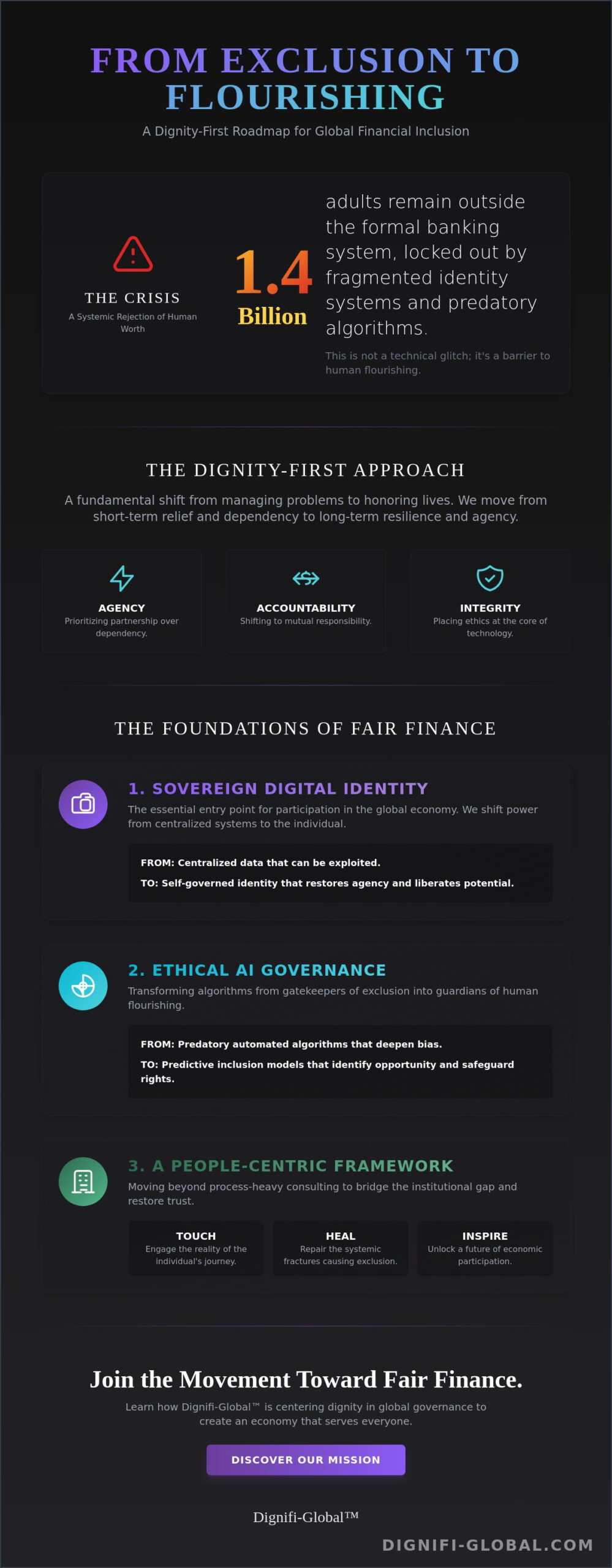
What if the tools intended to connect us are the very mechanisms keeping 1.4 billion adults outside the gates of economic participation? By 2026, the persistence of fragmented identity systems and biased algorithms won’t be seen as a technical glitch; it’ll be recognized as a systemic rejection of human worth. You likely recognize that our current financial architecture often fosters dependency rather than true resilience. We believe that the path toward fair finance starts with a fundamental shift in perspective. People aren’t problems to be managed; they’re lives to be honored.

In this exploration, you’ll discover how the intersection of digital identity and ethical AI governance is transforming financial systems from exclusionary mechanisms into foundations for human flourishing. We’re moving beyond the cold, clinical language of strategy to offer a dignity-first roadmap for global inclusion. This framework outlines how ethical AI models and sustainable institutional governance can bridge the gap between exclusion and opportunity. We’ll examine the specific steps needed to touch, heal, and inspire a global economy that finally centers on the individual.

"Fair finance is not achieved through access alone — it requires systems that are designed with accountability, equity, and human dignity at their core."

— H.E. Roné de Beauvoir

Key Takeaways

  • Learn how a "Dignity-First" approach transforms financial systems into mechanisms of mutual accountability that honor human lives rather than just managing transactions.

  • Discover why sovereign digital identity serves as the foundational infrastructure for true inclusion, ensuring individual agency replaces the risks of centralized systems.

  • Explore the shift from predatory automated algorithms to predictive inclusion models that utilize ethical AI governance as a guardian of human flourishing.

  • Master a strategic five-step roadmap for institutional modernization that centers on fair finance by moving beyond process-heavy consulting toward people-centric advisory.

  • Understand how to integrate the "Touch, Heal, Inspire" framework into global governance to bridge the institutional gap and restore trust in global financial structures.

Table of Contents

Beyond Transactions: Redefining Fair Finance for a Digital Age

By 2026, the global perception of fair finance has evolved beyond the narrow confines of affordable lending. It’s no longer just about the cost of capital; it’s about a system of mutual accountability that recognizes the inherent value of every participant. This shift centers on a dignity-first approach. We’ve moved past the era of managing problems to a new paradigm of honoring lives. In this model, the financial system serves the person, not the other way around. We don’t view individuals as data points to be processed, but as contributors to a shared prosperity.

The Touch, Heal, Inspire methodology serves as the heartbeat of this systemic redesign. We touch the reality of the individual’s journey, heal the systemic fractures that caused exclusion, and inspire a future where economic participation is a gateway to human potential. This isn’t a clinical process; it’s a humanitarian mission grounded in moral responsibility. It requires us to look at the intersection of technology and human rights with a steady, visionary gaze.

The Moral Imperative of Financial Inclusion

Access to financial inclusion is a foundational human right in our globalized economy. When 1.4 billion adults remain outside the formal banking system, as recorded in recent World Bank Global Findex data, the cost isn’t just felt by the individual. Systemic barriers erode institutional resilience and stifle global growth. We must reject outdated dependency structures that treat the marginalized as charity cases. Instead, we embrace partnership-based models that recognize the agency of every human being. This is how we restore trust between institutions and the people they are meant to serve.

Moving from Relief to Resilience

Sustainable resilience requires governance to precede technology. While digital tools provide the mechanism for change, ethical governance provides the purpose. Inclusive financial systems do more than help individuals; they strengthen the entire global economic fabric by creating a broader base of stability and innovation. This transition replaces short-term relief with long-term resilience, ensuring that the architecture of our economy is built on solid ground. Fair finance is an architecture of human flourishing.

  • Accountability: Shifting from one-way transactions to mutual responsibility.

  • Agency: Prioritizing partnership over dependency structures.

  • Integrity: Placing ethical governance at the center of all digital initiatives.

Digital Identity: The Foundational Infrastructure of Fairness

Digital identity serves as the essential entry point for all fair finance initiatives. It is not merely a technical requirement; it is a fundamental act of recognition that validates a person’s existence within the global economy. Traditional centralized ID systems often aggregate power in the hands of a few, creating vulnerabilities where data can be exploited or withheld. We advocate for a shift toward sovereign digital identity, which restores agency to the individual. This model ensures that people own their data, rather than being owned by it. By centering the person instead of the process, we move away from cold, clinical data collection and toward a system that honors human worth. Organizations like the Consumer Financial Protection Bureau highlight that consumer rights and transparency are the bedrock of any equitable financial landscape. When identity is secure and self-governed, it becomes a tool for liberation rather than a mechanism for surveillance.

Sovereign Identity for Global Inclusion

The World Bank reported in 2021 that 1.4 billion adults remain unbanked, largely due to a lack of verifiable documentation. Sovereign identity provides the foundational infrastructure to bridge this divide. This technology is particularly vital in the context of the Palermo Protocol (2000), which seeks to prevent, suppress, and punish trafficking in persons. Secure digital IDs allow vulnerable populations to prove their identity without relying on physical documents that can be stolen or confiscated by exploiters. By providing a permanent, portable record of identity, we can effectively disrupt the cycles of human trafficking. This approach does more than just facilitate transactions; it protects the sanctity of the individual. Our methodology seeks to Touch the lives of the marginalized, Heal the fractures in our social systems, and Inspire a new standard for global ethics.

Bridging the Gap for Refugees and Displaced Persons

For the 108.4 million people forcibly displaced worldwide as of 2023, digital identity is a lifeline for financial reintegration. The principle of non-refoulement, established in the 1951 Refugee Convention, must extend to data protection. Financial access should never come at the cost of safety. Digital identity allows refugees to carry their credit histories and credentials across borders, facilitating a transition from temporary humanitarian aid to permanent financial participation. A "dignity-first" framework ensures that displaced persons are not viewed as problems to be managed, but as lives to be honored. This transition is essential for long-term flourishing and systemic stability. Our commitment to restoring agency through policy leadership ensures that the intersection of technology and human rights remains a space of hope and accountability. By honoring the journey of the displaced, we build a more resilient and inclusive global community.
Fair Finance in 2026: A Governance Framework for Global Inclusion

Ethical AI Governance: Guardrails Against Algorithmic Exclusion

Artificial intelligence acts as a double-edged sword in the pursuit of fair finance. While it offers the speed required for global scale, it also risks codifying historical biases into digital stone. We’re witnessing a necessary transition from predatory automated systems, which often penalized the vulnerable, to predictive inclusion models that recognize latent potential. This shift requires contextual intelligence. Policy design cannot rely on raw data alone; it must understand the lived realities of the individuals behind the numbers. Governance provides the only viable solution to the "black box" problem in credit scoring, transforming opaque algorithms into transparent pathways for human flourishing. By centering the individual, we ensure that technology serves to bridge gaps rather than widen them.

Modernizing Policy Frameworks for AI

Global financial institutions must adopt regulatory standards that prioritize accountability over mere efficiency. Operationalizing AI governance requires moving beyond boardroom theory into daily practice. This involves rigorous auditing of AI systems to identify hidden biases that have historically plagued lending processes. Since the 2008 financial crisis, the evolution of fair lending practices has shown that technology must be tempered by oversight. In 2023, the European Union’s AI Act set a precedent by classifying credit scoring as high-risk, demanding stricter transparency. Institutions that fail to audit their datasets risk perpetuating 40 years of systemic exclusion under the guise of modern innovation. True leadership requires a commitment to fair finance that is verified through constant, independent evaluation of algorithmic outcomes.

Centering the Human in the Machine

AI transformation isn’t a technical hurdle; it’s a governance challenge. We advocate for "dignity-first" AI, ensuring that every algorithm serves the flourishing of the individual rather than the convenience of the institution. When we treat people as lives to be honored instead of data points to be managed, the architecture of finance changes. Our methodology focuses on a rhythmic cadence of restoration: we Touch the lives of the unbanked, Heal the fractures in the system, and Inspire a new era of economic agency. This approach ensures that technology remains a tool for empowerment, not a barrier to entry. Humans must remain the final arbiters of financial worth because a machine can calculate risk, but only a human can recognize the inherent dignity of a dreamer.

  • Accountability: Establishing clear lines of responsibility for algorithmic decisions.

  • Transparency: Ensuring credit scoring models are explainable to the end-user.

  • Equity: Actively seeking to include populations previously ignored by traditional data.

Strategic Implementation: Bridging the Institutional Inclusion Gap

Transitioning toward fair finance requires a departure from the sterile, process-heavy consulting that has dominated the last decade. It demands a move toward people-centric strategic advisory where human agency is the primary metric of success. To build systems that actually work, institutions must adopt a roadmap that honors the individual while meeting global standards. This journey isn’t about mere compliance; it’s about the fundamental restoration of trust between the institution and the citizen.

  • Ethical Alignment: Map every institutional objective to the UN Sustainable Development Goals, specifically targeting Goal 10 (Reduced Inequalities) by the 2030 deadline.

  • Dignity Impact Auditing: Implement quarterly audits that measure how financial products restore personal agency rather than just tracking transaction volumes.

  • Algorithmic Accountability: Establish board-level oversight for AI models to ensure automated decisions don’t perpetuate historical biases.

  • Multilateral Synergy: Form partnerships with entities like the UNDP or the World Bank to leverage shared infrastructure for inclusive growth.

  • Digital-First Resilience: Replace paper-based relief with permanent digital identity frameworks that survive geopolitical shifts.

The Board’s Role in Governance Leadership

Leadership begins with the conviction that people are not problems to be managed; they are lives to be honored. Boards must align their vision with the 2021 World Bank finding that 1.4 billion adults remain unbanked. This isn’t a technical failure but a governance one. By centering top-down AI governance, organizations ensure that resilience is built into the foundation of the technology. Dignity impact auditing allows leaders to see the human face behind the data, moving the conversation from profit margins to the flourishing of global citizens. It’s a shift from seeing risk to seeing potential.

Modernizing Humanitarian Aid Frameworks

The shift from traditional relief to digital-first resilience marks a turning point in global development. We don’t just provide aid; we restore the infrastructure of hope through community finance. This model leverages local economic development to ensure that recovery is self-sustaining. Our Humanitarian Resilience Programs serve as a foundational pillar in this effort, bridging the gap between immediate crisis and long-term stability. By integrating digital identity into aid delivery, we touch the lives of the vulnerable, heal the fractures in the system, and inspire a new era of global participation. It’s time to choose partnership over dependency and people, not processes. This approach ensures fair finance is a reality for the 160 million people currently displaced by conflict and climate change.

To begin your journey toward ethical leadership, explore our strategic advisory services.

Dignifi-Global™: Centering Dignity in Global Governance

True progress in the international financial sector requires more than technological adoption; it demands a profound moral realignment. Dignifi-Global™ stands as the visionary partner for institutions ready to modernize their foundations through the lens of human worth. We recognize that the convergence of AI, digital identity, and fair finance represents the most significant opportunity for global equity since the dawn of the digital age. This isn’t merely about providing temporary relief to the underserved. It’s about building sustainable resilience that allows individuals to flourish within a system that recognizes their inherent value.

Our approach shifts the focus from dependency to partnership. We believe that people aren’t problems to be managed; they are lives to be honored. By integrating advanced biometric identity with ethical AI, we create pathways for the 1.4 billion adults who remained unbanked as of 2021 to finally enter the formal economy. This transition restores agency to the individual while providing institutions with the robust, verifiable data needed to maintain systemic stability. We are moving beyond the cold, clinical structures of the past toward a future where every transaction is an act of recognition.

Policy Leadership for a Globalized World

Under the strategic guidance of Her Excellency Roné de Beauvoir, our organization bridges the gap between high-level policy and human-centric implementation. From our headquarters in Houston, Texas, we serve as a central hub for global governance innovation, advising leaders on how to integrate complex technologies without sacrificing ethical integrity. We don’t view digital transformation as a technical hurdle, but as a foundational requirement for a just society. For those seeking to lead in this new era, our Ethical AI Governance Frameworks offer the necessary roadmap for balancing rapid innovation with deep accountability.

The Future of Institutional Resilience

The era of passive compliance is ending. Proactive leadership is the only path forward for institutions that wish to remain relevant in a rapidly evolving global market. Dignifi-Global™ invites stakeholders to move beyond the status quo and embrace a strategy that prioritizes long-term flourishing over short-term metrics. Our "Touch, Heal, Inspire" methodology acts as the heartbeat of our work, ensuring that every policy we craft and every system we design serves the higher purpose of human dignity.

We invite you to take a definitive step toward a more equitable future. You can partner with Dignifi-Global™ to design your inclusion strategy and join us in our mission to create a world where fair finance is a foundational reality for every citizen. Together, we can build a global architecture that honors the life of every person it touches.

Leading the Shift Toward Global Financial Flourishing

The path toward 2026 requires a departure from cold, algorithmic exclusion toward a system that centers human worth. We’ve explored how foundational digital identity and ethical AI governance serve as the essential guardrails for this new era. By prioritizing accountability over mere efficiency, institutions can bridge the inclusion gap that currently leaves 1.4 billion adults unbanked according to World Bank 2021 data. This evolution isn’t just about technical updates; it’s a fundamental commitment to fair finance that honors the individual. We must move beyond transactions to restore the social contract through governance that protects human rights at every digital intersection.

Dignifi-Global™, led by Her Excellency Roné de Beauvoir, stands at the specialized intersection of AI and human rights to guide this transition. Our proprietary Dignity-First methodology ensures your organization understands that people aren’t problems to be managed; they’re lives to be honored. We invite you to touch the future of governance, heal systemic divides, and inspire a legacy of true inclusion. Begin Your Institutional Transformation with Dignifi-Global™. The future of global equity is waiting for leaders with the courage to build it.

Frequently Asked Questions

What is the definition of fair finance in a global governance context?

Fair finance is the systemic alignment of fiscal policy with human rights to ensure every individual has the opportunity for economic flourishing. It’s not a mere set of transactions but a moral commitment to equitable access. The 2015 Addis Ababa Action Agenda serves as a foundational blueprint for this model, directing global capital toward the 17 Sustainable Development Goals to bridge the wealth gap.

How does digital identity enable financial inclusion for vulnerable populations?

Digital identity provides the 850 million people currently lacking legal documentation with a secure, portable record of their existence. This foundational tool allows marginalized groups to access 100 percent of the banking services they have historically been denied. By centering the individual through biometric or blockchain records, we move from a system of exclusion to one of universal recognition and dignity.

Can ethical AI governance prevent bias in financial services?

Ethical AI governance prevents bias by embedding accountability and human rights directly into the algorithmic design process. The 2021 UNESCO Recommendation on the Ethics of AI provides a framework for 193 member states to ensure technology honors human agency. It’s about auditing data inputs to ensure we aren’t just automating old prejudices but are instead restoring justice to credit scoring systems.

What are the main pillars of the Dignity-First framework?

The Dignity-First framework rests on three foundational pillars: Radical Accountability, Human Agency, and Systemic Flourishing. This methodology follows a core rhythm to touch the lives of the marginalized, heal the fractures in our social systems, and inspire a global shift toward ethical leadership. It’s a move away from managing problems toward honoring the 8 billion lives that constitute our global community.

How do humanitarian resilience programs differ from traditional aid?

Humanitarian resilience programs focus on building long-term local capacity while traditional aid often creates cycles of dependency. The 2016 Grand Bargain agreement shifted 25 percent of funding toward local responders to ensure communities can withstand future shocks. We don’t just provide temporary relief; we foster the structural stability required for a community to thrive independently of external intervention.

What role do international regulatory standards play in fair finance?

International regulatory standards provide the essential guardrails that ensure fair finance initiatives remain transparent and secure across borders. The Financial Action Task Force (FATF) updated its standards in 2019 to include digital assets, creating a unified language for 200 jurisdictions. These rules don’t just prevent crime; they build the trust necessary for global institutions to invest in emerging markets with confidence.

How can institutions balance data privacy with the need for digital identity?

Institutions balance privacy and identity by adopting decentralized technologies that give individuals 100 percent control over their personal data. The 2018 General Data Protection Regulation (GDPR) established that privacy is a fundamental right, not a luxury. By utilizing zero-knowledge proofs, we can verify a person’s eligibility for services without exposing their entire history, honoring their right to digital autonomy.

Why is AI governance considered a leadership problem rather than a technical one?

AI governance is a leadership problem because technology is a mirror that reflects the moral convictions and priorities of its creators. When we treat people as data points, we fail our foundational duty to honor them as lives. True leadership requires us to view AI not as a technical hurdle, but as a strategic opportunity to embed our highest values into the architecture of the future. For a deeper examination of how financial systems for global inclusion can be redesigned around dignity and ethical governance, explore our foundational case study.
H.E. Roné de Beauvoir

Diplomatic Envoy | Peace Ambassador

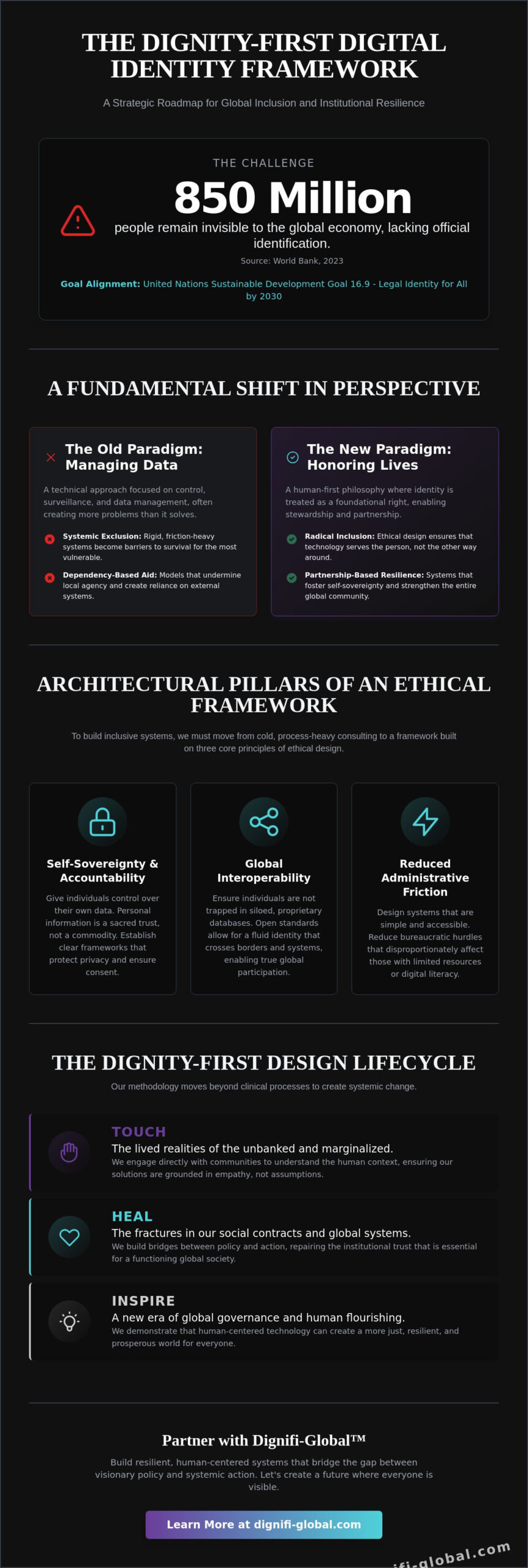
The true measure of a nation’s progress isn’t found in the complexity of its code, but in the visibility of its most vulnerable citizens. Today, 850 million individuals remain excluded from the global economy because our current models of digital identity system design prioritize technical protocols over human presence. You recognize that the fear of creating exclusionary systems is a moral weight that many leaders carry. We must shift our focus from mere data management to a dignity-first restoration of foundational rights; people aren’t problems to be managed, they’re lives to be honored.

This article provides the clarity you need to master the principles of ethical design, ensuring your institution bridges the inclusion gap by 2026. You’ll gain a strategic framework that aligns with the UN Sustainable Development Goals while reinforcing institutional resilience through inclusive policy. We’ll explore how to touch the lives of the marginalized, heal the fractures in our social contracts, and inspire a new era of global governance. Here is your roadmap for centering human dignity at the intersection of technology and human rights.

Key Takeaways

  • Reframe identity as a foundational human right, shifting your focus from managing data points to honoring the inherent dignity of every individual.

  • Master the principles of ethical digital identity system design to build resilient architectures that prioritize individual self-sovereignty and global interoperability.

  • Evaluate the strategic resilience of centralized versus decentralized governance models to ensure your framework can withstand the complexities of global aid.

  • Implement a "Dignity-First" design lifecycle that moves beyond clinical processes to touch the lived realities of the unbanked and heal systemic barriers.

  • Discover how to bridge the gap between visionary policy and systemic action, centering human flourishing as the ultimate metric for institutional success.

Table of Contents

The Moral Imperative of Digital Identity System Design

The era of artificial intelligence demands a radical reimagining of how we define the self in the digital sphere. Digital identity is no longer a mere technical convenience; it’s a foundational human right that determines who can participate in modern society. Effective digital identity system design must move beyond the narrow confines of data management to embrace a more profound calling. We shouldn’t seek to manage problems, but rather to honor lives. By centering the human experience, we ensure that technology serves the soul rather than the spreadsheet. This shift aligns directly with United Nations Sustainable Development Goal 16.9, which aims to provide legal identity for all by 2030. When institutions adopt this high-minded perspective, they build resilience that withstands global shocks. They move from a posture of surveillance to one of stewardship, recognizing that a secure identity is the bedrock of institutional trust and social flourishing.

When we view identity through the lens of dignity, the architecture of our systems changes. It’s not about creating a digital folder for a citizen; it’s about restoring the agency of an individual. This "Dignity-First" approach prevents the systemic exclusion of vulnerable populations who are often erased by rigid, clinical algorithms. We must remember that people are not problems to be managed; they are lives to be honored. This philosophy guides our methodology as we seek to Touch the heart of systemic challenges, Heal the fractures in global governance, and Inspire a future where every person is visible and valued.

Identity as the Gateway to Global Inclusion

Access to a verified identity is the prerequisite for financial inclusion and the delivery of essential humanitarian aid. According to World Bank data from 2023, approximately 850 million people globally lack official identification, leaving them invisible to the very systems designed to protect them. Legal identity provides the structural stability required for sustainable resilience in emerging economies, acting as a bridge to banking, healthcare, and education. For a comprehensive Digital Identity Overview, one can see how these systems function as the connective tissue between marginalized communities and the global marketplace. Without a robust digital identity system design, the promise of global inclusion remains an abstract ideal rather than a lived reality.

Inclusive Design in global governance is the intentional practice of creating systems that recognize every individual’s inherent worth, ensuring no person is invisible to the institutions meant to serve them.

The Cost of Exclusionary Architecture

Systems built on exclusionary or "friction-heavy" architecture carry hidden risks that ripple across societies. When identity verification requires documentation that displaced persons or those in extreme poverty cannot provide, the system itself becomes a barrier to survival. This lack of foresight undermines institutional trust and leads to poor humanitarian outcomes. In 2019, various international reports highlighted how rigid biometric requirements could inadvertently delay life-saving assistance in conflict zones. To rectify this, we must transition from dependency-based aid to partnership-based resilience. This shift requires us to:

  • Prioritize interoperability to ensure individuals aren’t trapped in siloed, proprietary databases.

  • Reduce administrative friction that disproportionately affects those with limited digital literacy.

  • Establish clear accountability frameworks that protect personal data as a sacred trust.

This transformation is not merely a technical upgrade; it’s a moral necessity. By moving away from cold, process-heavy consulting, we can build systems that foster partnership over dependency. We believe that when you honor the individual, you strengthen the entire global community. This is the path toward a future where technology and human rights intersect to create a world of universal flourishing.

Architectural Pillars of an Ethical Identity Framework

Building a future where every individual is recognized requires more than technical prowess; it demands a moral architecture. Effective digital identity system design doesn’t merely catalog data points; it honors human existence. This framework rests on four foundational pillars that ensure technology serves the person, rather than the person serving the system. We’re moving away from a model of control and toward a model of flourishing.

  • Self-Sovereignty: We must restore agency to the individual, allowing them to own and manage their digital footprint. It’s not about being a record in a database; it’s about being the author of your own story.

  • Interoperability: Systems must speak a common language across 195 sovereign nations. Without this, we create digital silos that trap the vulnerable.

  • Privacy by Design: Data protection isn’t a secondary patch; it’s woven into the initial lines of code. We protect the person by protecting their data from the moment of inception.

  • Inclusivity: We design for the "last mile," reaching the 850 million people who, according to 2022 World Bank data, lack official identification. If a system doesn’t work for the most marginalized, it doesn’t work at all.

The goal is to bridge the gap between technical capability and human rights. By centering our methodology on these pillars, we can touch the lives of the unseen, heal the fractures in our social contracts, and inspire a global community built on mutual trust. This is the essence of a dignity-first approach to global development.

Centering the Human Experience in System Design

Ethical systems begin with policy, not procurement. We’ve seen that when technology leads, human rights often follow at a distance. True digital identity system design balances biometric security with the right to anonymity. It follows the principle of proportionality, collecting only the data required for a specific service. We prioritize people over processes, ensuring that data collection is never an end in itself but a means to empower a life.

Governance and Accountability Standards

Integrity is maintained through transparency and rigorous oversight. Robust systems establish clear audit trails to track how data is accessed, ensuring every interaction is visible and justified. This accountability is anchored in international standards. Aligning with the NIST Digital Identity Guidelines provides a technical foundation for secure authentication. However, technical compliance is only half the battle; independent oversight bodies must also ensure these systems honor the 30 articles of the Universal Declaration of Human Rights.

Digital Identity System Design for Global Inclusion: A Strategic Framework for 2026

Effective digital identity system design requires us to confront a fundamental tension between state authority and individual autonomy. We must move beyond viewing identity as a bureaucratic ledger; we must see it as a sacred trust. Centralized systems offer administrative efficiency and national security, yet they often create single points of failure that jeopardize the most vulnerable. When a centralized database is compromised or weaponized by a shifting political regime, the principle of non-refoulement is shattered. This legal protection against being returned to a country where one faces persecution depends on the integrity of the person’s record. We don’t just build databases; we restore the foundational right to be seen without being targeted.

To touch the lives of the displaced, we must heal the fractures in our trust frameworks. The rise of Federated and Decentralized models reflects a shift in perspective. It’s a move toward partnership over dependency. Strategic considerations for cross-border humanitarian resilience programs now focus on interoperability. This ensures that a refugee’s credentials remain valid as they cross from one jurisdiction to another. By centering the human experience, we ensure that a change in geography doesn’t result in a loss of personhood.

The Case for Decentralized Sovereignty

Self-Sovereign Identity (SSI) and blockchain technology prevent identity theft in conflict zones by removing the need for a central honeypot of data. In 2024, institutional collapse in multiple regions has shown that when a government office falls, the people’s legal existence shouldn’t fall with it. SSI allows individuals to carry their credentials on personal devices, secured by cryptography rather than a state official’s signature. Self-Sovereign Identity represents the gold standard for humanitarian dignity because it grants the individual total agency over their own existence. This decentralized approach reduces institutional fragility and honors the individual’s right to privacy.

Hybrid Models for Institutional Stability

While decentralization offers protection, centralized registries remain a necessity for national security and the delivery of foundational services. The World Bank ID4D Initiative reports that approximately 850 million people globally still lack any form of official identification. Bridging the gap between traditional civil registration and modern digital ecosystems requires a hybrid approach. This isn’t about choosing one over the other, but about creating a "dignity-first" architecture where the state provides the foundation and the individual maintains the keys. Successful public-private partnerships, such as the implementation of the MOSIP platform in Ethiopia and the Philippines, demonstrate how open-source standards can foster inclusion while maintaining state sovereignty. Through this balance, we can touch the marginalized, heal systemic exclusion, and inspire a future where digital identity system design serves as a bridge to global flourishing. People are not problems to be managed; they are lives to be honored.

Implementing the Dignity-First Design Lifecycle

Effective digital identity system design requires a departure from the sterile, data-centric models of the past. At Dignifi-Global™, we operate through a three-fold methodology: Touch, Heal, and Inspire. We begin by touching the lived reality of the 850 million people who lack legal identification according to 2023 World Bank data. This isn’t a mere data collection exercise; it’s an act of witnessing the barriers faced by the unbanked. We then move to heal systemic fractures by restoring trust through transparent, accountable policy leadership. Finally, we inspire by crafting systems that foster long-term human flourishing rather than simple administrative compliance.

Monitoring these systems is a continuous moral obligation. We implement rigorous auditing for ethical AI governance solutions to ensure that algorithms don’t inadvertently replicate the biases they’re meant to dissolve. This ongoing vigilance transforms a static product into a living, breathing ecosystem of equity. By centering human rights in our technical audits, we bridge the gap between innovation and integrity.

Step 1: Foundational Policy Assessment

Before a single line of code is written, we conduct an Inclusion Impact Assessment. This process maps the intersection of AI policy and identity strategy to prevent the digital divide from becoming a digital canyon. We don’t identify stakeholders from the top down. Instead, we center the voices of the marginalized. By honoring those at the periphery, we ensure the system is built to support the most vulnerable first. This foundational work aligns with the UN Sustainable Development Goal 16.9, which aims to provide legal identity for all by 2030.

Step 2: Technical Architecture and Pilot Testing

Our approach to digital identity system design prioritizes resilience over mere technical efficiency. We implement Contextual Intelligence in AI-driven identity checks, allowing the system to understand the nuances of local environments. During pilot testing, we iterate based on real-world humanitarian feedback. If a biometric scan fails because of manual labor or environmental conditions, the system must adapt. We’ve seen that systems ignoring these human realities fail 40% more often in rural deployments. We choose partnership over dependency, building infrastructure that honors the individual’s journey toward fair finance and financial sovereignty. The evolution of inclusive financial systems for global inclusion demonstrates how dignity-first principles can be applied across both identity and economic participation frameworks.

Ready to transform your institutional framework into a beacon of inclusion? Partner with Dignifi-Global™ to lead with dignity.

Dignifi-Global™: Partnering for Global Institutional Resilience

Systemic change requires more than technical expertise; it demands a moral compass. Dignifi-Global™ serves as the vital bridge between visionary policy and tangible systemic action. We recognize that digital identity system design is not merely a data exercise. It is a foundational act of restoring human worth to those the current systems have overlooked. Our "Dignity-First" methodology ensures that ethical AI and identity strategies aren’t just compliant, but transformative. We move beyond the cold metrics of efficiency to center the human experience in every framework we build. By aligning technological capability with moral responsibility, we help institutions move from reactive measures to proactive, resilient leadership. Institutions seeking to modernize their ethical frameworks will find that global governance consulting rooted in dignity-first principles is essential to closing the gap between high-level policy and real humanitarian impact.

Policy Leadership for a Globalized World

Global institutions trust the visionary leadership of Her Excellency Roné de Beauvoir because she speaks the language of both diplomacy and innovation. At Dignifi-Global™, we create a unique synergy between ai governance solutions and identity design. This isn’t about managing data points. It’s about honoring lives. Our consulting services help modernize aid frameworks, moving them from temporary relief to long-term resilience. We’ve seen how traditional models often create dependency. We choose a different path. By centering our work on sustainable outcomes, we empower nations to build systems where every citizen can flourish. Our approach follows a rhythmic commitment to Touch, Heal, and Inspire the communities we serve. This three-part cadence ensures that every policy we craft is grounded in the reality of human needs.

  • Touch: Directly engaging with the lived realities of the 1.1 billion people globally who lack formal identification.

  • Heal: Restoring trust through transparent, ethical governance and decentralized technologies that protect privacy.

  • Inspire: Creating pathways for economic participation that honor the individual’s journey and potential.

Taking the Next Step Toward Inclusion

Building a legacy of dignity starts with a single strategic decision. We invite global leaders and institutional stakeholders to move beyond the status quo of process-heavy consulting. Fair finance and inclusive financial system development is the cornerstone of a stable global economy. When you engage Dignifi-Global™ for strategic advisory, you aren’t just hiring consultants. You’re partnering with an organization that believes people aren’t problems to be managed, but lives to be honored. We help you navigate the complexities of digital identity system design with a focus on accountability and human rights. It’s time to lead the future of global inclusion by building systems that recognize the inherent value of every human being. Partner with Dignifi-Global™ to design your ethical future and join us in our mission to reshape the world through dignity and innovation.

Architecting a Future Where Every Identity Flourishes

The path to 2026 demands a radical departure from the cold, data-centric models of the past. We’ve explored how ethical digital identity system design is a foundational moral responsibility, not just a technical requirement. By centering architectural pillars on human rights and choosing governance that prioritizes partnership over dependency, global institutions can bridge the gap between exclusion and agency. We don’t view individuals as data points to be processed; we see them as lives to be honored.

Under the leadership of Her Excellency Roné de Beauvoir, Dignifi-Global brings a unique perspective to humanitarian resilience and ethical AI. Our proprietary Touch, Heal, Inspire methodology ensures that every system we build restores dignity instead of merely recording existence. As we approach the 2026 milestone for global inclusion, the choice to implement a dignity-first lifecycle becomes the difference between a system that manages and a system that empowers. We’re ready to help you build a legacy of trust.

Begin Your Dignity-First Transformation with Dignifi-Global™

The future of global identity is bright when we choose to lead with the heart. Together, we can create a world where every individual has the opportunity to thrive.

Frequently Asked Questions

What is the primary goal of digital identity system design in a humanitarian context?

The primary goal is to restore human agency by providing a secure, portable means of asserting one’s rights. In 2023, the UNHCR recorded 110 million forcibly displaced individuals who require recognized credentials to access life-saving services. We don’t view these people as problems to be managed; they’re lives to be honored through a dignity-first approach that centers their humanity over administrative convenience.

How does digital identity support the UN Sustainable Development Goals (SDGs)?

Digital identity acts as a catalyst for the UN Sustainable Development Goals, specifically Target 16.9, which aims for legal identity for all by 2030. According to the World Bank ID4D 2022 report, 850 million people lack official identification. By bridging this gap, we touch lives, heal systemic exclusion, and inspire a future where every person participates in the global economy.

What is the difference between foundational and functional identity systems?

Foundational systems provide a general-purpose identity for all citizens, while functional systems are built for specific sectors like healthcare or voting. Effective digital identity system design integrates these layers to ensure a person’s core identity remains stable across various services. This structure reduces the 30 percent administrative overhead typically found in fragmented systems, creating a more cohesive social fabric.

How can we ensure digital identity systems do not lead to mass surveillance?

We prevent mass surveillance by implementing decentralized identifiers and zero-knowledge proofs that ensure individuals retain control over their personal data. The 2018 Principles on Identification for Sustainable Development mandate that systems prioritize user privacy to avoid state overreach. Our methodology focuses on building trust through accountability, ensuring that technology serves the person rather than the observer.

What role does AI play in modern digital identity system design?

AI enhances modern digital identity system design by automating document verification and detecting sophisticated fraud patterns with high precision. NIST 2023 benchmarks show that advanced algorithms now achieve 99 percent accuracy across diverse demographic groups. These tools don’t just process data; they protect the sanctity of an individual’s digital presence by identifying threats before they cause harm.

How do we protect the identity of refugees under the principle of non-refoulement?

Protecting refugees under the principle of non-refoulement requires strict data localization and encryption to prevent sensitive information from reaching persecuting authorities. The 1951 Refugee Convention establishes the legal bedrock for this protection. We apply a dignity-first lens to ensure that a refugee’s data acts as a shield, not a beacon, honoring their safety as they seek sanctuary.

What are the risks of using biometric data in digital identity systems?

Biometric data carries the inherent risk of irrevocability, meaning a person cannot change their fingerprints or iris patterns if a breach occurs. Research from 2022 indicates that False Reject Rates can be 20 percent higher for certain ethnic groups if the sensors aren’t properly calibrated. We must address these technical gaps to avoid creating new forms of digital exclusion that marginalize the very people we aim to serve.

Why is interoperability essential for global financial inclusion?

Interoperability is the heartbeat of global financial inclusion because it allows different systems to communicate and verify identities across borders. The GSMA 2023 State of the Industry Report highlights that mobile money accounts reached 1.6 billion, yet many remain siloed. By breaking these barriers, we create a rhythmic flow of capital that empowers individuals to build livelihoods and achieve long-term flourishing. For a deeper examination of how equitable financial systems can be structured to serve the most vulnerable, our dignity-first case study offers concrete frameworks for institutional action.

About the Author

H.E. Roné de Beauvoir is the founder of Dignifi-Global™, a policy and thought leadership platform focused on artificial intelligence, digital identity, and financial inclusion. Her work centers on developing human-centered frameworks that align technological advancement with dignity, accountability, and global access.