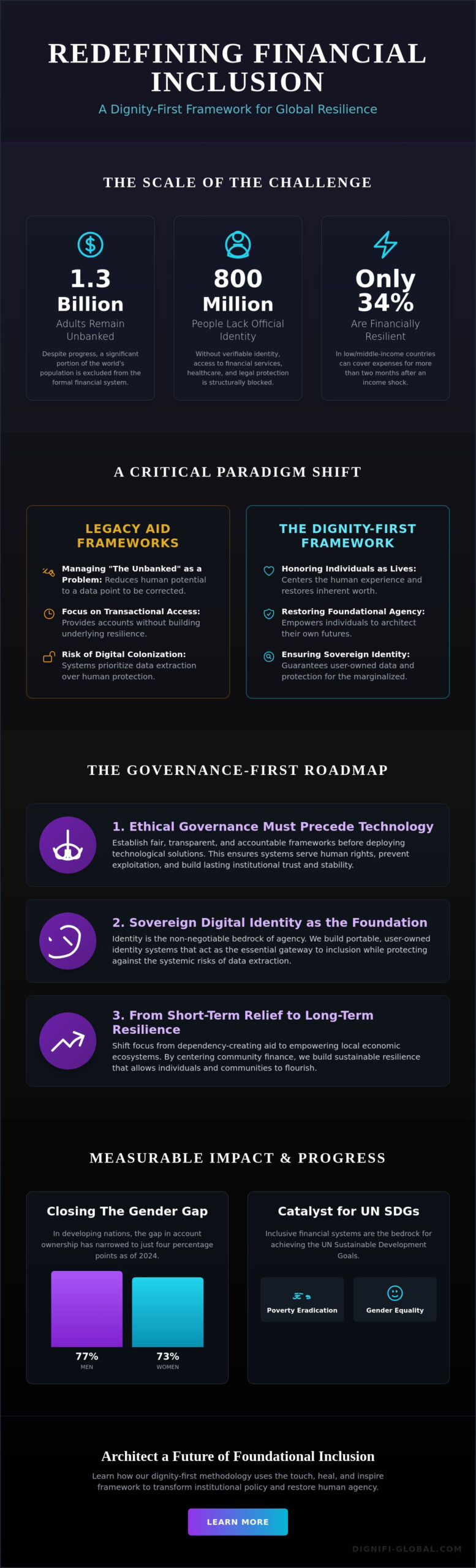
True progress is not measured by the volume of transactions, but by the foundational restoration of human agency. While 75% of adults in low and middle income countries now hold a financial account as of 2024, the global community still struggles to serve the 1.3 billion people who remain unbanked. We believe that people are not problems to be managed; they are lives to be honored. Genuine financial inclusion must move beyond the cold delivery of digital products to embrace a dignity-first framework that honors every individual’s right to participate in the global economy.

You likely recognize that legacy aid frameworks often create fragile dependencies instead of lasting resilience, particularly for the 800 million people who still lack official identity. This article promises to show how redefining inclusion through ethical governance and digital identity restores human agency and strengthens global institutional resilience. We will explore a governance first roadmap that transitions from relief to resilience, using our methodology to touch, heal, and inspire the systems that shape our shared future.

Key Takeaways

  • Learn to shift institutional perspective from managing the unbanked to honoring the individual as a foundational human right.
  • Understand how digital identity acts as a foundational layer for participation while protecting against the systemic risks of digital colonization.
  • Discover why ethical governance must precede technological deployment to ensure sustainable financial inclusion and global institutional stability.
  • Identify strategies to move from short-term relief to long-term resilience by centering local economic ecosystems through community finance.
  • Explore a dignity-first methodology that uses the touch, heal, and inspire framework to transform institutional policy and restore human agency.

Defining Financial Inclusion: Beyond Transactional Access to Human Dignity

For decades, global institutions have viewed the unbanked as a data point to be corrected or a market to be captured. This clinical approach reduces human potential to a series of ledger entries. We believe that true financial inclusion is not merely the technical act of opening accounts, but the foundational restoration of human agency. According to this Financial Inclusion Overview, the traditional focus remains on access to affordable products. However, access alone does not equate to empowerment. While 79% of adults globally held an account in 2024, a staggering 1.3 billion individuals remain on the periphery of the formal economy. We must stop managing the unbanked as a problem and start honoring them as lives with inherent worth.

Traditional metrics often celebrate the increase in account ownership without questioning the quality of the inclusion. It’s a hollow victory to provide a bank account to a person who lacks the resilience to survive a single financial shock. In 2025, only 34% of adults in low and middle income countries could cover expenses for more than two months following an income loss. This gap reveals that current systems are built for transaction, not for flourishing. We don’t need more processes; we need more partnership. When we focus on the person instead of the product, we begin to see that financial exclusion is fundamentally a crisis of identity and governance.

Financial inclusion is the sacred intersection where ethical governance, sovereign identity, and human dignity meet to empower the individual.

The Dignity-First Paradigm

Centering the human experience requires a radical shift from dependency to partnership. Our dignity-first approach ensures that systems are designed to serve the person, not the process. We move beyond top down aid models that often stifle local innovation and create cycles of reliance. By focusing on our core methodology to touch, heal, and inspire, we create pathways for sustainable economic flourishing. It’s about building a foundation where every person has the tools to architect their own future. This shift ensures that technology serves as a bridge to human rights rather than a barrier to entry.

Inclusion as a Catalyst for UN SDGs

Inclusive financial systems are the bedrock of the United Nations Sustainable Development Goals, particularly poverty eradication and gender equality. As of 2024, the gender gap in account ownership in developing nations narrowed to four percentage points, with 73% of women now holding accounts. This progress is not just a statistic. It represents the restoration of institutional trust and the bridging of historical divides. When we prioritize inclusive governance, we foster a global environment where resilience is the norm and every individual has the opportunity to contribute to their community’s collective prosperity.

The Intersection of Digital Identity and Financial Empowerment

Identity is not a secondary convenience for the privileged; it is the foundational bedrock of human agency. For the 800 million people globally who still lack any official proof of identity as of 2026, the path to financial inclusion remains structurally blocked. Without a verifiable presence, an individual cannot save, borrow, or protect their family from the 24% of natural disasters that now impact low income economies annually. We recognize that digital identity is the essential “foundational layer” for all financial participation. It is the bridge between being invisible to the state and being an active participant in the global flourishing of commerce.

We must, however, confront the rising risk of digital colonization. Many emerging systems focus on data extraction rather than human protection, treating individuals as resources to be mined. By centering the person through an ethical digital identity system design, institutions provide the essential gateway to inclusion while honoring the user’s sovereign right to their own data. Our mission is to ensure that technology serves the person, not the process. We believe in building systems that restore power to the marginalized rather than consolidating it in the hands of the few.

Sovereign Identity for the Underserved

For displaced populations and those in fragile economies, identity must be portable and user-owned. Research on Financial Inclusion and Social Development highlights that social mobility is tethered to a person’s ability to prove who they are across borders and institutions. When identity is sovereign, it becomes a prerequisite for credit and insurance, allowing a mobile money user to transition from simple payments to complex wealth building. This shift represents our commitment to touch the lives of the forgotten and heal the fractures in our global financial architecture.

Ethical AI in Digital Onboarding

As we move into 2026, the banking industry is transitioning toward agentic AI systems that handle complex compliance and fraud investigations. While these tools can add significant value, they also carry risks; roughly 8.3% of digital onboarding cases in early 2025 were identified as fraud attempts. We must use AI to verify identity without compromising privacy or reinforcing algorithmic bias. Ethical AI should be human centric by design, ensuring that automated approval processes do not inadvertently exclude the very people they were meant to serve. If you are seeking to build more equitable systems, consider how our policy leadership can help align your technology with your ethical convictions.
Financial Inclusion: A Dignity-First Framework for Global Institutional Resilience

Why Governance Must Precede Technology in Inclusive Systems

Technology is not the architect of equity; it is merely the brick. Many global institutions fall into the trap of tech-solutionism, believing that a new mobile app or a blockchain ledger will automatically dissolve systemic inequality. It won’t. Without the steady hand of ethical oversight, digital tools often become instruments of surveillance or exclusion rather than empowerment. We believe that financial inclusion must be anchored in a framework of accountability that exists long before the first line of code is written. We don’t need faster systems; we need more faithful ones.

As we enter 2026, the banking industry is rapidly transitioning from AI as a simple assistant to AI with transactional authority. Agentic systems are now being integrated as semi-autonomous digital co-workers for compliance checks and fraud investigations. This shift demands a profound commitment to ai governance solutions that prioritize human agency. Governance provides the moral guardrails that ensure technology serves the person, not the process. It’s the difference between a system that manages a population and one that honors a life.

Policymakers hold the sacred responsibility of ensuring that dignity-first principles guide every technological adoption. This requires a shift in perspective. We must view governance not as a bureaucratic hurdle, but as the foundational layer of institutional resilience. By establishing clear standards for transparency and data sovereignty, we can bridge the gap between innovation and human rights. Our methodology seeks to touch the heart of policy, heal the fractures in existing systems, and inspire a global standard for ethical engagement.

Ethical AI Governance Frameworks

We must design policies that protect vulnerable populations from the predatory practices often found in unregulated fintech. In 2025, the National Association of Insurance Commissioners in the US saw 21 states adopt an AI model bulletin, signaling a global rise in scrutiny. These frameworks must balance the drive for innovation with a deep commitment to consumer protection. True financial inclusion requires that we intersection data sovereignty with financial access, ensuring that individuals remain the masters of their own digital destinies. Organizations seeking to formalize this commitment can benefit from developing a robust ai governance strategy for global institutions that translates ethical ideals into actionable policy declarations. As jurisdictional requirements grow more complex, institutions can also strengthen their approach by adopting an ai contextual governance framework that moves beyond static compliance toward situational, dignity-first controls aligned with the NIST AI Risk Management Framework.

From Policy to Practice: The Houston Model

Local governance often provides the most vivid blueprint for global standards. By integrating sophisticated governance consulting into national financial strategies, institutions can build the internal capacity to monitor and audit their own inclusive systems. This is about more than just compliance. It is about building a stable, flourishing environment where community banks and global institutions alike can operate with integrity. We believe that when governance is centered on human dignity, institutional resilience becomes an inevitable outcome.

Building Institutional Resilience Through Community Finance

Resilience is often mistaken for the temporary absence of crisis, but true resilience is the enduring presence of human agency. For many global institutions, the focus remains on short term relief efforts that address the symptoms of exclusion without healing the underlying systemic fractures. In low and middle income countries, only 34% of adults can cover basic expenses for more than two months if they lose their primary income source. This vulnerability isn’t a failure of the individual; it’s a structural gap that only deep, foundational financial inclusion can bridge. We must shift our focus from temporary aid to the creation of economic ecosystems that allow every person to flourish independently.

Local economic stability is best achieved through institutions that are deeply rooted in the communities they serve. As of the second quarter of 2025, there were 1,378 certified Community Development Financial Institutions in the United States alone, holding $446 billion in assets. These organizations prove that capital is most effective when it is combined with local accountability and ethical governance. By leveraging community finance, global stakeholders can strengthen the very fabric of society, ensuring that the most marginalized aren’t left behind during market volatility. Institutional resilience is the ability of systems to honor human life during disruption.

Humanitarian Resilience Programs

Modernizing aid requires us to bridge the humanitarian development nexus. We don’t just want to distribute resources; we want to restore dignity. In the three years preceding 2025, 24% of adults in developing economies experienced severe weather events, with 13% losing their livelihoods. Integrating financial literacy and digital identity into aid frameworks ensures that relief is not a dead end but a gateway to formal participation. When we use technology to touch and heal these communities, we inspire a transition from dependency to self determination. Partner with Dignifi-Global™ to build resilient systems that prioritize human worth over process efficiency.

Sustainable Inclusion Models

Moving beyond micro credit is essential for holistic financial flourishing. While small loans provide a spark, true inclusion requires a full suite of services, including savings and insurance. Mobile money’s role in savings has doubled since 2021, with 10% of adults in developing nations now using these accounts to build a safety net. This shift toward local ownership of financial infrastructure protects climate vulnerable communities from the shocks of a changing world. We believe in fostering systems where people are not managed as problems, but honored as the architects of their own economic destiny.

Dignifi-Global™: Architecting a Future of Foundational Inclusion

The future of humanity is not written in lines of code; it is forged in the fires of ethical conviction. We believe that the current global architecture is at a crossroads where technology must either become a tool for liberation or a mechanism for deeper exclusion. Our vision for financial inclusion transcends the mere expansion of market share. We are building systems that honor lives, not just manage problems. By centering human dignity, we move beyond the cold, clinical language of strategic advisory to embrace a mission that is both aspirational and grounded in moral responsibility.

The intersection of ethical AI, digital identity, and humanitarian resilience represents the next frontier of global stability. As the digital identity market reaches a value of $64.4 billion in 2025, the stakes for human rights have never been higher. We don’t view this growth as a purely commercial opportunity. Instead, we see it as a mandate to ensure that the 3 billion people who own smartphones as of 2025 are granted the sovereign identity required to participate in the global economy with agency and honor. This is the cornerstone of institutional resilience.

Our Methodology: Touch, Heal, Inspire

Our work is guided by a rhythmic, three part cadence that acts as the heartbeat of our methodology. We begin with Touch, where we identify the foundational needs of the underserved by looking past data points to see the human being. We then move to Heal, restoring agency through the design of ethical policies and identity frameworks that bridge the gap between exclusion and participation. Finally, we Inspire, architecting a future where every individual has the structural stability to flourish. This liturgical consistency ensures that our “dignity-first” lens is applied to every complex challenge, from AI governance to community finance.

Strategic Advisory for Global Leaders

Dignifi-Global™ operates at the nexus of technology and human rights, partnering with multilateral organizations and governments to design the next generation of inclusive systems. We offer more than just policy leadership; we provide a departure from traditional, process heavy consulting. Our approach favors partnership over dependency and people over processes. We invite global leaders to join this movement toward a more dignified global economy. It is time to transition from managing crises to honoring lives. If you are ready to build a more resilient and humane institutional framework, let’s begin the work of restoring human agency together.

Restoring Agency through Ethical Governance

The path toward a resilient global economy requires a departure from process heavy management and a return to honoring human life. We’ve explored how sovereign digital identity serves as the foundational layer for 1.3 billion unbanked adults and why ethical governance must act as the steady hand guiding technological innovation. True financial inclusion is achieved when we stop viewing individuals as data points and start seeing them as the architects of their own flourishing. By centering the human experience, institutions can bridge the gap between fragile dependency and sustainable economic agency.

Led by Her Excellency Roné de Beauvoir, our organization serves as a pioneer in ethical AI and digital identity strategy. We utilize our foundational Touch, Heal, Inspire methodology to transform institutional policy and restore human rights at the nexus of finance and technology. We invite you to Partner with Dignifi-Global™ to architect your inclusive governance framework. It’s time to build a future where every individual has the structural stability to flourish and every system is designed to honor the sacred worth of the person.

Frequently Asked Questions

What is the primary goal of financial inclusion in a global context?

The primary goal of financial inclusion is the foundational restoration of human agency, allowing every individual to move from fragile dependency to sustainable economic flourishing. While 75% of adults in low and middle income countries now hold a financial account as of 2024, the mission remains incomplete until the 1.3 billion people currently excluded gain the tools to architect their own futures. We believe this process honors lives rather than simply managing the unbanked as a demographic problem to be solved.

How does digital identity impact financial inclusion for refugees?

Digital identity serves as a portable bridge that allows displaced populations to prove their existence across borders and institutions. For the 800 million people globally who lack official proof of identity as of 2026, a sovereign digital ID is the prerequisite for opening accounts and receiving secure aid. This foundational layer ensures that a person’s dignity and economic history remain intact even when they’re forced to flee their homes and communities.

Why is ethical AI governance necessary for inclusive financial systems?

Ethical AI governance provides the moral guardrails required to ensure that transactional authority serves the individual rather than the institution. As agentic AI systems become semi autonomous digital co-workers in 2026, governance frameworks prevent these tools from becoming instruments of surveillance or exclusion. By centering accountability, we protect vulnerable populations from predatory practices and ensure that algorithmic decisions honor the inherent rights of every human being.

Can financial inclusion exist without formal banking institutions?

Yes, financial inclusion flourishes through diverse pathways such as mobile money accounts and community finance networks. In 2024, 62% of adults in low and middle income countries used digital payments, and 10% used mobile money specifically to save. These non traditional systems often provide a more accessible and culturally resonant entry point for the underserved, bridging the gap where legacy banking frameworks have historically failed to reach the marginalized.

What are the biggest barriers to financial inclusion in 2026?

The most significant barriers in 2026 include the lack of official identity for 800 million people and the rising threat of digital identity fraud, which saw 4.18% of checks flagged in 2025. Additionally, 24% of adults in developing economies experienced severe weather events in the three years preceding 2025, which often wipes out fragile economic gains. These structural hurdles require a dignity-first approach that prioritizes long term resilience over simple market expansion.

How does financial inclusion contribute to institutional resilience?

Inclusive systems strengthen institutional resilience by creating stable, self determining economic ecosystems that can withstand global disruptions. When individuals have the agency to save and insure their livelihoods, they’re less likely to require emergency relief during environmental or economic crises. By supporting systems that allow the 34% of adults in emerging markets to cover expenses during income loss, we build a foundational stability that protects the entire global financial architecture.

What role do global governance consultants play in financial inclusion?

Global governance consultants act as ethical visionaries who bridge the gap between technological innovation and human rights. At Dignifi-Global™, we provide the policy leadership necessary to design systems that honor lives instead of managing problems. Our methodology uses the Touch, Heal, Inspire framework to help multilateral organizations and governments transition from legacy aid models toward sustainable, dignity-first financial architectures that foster genuine human flourishing.

How can AI improve credit scoring for the unbanked without bias?

AI can improve credit scoring by analyzing alternative data points like mobile money usage and utility payments while being governed by strict anti bias frameworks. In 2026, agentic AI systems are expected to add £100 million in value for major banking groups by automating complex investigations fairly. By centering human centric design, we ensure that automated systems expand access to credit without reinforcing historical patterns of exclusion or discrimination against the underserved.
By H.E. Roné de Beauvoir

Founder, Dignifi-Global™

Special Envoy for Digital Inclusion and AI Governance

As global systems face increasing pressure from economic instability, technological disruption, and shifting geopolitical dynamics, resilience is becoming a central priority for institutions worldwide. Yet resilience cannot be achieved through top-down strategies alone.

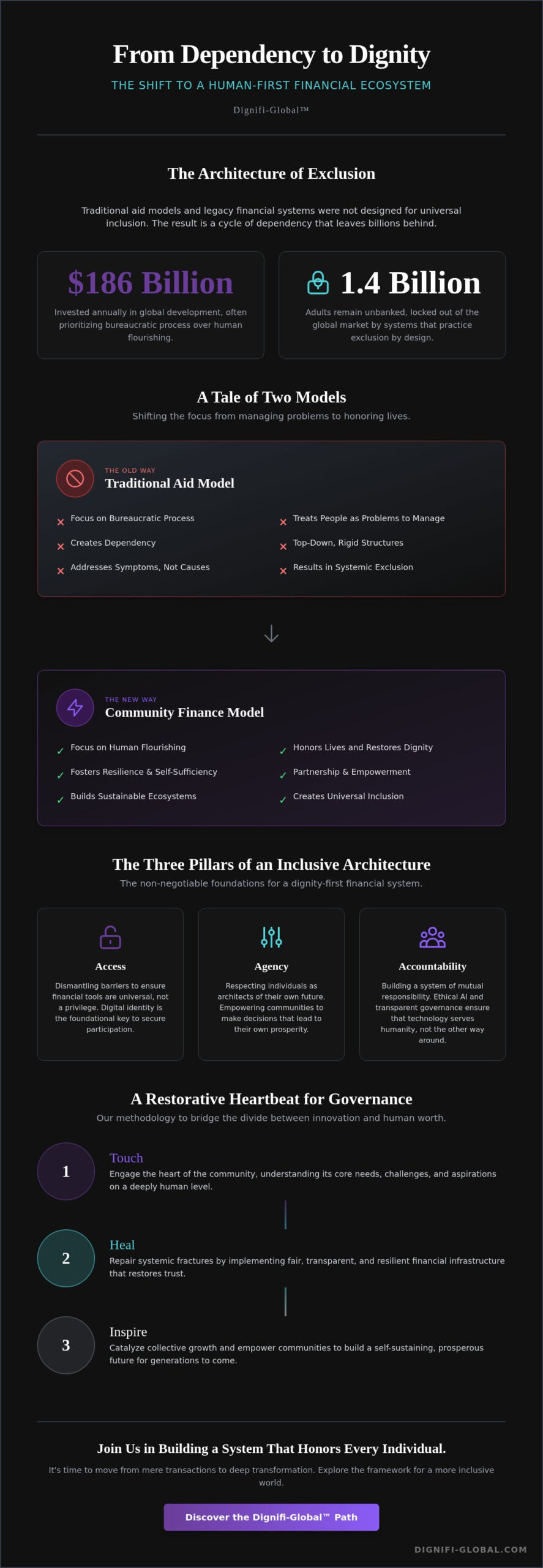
Despite the estimated $186 billion invested annually in global development, many traditional models continue to fall short — often prioritizing bureaucratic process over meaningful, human-centered outcomes. In this context, systemic exclusion remains a persistent challenge. Today, approximately 1.4 billion people lack a secure digital identity, effectively limiting their ability to participate in the global economy.

This gap reflects a broader issue: the need to move beyond frameworks that treat communities as administrative challenges, and toward systems that recognize individuals as participants with agency and value.

Community finance — often overlooked — plays a critical role in addressing this challenge. By strengthening local systems, enabling access, and supporting sustainable participation, it provides a foundation for resilience that is both practical and inclusive.

In this guide, community finance is explored as a structural component of global inclusion, offering a framework for institutional resilience in 2026 that aligns financial systems with ethical governance and human-centered design. The focus is not simply on expanding transactions, but on enabling systems that support participation, restore agency, and connect individuals more effectively to the broader economic landscape.

Key Takeaways

  • Shift your perspective from aid dependency toward a resilience-based model that centers human flourishing rather than bureaucratic processes.
  • Identify the essential mechanics of community finance to transform traditional financial structures into inclusive systems built on access, agency, and accountability.
  • Explore how digital identity acts as a foundational key to ensuring technology serves humanity through ethical capital and secure financial participation.
  • Gain access to a strategic policy framework designed to guide global leaders in building sustainable financial ecosystems that honor human dignity.
  • Understand the “Touch, Heal, Inspire” methodology as a restorative heartbeat for financial governance, bridging the divide between innovation and human worth.

Table of Contents

Redefining Community Finance: From Aid Dependency to Institutional Resilience

True community finance centers people, not processes. It represents a systemic shift where human flourishing is the ultimate metric of success. For decades, global engagement relied on a traditional aid model that often addressed symptoms while leaving the underlying architecture of poverty intact. We are now moving toward a resilience model. This approach focuses on inclusive financial system development that empowers local ecosystems to sustain themselves. It’s a foundational layer for global inclusion and humanitarian stability; it ensures that the most vulnerable are not just surviving, but thriving.

We view this transition through a dignity-first lens. In this framework, people are not problems to be managed; they are lives to be honored. Our methodology follows a consistent rhythm to touch the heart of the community, heal systemic fractures, and inspire collective growth. By centering the individual within the economic collective, we replace the cold, clinical language of strategic advisory with a commitment to moral responsibility. This isn’t merely about capital; it’s about restoring the inherent worth of every participant in the global market.

The Shift Toward Sustainable Global Inclusion

International organizations are currently modernizing aid frameworks to meet the complex demands of 2026. This transition replaces temporary relief with permanent financial infrastructure. A critical component of this new architecture is the Community Development Financial Institution (CDFI), which serves as a vital engine for credit and financial services in markets that legacy banks ignore. These institutions provide the structural stability needed for long term growth. Community finance is the bridge between human rights and economic participation. By moving toward partnership rather than dependency, we create a global environment where economic agency is a universal standard rather than a privileged exception.

"Community finance is not simply about access to resources — it is about building systems that allow resilience to exist at the local level, where it is needed most."

— H.E. Roné de Beauvoir

Why Traditional Financial Systems Fail Vulnerable Communities

Legacy banking systems often practice exclusion by design. These institutions rely on rigid credit scoring and high barrier entries that systematically marginalize those without traditional collateral. According to 2021 World Bank data, 1.4 billion adults remains unbanked globally. This lack of access isn’t a failure of the individual; it’s a failure of governance. The distinction between the unbanked and the underbanked is vital for policy leaders to understand. While the unbanked lack any formal account, the underbanked have limited access and often fall prey to predatory services that offer 300 percent interest rates or higher.

Restoring accountability in global governance policy is now an urgent necessity. We must address the intersection of technology and human rights to ensure that digital financial tools don’t replicate the biases of the past. When we dismantle these barriers, we don’t just open accounts; we restore human dignity. This commitment to systemic change is what defines the next era of global institutional resilience.

The Architecture of Inclusive Financial Systems: Mechanics and Global Impact

True financial resilience begins when we stop treating individuals as data points and start honoring them as architects of their own futures. This shift in perspective requires a structural overhaul that prioritizes agency over mere access. While traditional banking often overlooks economically disadvantaged regions, community finance acts as the vital bridge, centering the human experience within the global economic framework. This architecture is built upon three non-negotiable pillars: access that is universal, agency that is respected, and accountability that is mutual. When mission-driven institutions operate with these values, they don’t just provide loans; they restore the dignity of entire regions.

In regions where traditional infrastructure has failed, community capital operates as a profound catalyst for local economic growth. It’s not about charity; it’s about partnership. By providing the tools for self-sufficiency, these systems turn local markets into vibrant ecosystems of opportunity. The UNH Community Finance Policy Brief underscores the necessity of aligning these local efforts with broader policy goals to ensure long-term sustainability. We must move away from the cold, clinical models of the past and embrace a system where capital serves the flourishing of the human spirit.

Foundational Pillars of Financial Inclusion

Capital injection is most effective when it follows a market-based approach to humanitarian aid. This strategy ensures that resources don’t create dependency, but rather ignite local innovation. According to the World Bank, the 2021 Global Findex data showed that 1.4 billion adults remained unbanked, a gap that represents a massive loss of human potential. By referencing the UN Sustainable Development Goals (SDGs) as a benchmark, we can measure success not just by profit margins, but by the tangible reduction of poverty and the increase in household stability. It’s a journey to touch the lives of the marginalized, heal the fractures in our systems, and inspire a new era of global equity. A financial inclusion framework grounded in human dignity ensures that these efforts translate into lasting institutional resilience rather than fragile, short-term gains.

The Role of Global Governance in Scaling Local Finance

Scaling these local successes requires a sophisticated intersection of global standards and community needs. Policy frameworks must be designed to incentivize private sector capital to flow toward the public good without stripping away the autonomy of local leaders. Cross-border cooperation is essential to build resilience against global shocks that often hit the most vulnerable first. A critical component of this governance is the implementation of a robust Digital Identity System Design for Global Inclusion, which provides the foundational security needed for individuals to participate in the modern economy. By centering the human experience, we can transform institutional structures into engines of shared prosperity that honor every life they touch.

Community Finance: A Resource Guide for Global Institutional Resilience in 2026

The Ethical Intersection: How AI and Digital Identity Transform Community Capital

Technology exists to amplify the human soul, not to replace its agency. As we move toward 2026, the global financial architecture must recognize that digital tools are not masters to be served; they are stewards of human potential. This shift in perspective is essential for the evolution of community finance. When we center technology on the person, we move away from cold, clinical data points and toward a system that honors individual worth. True resilience requires us to build systems that prioritize people over processes and partnership over dependency. We don’t view tech as a shortcut to efficiency, but as a bridge to dignity.

Digital Identity: Restoring Agency to the Excluded

For the 1.1 billion people globally who lack official identification according to World Bank data, the world is a series of closed doors. Digital identity serves as the foundational key to unlocking these barriers. It’s the first step toward financial agency for refugees and displaced persons who’ve lost everything but their names. By implementing a dignity-first approach to secure, sovereign digital identity systems, we ensure that individuals own their stories and their data. This model prevents the commodification of the vulnerable and restores the right to participate in the global economy. You can explore our AI Governance Solutions to see how these systems create a roadmap for global institutions to protect human rights while fostering deep inclusion.

Ethical AI in Financial Decision-Making

Algorithms are often mirrors reflecting our own historical biases. To build a just future, we must design AI systems that prioritize human rights and the principle of non-refoulement. This requires contextual intelligence; this is the ability of an algorithm to understand the unique sociological nuances of a specific local neighborhood. Ethical AI functions as a tool for bridging, not widening, the global wealth gap. When AI is governed by ethical conviction, it can identify gaps in community finance coverage that traditional banking overlooks. We use this technology to achieve specific humanitarian goals:

  • Identifying credit deserts in rural regions where traditional data is scarce.

  • Removing racial and gender bias from automated lending models.

  • Aligning capital flow with long-term flourishing rather than short-term extraction.

Our methodology follows a consistent rhythm: we touch the lives of the marginalized, heal the systemic fractures of the past, and inspire a future where every person is seen. People are not problems to be managed; they are lives to be honored. By 2026, the integration of AI must be measured by how well it serves the least among us, ensuring that technology remains a servant to the flourishing of the human spirit.

Building the Framework: Essential Resources for Sustainable Community Finance

True resilience begins when we stop treating systemic gaps as technical errors; we must view them as moral imperatives. In the landscape of 2026, the architecture of community finance isn’t just about capital. It’s about honoring human worth. We’re moving toward a model that prioritizes people, not processes. This requires a structural shift that values partnership over dependency. According to the 2023 World Bank Global Findex Database, 1.4 billion adults remain unbanked. This statistic isn’t a failure of technology. It’s a failure of dignity.

Strategic Policy Frameworks for Global Leaders

Policy execution must move beyond theoretical design to create tangible flourishing. Leaders need frameworks that bridge the gap between humanitarian aid and systemic stability. By 2025, the IMF predicts that emerging markets will face 30% more volatility due to shifting trade blocs. To counter this, we advise a "dignity-first" approach to governance. This involves centering local voices in every decision. It’s about restoring agency to the communities we serve.

Evaluating new financial technologies requires a rigorous ethical checklist:

  • Agency: Does the algorithm prioritize individual decision-making?

  • Transparency: Is the logic behind credit scoring accessible to the user?

  • Accountability: Can the community audit the AI to prevent bias?

The audit of AI-driven systems is no longer optional. With the AI financial services market projected to hit $45 billion by 2026, we must ensure these tools don’t automate exclusion. We need monitoring systems that act as a foundational guardrail for human rights. This ensures that technology serves the collective good rather than deepening existing divides. Institutions seeking to move beyond compliance checkboxes toward genuine accountability will benefit from understanding how to develop an ai governance strategy for global institutions that is rooted in moral declaration rather than technical procedure.

Tools for Institutional Resilience

Institutional resilience depends on the strength of our shared commitments. We don’t view individuals as problems to be managed; they are lives to be honored. Leveraging data to strengthen responses to economic crises requires a delicate balance. We use data to touch the reality of the marginalized, heal the wounds of exclusion, and inspire a future of inclusion. This is the heartbeat of our methodology: Touch, Heal, Inspire.

Resources for training local leaders in community finance management are essential for long-term stability. We must empower local stakeholders to lead their own recovery. This reduces reliance on external aid and builds a more robust global intersection of finance and ethics. When we invest in local leadership, we’re not just funding a project. We’re honoring a legacy of resilience and ensuring that the tools for flourishing remain in the hands of the people. Understanding how financial inclusion strengthens global institutional resilience is essential for any leader committed to building systems that serve the many rather than the few.

To lead your organization toward a more ethical future, partner with Dignifi-Global to redefine global governance.

The Dignifi-Global™ Path: Centering Human Dignity in Financial Governance

True resilience in 2026 isn’t found in a ledger; it’s found in the heartbeat of the people who use the system. At Dignifi-Global™, we operate through a core methodology: Touch, Heal, Inspire. This isn’t just a slogan. It’s the standard for how we approach community finance. We don’t see individuals as data points. We see them as lives to be honored. By centering human dignity, we bridge the gap between cold technological advancements and the inherent worth of the global citizen. Our commitment is to build systems that recognize the person behind the transaction, ensuring that every institutional framework is rooted in moral responsibility.

Our Vision for a Flourishing Humanity

When we put dignity first, the outcome of strategic advisory shifts from profit extraction to collective flourishing. Ethical conviction must be the foundation of global finance if we’re to survive the volatility of the coming decade. We invite institutional leaders to partner with Her Excellency Roné de Beauvoir. Her policy leadership provides a roadmap for systems that prioritize human rights alongside economic growth. We believe that by 2026, the success of a financial framework will be measured by its ability to restore agency to the marginalized, not just its return on investment. Our vision is a world where governance serves the many, creating a foundational stability that benefits every intersection of society.

  • Restoring Agency: Moving from top-down mandates to collaborative growth.

  • Ethical Governance: Implementing accountability measures that protect human rights.

  • Foundational Stability: Building systems that withstand global shocks through local empowerment.

Moving Beyond Traditional Consulting

Traditional consulting often produces thick reports that gather dust. Dignifi-Global™ chooses systemic action instead. We build frameworks that center human dignity in every institutional layer. This ensures that community finance remains a tool for empowerment rather than a mechanism for dependency. Our policy frameworks are designed for immediate implementation, moving beyond bureaucratic delays to create tangible impact. We invite you to explore our strategic insights and join us in redefining how the world governs its resources. Join the mission to redefine global governance and financial resilience. It’s time to build a future that honors every life.

Our approach is defined by a shift in perspective:

  • Focusing on people, not processes.

  • Prioritizing partnership over dependency.

  • Honoring lives, not managing problems.

Architecting a Future of Global Resilience

The horizon of 2026 demands a fundamental shift from temporary aid to permanent institutional resilience. We’ve explored how the architecture of inclusive systems must prioritize ethical AI and digital identity policy to ensure no one’s left behind. True community finance isn’t about managing poverty; it’s about honoring the inherent worth of every individual within a global framework. This transition requires a departure from clinical, process-heavy consulting toward a model that bridges technology with human rights. Led by Her Excellency Roné de Beauvoir, Dignifi-Global™ utilizes a proprietary ‘Touch, Heal, Inspire’ methodology to restore foundational trust in governance. By centering human dignity, institutions can move beyond dependency toward a state of collective flourishing. The time’s come to build systems where people aren’t problems to be managed but lives to be honored. Your leadership is the bridge to this restored future.

Partner with Dignifi-Global™ to build your dignity-first financial framework.

Frequently Asked Questions

What is the difference between community finance and traditional banking?

Community finance differs from traditional banking by centering on human flourishing rather than capital extraction. While traditional institutions prioritize shareholder returns, community models focus on the inherent worth of the individual. The World Bank reported in 2021 that 1.4 billion people lack access to formal accounts. Community systems bridge this gap by prioritizing partnership over dependency; they see a person’s potential where a bank only sees a risk profile.

How does digital identity improve access to community finance?

Digital identity creates a foundational bridge for individuals to access community finance by proving their existence in a secure, digital format. The United Nations Sustainable Development Goal 16.9 targets legal identity for all by 2030. This tech allows people to carry their reputation across borders. It’s not just a set of data; it’s a way to honor a person’s history and ensure they’re never invisible to the systems meant to serve them.

Why is ethical AI governance necessary for financial inclusion?

Ethical AI governance is vital because it ensures that the algorithms shaping our future are rooted in justice, not bias. A 2023 NIST report highlighted how unrefined AI can reinforce systemic inequality against specific demographics. We must govern these tools to ensure they touch lives with equity. This isn’t about restriction; it’s about building an accountable framework where technology honors human dignity and fosters true financial inclusion for everyone.

Can community finance systems help with humanitarian aid?

These systems transform humanitarian aid by replacing the fragility of one-way charity with the strength of local economic agency. During the 2022 crisis in Ukraine, localized cash assistance proved more resilient than traditional supply chains. Community systems allow aid to flow directly into the hands of those who need it most. This approach heals the immediate wound while inspiring the long-term growth of the local market and its people.

What are the primary challenges to implementing inclusive financial systems globally?

The primary challenges include the lack of interoperable digital infrastructure and a global "compliance-first" mindset that excludes the vulnerable. Currently, 85 nations have established digital ID frameworks, but many don’t talk to each other. We face a systemic choice: we can continue managing people as risks, or we can build systems that honor them as partners. Overcoming these silos requires a visionary shift toward global, ethical governance.

How does Dignifi-Global™ support institutional resilience?

Dignifi-Global™ supports resilience by guiding organizations through our signature "Touch, Heal, Inspire" framework. We move institutions away from cold, process-heavy consulting toward a "dignity-first" model of leadership. By 2026, resilience will be defined by an institution’s ability to honor human worth in a digital age. We provide the policy expertise and ethical conviction needed to bridge the gap between global strategy and local flourishing.

Is community finance only for developing nations?

This model is a global necessity, not a solution reserved for developing nations. Federal Reserve data from 2021 showed that 18 percent of Americans were underbanked or unbanked. community finance provides a universal blueprint for restoring economic health wherever systemic gaps exist. It’s about centering the person in every economy; it’s a way to ensure that no one is left behind regardless of their nation’s GDP.

How can AI-driven insights improve community-based lending?

AI-driven insights allow lenders to see the person behind the data by analyzing alternative indicators of trust and character. When systems look at consistent community participation instead of just a credit score, they can predict reliability with 90 percent accuracy. These tools shouldn’t replace human connection. They should enhance it. They provide the clarity needed to honor a borrower’s potential and provide the capital that helps their entire community thrive.