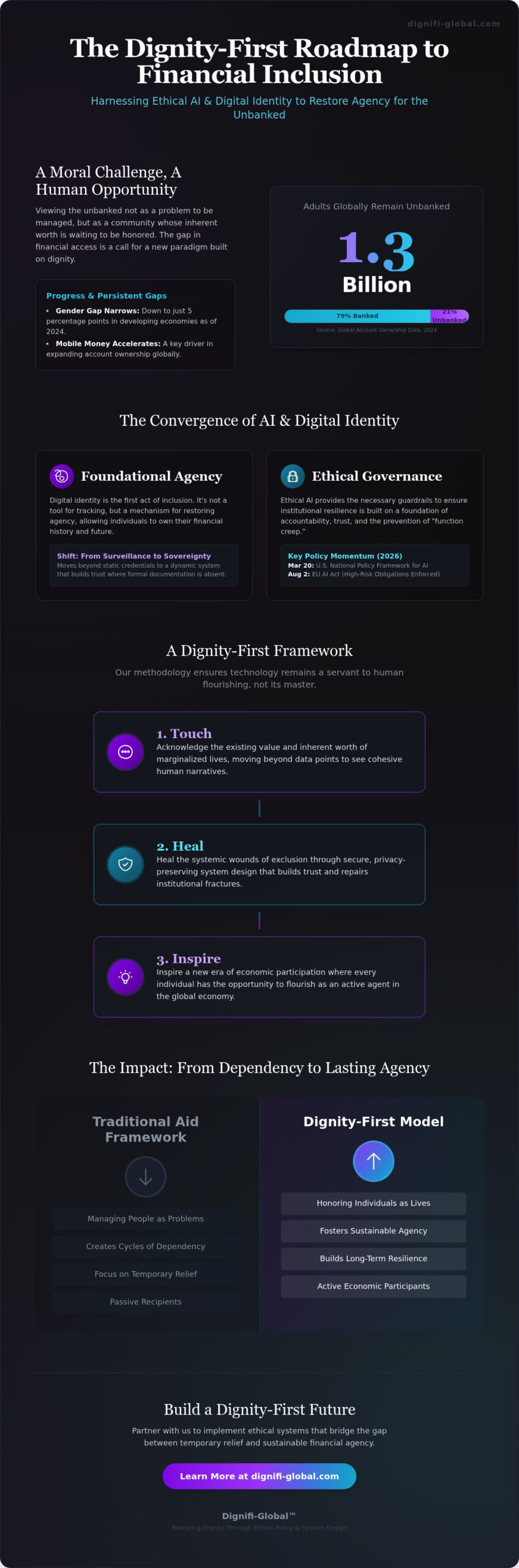
What if the 1.3 billion adults who remain unbanked today are not a problem to be managed, but a community waiting for their inherent worth to be honored? While 79 percent of adults globally held a financial account by 2024, the remaining gap represents a profound moral challenge that technology alone cannot fix. We believe the strategic implementation of AI and digital identity for financial inclusion is not about tracking individuals; it’s about centering human dignity and restoring agency. You likely recognize that existing digital ID systems often risk becoming tools for surveillance or further exclusion rather than empowerment.

This article demonstrates how the intersection of ethical AI governance and secure digital identity systems creates a foundational roadmap for global financial inclusion and institutional resilience. We will move beyond the limitations of traditional aid to explore a dignity-first framework for system design. By examining the shift toward accountability following the U.S. National Policy Framework for Artificial Intelligence released on March 20, 2026, we provide a preview of how to bridge the gap between temporary relief and sustainable financial agency. It’s time to embrace a model of partnership over dependency, ensuring every individual has the opportunity to flourish.

Key Takeaways

  • Shift the perspective from managing problems to honoring lives by adopting a visionary paradigm for inclusive technology.
  • Recognize digital identity as the foundational layer of agency, allowing marginalized populations to own their financial history and future.
  • Implement ethical governance to transform AI and digital identity for financial inclusion into a secure roadmap for institutional resilience.
  • Bridge the gap between temporary relief and sustainable agency by modernizing aid frameworks with dignity-first strategic insights.
  • Apply the “Touch, Heal, Inspire” methodology to ensure that global governance structures prioritize the flourishing of human dignity.

The Convergence of AI and Digital Identity: A New Paradigm for Inclusion

The intersection of technology and humanity is not merely a technical frontier; it’s a moral landscape where the future of global equity is decided. For too long, financial systems have viewed the 1.3 billion unbanked individuals as a data gap to be filled or a logistical hurdle to be cleared. We believe that true progress occurs when we stop managing people as problems and start honoring them as lives. By leveraging AI and digital identity for financial inclusion, we can transform fragmented data points into cohesive narratives of human potential. This year, 2026, marks a pivotal moment as high-risk obligations under the EU AI Act come into force on August 2, 2026, and the U.S. National Policy Framework for Artificial Intelligence begins to reshape how we view the intersection of ethics and innovation. It’s about agency, not just access.

Defining AI and Digital Identity in a Humanitarian Context

AI-driven identity serves as a vehicle for sovereign agency, ensuring that an individual’s digital presence is an instrument of empowerment rather than a ledger of surveillance. While a traditional digital identity often acts as a static record of government-issued credentials, AI-enhanced systems dynamically process alternative data to build trust where formal documentation is absent. Our methodology approaches this through a specific rhythm: we Touch the lives of the marginalized by acknowledging their existing value, Heal the systemic wounds of exclusion through secure design, and Inspire a new era of participation. This approach ensures that technology remains a servant to human flourishing, not its master.

The Economic and Social Case for Ethical Systems

The journey from temporary relief to sustainable resilience requires a shift in how institutions deploy capital and technology. While traditional aid frameworks often create cycles of dependency, inclusive financial systems built on ethical AI foster long-term agency. This transition is essential for meeting the UN Sustainable Development Goals, particularly those focused on eradicating poverty and reducing inequality. By 2024, the gender gap in account ownership in developing economies had already narrowed to 5 percentage points, a testament to the power of mobile technology. However, without robust governance, we risk the “function creep” identified in World Bank reports, where data collected for one purpose is used to marginalize the vulnerable in another. Ethical AI and digital identity for financial inclusion provide the necessary guardrails to ensure that institutional resilience is built on a foundation of accountability and trust.

Foundational Agency: Why Digital Identity Precedes Financial Access

Identity is the first act of inclusion. Without a recognized digital presence, an individual remains invisible to the systems that provide credit, safety, and opportunity. While 79 percent of adults globally held a financial account by 2024, the 1.3 billion who remain unbanked are often excluded simply because they lack the “foundational” credentials required by traditional institutions. We view digital identity system design not as a tool for tracking, but as a mechanism for restoring agency. It’s the essential layer that allows refugees and marginalized populations to own their financial history; this transforms them from passive recipients of aid into active participants in the global economy.

The Moral Architecture of Identity

A dignity-first approach to identity systems requires a fundamental shift from surveillance to sovereignty. Existing frameworks often prioritize the needs of the institution over the rights of the individual, leading to systems that feel like management rather than empowerment. We advocate for partnership over dependency; we believe people are not problems to be managed, but lives to be honored. By utilizing AI and digital identity for financial inclusion, we can create insights that acknowledge the inherent worth of individuals previously deemed “unbankable.” This isn’t about clinical data collection. It’s about centering the human experience to ensure that technology heals the fractures in our social fabric rather than widening them.

Bridging the Gap for the Unbanked

The traditional “know your customer” (KYC) barrier has long served as a gatekeeper that keeps the vulnerable at the margins. Secure digital identity for financial services provides a solution by automating trust in fragile contexts. Since 84 percent of adults in low- and middle-income countries now own a mobile phone, we have an unprecedented opportunity to verify creditworthiness through alternative data. The strategic deployment of AI and digital identity for financial inclusion allows models to analyze patterns of mobile usage or utility payments to build a financial footprint where none existed before. This transition toward financial inclusion acts as a stabilizer for global institutions, replacing volatile relief cycles with long-term economic resilience. If you’re ready to rethink your institutional strategy, we invite you to explore our governance consulting services to build a more humane future.
AI and Digital Identity for Financial Inclusion: Restoring Dignity in a Digital Age

The Governance Prerequisite: Why Ethical AI Must Lead Technology

Technology remains a neutral force until it’s animated by human intent. We believe that technology without governance is a risk, but governance with dignity is a solution. A common objection suggests that AI is a cold, impersonal tool that will only deepen the global divide. However, when we apply a dignity-first lens, we see that ethical policy can transform these algorithms into instruments of compassion. Engaging in global governance consulting isn’t an administrative hurdle; it’s the foundational act of building a system that recognizes human worth. We must ensure that AI and digital identity for financial inclusion are developed within a framework of accountability that precedes any technical deployment.

Governance Over Technology: A Systemic Shift

Governance must precede technology. In humanitarian contexts, the rush to innovate often leads to “automated exclusion,” where flawed algorithms replicate the very biases they were meant to solve. If we don’t establish ethical guardrails before implementation, we risk creating a digital panopticon rather than a pathway to prosperity. Our methodology requires a systemic shift toward a top-down ethical framework. This ensures that every institutional partner is held to the highest standard of transparency. By doing so, we move from a paradigm of managing problems to one of honoring lives, ensuring that institutional resilience is rooted in moral responsibility.

The Ethics of Inference and Profiling

The traditional data-centric model of banking often fails the 1.3 billion unbanked by reducing complex human experiences to binary data points. We advocate for a model that centers meaningful human intervention within AI decision-making processes. It’s vital to uphold the digital equivalent of non-refoulement; we must ensure that the data collected to provide AI and digital identity for financial inclusion is never weaponized against the vulnerable. Our three-part cadence, Touch, Heal, Inspire, guides this transition. We touch the system with ethical policy, heal the scars of exclusion through transparent inferences, and inspire a future where every individual can flourish. This is the essence of restoring dignity in a digital age.

From Relief to Resilience: Strategic Implementation for Institutions

Institutional resilience isn’t built on the efficiency of a transaction; it’s forged in the fires of trust and accountability. For multilateral partners, the path forward requires a departure from traditional aid frameworks that often prioritize process over people. We propose a strategic shift where relief serves as a bridge to long-term flourishing. By integrating AI governance solutions into existing humanitarian programs, organizations can ensure that technological adoption honors the individual. This is how AI and digital identity for financial inclusion moves from a theoretical concept to a foundational reality for the world’s most vulnerable. It’s about agency, not just access.

Modernizing Humanitarian Aid Frameworks

Modernizing aid means moving from short-term relief to long-term agency. In 2024, 62 percent of adults in low- and middle-income economies made or received digital payments, marking a 28 percent increase over the last decade. This surge highlights the potential for secure cash-transfer programs powered by digital identity. To ensure these systems remain dignity-first, institutions should follow a rigorous technological audit checklist:

  • Does the system treat the individual as a life to be honored rather than a problem to be managed?
  • Is the digital footprint sovereign, ensuring the user owns their financial history?
  • Are there transparent mechanisms for human accountability in every AI-driven inference?

The Role of Policymakers in 2026

The role of the global statesperson in 2026 is to bridge the gap between innovation and ethics. The White House released its National Policy Framework for Artificial Intelligence on March 20, 2026, signaling a move toward consolidated federal oversight. For policymakers, this represents a call to action. We must move beyond a patchwork of regulations to a unified vision that centers human flourishing. It’s not enough to manage risks; we must actively create the conditions for partnership-based ecosystems. This involves aligning government mandates with technology providers who share a commitment to moral responsibility. This systemic policy change is the heartbeat of our methodology. Strengthen your humanitarian strategy with our humanitarian resilience programs to ensure no community is left behind.

Restoring Dignity through Ethical Policy: The Dignifi-Global™ Methodology

The architecture of our digital future must be built on the bedrock of human worth. We believe technology is a mirror of our collective values; if we design systems for efficiency alone, we risk building a world that is efficient but hollow. The Dignifi-Global™ Methodology rejects the clinical reduction of individuals into binary data sets. Instead, we center the human experience at the very heart of AI and identity strategy. By embracing the strategic deployment of AI and digital identity for financial inclusion, we can move beyond the systemic failures of the past. We don’t see data points; we see destinies waiting to be fulfilled.

The Dignity-First Approach to Global Inclusion

Our unique policy frameworks are rooted in the visionary leadership of Her Excellency Roné de Beauvoir. Her vision for a more humane future is built on the conviction that people are lives to be honored, not problems to be managed. This philosophy informs every aspect of our work, from policy leadership to strategic advisory. We provide a specific framework for AI and digital identity for financial inclusion that prioritizes the flourishing of the individual above the convenience of the institution. It’s a shift from dependency to partnership. This ensures that the digital tools of tomorrow are used to restore the agency that was stripped away yesterday.

Partnering for a Sustainable Future

The urgency of this mission cannot be overstated. As we approach the full implementation of high-risk AI obligations on August 2, 2026, the window for building ethical systems is narrowing. We invite global leaders, institutional stakeholders, and humanitarian pioneers to join us in this transformation. Building resilient systems is not a task for the next crisis; it’s a responsibility for today. Our methodology provides the cadence needed to navigate this complexity. We Touch the lives of the marginalized with empathy, Heal the systemic wounds of exclusion through ethical governance, and Inspire a global community to reach for a higher plane of engagement. Dignifi-Global™ stands as your visionary partner in this journey, bridging the gap between technological potential and human dignity. Let’s build a future where every life is honored and every voice is heard.

Honoring the Future of Global Agency

The path toward a more equitable world requires us to look beyond the code and see the faces of the 1.3 billion individuals still waiting for an invitation to participate. We have established that digital identity serves as the foundational layer of agency and that ethical governance must lead every technological advancement. By centering human dignity, we transform AI and digital identity for financial inclusion from a mere technical objective into a moral imperative. This systemic shift moves institutions from providing temporary relief to fostering sustainable resilience, ensuring every individual has the opportunity to flourish in our digital age.

Led by Her Excellency Roné de Beauvoir, our visionary approach is designed to bridge the gap between global policy and human worth. We invite you to partner with Dignifi-Global™ to design the future of ethical inclusion and witness the power of our Touch, Heal, Inspire methodology. Together, we can restore the agency of the marginalized and build a global financial system that honors every life. The future of humanity is not a problem to be managed; it’s a legacy we are building together with calm, steady confidence. Let’s create a world where technology serves the heart.

Frequently Asked Questions

How does AI improve financial inclusion for the unbanked?

AI improves inclusion by analyzing alternative data points, such as mobile phone usage and utility payments, to establish creditworthiness for the 1.3 billion adults who remain unbanked. By 2024, digital payment adoption in low-income economies reached 62 percent, providing a rich narrative of financial behavior that traditional systems often ignore. It’s about recognizing inherent value where legacy institutions see only a data void.

What are the risks of using digital identity in humanitarian aid?

The primary risks involve “function creep” and automated exclusion, where data intended for relief is weaponized for surveillance or biased algorithms marginalize the vulnerable. Without a dignity-first framework, these systems can inadvertently replicate the systemic fractures they aim to heal. We must ensure that digital footprints remain sovereign and protected against unauthorized profiling.

Why is governance more important than technology in AI implementation?

Governance provides the moral intent that technology lacks; technology is a neutral force, but governance is a solution. As the high-risk obligations of the EU AI Act come into force on August 2, 2026, it’s clear that policy must precede deployment to prevent systemic harm. Governance ensures we are honoring lives rather than merely managing data points.

Can digital identity systems protect individual privacy?

Yes, secure systems protect privacy through decentralized architectures and sovereign identity models where the individual retains ownership of their data. Implementing AI and digital identity for financial inclusion requires a commitment to transparency and accountability. This approach prevents the invasive profiling common in traditional, data-dense institutional models.

What is the “dignity-first” approach to financial system design?

A dignity-first approach centers the human experience by treating individuals as lives to be honored rather than problems to be managed. It utilizes our “Touch, Heal, Inspire” framework to ensure that every technological adoption restores personal agency. This philosophy moves the conversation from clinical transactions to a higher plane of human flourishing.

How does Dignifi-Global™ support global institutions in AI policy?

Dignifi-Global™ provides ethical AI governance frameworks and strategic insights that help institutions navigate the complex intersection of technology and human rights. We bridge the gap between innovation and ethics through visionary policy leadership. Our methodology empowers partners to move from temporary relief cycles toward sustainable, partnership-based institutional resilience.

What role does AI play in humanitarian resilience programs?

AI strengthens resilience by automating trust and optimizing secure cash-transfer programs in fragile or conflict-affected contexts. Since 84 percent of adults in low-income countries now own a mobile phone, AI can verify identities and assess needs with unprecedented precision. This allows institutions to build long-term agency instead of fostering perpetual dependency.

How can policymakers ensure AI governance is ethical and inclusive?

Policymakers must adopt unified frameworks, such as the U.S. National Policy Framework for Artificial Intelligence released on March 20, 2026, that prioritize accountability and transparency. They should mandate meaningful human intervention in every AI-led financial inference. Governance remains truly inclusive only when it protects the digital sovereignty of the marginalized.
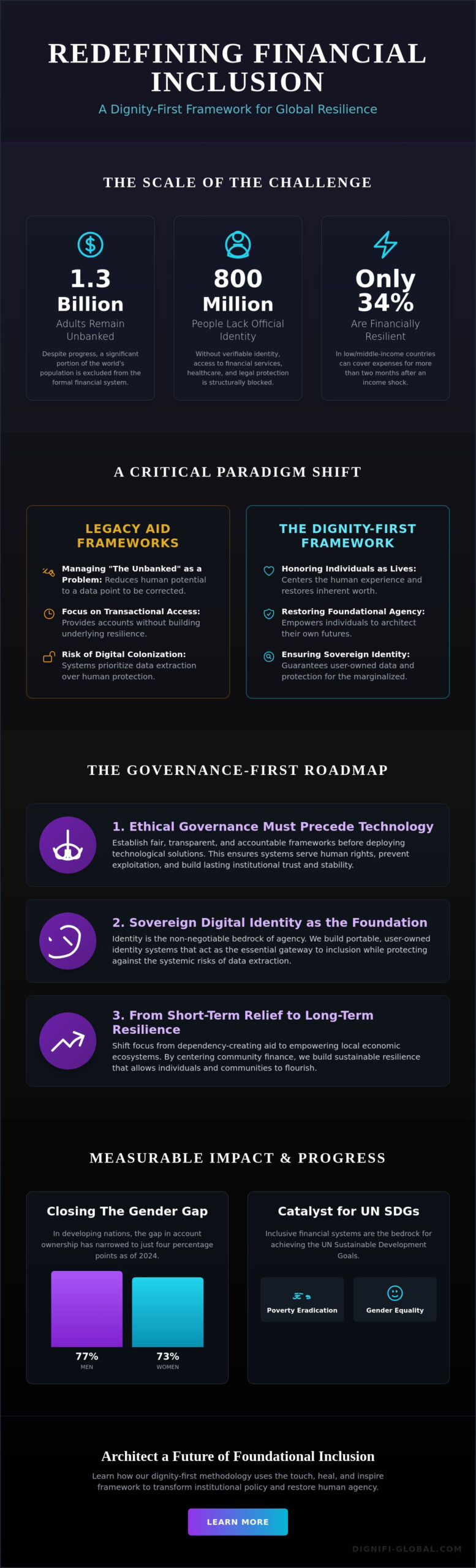
True progress is not measured by the volume of transactions, but by the foundational restoration of human agency. While 75% of adults in low and middle income countries now hold a financial account as of 2024, the global community still struggles to serve the 1.3 billion people who remain unbanked. We believe that people are not problems to be managed; they are lives to be honored. Genuine financial inclusion must move beyond the cold delivery of digital products to embrace a dignity-first framework that honors every individual’s right to participate in the global economy.

You likely recognize that legacy aid frameworks often create fragile dependencies instead of lasting resilience, particularly for the 800 million people who still lack official identity. This article promises to show how redefining inclusion through ethical governance and digital identity restores human agency and strengthens global institutional resilience. We will explore a governance first roadmap that transitions from relief to resilience, using our methodology to touch, heal, and inspire the systems that shape our shared future.

Key Takeaways

  • Learn to shift institutional perspective from managing the unbanked to honoring the individual as a foundational human right.
  • Understand how digital identity acts as a foundational layer for participation while protecting against the systemic risks of digital colonization.
  • Discover why ethical governance must precede technological deployment to ensure sustainable financial inclusion and global institutional stability.
  • Identify strategies to move from short-term relief to long-term resilience by centering local economic ecosystems through community finance.
  • Explore a dignity-first methodology that uses the touch, heal, and inspire framework to transform institutional policy and restore human agency.

Defining Financial Inclusion: Beyond Transactional Access to Human Dignity

For decades, global institutions have viewed the unbanked as a data point to be corrected or a market to be captured. This clinical approach reduces human potential to a series of ledger entries. We believe that true financial inclusion is not merely the technical act of opening accounts, but the foundational restoration of human agency. According to this Financial Inclusion Overview, the traditional focus remains on access to affordable products. However, access alone does not equate to empowerment. While 79% of adults globally held an account in 2024, a staggering 1.3 billion individuals remain on the periphery of the formal economy. We must stop managing the unbanked as a problem and start honoring them as lives with inherent worth.

Traditional metrics often celebrate the increase in account ownership without questioning the quality of the inclusion. It’s a hollow victory to provide a bank account to a person who lacks the resilience to survive a single financial shock. In 2025, only 34% of adults in low and middle income countries could cover expenses for more than two months following an income loss. This gap reveals that current systems are built for transaction, not for flourishing. We don’t need more processes; we need more partnership. When we focus on the person instead of the product, we begin to see that financial exclusion is fundamentally a crisis of identity and governance.

Financial inclusion is the sacred intersection where ethical governance, sovereign identity, and human dignity meet to empower the individual.

The Dignity-First Paradigm

Centering the human experience requires a radical shift from dependency to partnership. Our dignity-first approach ensures that systems are designed to serve the person, not the process. We move beyond top down aid models that often stifle local innovation and create cycles of reliance. By focusing on our core methodology to touch, heal, and inspire, we create pathways for sustainable economic flourishing. It’s about building a foundation where every person has the tools to architect their own future. This shift ensures that technology serves as a bridge to human rights rather than a barrier to entry.

Inclusion as a Catalyst for UN SDGs

Inclusive financial systems are the bedrock of the United Nations Sustainable Development Goals, particularly poverty eradication and gender equality. As of 2024, the gender gap in account ownership in developing nations narrowed to four percentage points, with 73% of women now holding accounts. This progress is not just a statistic. It represents the restoration of institutional trust and the bridging of historical divides. When we prioritize inclusive governance, we foster a global environment where resilience is the norm and every individual has the opportunity to contribute to their community’s collective prosperity.

The Intersection of Digital Identity and Financial Empowerment

Identity is not a secondary convenience for the privileged; it is the foundational bedrock of human agency. For the 800 million people globally who still lack any official proof of identity as of 2026, the path to financial inclusion remains structurally blocked. Without a verifiable presence, an individual cannot save, borrow, or protect their family from the 24% of natural disasters that now impact low income economies annually. We recognize that digital identity is the essential “foundational layer” for all financial participation. It is the bridge between being invisible to the state and being an active participant in the global flourishing of commerce.

We must, however, confront the rising risk of digital colonization. Many emerging systems focus on data extraction rather than human protection, treating individuals as resources to be mined. By centering the person through an ethical digital identity system design, institutions provide the essential gateway to inclusion while honoring the user’s sovereign right to their own data. Our mission is to ensure that technology serves the person, not the process. We believe in building systems that restore power to the marginalized rather than consolidating it in the hands of the few.

Sovereign Identity for the Underserved

For displaced populations and those in fragile economies, identity must be portable and user-owned. Research on Financial Inclusion and Social Development highlights that social mobility is tethered to a person’s ability to prove who they are across borders and institutions. When identity is sovereign, it becomes a prerequisite for credit and insurance, allowing a mobile money user to transition from simple payments to complex wealth building. This shift represents our commitment to touch the lives of the forgotten and heal the fractures in our global financial architecture.

Ethical AI in Digital Onboarding

As we move into 2026, the banking industry is transitioning toward agentic AI systems that handle complex compliance and fraud investigations. While these tools can add significant value, they also carry risks; roughly 8.3% of digital onboarding cases in early 2025 were identified as fraud attempts. We must use AI to verify identity without compromising privacy or reinforcing algorithmic bias. Ethical AI should be human centric by design, ensuring that automated approval processes do not inadvertently exclude the very people they were meant to serve. If you are seeking to build more equitable systems, consider how our policy leadership can help align your technology with your ethical convictions.

Financial Inclusion: A Dignity-First Framework for Global Institutional Resilience

Why Governance Must Precede Technology in Inclusive Systems

Technology is not the architect of equity; it is merely the brick. Many global institutions fall into the trap of tech-solutionism, believing that a new mobile app or a blockchain ledger will automatically dissolve systemic inequality. It won’t. Without the steady hand of ethical oversight, digital tools often become instruments of surveillance or exclusion rather than empowerment. We believe that financial inclusion must be anchored in a framework of accountability that exists long before the first line of code is written. We don’t need faster systems; we need more faithful ones.

As we enter 2026, the banking industry is rapidly transitioning from AI as a simple assistant to AI with transactional authority. Agentic systems are now being integrated as semi-autonomous digital co-workers for compliance checks and fraud investigations. This shift demands a profound commitment to ai governance solutions that prioritize human agency. Governance provides the moral guardrails that ensure technology serves the person, not the process. It’s the difference between a system that manages a population and one that honors a life.

Policymakers hold the sacred responsibility of ensuring that dignity-first principles guide every technological adoption. This requires a shift in perspective. We must view governance not as a bureaucratic hurdle, but as the foundational layer of institutional resilience. By establishing clear standards for transparency and data sovereignty, we can bridge the gap between innovation and human rights. Our methodology seeks to touch the heart of policy, heal the fractures in existing systems, and inspire a global standard for ethical engagement.

Ethical AI Governance Frameworks

We must design policies that protect vulnerable populations from the predatory practices often found in unregulated fintech. In 2025, the National Association of Insurance Commissioners in the US saw 21 states adopt an AI model bulletin, signaling a global rise in scrutiny. These frameworks must balance the drive for innovation with a deep commitment to consumer protection. True financial inclusion requires that we intersection data sovereignty with financial access, ensuring that individuals remain the masters of their own digital destinies. Organizations seeking to formalize this commitment can benefit from developing a robust ai governance strategy for global institutions that translates ethical ideals into actionable policy declarations. As jurisdictional requirements grow more complex, institutions can also strengthen their approach by adopting an ai contextual governance framework that moves beyond static compliance toward situational, dignity-first controls aligned with the NIST AI Risk Management Framework.

From Policy to Practice: The Houston Model

Local governance often provides the most vivid blueprint for global standards. By integrating sophisticated governance consulting into national financial strategies, institutions can build the internal capacity to monitor and audit their own inclusive systems. This is about more than just compliance. It is about building a stable, flourishing environment where community banks and global institutions alike can operate with integrity. We believe that when governance is centered on human dignity, institutional resilience becomes an inevitable outcome.

Building Institutional Resilience Through Community Finance

Resilience is often mistaken for the temporary absence of crisis, but true resilience is the enduring presence of human agency. For many global institutions, the focus remains on short term relief efforts that address the symptoms of exclusion without healing the underlying systemic fractures. In low and middle income countries, only 34% of adults can cover basic expenses for more than two months if they lose their primary income source. This vulnerability isn’t a failure of the individual; it’s a structural gap that only deep, foundational financial inclusion can bridge. We must shift our focus from temporary aid to the creation of economic ecosystems that allow every person to flourish independently.

Local economic stability is best achieved through institutions that are deeply rooted in the communities they serve. As of the second quarter of 2025, there were 1,378 certified Community Development Financial Institutions in the United States alone, holding $446 billion in assets. These organizations prove that capital is most effective when it is combined with local accountability and ethical governance. By leveraging community finance, global stakeholders can strengthen the very fabric of society, ensuring that the most marginalized aren’t left behind during market volatility. Institutional resilience is the ability of systems to honor human life during disruption.

Humanitarian Resilience Programs

Modernizing aid requires us to bridge the humanitarian development nexus. We don’t just want to distribute resources; we want to restore dignity. In the three years preceding 2025, 24% of adults in developing economies experienced severe weather events, with 13% losing their livelihoods. Integrating financial literacy and digital identity into aid frameworks ensures that relief is not a dead end but a gateway to formal participation. When we use technology to touch and heal these communities, we inspire a transition from dependency to self determination. Partner with Dignifi-Global™ to build resilient systems that prioritize human worth over process efficiency.

Sustainable Inclusion Models

Moving beyond micro credit is essential for holistic financial flourishing. While small loans provide a spark, true inclusion requires a full suite of services, including savings and insurance. Mobile money’s role in savings has doubled since 2021, with 10% of adults in developing nations now using these accounts to build a safety net. This shift toward local ownership of financial infrastructure protects climate vulnerable communities from the shocks of a changing world. We believe in fostering systems where people are not managed as problems, but honored as the architects of their own economic destiny.

Dignifi-Global™: Architecting a Future of Foundational Inclusion

The future of humanity is not written in lines of code; it is forged in the fires of ethical conviction. We believe that the current global architecture is at a crossroads where technology must either become a tool for liberation or a mechanism for deeper exclusion. Our vision for financial inclusion transcends the mere expansion of market share. We are building systems that honor lives, not just manage problems. By centering human dignity, we move beyond the cold, clinical language of strategic advisory to embrace a mission that is both aspirational and grounded in moral responsibility.

The intersection of ethical AI, digital identity, and humanitarian resilience represents the next frontier of global stability. As the digital identity market reaches a value of $64.4 billion in 2025, the stakes for human rights have never been higher. We don’t view this growth as a purely commercial opportunity. Instead, we see it as a mandate to ensure that the 3 billion people who own smartphones as of 2025 are granted the sovereign identity required to participate in the global economy with agency and honor. This is the cornerstone of institutional resilience.

Our Methodology: Touch, Heal, Inspire

Our work is guided by a rhythmic, three part cadence that acts as the heartbeat of our methodology. We begin with Touch, where we identify the foundational needs of the underserved by looking past data points to see the human being. We then move to Heal, restoring agency through the design of ethical policies and identity frameworks that bridge the gap between exclusion and participation. Finally, we Inspire, architecting a future where every individual has the structural stability to flourish. This liturgical consistency ensures that our “dignity-first” lens is applied to every complex challenge, from AI governance to community finance.

Strategic Advisory for Global Leaders

Dignifi-Global™ operates at the nexus of technology and human rights, partnering with multilateral organizations and governments to design the next generation of inclusive systems. We offer more than just policy leadership; we provide a departure from traditional, process heavy consulting. Our approach favors partnership over dependency and people over processes. We invite global leaders to join this movement toward a more dignified global economy. It is time to transition from managing crises to honoring lives. If you are ready to build a more resilient and humane institutional framework, let’s begin the work of restoring human agency together.

Restoring Agency through Ethical Governance

The path toward a resilient global economy requires a departure from process heavy management and a return to honoring human life. We’ve explored how sovereign digital identity serves as the foundational layer for 1.3 billion unbanked adults and why ethical governance must act as the steady hand guiding technological innovation. True financial inclusion is achieved when we stop viewing individuals as data points and start seeing them as the architects of their own flourishing. By centering the human experience, institutions can bridge the gap between fragile dependency and sustainable economic agency.

Led by Her Excellency Roné de Beauvoir, our organization serves as a pioneer in ethical AI and digital identity strategy. We utilize our foundational Touch, Heal, Inspire methodology to transform institutional policy and restore human rights at the nexus of finance and technology. We invite you to Partner with Dignifi-Global™ to architect your inclusive governance framework. It’s time to build a future where every individual has the structural stability to flourish and every system is designed to honor the sacred worth of the person.

Frequently Asked Questions

What is the primary goal of financial inclusion in a global context?

The primary goal of financial inclusion is the foundational restoration of human agency, allowing every individual to move from fragile dependency to sustainable economic flourishing. While 75% of adults in low and middle income countries now hold a financial account as of 2024, the mission remains incomplete until the 1.3 billion people currently excluded gain the tools to architect their own futures. We believe this process honors lives rather than simply managing the unbanked as a demographic problem to be solved.

How does digital identity impact financial inclusion for refugees?

Digital identity serves as a portable bridge that allows displaced populations to prove their existence across borders and institutions. For the 800 million people globally who lack official proof of identity as of 2026, a sovereign digital ID is the prerequisite for opening accounts and receiving secure aid. This foundational layer ensures that a person’s dignity and economic history remain intact even when they’re forced to flee their homes and communities.

Why is ethical AI governance necessary for inclusive financial systems?

Ethical AI governance provides the moral guardrails required to ensure that transactional authority serves the individual rather than the institution. As agentic AI systems become semi autonomous digital co-workers in 2026, governance frameworks prevent these tools from becoming instruments of surveillance or exclusion. By centering accountability, we protect vulnerable populations from predatory practices and ensure that algorithmic decisions honor the inherent rights of every human being.

Can financial inclusion exist without formal banking institutions?

Yes, financial inclusion flourishes through diverse pathways such as mobile money accounts and community finance networks. In 2024, 62% of adults in low and middle income countries used digital payments, and 10% used mobile money specifically to save. These non traditional systems often provide a more accessible and culturally resonant entry point for the underserved, bridging the gap where legacy banking frameworks have historically failed to reach the marginalized.

What are the biggest barriers to financial inclusion in 2026?

The most significant barriers in 2026 include the lack of official identity for 800 million people and the rising threat of digital identity fraud, which saw 4.18% of checks flagged in 2025. Additionally, 24% of adults in developing economies experienced severe weather events in the three years preceding 2025, which often wipes out fragile economic gains. These structural hurdles require a dignity-first approach that prioritizes long term resilience over simple market expansion.

How does financial inclusion contribute to institutional resilience?

Inclusive systems strengthen institutional resilience by creating stable, self determining economic ecosystems that can withstand global disruptions. When individuals have the agency to save and insure their livelihoods, they’re less likely to require emergency relief during environmental or economic crises. By supporting systems that allow the 34% of adults in emerging markets to cover expenses during income loss, we build a foundational stability that protects the entire global financial architecture.

What role do global governance consultants play in financial inclusion?

Global governance consultants act as ethical visionaries who bridge the gap between technological innovation and human rights. At Dignifi-Global™, we provide the policy leadership necessary to design systems that honor lives instead of managing problems. Our methodology uses the Touch, Heal, Inspire framework to help multilateral organizations and governments transition from legacy aid models toward sustainable, dignity-first financial architectures that foster genuine human flourishing.

How can AI improve credit scoring for the unbanked without bias?

AI can improve credit scoring by analyzing alternative data points like mobile money usage and utility payments while being governed by strict anti bias frameworks. In 2026, agentic AI systems are expected to add £100 million in value for major banking groups by automating complex investigations fairly. By centering human centric design, we ensure that automated systems expand access to credit without reinforcing historical patterns of exclusion or discrimination against the underserved.