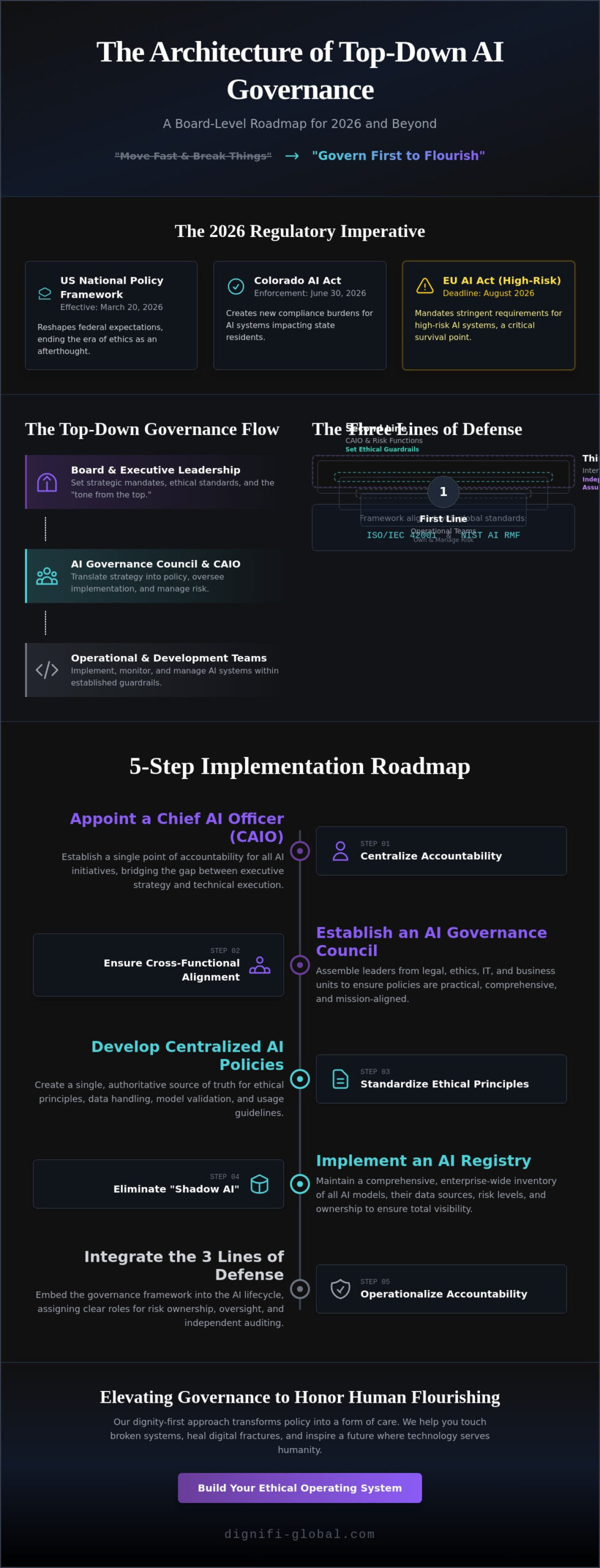
What if the greatest risk to your institution isn’t a rogue algorithm, but a board that views technology as a process to be managed rather than a life to be honored? As the United States National Policy Framework for AI released on March 20, 2026, begins to reshape federal expectations, the era of treating ethics as an afterthought has ended. You’re likely struggling to reconcile the Colorado AI Act’s June 30, 2026, implementation with the high-risk requirements of the EU AI Act arriving this August. This regulatory fragmentation creates a profound sense of urgency for leaders who refuse to let human dignity be lost in the code.
You’ll find that mastering the architecture of top-down ai governance is the only way to transform these complex burdens into an ethical operating system. This guide provides a clear roadmap for board-level oversight that moves beyond cold metrics toward a dignity-first model of systemic accountability. We’ll explore how to align your global operations with the latest 2026 standards while verifying that every deployment serves the flourishing of humanity. By the end, you’ll possess the strategic insight to touch the heart of your organization, heal fragmented processes, and inspire a future where technology honors every life it encounters.
Key Takeaways
- Transition from a “move fast and break things” mindset to a “govern first to flourish” model that centers human dignity at every executive level.
- Master the architecture of top-down ai governance by integrating the Three Lines of Defense into your AI lifecycle and aligning with global ISO standards.
- Balance the strengths of centralized mandates with inclusive values to protect institutional resilience in high-stakes environments like finance and aid.
- Execute a structured five-step roadmap to appoint a Chief AI Officer and establish a council that aligns your technology with your humanitarian mission.
- Discover how a dignity-first approach transforms policy into a form of care, using the Touch, Heal, Inspire methodology to elevate global standards.
What is Top-Down AI Governance and Why is it Essential in 2026?
Top-down AI governance is a centralized framework where strategic mandates and ethical standards flow directly from executive leadership to the operational heart of an organization. It’s a shift in power that moves the responsibility of algorithmic oversight from the server room to the boardroom. In the current landscape of 2026, the reckless culture of “move fast and break things” has been replaced by a more sustainable commitment: “govern first to flourish.” This transition is driven by the realization that institutional resilience is built on trust; and trust is the product of visible, principled leadership.
With the high-risk system requirements of the EU AI Act set to take effect in August 2026, the necessity of top-down ai governance has become a matter of survival. Global institutions are facing a fragmented patchwork of regulations, including the Colorado AI Act that begins enforcement on June 30, 2026. Centralized authority is required to navigate these complexities, ensuring that an organization speaks with one voice across multiple jurisdictions. Without a unified mandate, institutions risk falling into a reactive posture that compromises both their values and their operational stability.
The Pillars of Institutional Authority
Establishing a “tone from the top” isn’t just a suggestion; it’s a non-negotiable strategic priority for the modern era. This structure defines clear lines of accountability that stretch from the Board of Directors to the data scientists writing the code. Centralized policy-making prevents the rise of “shadow AI,” where departments deploy unvetted tools that create fragmented risk profiles. By taking command of the technological narrative, leadership ensures that every automated system remains an extension of the institution’s mission. As we witness the rise of government by algorithm, the role of executive oversight becomes the primary defense against systemic failure.
The Dignity-First Perspective on Governance
A visionary approach to governance moves beyond the simplistic binary of “safe versus unsafe” systems. We must ask whether our technology is dignified or exploitative. This requires centering people, not processes, within the foundational architecture of the organization. Top-down mandates provide the necessary weight to protect marginalized populations, ensuring that centralized ethical standards act as a barrier against the hidden harms of algorithmic bias. By honoring the individual, we transform governance from a clinical checklist into a humanitarian mission. This methodology allows us to touch the broken systems of the past, heal the fractures in our digital society, and inspire a future where technology serves the flourishing of all humanity.
The Architecture of a Top-Down AI Governance Framework
A robust architecture for AI oversight isn’t merely a technical diagram; it’s a moral blueprint for institutional integrity. To build this structure, global organizations must integrate the Three Lines of Defense (3-LoD) model directly into their AI lifecycle management. In a top-down ai governance framework, the first line consists of operational teams who own the risk. The second line, led by the Chief AI Officer, sets the ethical guardrails. The third line provides independent audit and assurance. This hierarchy ensures that accountability isn’t a vague concept but a structural reality that protects both the institution and the individuals it serves.
Mapping these institutional policies to international standards like ISO/IEC 42001 and the NIST AI RMF provides the necessary scaffolding to meet the EU AI Act’s August 2026 deadline. A centralized AI Registry serves as the “single source of truth” for every enterprise-wide deployment. Without this centralized visibility, “shadow AI” can proliferate, creating fragmented risk profiles that no board can effectively manage. By maintaining a unified registry, executive leadership ensures that every algorithm aligns with the organization’s core mission. Research into AI governance around the world demonstrates that top-down consistency is the only way to maintain trust across diverse geographic regions.
Intersection of AI and Digital Identity
Dignity begins with the recognition of the individual. Secure digital identity system design is the bedrock of secure AI governance; it’s the bridge between a digital record and a human life. Managing sovereign identity within a centralized governance mandate allows institutions to honor privacy while ensuring accountability. This is particularly vital in humanitarian aid frameworks, where AI systems must respect the non-refoulement principle and safeguard the data of the vulnerable. If you’re seeking to bridge these complex domains, our policy leadership can help you design a system that prioritizes inclusion.
Operationalizing Ethical Use Policies
High-minded “Ethics Charters” often fail because they lack technical teeth. We must translate philosophical premises into specific, measurable technical constraints that automated compliance tools can monitor in real time. This top-down structure allows for a “liturgical” consistency in how data is handled and decisions are made. Contextual intelligence ensures that these centralized mandates remain flexible enough to adapt to local humanitarian needs while never compromising the foundational dignity of the person. By centering people rather than processes, we transform clinical oversight into a profound act of care.
Top-Down vs. Co-Governance: Navigating the Strategic Debate
Strategic leadership is not the accumulation of power; it’s the courageous assumption of responsibility for the lives we serve. In the current 2026 landscape, a tension has emerged between the efficiency of centralized mandates and the inclusivity of co-governance. While critics suggest that a rigid hierarchy stifles innovation, the reality of high-stakes environments like finance and humanitarian aid tells a different story. In these sectors, decentralized models often create “accountability vacuums” where no one is responsible when an algorithm fails. Effective top-down ai governance provides the structural stability needed to weather the storms of regulatory fragmentation, ensuring that ethical standards are never left to chance.
We must address the critique from institutions like the Harvard Law Review, which argues that centralized control is a poor fit for the fluid nature of AI. This perspective assumes that top-down authority is inherently non-democratic. It’s not. As explored in NYU’s framework for AI governance, a people-centered justice approach can be mandated from the executive level to ensure that democratic values are baked into the system’s DNA. The most resilient institutions are those that find a hybrid middle ground: they set centralized standards at the board level while allowing for decentralized execution within local operational teams.
When Top-Down is Non-Negotiable
In certain scenarios, a centralized mandate isn’t just a choice; it’s a requirement for survival. The EU AI Act’s August 2026 deadline for high-risk systems means the board must hold the final say on compliance and risk tolerance. When we provide global governance consulting for humanitarian agencies, we see that fragmentation is fatal. Inconsistent AI policies across different regions don’t just create legal headaches. They threaten the institutional resilience required to protect vulnerable populations during a crisis. Centralization ensures that the “dignity-first” lens is applied consistently, regardless of where the technology is deployed.
Integrating Stakeholder Feedback into the Hierarchy
Authority without empathy is merely control. To prevent the “Ethical Visionary” from becoming an isolated figurehead, leadership must build “listening loops” that inform policy without diluting accountability. Ethical Advisory Boards play a vital role here, acting as a conscience that checks executive power and ensures that the technology remains a tool for human flourishing. True authority is found at the intersection where executive mandates meet human-centric feedback, ensuring that the “tone from the top” is informed by the realities on the ground. By centering people rather than processes, we transform the governance hierarchy into a living bridge between institutional vision and human need.
How to Implement Top-Down AI Governance: A 5-Step Roadmap
Implementing a visionary framework requires more than just technical adjustments; it demands a fundamental realignment of institutional purpose. Moving from abstract ethics to concrete action is the hallmark of effective top-down ai governance. This roadmap ensures that your transition from policy to practice is both regulatory-compliant and deeply humane. By following these steps, global institutions can move beyond the “evidence-ready” requirements of the 2026 landscape to build a legacy of trust.
- Step 1: Define the North Star. Aligning AI governance with the institutional mission ensures that technology remains a servant to human flourishing.
- Step 2: Establish the Governance Body. Appointing a Chief AI Officer (CAIO) and a cross-functional council provides the necessary weight to executive mandates.
- Step 3: Inventory and Risk Categorization. Mapping every AI use case against potential human impact allows for the prioritization of high-risk systems under the August 2026 EU AI Act.
- Step 4: Deploy Operational Templates. Utilizing AI enterprise governance templates standardizes ethical guardrails across diverse departments.
- Step 5: Audit and Iterate. Moving from static policy to dynamic oversight ensures the framework evolves alongside the technology.
Step 1 & 2: Setting the Foundation
Before a single line of code is audited, leadership must conduct an “Institutional Values Audit.” This isn’t a check-box exercise; it’s a deep dive into the soul of the organization to ensure that technology serves humanity. To maintain true top-down authority, the CAIO must report directly to the CEO or the Board. This structural link ensures that the “Dignity-First” KPI carries the same weight as financial performance. When authority flows from the highest level, it signals that people are not problems to be managed, but lives to be honored.
Step 4 & 5: Scaling with Accountability
Scaling accountability across a global institution requires the right instruments for the task. By leveraging essential AI governance tools, leaders can enforce policy in real-time rather than waiting for annual reviews. For high-risk humanitarian systems, establishing a “Red-Teaming” protocol is essential to stress-test algorithms against unintended biases. The governance framework must be a living organism to survive the 2026 technological pace, adapting to new challenges while remaining rooted in foundational principles. This iterative process allows us to touch the operational reality, heal systemic vulnerabilities, and inspire a culture of responsibility. If you’re ready to bridge the gap between policy and practice, our strategic insights can help you lead with conviction.
Dignifi-Global™: Elevating Governance to Honor Human Flourishing
Dignifi-Global™ stands at the foundational intersection of technological advancement and human rights. We don’t just draft policies; we restore the essential connection between institutional power and individual flourishing. Our “Touch, Heal, Inspire” methodology serves as the heartbeat of our methodology, guiding organizations through the complexities of the 2026 landscape. We touch the structural vulnerabilities of existing systems, heal the fractures caused by algorithmic bias, and inspire a global standard that honors human worth. This is not merely strategic advisory; it is a commitment to a future where technology serves the heart of humanity.
Within our visionary model, top-down ai governance is not a cold regulatory exercise but the highest form of humanitarian care in the digital age. It’s the mechanism through which we transition from traditional, reactive relief to sustainable, AI-enabled resilience. By centering people, not processes, we ensure that every executive mandate acts as a shield for the vulnerable. This approach allows institutions to bridge the gap between clinical policy leadership and the profound reality of human worth. We believe that true governance happens when leadership chooses partnership over dependency and empowerment over control.
The Dignity-First Advantage
The transition from “problem management” to “life honoring” systems represents the ultimate competitive advantage for global institutions. We’ve seen that systems designed solely for efficiency often manage people out of their own dignity. Our frameworks strengthen financial inclusion through ethical design that recognizes the individual as a life to be honored, not a data point to be processed. Collaborating with Dignifi-Global™ provides the specialized policy advisory needed to move beyond the August 2026 compliance deadlines toward true moral authority. We help you build systems that don’t just function, but flourish.
Next Steps for Visionary Leaders
The path toward institutional resilience requires a clear assessment of your current governance maturity. We offer proprietary diagnostic tools to help visionary leaders identify where their structures can be elevated to meet the ethical demands of the modern era. We invite you to join our global network of ethical AI and digital identity pioneers who are committed to a “dignity-first” future. By implementing a robust top-down ai governance framework, you’re not just securing your organization; you’re taking a stand for the future of our digital society. Ultimately, establishing these standards is an act of diplomatic prestige and a profound expression of moral courage.
Leading the Future with Moral Clarity
The path toward 2027 requires more than just meeting the August 2026 EU AI Act deadlines; it demands a fundamental commitment to the person. By centering a top-down ai governance architecture, you ensure that institutional power is used to restore, not just to regulate. We’ve moved beyond the era of managing problems and entered an age of honoring lives. This transition requires the courage to set a centralized mandate that prioritizes human flourishing over mere operational efficiency.
Dignifi-Global™, led by Her Excellency Roné de Beauvoir, brings diplomatic prestige and a dignity-first proprietary methodology to the nexus of technology and human rights. Our global institutional stature allows us to bridge the gap between abstract policy and concrete humanitarian impact. We’re here to help you touch the systems of today, heal the vulnerabilities of the digital age, and inspire a future where every individual is valued. Secure your institution’s future with Dignifi-Global’s Ethical AI Governance Frameworks.
Your leadership is the catalyst for a more humane digital world. Step forward with confidence and build a legacy of trust that will endure for generations.
Frequently Asked Questions
Is top-down AI governance too slow for rapid technological changes?
No, top-down governance provides the essential guardrails that allow for safe, rapid innovation. The March 20, 2026, National Policy Framework for AI highlights that centralized oversight actually prevents the paralysis of regulatory uncertainty. By setting clear standards, leadership touches the operational reality and heals the fear of unintended harm. This structure allows teams to move with confidence rather than caution.
How does top-down governance differ from traditional corporate compliance?
Top-down governance focuses on the flourishing of the person, while traditional compliance often settles for mere legal box-ticking. Traditional models view individuals as problems to be managed; our approach views them as lives to be honored. This framework is not a reactive process; it’s a proactive expression of ethical conviction that starts at the board level and flows through every department.
Can a top-down approach still be ‘human-centric’ and inclusive?
Yes, because true inclusion is a mandate that must be protected by institutional authority to be effective. A centralized approach ensures that marginalized populations are shielded from algorithmic bias through the enforcement of universal ethical standards. Inclusion isn’t a happy accident. It’s a deliberate, top-down commitment to restorative justice and the inherent worth of every human being.
What are the primary risks of failing to implement top-down AI oversight?
The primary risks involve the creation of accountability vacuums and the proliferation of “shadow AI” across the organization. Failing to implement top-down ai governance leaves an institution vulnerable to the Colorado AI Act’s June 30, 2026, enforcement date. Without centralized oversight, fragmented policies threaten the very resilience required to protect human dignity during periods of rapid technological transformation.
How does the EU AI Act influence top-down governance strategies in 2026?
The EU AI Act mandates a centralized accountability structure for all high-risk systems by August 2026. This legislation requires a clear chain of command to ensure that technical teams align with strict transparency and safety standards. It effectively transforms top-down oversight from a strategic choice into a mandatory operational requirement for any global institution serving the European market.
What role does the Board of Directors play in AI governance frameworks?
The Board of Directors serves as the ultimate anchor for strategic vision and moral accountability. They’re responsible for defining the “tone from the top” and ensuring that every AI initiative aligns with the institution’s humanitarian mission. Their role is to bridge the gap between technological potential and the foundational responsibility to protect human dignity through active, principled oversight.
How can global institutions ensure governance consistency across different jurisdictions?
Consistency is maintained through a centralized AI Registry and the rigorous adoption of international standards like ISO/IEC 42001. By creating a single source of truth at the executive level, organizations can navigate the complex patchwork of global regulations. This ensures that an institution’s core values remain unwavering, regardless of the specific jurisdiction in which they choose to operate.
Is top-down governance applicable to small humanitarian organizations or only large entities?
Centralized oversight is a non-negotiable requirement for any entity that processes sensitive human data, regardless of its size. Small humanitarian organizations must adopt top-down ai governance to safeguard the non-refoulement principle and ensure aid remains a tool for flourishing. Accountability isn’t a luxury for the large; it’s a foundational responsibility for the principled and the brave.