What if the greatest risk to your institution isn’t a rogue algorithm, but a board that views technology as a process to be managed rather than a life to be honored? As the United States National Policy Framework for AI released on March 20, 2026, begins to reshape federal expectations, the era of treating ethics as an afterthought has ended. You’re likely struggling to reconcile the Colorado AI Act’s June 30, 2026, implementation with the high-risk requirements of the EU AI Act arriving this August. This regulatory fragmentation creates a profound sense of urgency for leaders who refuse to let human dignity be lost in the code.

You’ll find that mastering the architecture of top-down ai governance is the only way to transform these complex burdens into an ethical operating system. This guide provides a clear roadmap for board-level oversight that moves beyond cold metrics toward a dignity-first model of systemic accountability. We’ll explore how to align your global operations with the latest 2026 standards while verifying that every deployment serves the flourishing of humanity. By the end, you’ll possess the strategic insight to touch the heart of your organization, heal fragmented processes, and inspire a future where technology honors every life it encounters.

Key Takeaways

  • Transition from a “move fast and break things” mindset to a “govern first to flourish” model that centers human dignity at every executive level.
  • Master the architecture of top-down ai governance by integrating the Three Lines of Defense into your AI lifecycle and aligning with global ISO standards.
  • Balance the strengths of centralized mandates with inclusive values to protect institutional resilience in high-stakes environments like finance and aid.
  • Execute a structured five-step roadmap to appoint a Chief AI Officer and establish a council that aligns your technology with your humanitarian mission.
  • Discover how a dignity-first approach transforms policy into a form of care, using the Touch, Heal, Inspire methodology to elevate global standards.

What is Top-Down AI Governance and Why is it Essential in 2026?

Top-down AI governance is a centralized framework where strategic mandates and ethical standards flow directly from executive leadership to the operational heart of an organization. It’s a shift in power that moves the responsibility of algorithmic oversight from the server room to the boardroom. In the current landscape of 2026, the reckless culture of “move fast and break things” has been replaced by a more sustainable commitment: “govern first to flourish.” This transition is driven by the realization that institutional resilience is built on trust; and trust is the product of visible, principled leadership.

With the high-risk system requirements of the EU AI Act set to take effect in August 2026, the necessity of top-down ai governance has become a matter of survival. Global institutions are facing a fragmented patchwork of regulations, including the Colorado AI Act that begins enforcement on June 30, 2026. Centralized authority is required to navigate these complexities, ensuring that an organization speaks with one voice across multiple jurisdictions. Without a unified mandate, institutions risk falling into a reactive posture that compromises both their values and their operational stability.

The Pillars of Institutional Authority

Establishing a “tone from the top” isn’t just a suggestion; it’s a non-negotiable strategic priority for the modern era. This structure defines clear lines of accountability that stretch from the Board of Directors to the data scientists writing the code. Centralized policy-making prevents the rise of “shadow AI,” where departments deploy unvetted tools that create fragmented risk profiles. By taking command of the technological narrative, leadership ensures that every automated system remains an extension of the institution’s mission. As we witness the rise of government by algorithm, the role of executive oversight becomes the primary defense against systemic failure.

The Dignity-First Perspective on Governance

A visionary approach to governance moves beyond the simplistic binary of “safe versus unsafe” systems. We must ask whether our technology is dignified or exploitative. This requires centering people, not processes, within the foundational architecture of the organization. Top-down mandates provide the necessary weight to protect marginalized populations, ensuring that centralized ethical standards act as a barrier against the hidden harms of algorithmic bias. By honoring the individual, we transform governance from a clinical checklist into a humanitarian mission. This methodology allows us to touch the broken systems of the past, heal the fractures in our digital society, and inspire a future where technology serves the flourishing of all humanity.

The Architecture of a Top-Down AI Governance Framework

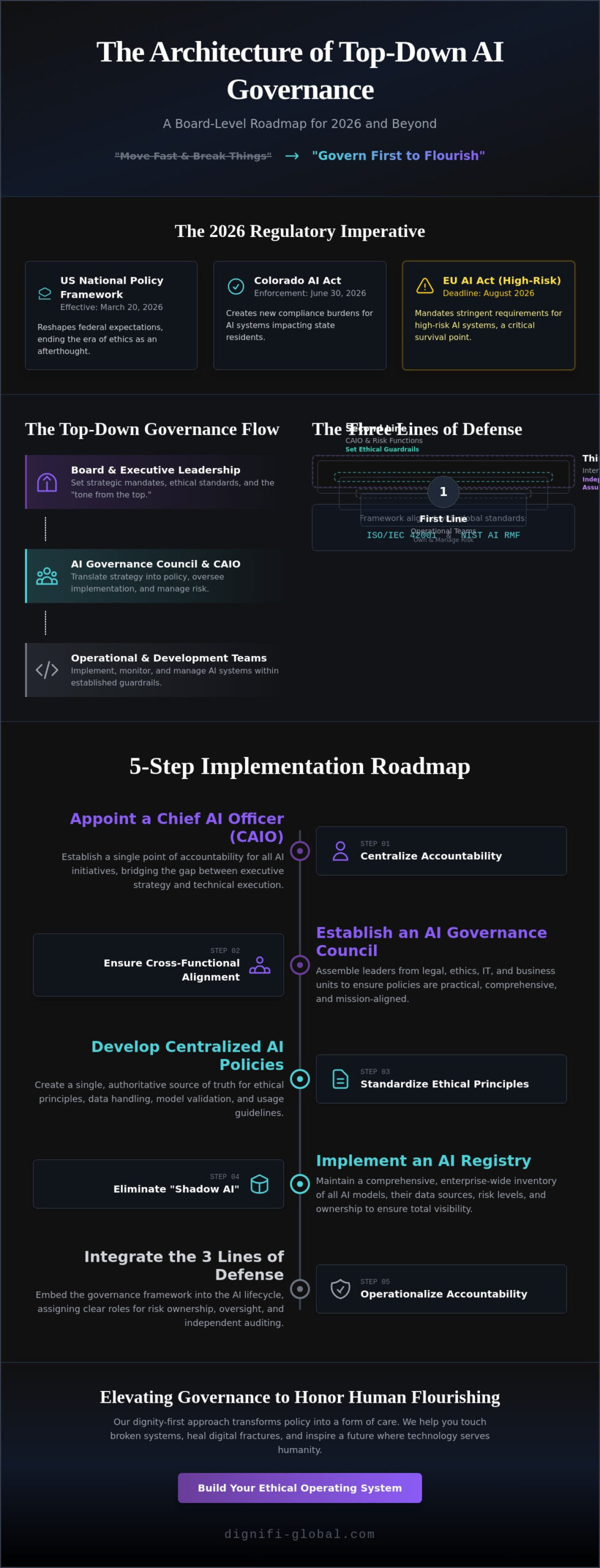
A robust architecture for AI oversight isn’t merely a technical diagram; it’s a moral blueprint for institutional integrity. To build this structure, global organizations must integrate the Three Lines of Defense (3-LoD) model directly into their AI lifecycle management. In a top-down ai governance framework, the first line consists of operational teams who own the risk. The second line, led by the Chief AI Officer, sets the ethical guardrails. The third line provides independent audit and assurance. This hierarchy ensures that accountability isn’t a vague concept but a structural reality that protects both the institution and the individuals it serves.

Mapping these institutional policies to international standards like ISO/IEC 42001 and the NIST AI RMF provides the necessary scaffolding to meet the EU AI Act’s August 2026 deadline. A centralized AI Registry serves as the “single source of truth” for every enterprise-wide deployment. Without this centralized visibility, “shadow AI” can proliferate, creating fragmented risk profiles that no board can effectively manage. By maintaining a unified registry, executive leadership ensures that every algorithm aligns with the organization’s core mission. Research into AI governance around the world demonstrates that top-down consistency is the only way to maintain trust across diverse geographic regions.

Intersection of AI and Digital Identity

Dignity begins with the recognition of the individual. Secure digital identity system design is the bedrock of secure AI governance; it’s the bridge between a digital record and a human life. Managing sovereign identity within a centralized governance mandate allows institutions to honor privacy while ensuring accountability. This is particularly vital in humanitarian aid frameworks, where AI systems must respect the non-refoulement principle and safeguard the data of the vulnerable. If you’re seeking to bridge these complex domains, our policy leadership can help you design a system that prioritizes inclusion.

Operationalizing Ethical Use Policies

High-minded “Ethics Charters” often fail because they lack technical teeth. We must translate philosophical premises into specific, measurable technical constraints that automated compliance tools can monitor in real time. This top-down structure allows for a “liturgical” consistency in how data is handled and decisions are made. Contextual intelligence ensures that these centralized mandates remain flexible enough to adapt to local humanitarian needs while never compromising the foundational dignity of the person. By centering people rather than processes, we transform clinical oversight into a profound act of care.
Top-Down AI Governance: A Strategic How-To Guide for Global Institutions in 2026

Top-Down vs. Co-Governance: Navigating the Strategic Debate

Strategic leadership is not the accumulation of power; it’s the courageous assumption of responsibility for the lives we serve. In the current 2026 landscape, a tension has emerged between the efficiency of centralized mandates and the inclusivity of co-governance. While critics suggest that a rigid hierarchy stifles innovation, the reality of high-stakes environments like finance and humanitarian aid tells a different story. In these sectors, decentralized models often create “accountability vacuums” where no one is responsible when an algorithm fails. Effective top-down ai governance provides the structural stability needed to weather the storms of regulatory fragmentation, ensuring that ethical standards are never left to chance.

We must address the critique from institutions like the Harvard Law Review, which argues that centralized control is a poor fit for the fluid nature of AI. This perspective assumes that top-down authority is inherently non-democratic. It’s not. As explored in NYU’s framework for AI governance, a people-centered justice approach can be mandated from the executive level to ensure that democratic values are baked into the system’s DNA. The most resilient institutions are those that find a hybrid middle ground: they set centralized standards at the board level while allowing for decentralized execution within local operational teams.

When Top-Down is Non-Negotiable

In certain scenarios, a centralized mandate isn’t just a choice; it’s a requirement for survival. The EU AI Act’s August 2026 deadline for high-risk systems means the board must hold the final say on compliance and risk tolerance. When we provide global governance consulting for humanitarian agencies, we see that fragmentation is fatal. Inconsistent AI policies across different regions don’t just create legal headaches. They threaten the institutional resilience required to protect vulnerable populations during a crisis. Centralization ensures that the “dignity-first” lens is applied consistently, regardless of where the technology is deployed.

Integrating Stakeholder Feedback into the Hierarchy

Authority without empathy is merely control. To prevent the “Ethical Visionary” from becoming an isolated figurehead, leadership must build “listening loops” that inform policy without diluting accountability. Ethical Advisory Boards play a vital role here, acting as a conscience that checks executive power and ensures that the technology remains a tool for human flourishing. True authority is found at the intersection where executive mandates meet human-centric feedback, ensuring that the “tone from the top” is informed by the realities on the ground. By centering people rather than processes, we transform the governance hierarchy into a living bridge between institutional vision and human need.

How to Implement Top-Down AI Governance: A 5-Step Roadmap

Implementing a visionary framework requires more than just technical adjustments; it demands a fundamental realignment of institutional purpose. Moving from abstract ethics to concrete action is the hallmark of effective top-down ai governance. This roadmap ensures that your transition from policy to practice is both regulatory-compliant and deeply humane. By following these steps, global institutions can move beyond the “evidence-ready” requirements of the 2026 landscape to build a legacy of trust.

  • Step 1: Define the North Star. Aligning AI governance with the institutional mission ensures that technology remains a servant to human flourishing.
  • Step 2: Establish the Governance Body. Appointing a Chief AI Officer (CAIO) and a cross-functional council provides the necessary weight to executive mandates.
  • Step 3: Inventory and Risk Categorization. Mapping every AI use case against potential human impact allows for the prioritization of high-risk systems under the August 2026 EU AI Act.
  • Step 4: Deploy Operational Templates. Utilizing AI enterprise governance templates standardizes ethical guardrails across diverse departments.
  • Step 5: Audit and Iterate. Moving from static policy to dynamic oversight ensures the framework evolves alongside the technology.

Step 1 & 2: Setting the Foundation

Before a single line of code is audited, leadership must conduct an “Institutional Values Audit.” This isn’t a check-box exercise; it’s a deep dive into the soul of the organization to ensure that technology serves humanity. To maintain true top-down authority, the CAIO must report directly to the CEO or the Board. This structural link ensures that the “Dignity-First” KPI carries the same weight as financial performance. When authority flows from the highest level, it signals that people are not problems to be managed, but lives to be honored.

Step 4 & 5: Scaling with Accountability

Scaling accountability across a global institution requires the right instruments for the task. By leveraging essential AI governance tools, leaders can enforce policy in real-time rather than waiting for annual reviews. For high-risk humanitarian systems, establishing a “Red-Teaming” protocol is essential to stress-test algorithms against unintended biases. The governance framework must be a living organism to survive the 2026 technological pace, adapting to new challenges while remaining rooted in foundational principles. This iterative process allows us to touch the operational reality, heal systemic vulnerabilities, and inspire a culture of responsibility. If you’re ready to bridge the gap between policy and practice, our strategic insights can help you lead with conviction.

Dignifi-Global™: Elevating Governance to Honor Human Flourishing

Dignifi-Global™ stands at the foundational intersection of technological advancement and human rights. We don’t just draft policies; we restore the essential connection between institutional power and individual flourishing. Our “Touch, Heal, Inspire” methodology serves as the heartbeat of our methodology, guiding organizations through the complexities of the 2026 landscape. We touch the structural vulnerabilities of existing systems, heal the fractures caused by algorithmic bias, and inspire a global standard that honors human worth. This is not merely strategic advisory; it is a commitment to a future where technology serves the heart of humanity.

Within our visionary model, top-down ai governance is not a cold regulatory exercise but the highest form of humanitarian care in the digital age. It’s the mechanism through which we transition from traditional, reactive relief to sustainable, AI-enabled resilience. By centering people, not processes, we ensure that every executive mandate acts as a shield for the vulnerable. This approach allows institutions to bridge the gap between clinical policy leadership and the profound reality of human worth. We believe that true governance happens when leadership chooses partnership over dependency and empowerment over control.

The Dignity-First Advantage

The transition from “problem management” to “life honoring” systems represents the ultimate competitive advantage for global institutions. We’ve seen that systems designed solely for efficiency often manage people out of their own dignity. Our frameworks strengthen financial inclusion through ethical design that recognizes the individual as a life to be honored, not a data point to be processed. Collaborating with Dignifi-Global™ provides the specialized policy advisory needed to move beyond the August 2026 compliance deadlines toward true moral authority. We help you build systems that don’t just function, but flourish.

Next Steps for Visionary Leaders

The path toward institutional resilience requires a clear assessment of your current governance maturity. We offer proprietary diagnostic tools to help visionary leaders identify where their structures can be elevated to meet the ethical demands of the modern era. We invite you to join our global network of ethical AI and digital identity pioneers who are committed to a “dignity-first” future. By implementing a robust top-down ai governance framework, you’re not just securing your organization; you’re taking a stand for the future of our digital society. Ultimately, establishing these standards is an act of diplomatic prestige and a profound expression of moral courage.

Leading the Future with Moral Clarity

The path toward 2027 requires more than just meeting the August 2026 EU AI Act deadlines; it demands a fundamental commitment to the person. By centering a top-down ai governance architecture, you ensure that institutional power is used to restore, not just to regulate. We’ve moved beyond the era of managing problems and entered an age of honoring lives. This transition requires the courage to set a centralized mandate that prioritizes human flourishing over mere operational efficiency.

Dignifi-Global™, led by Her Excellency Roné de Beauvoir, brings diplomatic prestige and a dignity-first proprietary methodology to the nexus of technology and human rights. Our global institutional stature allows us to bridge the gap between abstract policy and concrete humanitarian impact. We’re here to help you touch the systems of today, heal the vulnerabilities of the digital age, and inspire a future where every individual is valued. Secure your institution’s future with Dignifi-Global’s Ethical AI Governance Frameworks.

Your leadership is the catalyst for a more humane digital world. Step forward with confidence and build a legacy of trust that will endure for generations.

Frequently Asked Questions

Is top-down AI governance too slow for rapid technological changes?

No, top-down governance provides the essential guardrails that allow for safe, rapid innovation. The March 20, 2026, National Policy Framework for AI highlights that centralized oversight actually prevents the paralysis of regulatory uncertainty. By setting clear standards, leadership touches the operational reality and heals the fear of unintended harm. This structure allows teams to move with confidence rather than caution.

How does top-down governance differ from traditional corporate compliance?

Top-down governance focuses on the flourishing of the person, while traditional compliance often settles for mere legal box-ticking. Traditional models view individuals as problems to be managed; our approach views them as lives to be honored. This framework is not a reactive process; it’s a proactive expression of ethical conviction that starts at the board level and flows through every department.

Can a top-down approach still be ‘human-centric’ and inclusive?

Yes, because true inclusion is a mandate that must be protected by institutional authority to be effective. A centralized approach ensures that marginalized populations are shielded from algorithmic bias through the enforcement of universal ethical standards. Inclusion isn’t a happy accident. It’s a deliberate, top-down commitment to restorative justice and the inherent worth of every human being.

What are the primary risks of failing to implement top-down AI oversight?

The primary risks involve the creation of accountability vacuums and the proliferation of “shadow AI” across the organization. Failing to implement top-down ai governance leaves an institution vulnerable to the Colorado AI Act’s June 30, 2026, enforcement date. Without centralized oversight, fragmented policies threaten the very resilience required to protect human dignity during periods of rapid technological transformation.

How does the EU AI Act influence top-down governance strategies in 2026?

The EU AI Act mandates a centralized accountability structure for all high-risk systems by August 2026. This legislation requires a clear chain of command to ensure that technical teams align with strict transparency and safety standards. It effectively transforms top-down oversight from a strategic choice into a mandatory operational requirement for any global institution serving the European market.

What role does the Board of Directors play in AI governance frameworks?

The Board of Directors serves as the ultimate anchor for strategic vision and moral accountability. They’re responsible for defining the “tone from the top” and ensuring that every AI initiative aligns with the institution’s humanitarian mission. Their role is to bridge the gap between technological potential and the foundational responsibility to protect human dignity through active, principled oversight.

How can global institutions ensure governance consistency across different jurisdictions?

Consistency is maintained through a centralized AI Registry and the rigorous adoption of international standards like ISO/IEC 42001. By creating a single source of truth at the executive level, organizations can navigate the complex patchwork of global regulations. This ensures that an institution’s core values remain unwavering, regardless of the specific jurisdiction in which they choose to operate.

Is top-down governance applicable to small humanitarian organizations or only large entities?

Centralized oversight is a non-negotiable requirement for any entity that processes sensitive human data, regardless of its size. Small humanitarian organizations must adopt top-down ai governance to safeguard the non-refoulement principle and ensure aid remains a tool for flourishing. Accountability isn’t a luxury for the large; it’s a foundational responsibility for the principled and the brave.
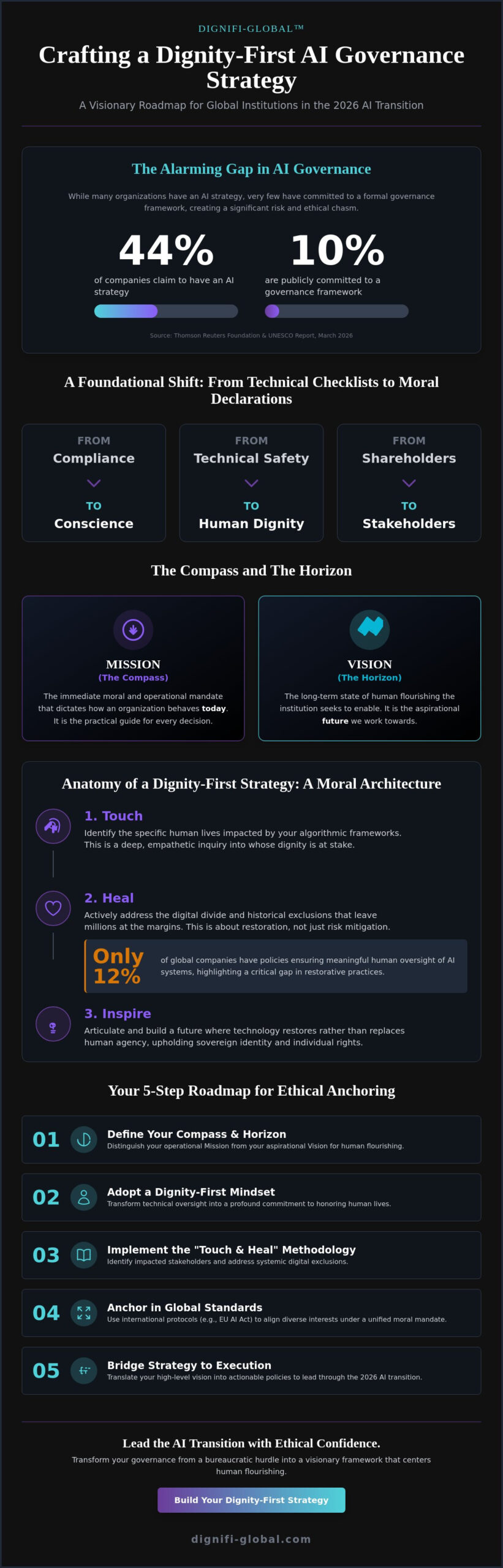
A March 2026 report by the Thomson Reuters Foundation and UNESCO reveals a startling reality: while 44% of companies claim to have an AI strategy, only 10% are publicly committed to a formal governance framework. This disconnect suggests that most organizations still view technology as a problem to be managed rather than a life to be honored. You’ve likely felt the growing tension between high-level ethical ideals and the practical reality of technical execution. It’s a gap that threatens to leave even the most prestigious organizations behind as global standards like the EU AI Act evolve toward their 2027 deadlines. Developing a robust ai governance strategy for global institutions isn’t about building a technical manual; it’s about making a moral declaration.

We believe that institutional resilience is rooted in people, not processes. This article provides a clear, actionable roadmap to help you craft a dignity-first mission and vision that aligns diverse stakeholders across the globe. You’ll learn to transform your governance from a bureaucratic hurdle into a visionary framework that centers human flourishing. We’ll preview the essential steps to bridge the intersection of technology and human rights, ensuring your institution doesn’t just survive the digital shift but leads it with steady, ethical confidence.

Key Takeaways

  • Distinguish your mission as an operational compass from your vision as a horizon for human flourishing to ensure your strategy remains both practical and aspirational.
  • Learn to craft a dignity-first ai governance strategy for global institutions that transforms technical oversight into a profound commitment to honoring human lives.
  • Implement the “Touch” and “Heal” methodology to identify impacted stakeholders and address the systemic exclusions often hidden within digital frameworks.
  • Follow a five-step roadmap for ethical anchoring, using international protocols to align diverse global interests under a single, unified moral mandate.
  • Bridge the gap between strategic drafting and policy execution to lead your institution through the complex regulatory shifts of the 2026 AI transition.

What is an AI Governance Mission and Vision for Global Institutions?

In the pursuit of systemic justice, an organization’s mission and vision serve as the dual pillars of its institutional soul. We define the AI governance mission as the “Compass.” It’s the immediate moral and operational mandate that dictates how an organization behaves today. Conversely, the vision is the “Horizon.” It represents the long-term state of human flourishing that the institution seeks to enable through its presence in the world. Traditional corporate mission statements often fail in the humanitarian sector because they prioritize efficiency over equity; they focus on shareholders rather than stakeholders. In the context of global aid, optimization is not the goal; restoration is. Dignity-First AI Governance is a transformative strategy that centers the sanctity of human life over the optimization of technical processes.

Crafting a robust ai governance strategy for global institutions requires a departure from the cold, clinical language of risk management. It demands a vocabulary of responsibility. When we define our purpose, we aren’t just checking boxes for a board meeting. We’re establishing a foundational promise to the communities we serve. This process involves more than just software updates; it involves a fundamental shift in how we view the intersection of technology and human rights.

The Shift from Compliance to Conscience

By May 2026, the global landscape of AI regulation has moved decisively toward protecting fundamental rights. We can no longer settle for a “do no harm” mentality. We must strive for proactive flourishing. Global governance consulting acts as the bridge here, connecting the rapid pace of innovation with the steady pulse of ethical conviction. We must contrast “Technical Safety” with “Human Dignity” in our strategic language. Safety is about avoiding errors; dignity is about honoring lives. It’s the difference between a system that doesn’t crash and a system that empowers the vulnerable.

Institutional Resilience as a Strategic Anchor

A strong vision protects organizations from ethical drift during periods of rapid technological upheaval. It ensures that every algorithmic decision aligns with the core mandate of financial inclusion and social equity. This ai governance strategy for global institutions views the intersection of AI policy and digital identity as a foundational pillar of resilience. When we anchor our strategy in human worth, we build systems that don’t just survive the digital shift. We build systems that inspire trust, bridge the digital divide, and foster long-term global stability.

The Anatomy of a Dignity-First AI Strategy

A dignity-first ai governance strategy for global institutions is built upon a rhythmic methodology: Touch, Heal, and Inspire. This framework moves beyond the traditional, data-centric models that treat individuals as problems to be managed. Instead, it honors them as lives to be restored. This approach is not a technical manual; it is a moral architecture designed to withstand the rapid shifts of the digital age.

In the Touch phase, we identify the specific human lives impacted by our algorithmic frameworks. This isn’t a high-level demographic analysis. It’s a deep, empathetic inquiry into whose dignity is at stake when a system makes a decision. The Heal phase follows, where we actively address the digital divide and the historical exclusions that leave millions at the margins. By May 2026, the necessity for this healing is clear; reports show that only 12% of global companies currently have policies ensuring human oversight of AI systems. Finally, the Inspire phase articulates a future where technology restores rather than replaces human agency. This requires a networked approach to AI governance that balances institutional power with individual rights.

The vocabulary of 2026 reflects this shift toward ethical conviction. We must speak of sovereign identity, where individuals own and control their digital presence. We must uphold non-refoulement in digital spaces, ensuring AI isn’t used to push the vulnerable back into harm’s way. We must demand algorithmic accountability that is both transparent and auditable. These aren’t just words; they’re foundational pillars of a resilient global institution.

Centering the Vulnerable in AI Policy

True institutional resilience begins at the margins. Your vision must prioritize those least served by existing systems. By incorporating community finance principles, we ensure that AI governance doesn’t just manage risk but actively builds wealth and opportunity. We’re moving from a model of dependency to one of partnership. This shift ensures that humanitarian AI frameworks empower local communities to lead their own development rather than waiting for external intervention.

The Role of Digital Identity in AI Vision

You can’t have ethical AI without a secure foundation for the individual. This is why digital identity system design is inseparable from an effective ai governance strategy for global institutions. Our mission must protect the “sovereign self” in an increasingly automated world. We draft clauses that honor lives, ensuring that identity remains a tool for liberation, not a mechanism for surveillance. If your organization seeks to lead this transition, exploring global governance consulting can help align your policy with these high-minded ideals.

How to Write a Mission and Vision for AI Governance in Global Institutions

Mission vs. Vision: Distinguishing the Horizon from the Compass

To lead with ethical conviction, a global leader must distinguish between the path they walk and the destination they seek. The mission serves as the “Compass,” providing the operational mandate for the what and how of daily oversight. It centers on accountability, transparency, and the rigorous application of foundational standards. Conversely, the vision is the “Horizon,” representing the aspirational “Why” behind every algorithmic decision. While the mission governs the process, the vision honors the life. A successful ai governance strategy for global institutions requires these two elements to be parallel yet distinct, ensuring that technical execution never loses sight of humanitarian purpose.

Consider the practical divergence between institutional mandates. A non-governmental organization (NGO) might draft a mission focused on “ensuring algorithmic non-refoulement in humanitarian corridors,” while its vision paints a world where “technology restores the agency of the displaced.” In contrast, a multilateral development bank may frame its mission around “inclusive financial system development through auditable AI lending,” with a vision of “universal financial flourishing that transcends geographic borders.” Both are principled, yet their operational compasses are tuned to their specific institutional callings.

Drafting the Mission: The Operational Mandate

The mission must provide a foundational governance structure that survives rapid technology cycles. By May 2026, this requires “Contextual Intelligence,” a specific capacity to adapt AI oversight to local sociological realities. It’s not enough to follow the ISO/IEC 42001:2023 standard; the mission must define the exact intersection where your technology meets human rights. This mandate ensures that accountability isn’t a vague ideal but a daily practice of centering the vulnerable. It moves the organization from a state of passive compliance to one of active stewardship, where policy frameworks are built to protect, not just to process.

Drafting the Vision: The Aspirational North Star

Your vision must be an evocative declaration of intent. It should employ powerful verbs: Centering the marginalized, Restoring lost agency, Bridging the digital divide, and Honoring the sovereign self. This aspirational North Star is critical for overcoming the “Trust Deficit” identified by global reports in early 2026, which found that only 12% of companies have policies ensuring human oversight. A visionary ai governance strategy for global institutions looks beyond the immediate hurdles of the EU AI Act or NIST frameworks. It imagines a state of global inclusion where technology serves as a partner in human dignity rather than a tool for systemic exclusion. When the horizon is clear, the institution remains resilient, guided by a steady confidence that suggests long-term wisdom.

How to Write Your AI Governance Strategy: A 5-Step Process

Developing an ai governance strategy for global institutions requires a transition from abstract philosophy to systemic action. It’s a journey that moves from the heart to the head. We follow five deliberate steps to ensure your framework is both visionary and grounded in moral responsibility. This process ensures that your institution doesn’t just manage technology but honors the humanity at its center.

  • Step 1: Stakeholder Mapping. Identify whose dignity is at stake by looking beyond the immediate user to the broader community. This is the “Touch” phase of our methodology.
  • Step 2: Ethical Anchoring. Align your strategy with international protocols like the Palermo Protocol and UNESCO’s 2021 Recommendation on the Ethics of AI. As of March 2026, over 70 countries have built their national strategies upon these global standards.
  • Step 3: Drafting the “Dignity-First” Core. Focus on lives to be honored; not data points to be processed. This step centers human flourishing as the primary metric of success.
  • Step 4: Stress-Testing. Use the NIST Generative AI Profile to simulate failures against your mission. With only 12% of companies ensuring human oversight in early 2026, this step is vital for institutional resilience.
  • Step 5: Institutional Integration. Move your high-minded vision into the hard reality of policy leadership. This is where the “Inspire” phase takes root, embedding the vision into the institutional DNA.

Gathering the Global Perspective

Top-down governance often fails because it ignores the bottom-up human experience. We must engage multilateral partners to ensure cross-border interoperability and shared accountability. Use the “Touch, Heal, Inspire” rhythm to guide stakeholder workshops, centering those at the intersection of technology and human rights. This collaborative approach builds partnership over dependency, ensuring your ai governance strategy for global institutions reflects a truly global mandate. By centering the vulnerable, we create a resilient framework that bridges the digital divide.

Refining the Language for Maximum Impact

Avoid the clinical, cold language of traditional consulting. Opt instead for institutional gravitas that reflects the weight of your humanitarian mission. Use “not/but” structures to clarify your shift in perspective. For example, your strategy should state: “We focus not on data management, but on human flourishing.” Your institution’s unique moral mandate should be a single, declarative sentence that honors the sovereign self. If you’re ready to move from vision to execution, our global governance consulting can help bridge the gap between high-level ethics and technical reality.

From Vision to Framework: Leading the 2026 AI Transition

The journey from a drafted vision to a living framework is the ultimate test of institutional leadership. It requires moving beyond the “Horizon” to implement concrete AI governance solutions that reflect your organization’s ethical soul. As we approach the December 2027 deadlines for the EU AI Act’s high-risk system requirements, the window for purely theoretical ethics is closing. We must establish moral authority before technological dominance takes hold. This transition demands the presence of a “Global Statesperson.” This is a leader who views technology not as a tool for extraction, but as a medium for restoration.

Success in this new era is not measured by traditional KPIs alone. We must look toward “Dignity Metrics.” These metrics evaluate the extent to which an algorithm preserves human agency, bridges the digital divide, and honors the sovereign self. When we prioritize these values, we transform our ai governance strategy for global institutions from a defensive posture into a proactive force for global inclusion. It’s a shift from managing risks to honoring lives.

Operationalizing the Vision

Translating aspirational goals into accountable policy frameworks requires steady, principled action. It’s about moving from the “Inspire” phase to the “Heal” phase in a practical, auditable way. This involves continuous auditing and what we call “Organizational Sight Validation.” This process ensures your algorithmic outputs remain aligned with your foundational mission even as technology evolves. Dignifi-Global™ stands as your partner in this transformative journey. We provide the strategic insights and thought leadership necessary to navigate the complex intersection of artificial intelligence and human rights with absolute clarity.

The Future of Institutional Resilience

The most resilient institutions of 2026 won’t be those with the most advanced code; they’ll be those with the clearest moral vision. True resilience is found in people, not processes. We must move from a dependency on technology to a partnership with humanity. This shift is the only way to restore trust in a landscape where, as of March 2026, only 10% of companies are publicly committed to a formal governance framework. A robust ai governance strategy for global institutions is the cornerstone of this new, humane era.

If your organization is ready to lead with ethical conviction, the time for systemic action is now. We invite you to reach out to HE Roné de Beauvoir for bespoke global governance consulting. Together, we can craft a strategy that honors every life it touches. Let’s build a future where technology serves the flourishing of all humanity, guided by a steady confidence and a long-term perspective.

Honoring Humanity in the Age of Automation

The journey toward ethical AI is not a race for technical dominance; it’s a commitment to systemic justice. You’ve learned how a mission serves as your operational compass while a vision provides the horizon for human flourishing. By following our five-step roadmap, you can move from abstract principles to an actionable ai governance strategy for global institutions that protects the vulnerable. This approach ensures that technology restores agency rather than merely managing problems. It prepares your organization for the rigorous December 2027 standards of the EU AI Act while addressing the trust deficit noted in March 2026 reports.

We stand at the nexus of technology and human rights, ready to guide your transition. Led by Her Excellency Roné de Beauvoir, our team specializes in humanitarian resilience and global inclusion. We utilize our proprietary “Touch, Heal, Inspire” methodology to transform policy into a profound declaration of human worth. Partner with Dignifi-Global™ to design your dignity-first AI governance framework and lead your institution with steady, ethical confidence. The future of humanity is not a problem to be managed; it’s a life to be honored. We look forward to building this new, humane era alongside you.

Frequently Asked Questions

How do I ensure my AI mission statement isn’t just ‘ethics washing’?

You ensure authenticity by anchoring your mission in auditable outcomes and specific international protocols. If your declaration doesn’t influence at least 25% of your procurement criteria or technical KPIs, it remains a superficial gesture. True commitment requires a shift from passive compliance to active stewardship, where every algorithmic choice is measured against its impact on human flourishing.

Should our AI vision be separate from our general institutional vision?

Your AI vision must be a specialized extension of your core institutional mandate. It acts as a digital mirror to your humanitarian values, ensuring that technology serves the same North Star as your physical operations. Siloing these visions creates a disconnect between your high-level ethics and your technical execution, which can lead to systemic institutional drift.

What are the most important ethical terms to include in AI governance in 2026?

Prioritize terms like sovereign identity, digital non-refoulement, and algorithmic accountability. These phrases move your framework beyond cold, technical safety toward a state of proactive restoration. Including “contextual intelligence” is also vital, as it reflects the requirement to adapt global standards to local sociological realities, a trend emphasized in the African Union’s 2024 Continental AI Strategy.

How often should a global institution update its AI governance strategy?

Review your strategy annually, with a deep recalibration occurring every 24 months to address the rapid pace of regulatory change. The December 2027 deadlines for high-risk systems under the EU AI Act make this frequency a requirement for institutional resilience. Regular updates allow you to integrate new guidance, such as the NIST AI 600-1 profile, while maintaining your foundational moral conviction.

Can a mission statement truly prevent algorithmic bias?

A mission statement sets the moral mandate for the technical audits and data scrubbing processes that actually reduce bias. It provides the “Compass” that empowers your teams to prioritize equity over speed. While the mission itself is not a technical fix, it creates the institutional accountability necessary to treat bias as a violation of human dignity rather than a mere data error.

What is the difference between AI ethics and AI governance in a strategy document?

AI ethics defines the “Why” and the moral principles of your organization, while AI governance provides the “How” through policy and accountability. Ethics is the soul of your framework; governance is the skeletal structure that supports it. A robust ai governance strategy for global institutions requires both to ensure that high-minded ideals are translated into concrete, systemic actions.

How do we balance ‘Innovation’ with ‘Dignity’ in our vision statement?

You balance these by defining innovation as a mechanism that serves human dignity, not as an independent goal. Your vision should state that progress is only legitimate if it restores agency and honors the sovereign self. This perspective ensures that technical advancements are viewed through a lens of partnership with humanity rather than a desire for technological dominance.

Who should be responsible for drafting the AI governance mission?

A cross-functional council led by an ethical visionary or a global statesperson should hold responsibility for drafting the mission. This group must include voices from the margins of the digital economy to ensure the ai governance strategy for global institutions is inclusive. This collaborative approach prevents the disconnect between high-level leadership and the ground-level human experience, centering lives instead of just managing problems.

By H.E. Roné de Beauvoir

Founder, Dignifi-Global™

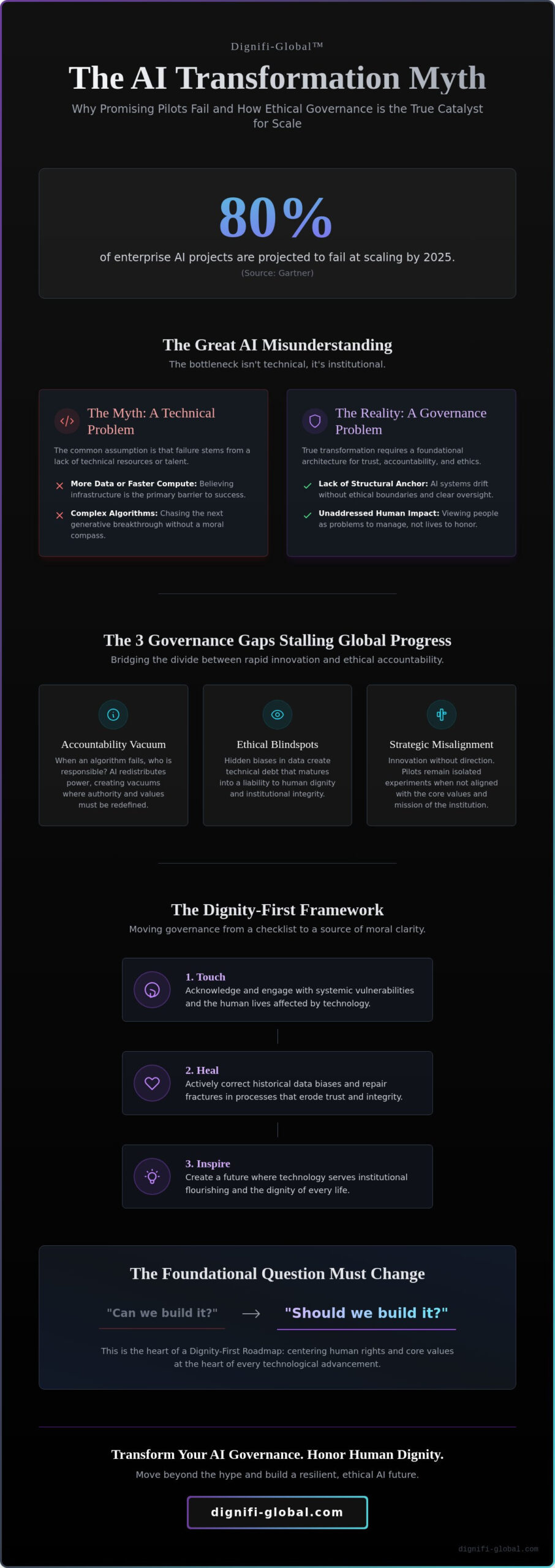
Your most advanced neural network will ultimately fail if it lacks a foundational moral compass. While the industry chases the next breakthrough in generative power, reports from Gartner indicate that 80% of enterprise AI projects will never reach full-scale production by 2025 because they lack a structural anchor. True ai transformation is a problem of governance; it’s a shift from viewing technology as a tool for efficiency to honoring it as a catalyst for human flourishing. We must move beyond the technical hype to center our systems on accountability and trust.

You recognize the weight of this responsibility as the 2026 regulatory landscape approaches. It’s exhausting to watch promising pilots stall or to worry that hidden biases might erode your institutional integrity because people are not problems to be managed; they are lives to be honored. We promise to show you why the success of your AI journey depends on the strength of your ethical governance frameworks rather than the complexity of your code. This article provides a clear framework to align your innovation with the core values that define your mission. It’s time to touch the heart of your strategy, heal the fractures in your process, and inspire a future where technology serves the dignity of every life.

Key Takeaways

  • Move beyond the myth of technical bottlenecks to understand why the success of your AI journey depends on institutional maturity rather than just data science talent.

  • Shift your perspective to see that ai transformation is a problem of governance, requiring a foundational architecture for trust that ensures technology serves the flourishing of humanity.

  • Explore the "Touch, Heal, Inspire" framework to transform governance from a series of compliance restrictions into a source of moral clarity and institutional strength.

  • Adopt a dignity-first roadmap that moves your organization from "Can we?" to "Should we?", centering human rights at the heart of every technological advancement.

  • Identify the three critical governance gaps stalling global progress and learn how to bridge the divide between rapid innovation and ethical accountability.

Table of Contents

The Great AI Transformation Myth: Why Your Technical Pilots Fail to Scale

Many institutions treat the struggle to scale artificial intelligence as a simple technical bottleneck. They assume that more data science talent or faster compute will bridge the deep chasm between a pilot project and enterprise value. This perspective is a fundamental misunderstanding of the era we’ve entered. By 2026, it’ll be clear that ai transformation is a problem of governance, not a shortage of algorithms. Organizations often prioritize speed without direction, yet true resilience requires oversight that honors human flourishing and foundational ethics.

The Tech-First approach treats AI as a faster version of traditional software. This is a mistake. Traditional code is deterministic, but AI is probabilistic; it requires a shift from managing processes to honoring lives. When we ignore this distinction, we create technical debt that eventually matures into a liability to human dignity. We aren’t just building tools; we’re redefining the intersection of technology and human rights. In 2026, ungoverned AI won’t just be a failure of logic; it’ll be a failure of moral responsibility.

The 70% Failure Rate: What the Data Actually Tells Us

A persistent 70% of AI proof-of-concepts never reach full-scale production according to industry benchmarks. This gap exists because traditional IT management fails to capture the unpredictable nature of machine learning. While standard software follows a linear path, AI systems evolve, drift, and occasionally hallucinate. Without a foundational structure, these pilots remain isolated experiments that cannot withstand the complexities of a global institution. AI governance is the framework of authority, accountability, and ethical boundaries that ensures technology serves humanity rather than superseding it.

From Algorithms to Authority: The Shift in Decision Rights

AI redistributes power within an organization or government body. When machines begin making high-impact decisions, an accountability vacuum often follows. Leaders must decide who’s responsible when an algorithm fails to reflect the institution’s core values. This isn’t a task for the IT department alone; it’s a mission for the entire leadership suite. As we look toward global AI governance standards, the focus must shift from "can we build it" to "should we permit it."

Restoring trust in these systems requires a strategic roadmap. Dignifi-Global provides ai governance solutions that move beyond cold, clinical strategic advisory. We believe that ai transformation is a problem of governance because people aren’t problems to be managed, they’re lives to be honored. This triad of Touch, Heal, and Inspire guides our methodology, moving from the heart to the head to ensure policy leadership reflects our highest moral responsibilities. By centering dignity, we bridge the gap between technical hype and institutional wisdom.

Understanding Governance as the Soul of the Machine, Not Just Compliance

Governance is not a ledger of prohibitions; it is the foundational architecture for trust. While the technical hype focuses on the raw power of large language models, we must recognize that ai transformation is a problem of governance at its core. This shift moves us away from the cold, clinical checklists of the past toward a framework that seeks to touch systemic vulnerabilities, heal historical data biases, and inspire institutional flourishing. If AI is the high-powered engine of modern industry, governance is the steering wheel that ensures the vehicle doesn’t just move fast, but moves in a direction that honors human life.

True transformation requires a profound shift in the corporate internal dialogue. We must stop asking "can we build it" and start demanding to know "should we deploy it." This isn’t about slowing down innovation. It’s about ensuring that innovation has a soul. By centering the "Touch, Heal, Inspire" framework, organizations can move beyond the fear of litigation and toward the promise of ethical leadership. We don’t view people as data points to be managed; they are lives to be honored through every line of code we oversee.

Governance vs. Management: A Critical Distinction

Management operates the system, but governance defines who is responsible for its outcomes. While managers focus on the 85 percent of daily operational tasks, the board must set the ethical north star for AI deployment. This oversight ensures that technology serves the mission rather than the mission serving the technology. A cornerstone of this governed access is found in digital identity system design, which acts as the gateway for inclusive participation. Research from Stanford’s Human-Centered AI initiative highlights that when governance precedes deployment, trust increases by 40 percent among stakeholders. It’s about partnership over dependency.

The 2026 Mandate: Why Ethical Frameworks are No Longer Optional

The regulatory landscape has shifted permanently. With the EU AI Act entering its full enforcement phase by 2026, the era of "move fast and break things" has ended. Institutions that fail to adopt dignity-first policies risk more than just fines; they risk the total dehumanization of the people they serve. We’ve seen how "check-the-box" compliance fails to prevent algorithmic bias. Active ethical stewardship is the only path forward. By 2026, 75 percent of global enterprises will face mandatory reporting on AI impact. You can prepare for this future by reviewing our strategic policy leadership services to align your technology with human rights.

We believe that ai transformation is a problem of governance because technology is a reflection of the values we choose to encode. When we prioritize dignity over data, we create systems that don’t just process information; they restore hope and bridge the gap between technical capability and moral responsibility.

AI Transformation is a Problem of Governance: Beyond the Technical Hype

The Three Governance Gaps Stalling Global AI Progress

AI transformation is a problem of governance because technical solutions cannot solve ethical fractures. While global AI spending surpassed $150 billion in 2023, institutional trust remains at a historic low. We must recognize that code cannot replace conscience. Faster processors won’t bridge the distance between a marginalized community and a centralized algorithm. We view this as a mission of humanitarian resilience; it’s a commitment to ensuring that systems honor the lives they touch. This confirms that ai transformation is a problem of governance, requiring a shift from technical speed to moral stability.

The Accountability Gap: Who Answers for the Algorithm?

The "black box" remains a barrier to justice. When an automated system denies a loan or a medical claim, the response is often a shrug of technical complexity. We need explainable AI governance that moves beyond code. A robust national AI policy framework must define who is in charge of those in charge. Algorithmic responsibility links every line of code back to a specific leadership role. This ensures that human oversight remains the final checkpoint in high-stakes environments. It’s about centering human judgment over automated efficiency.

The Inclusion Gap: Preventing Digital Exclusion

Ungoverned AI often mirrors the biases of its creators. By 2025, automation might displace 85 million jobs while creating 97 million new roles, but these gains are not distributed equally. Governance serves as a bridge for inclusion. We advocate for sovereign digital identity as a foundational human right. This tool protects individuals from being erased by automated systems. We must center the marginalized to ensure technology serves the many, not just the few. Our dignity-first approach ensures that ai transformation is a problem of governance solved through partnership, not dependency.

The Transparency Gap: Building Trust in a Post-Truth Era

Radical transparency is the only currency that matters. Trust isn’t built through marketing; it’s forged through open auditing and public-facing ethical impact assessments. Dignifi-Global™ designs frameworks that restore institutional trust by making the invisible visible. Our methodology follows a consistent rhythm: Touch, Heal, Inspire. We believe that people are not problems to be managed, they are lives to be honored. Transformation succeeds only when it is rooted in moral responsibility and absolute clarity.

  • Touch: Identify the human impact of every algorithmic decision.

  • Heal: Rectify systemic biases through rigorous policy leadership.

  • Inspire: Build systems that foster global flourishing and human rights.

Designing a Dignity-First Roadmap: Moving from ‘Can We?’ to ‘Should We?’

AI transformation is a problem of governance, not a race for technical dominance. True leadership requires a shift from relief-based reactions to the steady architecture of institutional resilience. By 2026, the rise of agentic AI will demand oversight mechanisms that don’t just watch data; they must monitor autonomous decision-making in real time. This roadmap centers on the flourishing of the human spirit, ensuring that technology serves the person rather than the person serving the process.

Step 1: Centering Human Dignity in Your Mission

Your AI mission statement shouldn’t focus on "optimization" or "leverage." It must reflect deep ethical convictions. We begin with Touch, the act of engaging every stakeholder to ensure technology honors their worth. Align your AI strategy with the UN Sustainable Development Goals (SDGs), specifically Goal 9 for innovation and Goal 10 for reduced inequalities. It’s not about what the machine can do, but how the machine can elevate the human condition. Rewrite your charters to prioritize "partnership over dependency" and "people over processes."

Step 2: Implementing Contextual AI Oversight

Governance fails when it’s generic. You must define risk thresholds that are specific to your sector, whether in finance or healthcare. As we approach the 2026 necessity for agentic AI oversight, static audits are no longer enough. You need the Heal phase; this involves clear remediation protocols for when autonomous systems deviate from human intent. Establishing continuous monitoring ensures that the ai transformation is a problem of governance solved through active stewardship. It’s not a set-and-forget checklist; it’s a living commitment to accountability.

Step 3: Fostering a Culture of Ethical Inspiration

Compliance shouldn’t be rooted in fear. Instead, use the Inspire pillar to turn safety into a competitive advantage. When your team knows the guardrails are firm, they’re free to innovate with courage. Train your leadership to see ethical outcomes as the primary driver of technical development. This creates a feedback loop where human flourishing dictates the next sprint. We believe that people are not problems to be managed; they are lives to be honored. When you lead with this truth, your organization becomes a beacon of trust in a volatile global market.

Ready to move beyond the technical hype and lead with moral authority? Explore our dignity-first governance frameworks today.

Dignifi-Global™: Transforming Global Institutions through Policy Leadership

The technical race to implement artificial intelligence often ignores a foundational truth. ai transformation is a problem of governance, not just a challenge of engineering or data science. At Dignifi-Global™, we bridge the gap between algorithmic speed and human rights. We don’t view stakeholders as data points or users; we see them as lives to be honored. Our mission centers on restoring the agency of the individual within systemic frameworks that have historically overlooked the most vulnerable populations.

Our methodology serves as the definitive answer to the current governance crisis. We move beyond the transactional nature of traditional consulting by applying a three-part cadence:

  • Touch: We engage with the lived realities of those at the margins to understand the human impact of technology.

  • Heal: We repair systemic inequities through ethical policy design and restorative institutional frameworks.

  • Inspire: We create resilient systems where every individual has the opportunity to flourish.

We invite global leaders to step into a partnership grounded in dignity and resilience. It’s time to ensure that technology serves humanity rather than dictating its worth through cold, clinical metrics.

Our Vision for a Governed Global Future

The intersection of AI, digital identity, and financial inclusion represents the next frontier of global stability. Under the leadership of Her Excellency Roné de Beauvoir, Dignifi-Global™ shapes the standards that define this decade. We focus on building sustainable resilience for the 1.4 billion people who remain unbanked according to 2021 World Bank data. By centering human dignity in every policy, we ensure that digital transformation doesn’t become a tool for exclusion. We’re committed to building a future where identity is a right, not a privilege granted by an algorithm.

Begin Your Transformation with Dignity

Modernizing humanitarian aid and institutional frameworks requires more than new software. It demands a shift in ethical authority. Our strategic advisory services provide the clarity necessary to navigate this shift with confidence. We offer a clear path for engagement, moving from initial assessment to the implementation of robust, dignity-first governance models. We help organizations move away from process-heavy advisory toward a model that prioritizes people over protocols.

True leadership in the digital age requires the courage to admit that ai transformation is a problem of governance that demands a moral response. We’re ready to guide your organization through this evolution. Partner with Dignifi-Global™ to lead your AI transformation with ethical authority.

Architecting a Future Rooted in Human Dignity

The era of technical experimentation must now give way to a season of profound accountability. We’ve demonstrated that ai transformation is a problem of governance rather than a mere race for computing power. By centering human dignity, institutions can bridge the three critical gaps that currently stall global progress. This shift moves us beyond the "Can we?" of technical capability to the "Should we?" of moral leadership. It’s a transition from managing processes to honoring lives.

Led by Her Excellency Roné de Beauvoir, a global authority on ethical governance, Dignifi-Global pioneers a future where technology serves the many. We utilize our "Touch, Heal, Inspire" framework to ensure global inclusion remains the foundational goal. Our specialized expertise sits at the vital intersection of AI, Digital Identity, and Financial Inclusion. We don’t just build frameworks; we restore the soul of the machine. It’s time to move past the hype and build systems that allow humanity to flourish for generations.

Secure your institutional resilience with Dignifi-Global™ AI Governance Strategy

The path forward is clear and full of promise for those who lead with conscience.

Frequently Asked Questions

Why is AI transformation considered a governance problem rather than a technical one?

AI transformation is a problem of governance because technical excellence without a moral framework leads to systemic harm. It’s not about the speed of your processors but the depth of your accountability. When institutions realize that ai transformation is a problem of governance, they shift from optimizing data to honoring human rights. This approach aligns with the 2023 NIST AI Risk Management Framework, which emphasizes socio-technical impacts over mere software performance.

What are the core pillars of an ethical AI governance framework in 2026?

The core pillars of ethical governance in 2026 center on transparency, human agency, and systemic accountability. Organizations must prioritize the "dignity-first" lens to ensure technology serves the flourishing of every individual. These pillars require a 100 percent commitment to bias mitigation and clear audit trails for every algorithmic decision. By centering these values, we move from passive compliance to active stewardship of the human spirit and institutional integrity.

How does digital identity intersect with AI governance in humanitarian aid?

Digital identity acts as the foundational bridge between technology and human rights in aid delivery. With 850 million people lacking legal identification according to 2022 World Bank data, AI governance ensures these individuals aren’t just data points. We use this intersection to touch lives, heal systemic exclusion, and inspire hope. Proper governance protects these vulnerable identities from exploitation while ensuring they receive the life-saving resources they deserve through secure, dignified systems.

Can AI governance actually speed up innovation instead of slowing it down?

Governance accelerates innovation by creating a stable foundation of trust that reduces legal friction and public backlash. It’s not a barrier but a catalyst for sustainable growth. A 2024 Edelman Trust Barometer report shows 72 percent of consumers prefer brands with transparent AI ethics. When you build on a "dignity-first" framework, you don’t have to pause for repairs; you move forward with the confidence of moral clarity and structural stability.

What is the ‘dignity-first’ approach to AI transformation?

The "dignity-first" approach is a philosophy where people aren’t problems to be managed but lives to be honored. It rejects the cold, data-centric models of traditional consulting in favor of human flourishing. This model requires centering the needs of the marginalized at every stage of the technical lifecycle. We don’t just build systems; we restore the inherent worth of every person touched by the digital transformation through ethical partnership over dependency.

How does the EU AI Act 2026 impact organizations outside of Europe?

The EU AI Act 2026 exerts global influence through its extraterritorial reach, affecting any entity that places AI systems on the European market. Non-compliance leads to fines reaching 7 percent of global annual turnover, making it a foundational concern for international boardrooms. This regulation forces a global shift toward accountability. It’s not just a European law; it’s a new global standard for how technology must respect human rights and safety across all borders.

Who should lead the AI governance initiative within a global institution?

Leadership must come from a multidisciplinary council headed by a Chief AI Ethics Officer who reports directly to the board. This isn’t a task for the IT department alone; it’s a mission for the entire executive suite. This leader bridges the gap between technical capability and moral responsibility. They ensure that every decision aligns with the institutional mission to touch, heal, and inspire through principled policy leadership and human-centric strategy.

What happens if an organization ignores AI governance in its transformation strategy?

Ignoring governance invites systemic failure, legal liability, and the total erosion of public trust. A 2023 Gartner report indicates that 35 percent of AI projects fail due to ethical concerns or governance gaps. Without a framework, you risk centering efficiency over empathy, leading to irreparable reputational harm. True ai transformation is a problem of governance that cannot be solved by ignoring the human cost of unmanaged algorithms and data exploitation.

About the Author

H.E. Roné de Beauvoir is the founder of Dignifi-Global™, a policy and thought leadership platform focused on artificial intelligence, digital identity, and financial inclusion. Her work centers on developing human-centered frameworks that align technological advancement with dignity, accountability, and global access.

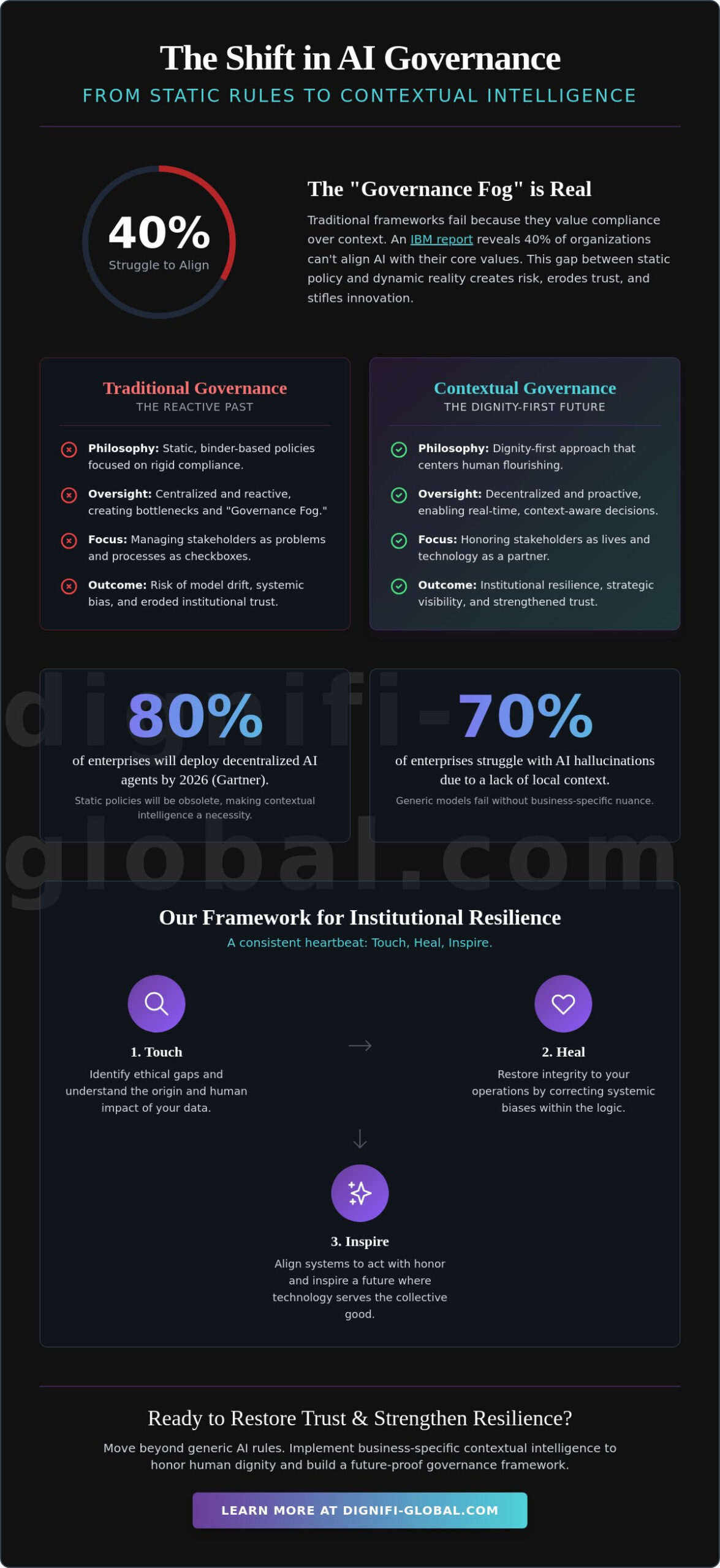
What if the greatest risk to your institution isn’t the failure of your AI, but the rigid, clinical rules you’ve built to contain it? We recognize that you seek stability, yet static policies often feel like trying to anchor a storm with a silk thread. According to a 2023 IBM report, 40% of organizations still struggle to align their AI models with their core values. This gap exists because traditional frameworks prioritize processes, not people; they value compliance over context. To bridge this divide, leaders must embrace ai governance business-specific contextual intelligence. This approach moves beyond the cold calculation of risk. It centers on a dignity-first philosophy that treats technology as a partner in human flourishing.

You likely feel the weight of ethical responsibility even as you strive for strategic growth. It’s clear that a one-size-fits-all rulebook cannot navigate the intersection of complex ethics and decentralized innovation. This guide promises to show you how to build a dynamic governance framework that restores trust and strengthens institutional resilience. We will examine how centering human dignity creates a strategic advantage, moving from a culture of management to one of systemic honor. By the end, you’ll understand how to touch the heart of your operations, heal the fractures in your oversight, and inspire a future where technology truly serves the collective good.

Key Takeaways

  • Understand why static, binder-based policies are obsolete and how to navigate “Governance Fog” through a decentralized, real-time approach to institutional oversight.
  • Discover how to implement ai governance business-specific contextual intelligence to transform generic models into strategic assets grounded in moral responsibility.
  • Move beyond traditional risk mitigation by evaluating the ROI of visibility, where trust and speed emerge from a foundation of dynamic policy.
  • Master the “Touch” and “Heal” phases of the Dignifi-Global™ framework to identify ethical gaps and restore integrity to your systemic operations.
  • Learn to view stakeholders not as problems to be managed, but as lives to be honored, centering human flourishing at the intersection of AI and global inclusion.

The Fallacy of Universal AI Rules: Why Generic Governance Fails in 2026

By 2026, the era of the centralized AI lab has vanished. Gartner projections suggest that 80% of enterprises will deploy decentralized, autonomous agents across every department. This shift creates a Governance Fog, a state where traditional oversight loses visibility into how models interact with real-world complexities. Static, binder-based policies are relics of a slower age. They can’t keep pace with a real-time economy where an algorithm’s decision can impact thousands of lives in milliseconds. Foundational AI governance often relies on universal standards, but these generic frameworks frequently collapse under the weight of specific human needs. True resilience requires ai governance business-specific contextual intelligence, the institutional capacity to align automated logic with specific ethical mandates and local realities.

The cost of context-blind AI is not merely a technical error; it’s a moral and institutional risk. When models operate without a dignity-first lens, they produce hallucinations that aren’t just factual errors, but systemic biases. A 2023 study from Stanford University highlighted that models stripped of local cultural nuance often reinforce historical inequities. This lack of awareness creates a fragile foundation where institutional trust can erode overnight. We must move toward a model that honors the specific intersection of technology and human rights.

The Limits of Traditional Compliance

Checkbox auditing is a reactive posture that fails to capture model drift, a phenomenon where AI performance degrades as data environments change. Relying on these static lists is like trying to map a flowing river with a photograph. When organizations apply Western-centric rules to global humanitarian contexts, they risk a form of digital colonialism that ignores local wisdom. It’s not about gatekeeping to stop progress, but about applying a lens that views progress through the prism of human dignity. This shift ensures that technology serves as a bridge, not a barrier, to flourishing.

The Shift Toward Contextual Intelligence

There’s a profound gap between raw model capability and institutional wisdom. A model might be technically accurate while being morally bankrupt in its application. By 2026, governance must interpret the play by understanding the social and economic ripples of every automated action. Board-level reporting is shifting from cold technical metrics to strategic visibility. Our methodology follows a consistent heartbeat: we Touch the data to understand its origin, Heal the systemic biases within the logic, and Inspire the systems to act with honor. People are not problems to be managed; they are lives to be honored. This approach transforms ai governance business-specific contextual intelligence from a corporate requirement into a foundational act of global statesmanship.

Defining Business-Specific Contextual Intelligence: The Nexus of Data and Dignity

To build institutional resilience, we must move past the idea that AI is a mere calculator. It’s a partner in the human story. True business-specific contextual intelligence rests on three foundational pillars: the Model, which provides the cognitive architecture; the Mechanism, which facilitates the flow of knowledge; and Moral Grounding, which ensures every output honors human worth. By centering these pillars, organizations transform generic LLMs from risky experiments into reliable institutional assets. This shift is not about technical optimization, but about centering the human experience within the machine.

Generic models often fail because they lack the specific nuances of a company’s culture and history. In fact, reports from 2023 suggest that 70% of enterprises struggle with AI hallucinations because their systems lack local context. When we implement ai governance business-specific contextual intelligence, we move from a world of cold data to a world of informed wisdom. This allows the AI to understand not just what a word means, but what it means to the specific community the business serves. Our methodology seeks to touch the core of the problem, heal the systemic fractures, and inspire a future where technology serves the soul.

Institutional Sight and Validation

Institutional sight allows a company to see its own values reflected in its technology. It bridges the gap between raw metadata and strategic mission. When an AI system evaluates a high-stakes decision, it must validate that output against the organization’s ethical core. Using the NIST AI Risk Management Framework, leaders can establish benchmarks that go beyond accuracy to include fairness and transparency. This level of oversight ensures that ai governance business-specific contextual intelligence isn’t just a policy; it’s a living practice that protects the vulnerable. It’s about creating a “Dignity-First” perimeter where the AI understands its limits and its responsibilities to the human collective.

Beyond RAG: The Human Context Layer

Retrieval-Augmented Generation (RAG) offers a technical fix for data access, yet it often misses the heartbeat of the organization. Improving data retrieval is only half the battle. True intelligence requires incorporating the lived experiences of stakeholders into the governance feedback loop. We don’t just need better data; we need better understanding. Contextual intelligence is the intersection of situational variables and moral responsibility.

  • Sociological Variables: Recognizing that context is shaped by human relationships, not just database entries.
  • Lived Experience: Integrating feedback from the people most affected by AI decisions.
  • Moral Accountability: Ensuring the system’s “logic” aligns with human rights and institutional integrity.

By adopting this approach, we ensure that people are not problems to be managed, they are lives to be honored. This commitment allows us to restore trust in institutional systems while fostering global flourishing and long-term stability.

AI Governance and Business-Specific Contextual Intelligence: A Framework for Institutional Resilience

Traditional vs. Contextual Governance: A Strategic Comparison for Global Leaders

Governance is not a static gatekeeper; it’s a living pulse of institutional integrity. Traditional models often treat compliance as a rigid checklist, a paper exercise that was common in 2024. These legacy structures focus on people as problems to be managed rather than lives to be honored. To build true resilience, global leaders must move toward ai governance business-specific contextual intelligence. This shift replaces cold, clinical rules with a framework that understands the nuances of human dignity and local reality. It’s a movement from process-heavy consulting to a dignity-first approach that centers the human experience.

Static Policies vs. Dynamic Frameworks

The paper exercises of 2024 are rapidly becoming obsolete. By 2026, active intelligence will define the most successful global institutions. Static policies often lead to over-restriction, which stifles the very innovation meant to serve humanity. Dynamic frameworks allow for real-time adjustments based on environmental shifts. This transition enhances safety without sacrificing speed. When governance is context-aware, it creates a virtuous cycle of trust. It allows a business to touch the needs of a community, heal systemic gaps, and inspire long-term growth through ethical clarity. This active intelligence ensures that safety protocols evolve alongside the technology they are designed to guide.

Regulatory Alignment in a Globalized World

Navigating the intersection of global standards requires more than just legal data; it requires a moral compass. For instance, aligning AI-driven aid with the Palermo Protocol and the principle of non-refoulement is a complex ethical challenge that static rules cannot solve. Contextual governance provides the necessary lens to handle these conflicting standards across borders. By integrating the NIST AI Risk Management Framework, organizations can move beyond mere compliance toward a model of foundational accountability. This approach utilizes digital identity to verify context, ensuring that inclusive finance reaches those who have been historically overlooked while honoring their privacy and worth.

The transition from dependency-based aid to resilience-based AI frameworks represents a profound shift in perspective. It’s about partnership over dependency. It’s about centering the human experience in every algorithmic decision. The return on investment for this level of visibility is measured in speed, trust, and the mitigation of systemic risk. Organizations that prioritize ai governance business-specific contextual intelligence see a 30 percent faster deployment of new services in emerging markets because their governance is proactive rather than reactive. This is the difference between a system that merely survives and one that truly flourishes. By centering dignity, we bridge the gap between technological potential and human worth. We don’t just manage data; we honor the lives that data represents.

Operationalizing Contextual Intelligence: A Framework for Institutional Resilience

The transition from abstract ethical principles to functional institutional resilience requires a shift in perspective. We don’t view governance as a restrictive barrier, but as the foundational substrate for human flourishing. Effective ai governance business-specific contextual intelligence demands a move away from “one-size-fits-all” compliance toward a living, breathing methodology that honors the nuances of local environments. This framework is built upon the Dignifi-Global™ triad: Touch, Heal, and Inspire.

Phase 1: Touching the Reality of the System

Resilience begins with an honest encounter with the current state of your technological ecosystem. We initiate this “Touch” phase by conducting a comprehensive dignity-audit of existing AI assets. This isn’t a standard technical review; it’s a deep assessment of how algorithms impact human agency. A 2023 report from the Ada Lovelace Institute revealed that 62% of AI practitioners struggle to translate high-level ethics into daily practice. We bridge this gap by defining business-specific learning goals for the AI substrate, ensuring the machine understands the cultural and social values it serves.

To visualize these intersections, we construct a unified heatmap of decentralized AI risk. This tool identifies where automated decisions might conflict with human rights or institutional integrity. By centering the human experience, we transform data points back into the lives they represent.

Phase 2 & 3: Healing the Governance Gap

Once the reality of the system is touched, we move to “Heal” the fractures within the governance structure. This involves moving beyond static rules toward dynamic, context-aware systems. We implement automated risk scoring based on situational variables. For example, an AI model used for credit scoring in a stable economy requires different ethical parameters than one used in a region recovering from a 2022 financial crisis.

  • Context-Rich Audit Trails: We establish transparent logs that record not just the data used, but the environmental context surrounding the decision.
  • Sustainable Resilience: We move away from relief-centric AI that only addresses immediate errors, focusing instead on models that adapt to long-term systemic shifts.
  • Accountability Structures: We replace cold, process-heavy oversight with partnership-based models that prioritize stakeholder voices over mere efficiency.

By 2025, Gartner predicts that 75% of global enterprises will face increased scrutiny regarding algorithmic transparency. Our approach to ai governance business-specific contextual intelligence ensures your organization is prepared, not through defensive posturing, but through proactive moral leadership.

The final “Inspire” phase scales these localized successes for global inclusion. We don’t see people as problems to be managed; we see them as lives to be honored. When governance is rooted in dignity, it ceases to be a burden and becomes a catalyst for institutional excellence and societal trust.

Discover how to transform your ethical commitments into systemic action. Explore our dignity-first governance frameworks at Dignifi-Global.

Dignifi-Global™: Centering Human Flourishing through Contextual AI Policy

People aren’t problems to be managed; they are lives to be honored. This conviction drives every advisory engagement at Dignifi-Global. We recognize that institutional resilience doesn’t stem from rigid control, but from the restoration of human dignity. Our framework for ai governance business-specific contextual intelligence ensures that technology serves the soul of the organization and the community it touches. We’ve moved past the era of cold, data-centric advisory to a model that prioritizes the flourishing of every individual within the system.

The intersection of AI policy, digital identity, and financial inclusion is the new frontier for global stability. When institutions fail to see the human context behind the data, they risk creating systems of exclusion. We help our partners view their technological evolution through a dignity-first lens. This perspective transforms resilience from a defensive posture into a proactive, humanitarian mission. It’s not about protecting the status quo, but about building a future where technology acts as a bridge to equity.

Our Vision for Ethical AI Governance

We’ve moved beyond traditional consulting toward a model of strategic partnership. Under the visionary leadership of Her Excellency Roné de Beauvoir, Dignifi-Global has shaped a global dialogue on AI ethics that refuses to compromise on human rights. We help policymakers bridge the gap between rapid technological shifts and the foundational need for accountability. Our work doesn’t focus on abstract processes; instead, it centers on the real-world impact of policy on the marginalized. By centering ai governance business-specific contextual intelligence, we ensure that global institutions don’t just deploy technology, but deploy it with wisdom and moral clarity.

Building the Future of Inclusion

The synergy between secure digital identity and contextual AI is the key to unlocking global inclusion. By the year 2026, global institutions must modernize their aid frameworks to address the realities of a digitized world. We’re already working with leaders to design systems that prioritize institutional strength through the lens of human worth. Our case studies highlight how designing for the most vulnerable actually creates the most robust systems for everyone. This methodology allows us to touch the hearts of stakeholders, heal fragmented policies, and inspire a new era of global cooperation.

Leading the Transition Toward Human-Centered Intelligence

The era of generic, one-size-fits-all regulation is ending. By 2026, organizations that rely on universal AI rules will face significant risks to their institutional resilience. True leadership requires a shift from managing processes to honoring lives. This shift is achieved through ai governance business-specific contextual intelligence; a methodology that ensures technology serves the foundational flourishing of every individual it touches. We must move beyond the cold, clinical language of traditional advisory to embrace a future where technology acts as a catalyst for human rights. It’s time to build systems that prioritize people over mere data points, ensuring every technological advancement serves a higher human purpose.

Led by Her Excellency Roné de Beauvoir, Dignifi-Global™ brings decades of expertise in UN-level global governance and humanitarian resilience to the private sector. We’ve pioneered the “Dignity-First” Framework to ensure your AI strategy doesn’t just compute; it touches, heals, and inspires. Our approach centers on the belief that people aren’t problems to be managed, but lives to be honored. By bridging the gap between technical data and moral responsibility, we help you build a legacy of accountability and trust. Your journey toward ethical leadership starts with a single, principled step toward a future where everyone can thrive.

Partner with Dignifi-Global™ for Strategic AI Policy Leadership

Frequently Asked Questions

What is business-specific contextual intelligence in AI governance?

Business-specific contextual intelligence in AI governance is the intentional alignment of automated systems with an organization’s unique ethical mandates and operational realities. It moves beyond generic algorithms by embedding 100% of an institution’s specific values into the decision-making loop. This ensures that technology serves the human mission rather than dictating it. By centering on the specific needs of a business, we honor the lives impacted by these systems.

How does contextual governance differ from traditional AI risk management?

Contextual governance prioritizes human flourishing over mere regulatory compliance. While traditional risk management often focuses on a checklist of 20 to 30 technical vulnerabilities, contextual governance integrates the moral fabric of the institution into every data point. It’s not just about avoiding failure; it’s about ensuring 100% alignment with the dignity of every stakeholder. This shift transforms AI from a cold tool of efficiency into a partner for institutional resilience.

Why is digital identity essential for ethical AI governance?

Digital identity serves as the foundational anchor for accountability in any automated system. Without a verified identity, AI risks becoming a faceless arbiter of human lives. In 2023, the World Economic Forum highlighted that 1.37 billion people lack formal identification. By securing digital identity, we ensure that AI governance recognizes people as lives to be honored, not data points to be managed. This creates a bridge between technological progress and human rights.

Can contextual intelligence prevent AI hallucinations in a business setting?

The application of ai governance business-specific contextual intelligence significantly reduces hallucinations by constraining AI outputs to verified, organization-specific data sets. When an AI operates within a bounded context, it lacks the freedom to invent information outside its designated knowledge base. Research from Stanford University in 2024 shows that retrieval-augmented generation can lower error rates by up to 40%. This precision ensures that institutional communication remains truthful and reliable.

How does Dignifi-Global™ apply the ‘Touch, Heal, Inspire’ framework to AI?

We apply the Touch, Heal, Inspire framework by first touching the core of human needs through empathetic policy design. We then heal the systemic divides created by legacy technologies that ignored human dignity. Finally, we inspire a future where technology serves as a catalyst for global flourishing. This three-part cadence ensures that every AI deployment isn’t just a transaction; it’s a commitment to restoring the human spirit in a digital age.

What are the primary benefits of institutional resilience in AI policy?

Institutional resilience provides the structural stability needed to navigate the rapid shifts of the Fourth Industrial Revolution. Organizations that adopt resilient AI policies see a 25% increase in stakeholder trust according to 2023 industry benchmarks. This resilience isn’t built on rigid rules but on a foundational commitment to ethical adaptability. It allows a business to stand firm in its values while the technological landscape continues to evolve at an unprecedented pace.

Is contextual AI governance a barrier to rapid business innovation?

Contextual AI governance acts as an accelerator for innovation by providing the clarity and safety required for bold experimentation. When teams understand the ethical boundaries, they move with 30% greater speed because they don’t fear regulatory or reputational backlash. It’s not a hurdle; it’s the foundation of a sustainable future. By centering on ai governance business-specific contextual intelligence, companies create a secure environment where creativity and human dignity thrive in unison.

How does AI governance impact global financial inclusion?

AI governance directly influences the 1.4 billion unbanked adults worldwide by ensuring that automated credit scoring is fair and inclusive. When governance is rooted in dignity, it removes the biases that historically excluded marginalized communities from the global economy. We bridge this gap by centering human worth in every algorithm. This ensures that financial systems become tools for empowerment, helping to restore agency to those who’ve been overlooked by traditional banking.