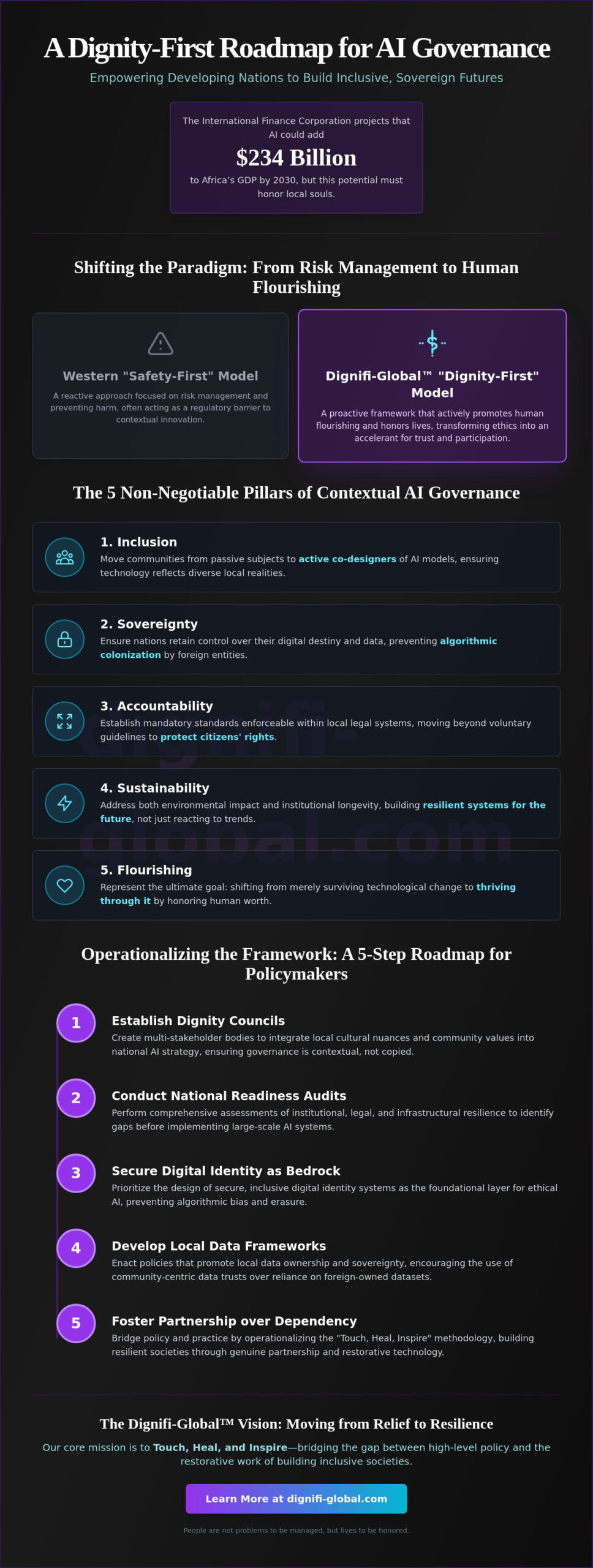
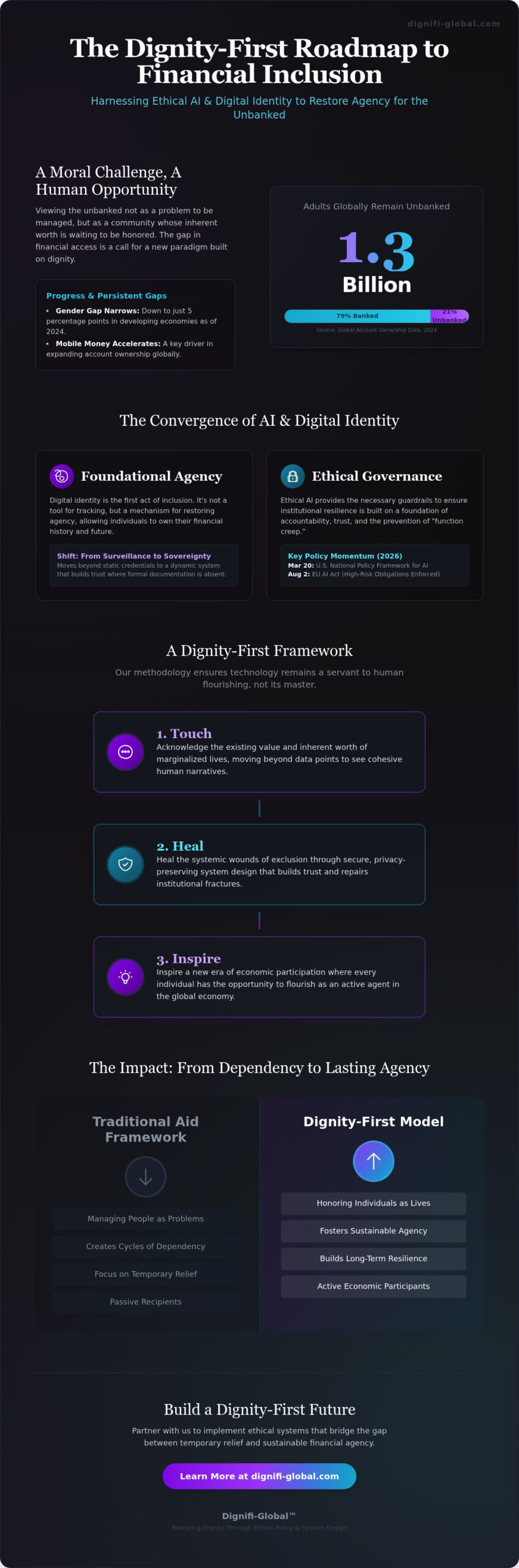
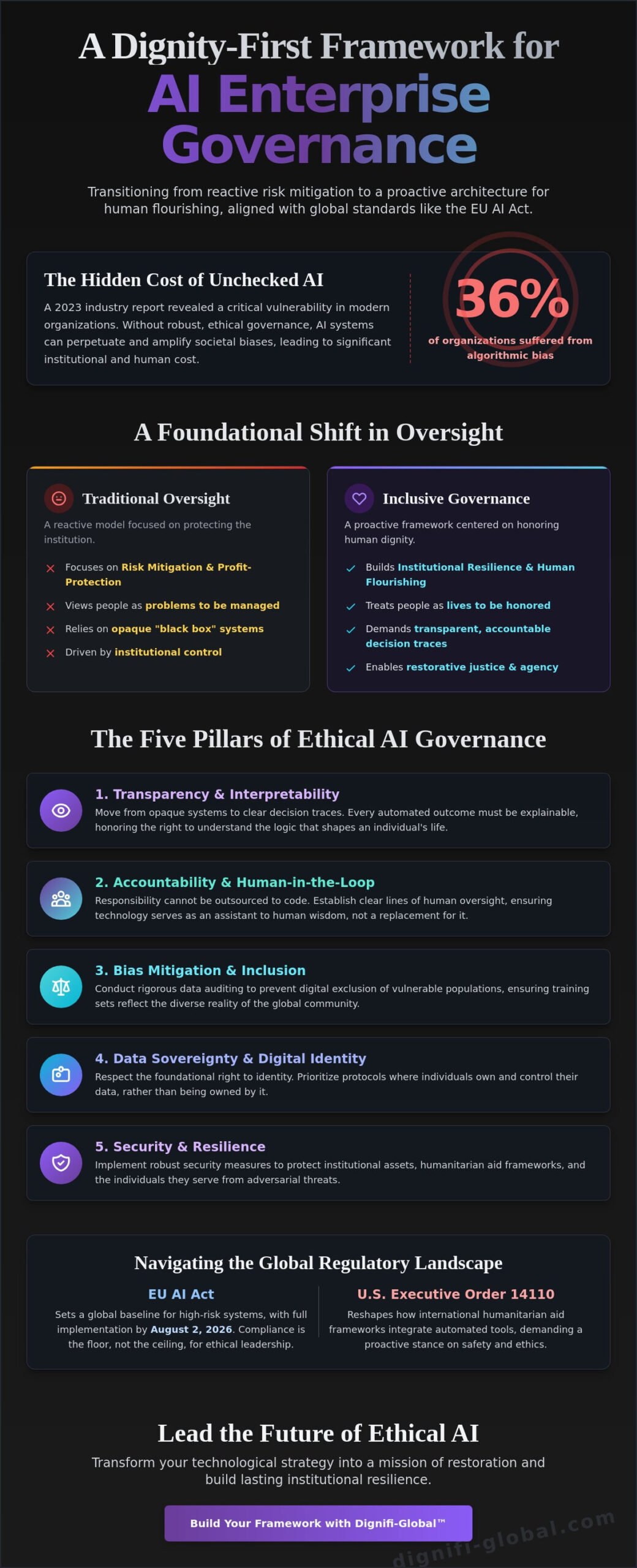
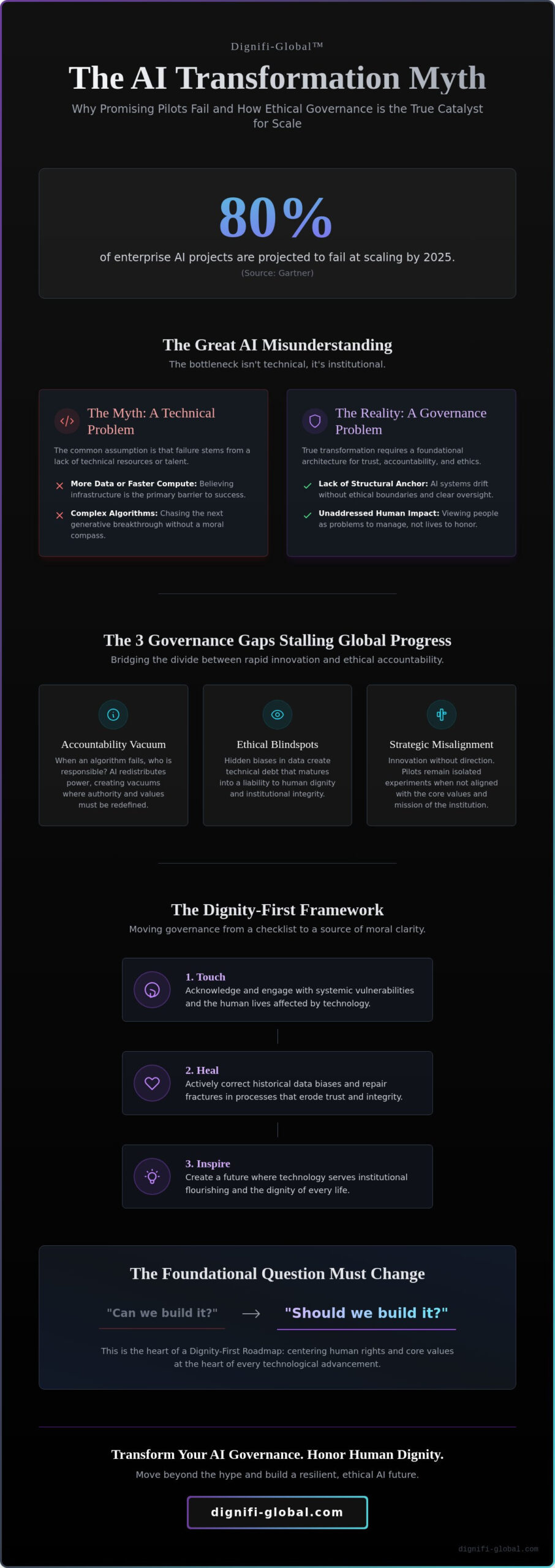
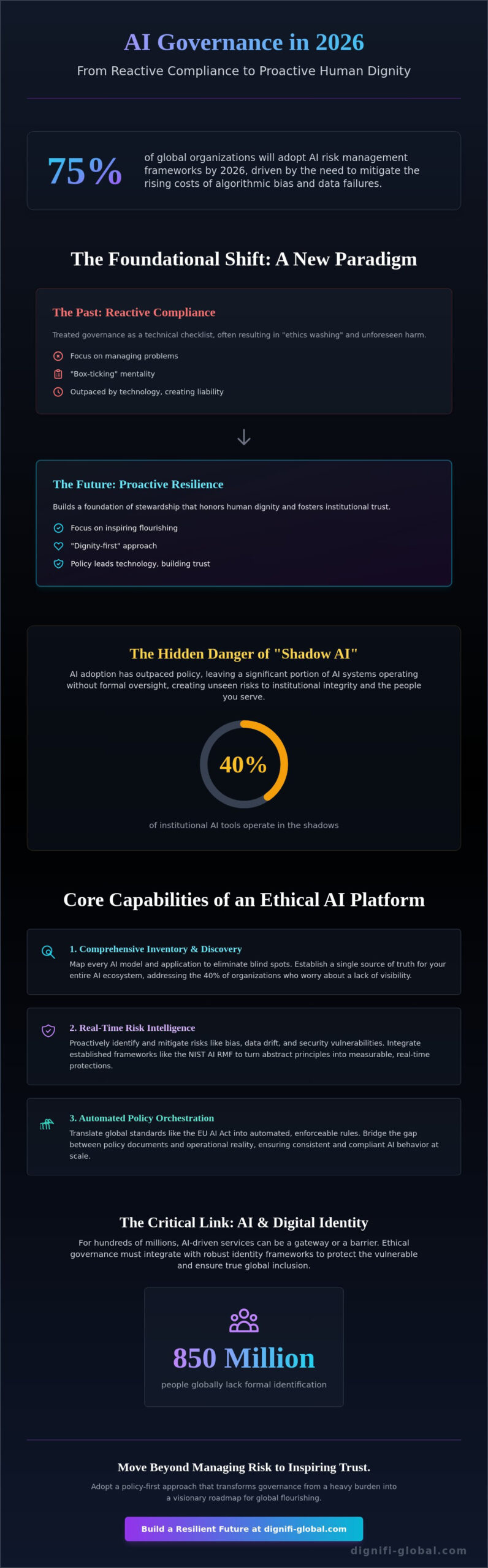
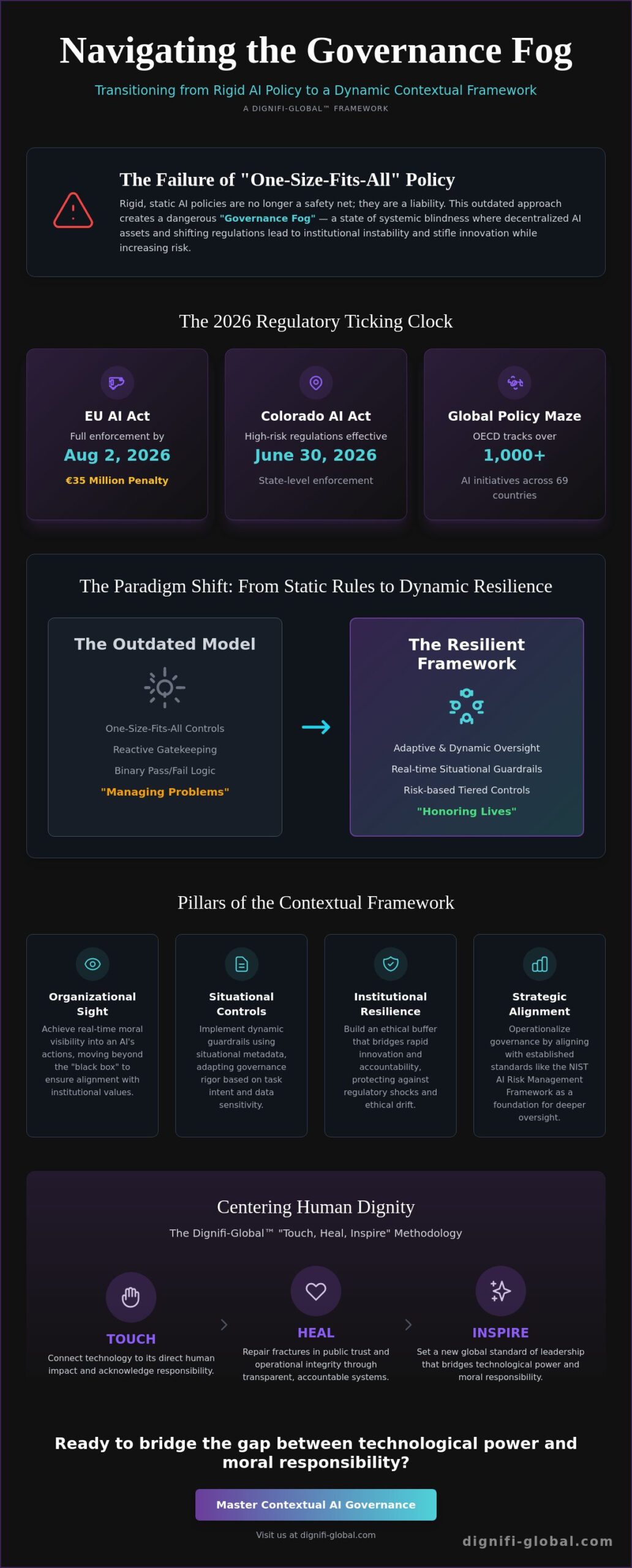
The rigid, one-size-fits-all AI policy your organization adopted last year isn’t a safety net; it’s a liability. As the EU AI Act reaches full enforcement on August 2, 2026, and California’s frontier model transparency requirements take hold, the era of static compliance has ended. You likely feel the weight of this “governance fog,” where decentralized AI assets and shifting jurisdictional rules create a sense of systemic instability. We understand that your mission isn’t just to avoid a €35 million penalty, but to ensure your technology serves the flourishing of the human spirit.

By mastering the ai contextual governance framework, you’ll learn to transition from reactive gatekeeping to a dynamic model that centers human dignity at every intersection of data and decision. We’ll show you how to move from “managing problems” to “honoring lives” through scalable, situational controls that align with the NIST AI Risk Management Framework. This journey will touch the core of your operational intent, heal the fractures in public trust, and inspire a new standard of global leadership that bridges the gap between technological power and moral responsibility.

Key Takeaways

  • Discover how to transition from rigid, one-size-fits-all policies to a dynamic ai contextual governance framework that adapts based on task intent and data sensitivity.
  • Develop “Organizational Sight” by utilizing situational metadata to implement real-time guardrails that protect both institutional integrity and individual rights.
  • Strengthen your organization’s resilience against shifting global regulations by building an ethical buffer that bridges the gap between rapid innovation and accountability.
  • Follow a strategic roadmap to inventory your AI assets and establish situation-specific risk thresholds that align technological behavior with organizational intent.
  • Learn to apply the Dignifi-Global™ “Touch, Heal, Inspire” methodology to your AI strategy, ensuring technology honors lives rather than simply managing problems.

Beyond Static Rules: Defining the AI Contextual Governance Framework

Governance is not a static gate to be guarded; it is a living lens through which we view our moral and operational responsibilities. For too long, institutions have relied on “static governance,” a model that applies the same rigid, binary controls to every system regardless of its impact. This outdated approach treats a retail pricing algorithm with the same gravity as a model distributing life-saving humanitarian aid. Such a lack of distinction is not safety, it is a failure of vision. The ai contextual governance framework emerges as a necessary evolution, operating as a dynamic oversight model that adapts its rigor based on task intent and data sensitivity.

By centering context, we move away from the cold, clinical application of rules and toward a system that honors human nuance. This framework recognizes that the risk profile of an AI agent depends entirely on its environment. We are currently witnessing the rise of a “Governance Fog,” a state of systemic blindness where leaders lack unified visibility into decentralized AI assets. In this fog, traditional binders of policy fail because they cannot account for the 1,000 plus AI policy initiatives currently tracked by the OECD across 69 countries. We must bridge the gap between technical oversight and algorithmic governance to ensure that our tools reflect our deepest values.

The Failure of One-Size-Fits-All AI Policy

Generic rules create a dangerous paradox: they stifle innovation through over-regulation while simultaneously increasing risk through under-regulation. When policies are too broad, they fail to catch the specific ethical failures that occur at the intersection of technology and human rights. Static policy creates institutional vulnerability in global aid environments by ignoring the shifting realities of human need in favor of fixed, technical parameters. This disconnect exists because technical model validation rarely accounts for the actual business-specific contextual intelligence required for responsible deployment. We don’t need more processes; we need more partnership between our ethical mandates and our digital execution.

Why 2026 Demands Contextual Intelligence

As of May 2026, the transition from experimental AI to integrated institutional AI is complete. With the EU AI Act reaching full enforcement on August 2, 2026, and Colorado’s AI Act implementing high-risk regulations on June 30, 2026, compliance is now a continuous operational function. In the landscape of financial inclusion, context determines “acceptable risk” by balancing the urgency of access with the necessity of protection. Organizations must move beyond the “problem-management” mindset and embrace a “dignity-first” perspective. To achieve this, leaders should explore the integration of AI governance business-specific contextual intelligence to ensure their systems remain resilient against regulatory shocks and ethical drift.

The Pillars of Contextual Organizational Sight Validation

Organizational Sight is the institutional capacity to perceive the ethical resonance of an AI’s actions in real-time. It is not merely a technical audit; it is a commitment to moral visibility. To achieve this, we must move beyond the opaque “black box” and toward transparent, context-aware assets. This visibility is achieved through Contextual Organizational Sight Validation, a process that ensures every automated decision aligns with the foundational values of the institution. By centering this validation, we transform AI from a cold tool of efficiency into a partner in human dignity.

The ai contextual governance framework relies on this sight to bridge the gap between abstract policy and concrete action. While voluntary standards like the NIST AI Risk Management Framework, released in January 2023, provide a structured starting point for risk assessment, true institutional resilience requires a deeper, situation-specific layer of oversight. This layer functions by integrating human-in-the-loop oversight at critical decision nodes. It ensures that machines don’t make life-altering choices without empathetic verification. We must remember that people are not problems to be managed; they are lives to be honored.

Metadata as the Foundation of Governance

The architecture of this sight rests upon situational metadata. We must capture the intent of the task, the sensitivity of the data involved, the specific environment of deployment, and the potential impact on the end-user. Automating this collection is essential. By embedding metadata triggers into the development cycle, organizations can maintain velocity without sacrificing accountability. We don’t just need data; we need the “why” behind the data to move from reactive management to proactive protection. This transition allows the institution to see not just what the AI is doing, but what it intends to achieve.

Validating Organizational Intent

Validation is the process of mapping AI outputs back to the core mission of the institution. Without this alignment, AI systems often suffer from “mission drift,” particularly in high-stakes environments like humanitarian aid distribution. Contextual sight is a fundamental prerequisite for effective ai governance solutions. It allows leaders to verify that an algorithm designed for inclusion doesn’t accidentally become an engine for exclusion. To lead with confidence, institutions must first ensure their technology honors the lives it touches. If you’re ready to move beyond process-heavy consulting, consider how a dignity-first advisory partner can help restore clarity to your digital ecosystem.
The AI Contextual Governance Framework: A Dignity-First Approach to Institutional Resilience

Institutional Resilience: Bridging AI Innovation and Ethical Accountability

Institutional resilience is the capacity to honor our ethical mandates while navigating the relentless tide of technological change. In the age of intelligence, resilience is not merely survival; it is the flourishing of our core values amidst systemic shifts. The ai contextual governance framework serves as a vital resilience buffer, shielding organizations from the regulatory shocks that define our current landscape. As the EU AI Act reaches full enforcement on August 2, 2026, the cost of non-compliance has risen to €35 million or 7% of global turnover. A contextual approach allows institutions to absorb these pressures without sacrificing their innovative spirit.

The most common objection to governance is the fear that it acts as a gate, blocking the path to progress. This is a narrow perspective that we must move beyond. Effective governance is actually a lens that brings institutional intent into focus. When you have a clear view of your risk thresholds, you can innovate with greater speed and less fear. This clarity is supported by institutional benchmarks like GAO’s AI Accountability Framework, which emphasizes that monitoring and performance are not separate from governance but are the very heart of it. By centering accountability, we restore trust in the systems that shape our future.

Traditional vs. Contextual Governance Frameworks

Traditional governance is often reactive, treating rules as static checkboxes that expire the moment a model is deployed. In contrast, the ai contextual governance framework is proactive and adaptive. It recognizes that low-risk models, such as internal document summarizers, require faster deployment pathways than high-stakes systems. This transition from being risk-averse to being risk-aware provides a superior return on investment by reducing administrative drag. A foundational element of this adaptability is digital identity system design, which allows institutions to verify the context of a user’s interaction with absolute certainty.

The Ethics of Global Inclusion

Contextual governance is the shield that protects vulnerable populations from the silent harms of algorithmic bias. By centering the human experience, we ensure that AI serves as a bridge to opportunity rather than a barrier to entry. This is particularly critical in the landscape of financial inclusion, where ethical oversight prevents automated systems from reinforcing historical cycles of poverty. We believe in partnership over dependency. Transparent governance empowers individuals to engage with technology on their own terms, restoring the dignity that data-centric models often strip away. When we align AI behavior with human worth, we don’t just manage a system; we honor a life.

A Strategic Roadmap for Operationalizing Contextual AI Governance

Governance is an active practice of institutional wisdom. It’s not a static document stored in a digital binder, but a rhythmic commitment to systemic integrity. Implementing an ai contextual governance framework requires a shift from passive compliance to active leadership. This roadmap provides the structure to bridge the gap between high-level ethical principles and the daily execution of automated intelligence. By following these steps, institutions can move from a state of reactive uncertainty to one of calm, steady confidence.

The journey toward operational resilience begins with five foundational actions. First, catalog every AI asset within the organization, ensuring no system remains hidden. Second, define risk thresholds that change based on the specific situation. Third, deploy automated monitoring to catch deviations before they become crises. Fourth, establish clear lines of human accountability, centering people over processes. Finally, commit to a cycle of continuous auditing that learns from operational reality. This is how we move beyond the cold, clinical management of data and toward the honoring of the lives that data represents.

Inventory and Contextual Classification

The first step in restoring sight to your institution is identifying “shadow AI,” those unauthorized tools and agents that emerge when formal systems are too slow. As of January 1, 2026, California’s new transparency laws mandate that developers of generative systems publish summaries of their training data. Organizations must go further, categorizing every model based on its potential impact on human flourishing and institutional risk. This classification should align with the highest global governance consulting standards. We don’t just ask what the model does; we ask whom it affects and what its intent truly is.

Implementing Automated Guardrails

Static policies fail because they cannot keep pace with the speed of algorithmic decision-making. We must implement policy-as-code to enforce contextual boundaries in real-time, creating a system that can pause or pivot when a risk threshold is breached. These guardrails feed into dashboards designed to provide “Strategic Visibility” to the Board, ensuring leaders have the clarity needed for high-level stewardship. Automation handles the repetitive oversight, yet we must always balance this with ethical human judgment in high-stakes scenarios. To begin your journey toward systemic integrity, partner with our global governance advisory team to build a framework that protects and inspires.

Centering Human Dignity: The Dignifi-Global™ Methodology

Governance is more than a set of technical protocols; it is a manifestation of our deepest ethical convictions. At Dignifi-Global™, we believe that the true measure of a system is not its efficiency, but its capacity to honor the inherent worth of every individual it touches. While traditional consulting firms view governance as a series of problems to be managed, we view it as a sacred opportunity to protect and elevate human lives. This shift in perspective is the foundation of our “Dignity-First” methodology, a lens that transforms cold data into a catalyst for global flourishing. By adopting the ai contextual governance framework, your institution moves beyond the cold, clinical application of rules and toward a model of partnership over dependency.

Our approach is built upon a rhythmic three-part cadence: Touch, Heal, Inspire. This framework allows us to modernize humanitarian aid and institutional structures by ensuring that technology serves humanity, rather than the other way around. By integrating this philosophy into your core strategy, you move beyond the “Governance Fog” and toward a future of systemic resilience and public trust. We don’t just seek to mitigate risk; we seek to restore the foundational bond between global institutions and the people they are called to serve.

Touch: Identifying the Intersection of Humanity and Technology

We begin by identifying the profound intersection where technology meets the human spirit. Our process of “Touching” involves a deep analysis of how every AI deployment affects the most marginalized members of our global community. We don’t just audit for risk; we listen for the human impact. This stage requires establishing a foundational ethical conviction at the board level, ensuring that leadership views digital identity and automated systems as tools for empowerment. When we center the marginalized, we create a more stable and inclusive foundation for all. This initial contact is the prerequisite for a truly effective ai contextual governance framework, as it defines the moral parameters of the system before the first line of code is executed.

Heal and Inspire: Restoring Trust through Governance

Healing begins when we address the institutional fractures caused by unmanaged AI risks and the erosion of public trust. We don’t merely patch holes; we heal the relationship between the institution and the people it serves by restoring accountability and transparency. This restoration then paves the way for Inspiration. We invite global leaders to see governance not as a burdensome gate, but as a visionary tool for systemic flourishing. The future of our global society depends on the “Ethical Visionary,” the leader who refuses to view individuals as data points and instead sees lives to be honored.

We invite you to lead this transition from reactive oversight to strategic flourishing. By adopting a tailored roadmap rooted in dignity, you can ensure your institution remains a beacon of trust and inclusion in a rapidly changing world. Contact our advisory team today to begin your journey toward a more humane digital future.

Restoring the Nexus of Technology and Human Worth

The shift from rigid compliance to dynamic oversight is no longer optional; it’s the foundational requirement for institutional survival in 2026. By embracing an ai contextual governance framework, you move beyond the “Governance Fog” into a state of strategic clarity where every automated decision honors human dignity. We’ve explored how situational metadata provides organizational sight and how resilience buffers against the €35 million penalties of the EU AI Act. This isn’t just about managing risk. It’s about centering the flourishing of the human spirit within our digital systems.

True leadership requires a departure from process-heavy consulting toward a partnership rooted in moral responsibility. Led by Her Excellency Roné de Beauvoir, our specialized advisory team uses a proprietary Dignity-First methodology to bridge the gap between innovation and humanitarian resilience. We invite you to Partner with Dignifi-Global™ to Modernize Your AI Governance Framework and lead the charge toward global inclusion. The future of humanity is not a problem to be solved, but a destiny to be honored. Let’s build a more humane world together.

Frequently Asked Questions

What is the primary difference between traditional AI governance and a contextual framework?

Traditional governance relies on static, binary rules that apply the same oversight to every system regardless of its purpose. In contrast, an ai contextual governance framework acts as a dynamic lens, adjusting its rigor based on the specific intent of the task and the sensitivity of the data. This shift ensures that high-stakes humanitarian models receive deeper ethical validation than low-risk internal tools, allowing for both safety and institutional speed.

How does an AI contextual governance framework improve institutional resilience?

Resilience is strengthened by creating an ethical buffer that allows organizations to absorb regulatory shocks without halting innovation. By June 30, 2026, the Colorado AI Act will require high-risk systems to meet strict standards; contextual models allow institutions to identify these risks early. This proactive approach prevents the systemic paralysis that often follows new legislation, ensuring the core mission remains stable amidst global technological shifts.

Can contextual governance be automated, or does it require constant human intervention?

Contextual governance utilizes policy-as-code to automate the enforcement of boundaries in real-time, yet it preserves human judgment for critical decision nodes. While automated guardrails handle 90% of routine monitoring, high-stakes scenarios involving human rights require empathetic verification. This hybrid model ensures that technology never operates in a moral vacuum, bridging the gap between digital efficiency and the human responsibility to honor lives.

How do we implement contextual governance in a decentralized global organization?

Implementation in decentralized organizations requires establishing “Organizational Sight” through a unified metadata layer that spans all jurisdictions. By August 2, 2025, transparency requirements for general-purpose AI models became mandatory under the EU AI Act. Global institutions must use these standards as a baseline while applying situation-specific thresholds that respect local cultural contexts. This approach replaces fragmented oversight with a cohesive, dignity-first strategy across all borders.

What role does digital identity play in validating AI context?

Digital identity serves as the foundational anchor that verifies the context of every interaction between a human and an AI system. It provides the necessary data to determine if a user’s rights are being protected or if a model is operating within its intended ethical boundaries. Without robust identity design, governance remains blind to the specific human impact, making it impossible to restore trust in automated financial or humanitarian systems.

Is an AI contextual governance framework compliant with global regulatory standards like the EU AI Act?

Yes, an ai contextual governance framework is designed to meet and exceed the risk-based requirements of the EU AI Act, which becomes fully enforceable on August 2, 2026. By categorizing AI systems based on situational risk, organizations can directly align with the Act’s prohibitions on social scoring and biometric surveillance. This methodology ensures that compliance is not a one-time check but a continuous operational function embedded in every decision.

How does Dignifi-Global™ help boards overcome Governance Fog?

Dignifi-Global™ helps boards clear the Governance Fog by providing strategic visibility that aligns AI behavior with the institution’s moral mandate. Through our “Touch, Heal, Inspire” framework, we move leadership away from process-heavy consulting toward a visionary stewardship of technology. We help boards see that people are not problems to be managed, restoring the clarity needed to lead with ethical conviction and long-term perspective.
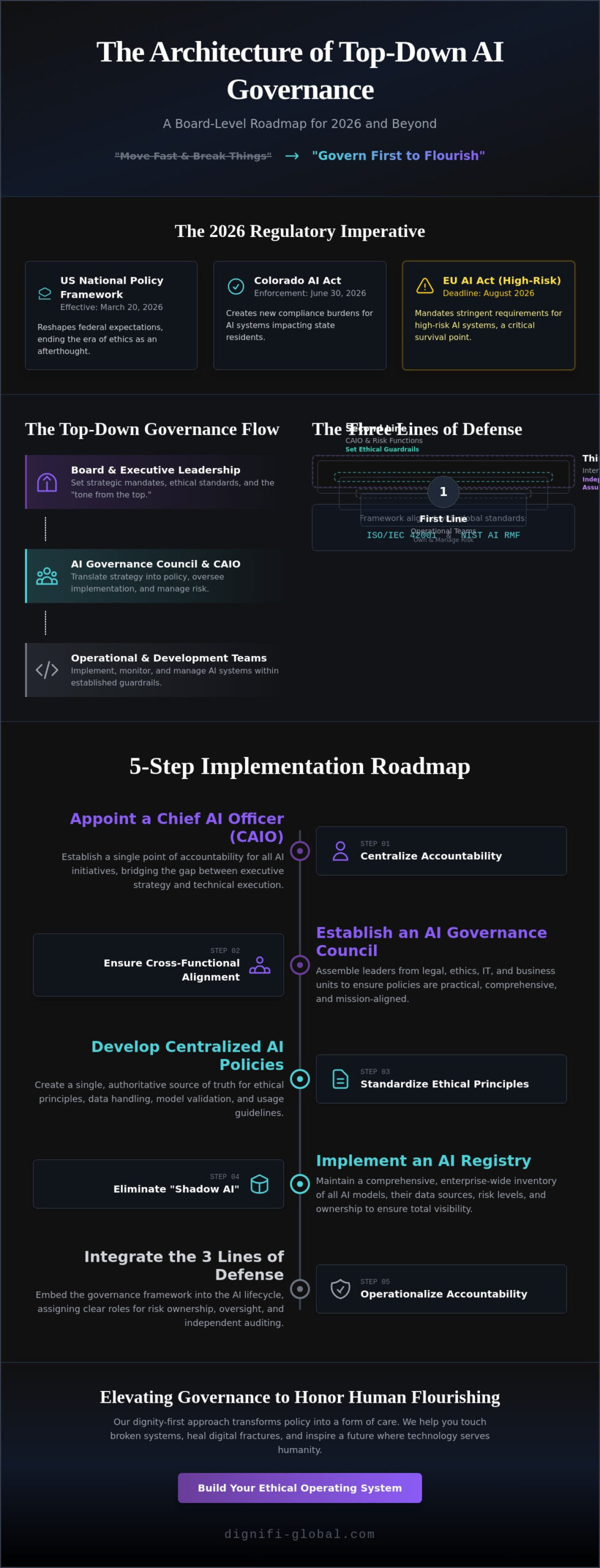
What if the greatest risk to your institution isn’t a rogue algorithm, but a board that views technology as a process to be managed rather than a life to be honored? As the United States National Policy Framework for AI released on March 20, 2026, begins to reshape federal expectations, the era of treating ethics as an afterthought has ended. You’re likely struggling to reconcile the Colorado AI Act’s June 30, 2026, implementation with the high-risk requirements of the EU AI Act arriving this August. This regulatory fragmentation creates a profound sense of urgency for leaders who refuse to let human dignity be lost in the code.

You’ll find that mastering the architecture of top-down ai governance is the only way to transform these complex burdens into an ethical operating system. This guide provides a clear roadmap for board-level oversight that moves beyond cold metrics toward a dignity-first model of systemic accountability. We’ll explore how to align your global operations with the latest 2026 standards while verifying that every deployment serves the flourishing of humanity. By the end, you’ll possess the strategic insight to touch the heart of your organization, heal fragmented processes, and inspire a future where technology honors every life it encounters.

Key Takeaways

  • Transition from a “move fast and break things” mindset to a “govern first to flourish” model that centers human dignity at every executive level.
  • Master the architecture of top-down ai governance by integrating the Three Lines of Defense into your AI lifecycle and aligning with global ISO standards.
  • Balance the strengths of centralized mandates with inclusive values to protect institutional resilience in high-stakes environments like finance and aid.
  • Execute a structured five-step roadmap to appoint a Chief AI Officer and establish a council that aligns your technology with your humanitarian mission.
  • Discover how a dignity-first approach transforms policy into a form of care, using the Touch, Heal, Inspire methodology to elevate global standards.

What is Top-Down AI Governance and Why is it Essential in 2026?

Top-down AI governance is a centralized framework where strategic mandates and ethical standards flow directly from executive leadership to the operational heart of an organization. It’s a shift in power that moves the responsibility of algorithmic oversight from the server room to the boardroom. In the current landscape of 2026, the reckless culture of “move fast and break things” has been replaced by a more sustainable commitment: “govern first to flourish.” This transition is driven by the realization that institutional resilience is built on trust; and trust is the product of visible, principled leadership.

With the high-risk system requirements of the EU AI Act set to take effect in August 2026, the necessity of top-down ai governance has become a matter of survival. Global institutions are facing a fragmented patchwork of regulations, including the Colorado AI Act that begins enforcement on June 30, 2026. Centralized authority is required to navigate these complexities, ensuring that an organization speaks with one voice across multiple jurisdictions. Without a unified mandate, institutions risk falling into a reactive posture that compromises both their values and their operational stability.

The Pillars of Institutional Authority

Establishing a “tone from the top” isn’t just a suggestion; it’s a non-negotiable strategic priority for the modern era. This structure defines clear lines of accountability that stretch from the Board of Directors to the data scientists writing the code. Centralized policy-making prevents the rise of “shadow AI,” where departments deploy unvetted tools that create fragmented risk profiles. By taking command of the technological narrative, leadership ensures that every automated system remains an extension of the institution’s mission. As we witness the rise of government by algorithm, the role of executive oversight becomes the primary defense against systemic failure.

The Dignity-First Perspective on Governance

A visionary approach to governance moves beyond the simplistic binary of “safe versus unsafe” systems. We must ask whether our technology is dignified or exploitative. This requires centering people, not processes, within the foundational architecture of the organization. Top-down mandates provide the necessary weight to protect marginalized populations, ensuring that centralized ethical standards act as a barrier against the hidden harms of algorithmic bias. By honoring the individual, we transform governance from a clinical checklist into a humanitarian mission. This methodology allows us to touch the broken systems of the past, heal the fractures in our digital society, and inspire a future where technology serves the flourishing of all humanity.

The Architecture of a Top-Down AI Governance Framework

A robust architecture for AI oversight isn’t merely a technical diagram; it’s a moral blueprint for institutional integrity. To build this structure, global organizations must integrate the Three Lines of Defense (3-LoD) model directly into their AI lifecycle management. In a top-down ai governance framework, the first line consists of operational teams who own the risk. The second line, led by the Chief AI Officer, sets the ethical guardrails. The third line provides independent audit and assurance. This hierarchy ensures that accountability isn’t a vague concept but a structural reality that protects both the institution and the individuals it serves.

Mapping these institutional policies to international standards like ISO/IEC 42001 and the NIST AI RMF provides the necessary scaffolding to meet the EU AI Act’s August 2026 deadline. A centralized AI Registry serves as the “single source of truth” for every enterprise-wide deployment. Without this centralized visibility, “shadow AI” can proliferate, creating fragmented risk profiles that no board can effectively manage. By maintaining a unified registry, executive leadership ensures that every algorithm aligns with the organization’s core mission. Research into AI governance around the world demonstrates that top-down consistency is the only way to maintain trust across diverse geographic regions.

Intersection of AI and Digital Identity

Dignity begins with the recognition of the individual. Secure digital identity system design is the bedrock of secure AI governance; it’s the bridge between a digital record and a human life. Managing sovereign identity within a centralized governance mandate allows institutions to honor privacy while ensuring accountability. This is particularly vital in humanitarian aid frameworks, where AI systems must respect the non-refoulement principle and safeguard the data of the vulnerable. If you’re seeking to bridge these complex domains, our policy leadership can help you design a system that prioritizes inclusion.

Operationalizing Ethical Use Policies

High-minded “Ethics Charters” often fail because they lack technical teeth. We must translate philosophical premises into specific, measurable technical constraints that automated compliance tools can monitor in real time. This top-down structure allows for a “liturgical” consistency in how data is handled and decisions are made. Contextual intelligence ensures that these centralized mandates remain flexible enough to adapt to local humanitarian needs while never compromising the foundational dignity of the person. By centering people rather than processes, we transform clinical oversight into a profound act of care.

Top-Down AI Governance: A Strategic How-To Guide for Global Institutions in 2026

Top-Down vs. Co-Governance: Navigating the Strategic Debate

Strategic leadership is not the accumulation of power; it’s the courageous assumption of responsibility for the lives we serve. In the current 2026 landscape, a tension has emerged between the efficiency of centralized mandates and the inclusivity of co-governance. While critics suggest that a rigid hierarchy stifles innovation, the reality of high-stakes environments like finance and humanitarian aid tells a different story. In these sectors, decentralized models often create “accountability vacuums” where no one is responsible when an algorithm fails. Effective top-down ai governance provides the structural stability needed to weather the storms of regulatory fragmentation, ensuring that ethical standards are never left to chance.

We must address the critique from institutions like the Harvard Law Review, which argues that centralized control is a poor fit for the fluid nature of AI. This perspective assumes that top-down authority is inherently non-democratic. It’s not. As explored in NYU’s framework for AI governance, a people-centered justice approach can be mandated from the executive level to ensure that democratic values are baked into the system’s DNA. The most resilient institutions are those that find a hybrid middle ground: they set centralized standards at the board level while allowing for decentralized execution within local operational teams.

When Top-Down is Non-Negotiable

In certain scenarios, a centralized mandate isn’t just a choice; it’s a requirement for survival. The EU AI Act’s August 2026 deadline for high-risk systems means the board must hold the final say on compliance and risk tolerance. When we provide global governance consulting for humanitarian agencies, we see that fragmentation is fatal. Inconsistent AI policies across different regions don’t just create legal headaches. They threaten the institutional resilience required to protect vulnerable populations during a crisis. Centralization ensures that the “dignity-first” lens is applied consistently, regardless of where the technology is deployed.

Integrating Stakeholder Feedback into the Hierarchy

Authority without empathy is merely control. To prevent the “Ethical Visionary” from becoming an isolated figurehead, leadership must build “listening loops” that inform policy without diluting accountability. Ethical Advisory Boards play a vital role here, acting as a conscience that checks executive power and ensures that the technology remains a tool for human flourishing. True authority is found at the intersection where executive mandates meet human-centric feedback, ensuring that the “tone from the top” is informed by the realities on the ground. By centering people rather than processes, we transform the governance hierarchy into a living bridge between institutional vision and human need.

How to Implement Top-Down AI Governance: A 5-Step Roadmap

Implementing a visionary framework requires more than just technical adjustments; it demands a fundamental realignment of institutional purpose. Moving from abstract ethics to concrete action is the hallmark of effective top-down ai governance. This roadmap ensures that your transition from policy to practice is both regulatory-compliant and deeply humane. By following these steps, global institutions can move beyond the “evidence-ready” requirements of the 2026 landscape to build a legacy of trust.

  • Step 1: Define the North Star. Aligning AI governance with the institutional mission ensures that technology remains a servant to human flourishing.
  • Step 2: Establish the Governance Body. Appointing a Chief AI Officer (CAIO) and a cross-functional council provides the necessary weight to executive mandates.
  • Step 3: Inventory and Risk Categorization. Mapping every AI use case against potential human impact allows for the prioritization of high-risk systems under the August 2026 EU AI Act.
  • Step 4: Deploy Operational Templates. Utilizing AI enterprise governance templates standardizes ethical guardrails across diverse departments.
  • Step 5: Audit and Iterate. Moving from static policy to dynamic oversight ensures the framework evolves alongside the technology.

Step 1 & 2: Setting the Foundation

Before a single line of code is audited, leadership must conduct an “Institutional Values Audit.” This isn’t a check-box exercise; it’s a deep dive into the soul of the organization to ensure that technology serves humanity. To maintain true top-down authority, the CAIO must report directly to the CEO or the Board. This structural link ensures that the “Dignity-First” KPI carries the same weight as financial performance. When authority flows from the highest level, it signals that people are not problems to be managed, but lives to be honored.

Step 4 & 5: Scaling with Accountability

Scaling accountability across a global institution requires the right instruments for the task. By leveraging essential AI governance tools, leaders can enforce policy in real-time rather than waiting for annual reviews. For high-risk humanitarian systems, establishing a “Red-Teaming” protocol is essential to stress-test algorithms against unintended biases. The governance framework must be a living organism to survive the 2026 technological pace, adapting to new challenges while remaining rooted in foundational principles. This iterative process allows us to touch the operational reality, heal systemic vulnerabilities, and inspire a culture of responsibility. If you’re ready to bridge the gap between policy and practice, our strategic insights can help you lead with conviction.

Dignifi-Global™: Elevating Governance to Honor Human Flourishing

Dignifi-Global™ stands at the foundational intersection of technological advancement and human rights. We don’t just draft policies; we restore the essential connection between institutional power and individual flourishing. Our “Touch, Heal, Inspire” methodology serves as the heartbeat of our methodology, guiding organizations through the complexities of the 2026 landscape. We touch the structural vulnerabilities of existing systems, heal the fractures caused by algorithmic bias, and inspire a global standard that honors human worth. This is not merely strategic advisory; it is a commitment to a future where technology serves the heart of humanity.

Within our visionary model, top-down ai governance is not a cold regulatory exercise but the highest form of humanitarian care in the digital age. It’s the mechanism through which we transition from traditional, reactive relief to sustainable, AI-enabled resilience. By centering people, not processes, we ensure that every executive mandate acts as a shield for the vulnerable. This approach allows institutions to bridge the gap between clinical policy leadership and the profound reality of human worth. We believe that true governance happens when leadership chooses partnership over dependency and empowerment over control.

The Dignity-First Advantage

The transition from “problem management” to “life honoring” systems represents the ultimate competitive advantage for global institutions. We’ve seen that systems designed solely for efficiency often manage people out of their own dignity. Our frameworks strengthen financial inclusion through ethical design that recognizes the individual as a life to be honored, not a data point to be processed. Collaborating with Dignifi-Global™ provides the specialized policy advisory needed to move beyond the August 2026 compliance deadlines toward true moral authority. We help you build systems that don’t just function, but flourish.

Next Steps for Visionary Leaders

The path toward institutional resilience requires a clear assessment of your current governance maturity. We offer proprietary diagnostic tools to help visionary leaders identify where their structures can be elevated to meet the ethical demands of the modern era. We invite you to join our global network of ethical AI and digital identity pioneers who are committed to a “dignity-first” future. By implementing a robust top-down ai governance framework, you’re not just securing your organization; you’re taking a stand for the future of our digital society. Ultimately, establishing these standards is an act of diplomatic prestige and a profound expression of moral courage.

Leading the Future with Moral Clarity

The path toward 2027 requires more than just meeting the August 2026 EU AI Act deadlines; it demands a fundamental commitment to the person. By centering a top-down ai governance architecture, you ensure that institutional power is used to restore, not just to regulate. We’ve moved beyond the era of managing problems and entered an age of honoring lives. This transition requires the courage to set a centralized mandate that prioritizes human flourishing over mere operational efficiency.

Dignifi-Global™, led by Her Excellency Roné de Beauvoir, brings diplomatic prestige and a dignity-first proprietary methodology to the nexus of technology and human rights. Our global institutional stature allows us to bridge the gap between abstract policy and concrete humanitarian impact. We’re here to help you touch the systems of today, heal the vulnerabilities of the digital age, and inspire a future where every individual is valued. Secure your institution’s future with Dignifi-Global’s Ethical AI Governance Frameworks.

Your leadership is the catalyst for a more humane digital world. Step forward with confidence and build a legacy of trust that will endure for generations.

Frequently Asked Questions

Is top-down AI governance too slow for rapid technological changes?

No, top-down governance provides the essential guardrails that allow for safe, rapid innovation. The March 20, 2026, National Policy Framework for AI highlights that centralized oversight actually prevents the paralysis of regulatory uncertainty. By setting clear standards, leadership touches the operational reality and heals the fear of unintended harm. This structure allows teams to move with confidence rather than caution.

How does top-down governance differ from traditional corporate compliance?

Top-down governance focuses on the flourishing of the person, while traditional compliance often settles for mere legal box-ticking. Traditional models view individuals as problems to be managed; our approach views them as lives to be honored. This framework is not a reactive process; it’s a proactive expression of ethical conviction that starts at the board level and flows through every department.

Can a top-down approach still be ‘human-centric’ and inclusive?

Yes, because true inclusion is a mandate that must be protected by institutional authority to be effective. A centralized approach ensures that marginalized populations are shielded from algorithmic bias through the enforcement of universal ethical standards. Inclusion isn’t a happy accident. It’s a deliberate, top-down commitment to restorative justice and the inherent worth of every human being.

What are the primary risks of failing to implement top-down AI oversight?

The primary risks involve the creation of accountability vacuums and the proliferation of “shadow AI” across the organization. Failing to implement top-down ai governance leaves an institution vulnerable to the Colorado AI Act’s June 30, 2026, enforcement date. Without centralized oversight, fragmented policies threaten the very resilience required to protect human dignity during periods of rapid technological transformation.

How does the EU AI Act influence top-down governance strategies in 2026?

The EU AI Act mandates a centralized accountability structure for all high-risk systems by August 2026. This legislation requires a clear chain of command to ensure that technical teams align with strict transparency and safety standards. It effectively transforms top-down oversight from a strategic choice into a mandatory operational requirement for any global institution serving the European market.

What role does the Board of Directors play in AI governance frameworks?

The Board of Directors serves as the ultimate anchor for strategic vision and moral accountability. They’re responsible for defining the “tone from the top” and ensuring that every AI initiative aligns with the institution’s humanitarian mission. Their role is to bridge the gap between technological potential and the foundational responsibility to protect human dignity through active, principled oversight.

How can global institutions ensure governance consistency across different jurisdictions?

Consistency is maintained through a centralized AI Registry and the rigorous adoption of international standards like ISO/IEC 42001. By creating a single source of truth at the executive level, organizations can navigate the complex patchwork of global regulations. This ensures that an institution’s core values remain unwavering, regardless of the specific jurisdiction in which they choose to operate.

Is top-down governance applicable to small humanitarian organizations or only large entities?

Centralized oversight is a non-negotiable requirement for any entity that processes sensitive human data, regardless of its size. Small humanitarian organizations must adopt top-down ai governance to safeguard the non-refoulement principle and ensure aid remains a tool for flourishing. Accountability isn’t a luxury for the large; it’s a foundational responsibility for the principled and the brave.

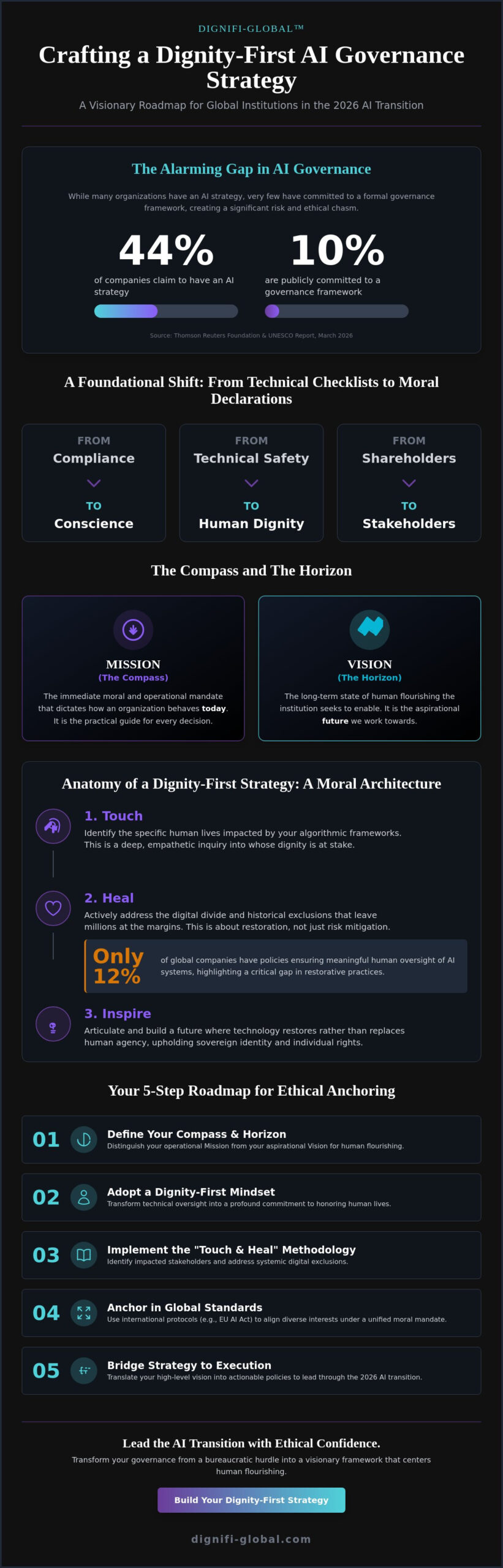
A March 2026 report by the Thomson Reuters Foundation and UNESCO reveals a startling reality: while 44% of companies claim to have an AI strategy, only 10% are publicly committed to a formal governance framework. This disconnect suggests that most organizations still view technology as a problem to be managed rather than a life to be honored. You’ve likely felt the growing tension between high-level ethical ideals and the practical reality of technical execution. It’s a gap that threatens to leave even the most prestigious organizations behind as global standards like the EU AI Act evolve toward their 2027 deadlines. Developing a robust ai governance strategy for global institutions isn’t about building a technical manual; it’s about making a moral declaration.

We believe that institutional resilience is rooted in people, not processes. This article provides a clear, actionable roadmap to help you craft a dignity-first mission and vision that aligns diverse stakeholders across the globe. You’ll learn to transform your governance from a bureaucratic hurdle into a visionary framework that centers human flourishing. We’ll preview the essential steps to bridge the intersection of technology and human rights, ensuring your institution doesn’t just survive the digital shift but leads it with steady, ethical confidence.

Key Takeaways

  • Distinguish your mission as an operational compass from your vision as a horizon for human flourishing to ensure your strategy remains both practical and aspirational.
  • Learn to craft a dignity-first ai governance strategy for global institutions that transforms technical oversight into a profound commitment to honoring human lives.
  • Implement the “Touch” and “Heal” methodology to identify impacted stakeholders and address the systemic exclusions often hidden within digital frameworks.
  • Follow a five-step roadmap for ethical anchoring, using international protocols to align diverse global interests under a single, unified moral mandate.
  • Bridge the gap between strategic drafting and policy execution to lead your institution through the complex regulatory shifts of the 2026 AI transition.

What is an AI Governance Mission and Vision for Global Institutions?

In the pursuit of systemic justice, an organization’s mission and vision serve as the dual pillars of its institutional soul. We define the AI governance mission as the “Compass.” It’s the immediate moral and operational mandate that dictates how an organization behaves today. Conversely, the vision is the “Horizon.” It represents the long-term state of human flourishing that the institution seeks to enable through its presence in the world. Traditional corporate mission statements often fail in the humanitarian sector because they prioritize efficiency over equity; they focus on shareholders rather than stakeholders. In the context of global aid, optimization is not the goal; restoration is. Dignity-First AI Governance is a transformative strategy that centers the sanctity of human life over the optimization of technical processes.

Crafting a robust ai governance strategy for global institutions requires a departure from the cold, clinical language of risk management. It demands a vocabulary of responsibility. When we define our purpose, we aren’t just checking boxes for a board meeting. We’re establishing a foundational promise to the communities we serve. This process involves more than just software updates; it involves a fundamental shift in how we view the intersection of technology and human rights.

The Shift from Compliance to Conscience

By May 2026, the global landscape of AI regulation has moved decisively toward protecting fundamental rights. We can no longer settle for a “do no harm” mentality. We must strive for proactive flourishing. Global governance consulting acts as the bridge here, connecting the rapid pace of innovation with the steady pulse of ethical conviction. We must contrast “Technical Safety” with “Human Dignity” in our strategic language. Safety is about avoiding errors; dignity is about honoring lives. It’s the difference between a system that doesn’t crash and a system that empowers the vulnerable.

Institutional Resilience as a Strategic Anchor

A strong vision protects organizations from ethical drift during periods of rapid technological upheaval. It ensures that every algorithmic decision aligns with the core mandate of financial inclusion and social equity. This ai governance strategy for global institutions views the intersection of AI policy and digital identity as a foundational pillar of resilience. When we anchor our strategy in human worth, we build systems that don’t just survive the digital shift. We build systems that inspire trust, bridge the digital divide, and foster long-term global stability.

The Anatomy of a Dignity-First AI Strategy

A dignity-first ai governance strategy for global institutions is built upon a rhythmic methodology: Touch, Heal, and Inspire. This framework moves beyond the traditional, data-centric models that treat individuals as problems to be managed. Instead, it honors them as lives to be restored. This approach is not a technical manual; it is a moral architecture designed to withstand the rapid shifts of the digital age.

In the Touch phase, we identify the specific human lives impacted by our algorithmic frameworks. This isn’t a high-level demographic analysis. It’s a deep, empathetic inquiry into whose dignity is at stake when a system makes a decision. The Heal phase follows, where we actively address the digital divide and the historical exclusions that leave millions at the margins. By May 2026, the necessity for this healing is clear; reports show that only 12% of global companies currently have policies ensuring human oversight of AI systems. Finally, the Inspire phase articulates a future where technology restores rather than replaces human agency. This requires a networked approach to AI governance that balances institutional power with individual rights.

The vocabulary of 2026 reflects this shift toward ethical conviction. We must speak of sovereign identity, where individuals own and control their digital presence. We must uphold non-refoulement in digital spaces, ensuring AI isn’t used to push the vulnerable back into harm’s way. We must demand algorithmic accountability that is both transparent and auditable. These aren’t just words; they’re foundational pillars of a resilient global institution.

Centering the Vulnerable in AI Policy

True institutional resilience begins at the margins. Your vision must prioritize those least served by existing systems. By incorporating community finance principles, we ensure that AI governance doesn’t just manage risk but actively builds wealth and opportunity. We’re moving from a model of dependency to one of partnership. This shift ensures that humanitarian AI frameworks empower local communities to lead their own development rather than waiting for external intervention.

The Role of Digital Identity in AI Vision

You can’t have ethical AI without a secure foundation for the individual. This is why digital identity system design is inseparable from an effective ai governance strategy for global institutions. Our mission must protect the “sovereign self” in an increasingly automated world. We draft clauses that honor lives, ensuring that identity remains a tool for liberation, not a mechanism for surveillance. If your organization seeks to lead this transition, exploring global governance consulting can help align your policy with these high-minded ideals.

How to Write a Mission and Vision for AI Governance in Global Institutions

Mission vs. Vision: Distinguishing the Horizon from the Compass

To lead with ethical conviction, a global leader must distinguish between the path they walk and the destination they seek. The mission serves as the “Compass,” providing the operational mandate for the what and how of daily oversight. It centers on accountability, transparency, and the rigorous application of foundational standards. Conversely, the vision is the “Horizon,” representing the aspirational “Why” behind every algorithmic decision. While the mission governs the process, the vision honors the life. A successful ai governance strategy for global institutions requires these two elements to be parallel yet distinct, ensuring that technical execution never loses sight of humanitarian purpose.

Consider the practical divergence between institutional mandates. A non-governmental organization (NGO) might draft a mission focused on “ensuring algorithmic non-refoulement in humanitarian corridors,” while its vision paints a world where “technology restores the agency of the displaced.” In contrast, a multilateral development bank may frame its mission around “inclusive financial system development through auditable AI lending,” with a vision of “universal financial flourishing that transcends geographic borders.” Both are principled, yet their operational compasses are tuned to their specific institutional callings.

Drafting the Mission: The Operational Mandate

The mission must provide a foundational governance structure that survives rapid technology cycles. By May 2026, this requires “Contextual Intelligence,” a specific capacity to adapt AI oversight to local sociological realities. It’s not enough to follow the ISO/IEC 42001:2023 standard; the mission must define the exact intersection where your technology meets human rights. This mandate ensures that accountability isn’t a vague ideal but a daily practice of centering the vulnerable. It moves the organization from a state of passive compliance to one of active stewardship, where policy frameworks are built to protect, not just to process.

Drafting the Vision: The Aspirational North Star

Your vision must be an evocative declaration of intent. It should employ powerful verbs: Centering the marginalized, Restoring lost agency, Bridging the digital divide, and Honoring the sovereign self. This aspirational North Star is critical for overcoming the “Trust Deficit” identified by global reports in early 2026, which found that only 12% of companies have policies ensuring human oversight. A visionary ai governance strategy for global institutions looks beyond the immediate hurdles of the EU AI Act or NIST frameworks. It imagines a state of global inclusion where technology serves as a partner in human dignity rather than a tool for systemic exclusion. When the horizon is clear, the institution remains resilient, guided by a steady confidence that suggests long-term wisdom.

How to Write Your AI Governance Strategy: A 5-Step Process

Developing an ai governance strategy for global institutions requires a transition from abstract philosophy to systemic action. It’s a journey that moves from the heart to the head. We follow five deliberate steps to ensure your framework is both visionary and grounded in moral responsibility. This process ensures that your institution doesn’t just manage technology but honors the humanity at its center.

  • Step 1: Stakeholder Mapping. Identify whose dignity is at stake by looking beyond the immediate user to the broader community. This is the “Touch” phase of our methodology.
  • Step 2: Ethical Anchoring. Align your strategy with international protocols like the Palermo Protocol and UNESCO’s 2021 Recommendation on the Ethics of AI. As of March 2026, over 70 countries have built their national strategies upon these global standards.
  • Step 3: Drafting the “Dignity-First” Core. Focus on lives to be honored; not data points to be processed. This step centers human flourishing as the primary metric of success.
  • Step 4: Stress-Testing. Use the NIST Generative AI Profile to simulate failures against your mission. With only 12% of companies ensuring human oversight in early 2026, this step is vital for institutional resilience.
  • Step 5: Institutional Integration. Move your high-minded vision into the hard reality of policy leadership. This is where the “Inspire” phase takes root, embedding the vision into the institutional DNA.

Gathering the Global Perspective

Top-down governance often fails because it ignores the bottom-up human experience. We must engage multilateral partners to ensure cross-border interoperability and shared accountability. Use the “Touch, Heal, Inspire” rhythm to guide stakeholder workshops, centering those at the intersection of technology and human rights. This collaborative approach builds partnership over dependency, ensuring your ai governance strategy for global institutions reflects a truly global mandate. By centering the vulnerable, we create a resilient framework that bridges the digital divide.

Refining the Language for Maximum Impact

Avoid the clinical, cold language of traditional consulting. Opt instead for institutional gravitas that reflects the weight of your humanitarian mission. Use “not/but” structures to clarify your shift in perspective. For example, your strategy should state: “We focus not on data management, but on human flourishing.” Your institution’s unique moral mandate should be a single, declarative sentence that honors the sovereign self. If you’re ready to move from vision to execution, our global governance consulting can help bridge the gap between high-level ethics and technical reality.

From Vision to Framework: Leading the 2026 AI Transition

The journey from a drafted vision to a living framework is the ultimate test of institutional leadership. It requires moving beyond the “Horizon” to implement concrete AI governance solutions that reflect your organization’s ethical soul. As we approach the December 2027 deadlines for the EU AI Act’s high-risk system requirements, the window for purely theoretical ethics is closing. We must establish moral authority before technological dominance takes hold. This transition demands the presence of a “Global Statesperson.” This is a leader who views technology not as a tool for extraction, but as a medium for restoration.

Success in this new era is not measured by traditional KPIs alone. We must look toward “Dignity Metrics.” These metrics evaluate the extent to which an algorithm preserves human agency, bridges the digital divide, and honors the sovereign self. When we prioritize these values, we transform our ai governance strategy for global institutions from a defensive posture into a proactive force for global inclusion. It’s a shift from managing risks to honoring lives.

Operationalizing the Vision

Translating aspirational goals into accountable policy frameworks requires steady, principled action. It’s about moving from the “Inspire” phase to the “Heal” phase in a practical, auditable way. This involves continuous auditing and what we call “Organizational Sight Validation.” This process ensures your algorithmic outputs remain aligned with your foundational mission even as technology evolves. Dignifi-Global™ stands as your partner in this transformative journey. We provide the strategic insights and thought leadership necessary to navigate the complex intersection of artificial intelligence and human rights with absolute clarity.

The Future of Institutional Resilience

The most resilient institutions of 2026 won’t be those with the most advanced code; they’ll be those with the clearest moral vision. True resilience is found in people, not processes. We must move from a dependency on technology to a partnership with humanity. This shift is the only way to restore trust in a landscape where, as of March 2026, only 10% of companies are publicly committed to a formal governance framework. A robust ai governance strategy for global institutions is the cornerstone of this new, humane era.

If your organization is ready to lead with ethical conviction, the time for systemic action is now. We invite you to reach out to HE Roné de Beauvoir for bespoke global governance consulting. Together, we can craft a strategy that honors every life it touches. Let’s build a future where technology serves the flourishing of all humanity, guided by a steady confidence and a long-term perspective.

Honoring Humanity in the Age of Automation

The journey toward ethical AI is not a race for technical dominance; it’s a commitment to systemic justice. You’ve learned how a mission serves as your operational compass while a vision provides the horizon for human flourishing. By following our five-step roadmap, you can move from abstract principles to an actionable ai governance strategy for global institutions that protects the vulnerable. This approach ensures that technology restores agency rather than merely managing problems. It prepares your organization for the rigorous December 2027 standards of the EU AI Act while addressing the trust deficit noted in March 2026 reports.

We stand at the nexus of technology and human rights, ready to guide your transition. Led by Her Excellency Roné de Beauvoir, our team specializes in humanitarian resilience and global inclusion. We utilize our proprietary “Touch, Heal, Inspire” methodology to transform policy into a profound declaration of human worth. Partner with Dignifi-Global™ to design your dignity-first AI governance framework and lead your institution with steady, ethical confidence. The future of humanity is not a problem to be managed; it’s a life to be honored. We look forward to building this new, humane era alongside you.

Frequently Asked Questions

How do I ensure my AI mission statement isn’t just ‘ethics washing’?

You ensure authenticity by anchoring your mission in auditable outcomes and specific international protocols. If your declaration doesn’t influence at least 25% of your procurement criteria or technical KPIs, it remains a superficial gesture. True commitment requires a shift from passive compliance to active stewardship, where every algorithmic choice is measured against its impact on human flourishing.

Should our AI vision be separate from our general institutional vision?

Your AI vision must be a specialized extension of your core institutional mandate. It acts as a digital mirror to your humanitarian values, ensuring that technology serves the same North Star as your physical operations. Siloing these visions creates a disconnect between your high-level ethics and your technical execution, which can lead to systemic institutional drift.

What are the most important ethical terms to include in AI governance in 2026?

Prioritize terms like sovereign identity, digital non-refoulement, and algorithmic accountability. These phrases move your framework beyond cold, technical safety toward a state of proactive restoration. Including “contextual intelligence” is also vital, as it reflects the requirement to adapt global standards to local sociological realities, a trend emphasized in the African Union’s 2024 Continental AI Strategy.

How often should a global institution update its AI governance strategy?

Review your strategy annually, with a deep recalibration occurring every 24 months to address the rapid pace of regulatory change. The December 2027 deadlines for high-risk systems under the EU AI Act make this frequency a requirement for institutional resilience. Regular updates allow you to integrate new guidance, such as the NIST AI 600-1 profile, while maintaining your foundational moral conviction.

Can a mission statement truly prevent algorithmic bias?

A mission statement sets the moral mandate for the technical audits and data scrubbing processes that actually reduce bias. It provides the “Compass” that empowers your teams to prioritize equity over speed. While the mission itself is not a technical fix, it creates the institutional accountability necessary to treat bias as a violation of human dignity rather than a mere data error.

What is the difference between AI ethics and AI governance in a strategy document?

AI ethics defines the “Why” and the moral principles of your organization, while AI governance provides the “How” through policy and accountability. Ethics is the soul of your framework; governance is the skeletal structure that supports it. A robust ai governance strategy for global institutions requires both to ensure that high-minded ideals are translated into concrete, systemic actions.

How do we balance ‘Innovation’ with ‘Dignity’ in our vision statement?

You balance these by defining innovation as a mechanism that serves human dignity, not as an independent goal. Your vision should state that progress is only legitimate if it restores agency and honors the sovereign self. This perspective ensures that technical advancements are viewed through a lens of partnership with humanity rather than a desire for technological dominance.

Who should be responsible for drafting the AI governance mission?

A cross-functional council led by an ethical visionary or a global statesperson should hold responsibility for drafting the mission. This group must include voices from the margins of the digital economy to ensure the ai governance strategy for global institutions is inclusive. This collaborative approach prevents the disconnect between high-level leadership and the ground-level human experience, centering lives instead of just managing problems.

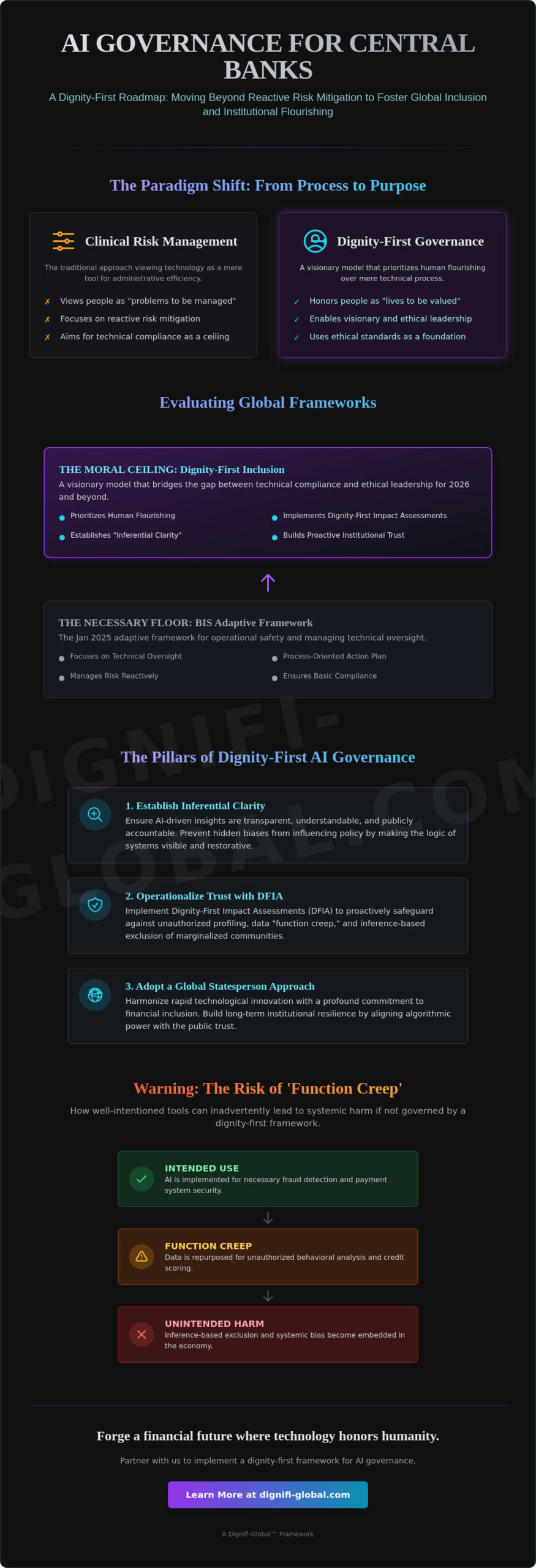
The true measure of a central bank’s success in 2026 is not the velocity of its digital transformation, but the depth of its moral accountability to the human lives it serves. As the Bank for International Settlements (BIS) established in its January 2025 adaptive framework, the rapid adoption of machine learning requires more than technical oversight. You likely feel the widening gap between the ten practical actions defined by the BIS and the daily reality of public skepticism regarding financial surveillance. Effective AI governance for central banks must be a foundational opportunity to restore trust; it is not merely a clinical process to be managed.

We believe that people are not problems to be managed, but lives to be honored. This article provides a comprehensive framework to help you move beyond reactive risk mitigation toward a dignity-first strategy that fosters global inclusion and institutional flourishing. You’ll explore the World Bank’s May 2026 priorities for institutional transparency and learn clear standards for AI-enabled inference and data separation. This roadmap bridges the gap between innovation and ethics, offering a steady path toward a more humane financial future that centers on the flourishing of all citizens.

Key Takeaways

  • Transition from clinical risk management to a visionary model of AI governance for central banks that prioritizes human flourishing over mere technical process.
  • Establish “inferential clarity” within your policy frameworks to ensure that AI-driven insights are transparent, understandable, and accountable to the public.
  • Enhance the BIS 10-point action plan by integrating a dignity-first methodology that bridges the gap between technical compliance and ethical leadership.
  • Operationalize institutional trust by implementing Dignity-First Impact Assessments (DFIA) to safeguard against unauthorized profiling and data “function creep.”
  • Build long-term resilience by adopting a “Global Statesperson” approach that harmonizes rapid technological innovation with a profound commitment to financial inclusion.

Beyond Data Inference: The Moral Imperative of AI Governance in Central Banking

The landscape of global finance is undergoing a profound metamorphosis that demands more than technical adjustment. It’s no longer sufficient to view technology as a mere tool for administrative efficiency. In 2026, AI governance for central banks represents the vital bridge between the cold logic of technological efficiency and the warm, enduring reality of human flourishing. We must recognize that the systems we build today dictate the boundaries of freedom and inclusion for generations to come. This is not a task for the technocrat alone; it is a sacred mission for the global statesperson who understands that every algorithm carries a moral weight. By centering our strategy on dignity, we move from a posture of reactive defense to one of visionary leadership.

The shift from direct data processing to “inferential capacity” marks a critical turning point for monetary authorities. While traditional systems analyzed what an individual did, modern AI predicts what a person might do, often using datasets that were never intended for such purposes. This capacity to infer behavior from massive datasets, such as those found in Central Bank Digital Currencies (CBDCs) and fast payment systems, changes the ethical equation entirely. We must move beyond the outdated mindset where people are viewed as “problems to be managed.” At Dignifi-Global™, our “dignity-first” premise is simple yet transformative: people are lives to be honored. Centering human dignity means ensuring that these powerful inferences never become a tool for unseen exclusion or systemic bias against the very citizens we aim to protect.

The Evolution of Central Bank Responsibility

Central banks are expanding their reach from narrow monetary stability toward fostering broad-based institutional resilience. Traditional data protection laws now act as a floor, not a ceiling, for ethical AI implementation. Mere compliance isn’t enough when the stakes involve the social contract itself. We’ve seen the Bank for International Settlements (BIS) advocate for an adaptive framework in their January 2025 report, yet the true challenge lies in moving from process to purpose. AI governance for central banks in 2026 is the strategic alignment of algorithmic power with public trust. By centering accountability, we transform these foundational pillars of ethical AI into a framework for lasting prosperity that honors the individual within the system.

The Risk of Function Creep in Modern Payment Systems

The intersection of fast payment systems and AI-driven supervision (SupTech) creates a high risk for “function creep.” What begins as necessary fraud detection can inadvertently morph into intrusive financial profiling. This is particularly dangerous in emerging markets where, as noted by the World Bank in May 2026, AI-based credit scoring often replaces formal histories, potentially baking bias into the bedrock of the economy. To prevent this, we must advocate for:

  • Protecting marginalized communities from “inference-based” exclusion that limits their access to capital.
  • Maintaining the social contract through radical transparency regarding how AI models influence policy decisions.
  • Ensuring robust data separation protocols that prevent the unauthorized use of private information for behavioral profiling.

Transparency isn’t just about open code; it’s about making the logic of our systems visible and restorative. It’s about building a system that heals the divides of the past and inspires confidence in a digital future where every person is seen and valued.

The Foundational Pillars of Ethical AI Policy for Monetary Authorities

True governance is not a shield against liability; it is a commitment to human flourishing. While the BIS Adaptive Framework provides a necessary floor for operational safety, central banks require a higher ceiling of moral responsibility. Effective AI governance for central banks rests on four foundational pillars that bridge the gap between algorithmic power and the public’s inherent right to dignity. These pillars are not mere processes to be managed; they are the structural supports for a more inclusive financial future. By centering these principles, institutions move from a posture of technical compliance to one of global statesmanship.

Transparency must evolve from simple technical disclosure to profound inferential clarity. It’s no longer sufficient to provide open-source code if the public cannot understand the logic that determines their financial standing. Accountability demands a shift from passive oversight to active human contestability. We must ensure that every automated decision can be challenged, reviewed, and corrected by a person whose primary mandate is the protection of human rights. Inclusivity requires us to build frameworks that don’t just mitigate bias but actively seek to restore those marginalized by traditional systems. Finally, resilience must encompass ethical stability. We must guard against ethical drift, where systems slowly prioritize institutional efficiency over the flourishing of the individual.

Centering Human Oversight in Algorithmic Decision-Making

Algorithmic financial supervision requires a robust mechanism for contestability. We believe that interdisciplinary AI committees, featuring ethicists and sociological experts alongside data scientists, are essential to maintain institutional wisdom. These committees should link every AI audit to specific financial inclusion goals. By centering the human experience, we ensure that technology serves the person, rather than the person serving the machine. If you seek to align your institution with these values, exploring our governance consulting services can help bridge the gap between intent and impact.

Digital Identity as a Prerequisite for Ethical Governance

The intersection of AI and finance is anchored by secure digital identity system design. Without a robust, dignity-first identity framework, AI-enabled finance risks becoming a tool for surveillance rather than empowerment. We must protect the Sovereign Identity, ensuring individuals maintain control over their digital selves even within the context of central bank digital currencies. This includes embedding non-refoulement principles into AI-driven flows, ensuring that financial data is never used to harm vulnerable populations seeking refuge or aid. Our methodology focuses on building partnership over dependency, honoring the lives behind the data points.

AI Governance for Central Banks: A Dignity-First Strategic Reference for 2026

Evaluating Global Standards: The BIS Adaptive Framework vs. Dignity-First Inclusion

The pursuit of excellence in AI governance for central banks requires us to distinguish between the map and the compass. While the Bank for International Settlements (BIS) provided an essential map in its January 29, 2025, report on AI adoption, a map alone cannot navigate the moral complexities of the coming decade. The BIS 10-point action plan serves as a vital foundation for operational safety, yet it often stops where the true work of leadership begins. We must move beyond the clinical boundaries of risk management toward a model of ethical leadership that centers on the flourishing of every citizen. True stability is not found in the absence of technical error, but in the presence of systemic justice.

The traditional “Three Lines of Defence” model, while robust for 20th-century banking, faces unprecedented strain against the AI hallucination risks of 2026. When an algorithm generates an “inferred identity” that excludes a legal entity from the credit market, as the European Central Bank noted in 2025, a process-heavy audit is insufficient. We believe that proportionate governance must also be principled governance. It’s not enough for a framework to be “adaptive” to new technology; it must be “restorative” to the human spirit. By shifting our perspective from managing risks to honoring lives, we transform central banking from a technical exercise into a humanitarian mission.

Strengths and Limitations of the BIS CGRM Report

The BIS report offers practical steps, such as maintaining AI inventories and developing workforce skills, which are necessary for institutional resilience. However, these actions often overlook the “Inclusion Gap” that persists when frameworks prioritize institutional security over public equity. While adaptive governance seeks to keep pace with the rapid acceleration of technology, visionary governance seeks to lead that technology toward the foundational restoration of human dignity. We must ensure that our interdisciplinary committees don’t just speak the language of data, but the language of sociological accountability.

Integrating Humanitarian Resilience into Financial Policy

Central banks in emerging markets and developing economies (EMDEs) face a unique intersection of rapid AI adoption and fragile regulatory guardrails. In regions where formal credit histories are rare, AI-driven scoring is already the primary gatekeeper for financial access as of May 2026. Moving beyond “compliance” means establishing a genuine partnership with the communities we serve, rather than fostering a culture of dependency on opaque systems. Our global governance consulting bridges this critical gap, ensuring that every policy decision is viewed through a dignity-first lens that honors the individual. This approach restores the social contract by centering transparency and meaningful human oversight at the heart of the financial system.

Operationalizing Trust: A 2026 Roadmap for Central Bank AI Implementation

Trust is not a static commodity to be guarded; it is a living relationship to be nurtured through principled action. While previous sections explored the moral imperative and foundational pillars, the true challenge lies in the transition from theory to practice. AI governance for central banks requires a deliberate, five step roadmap that moves beyond administrative compliance toward institutional flourishing. This journey centers on the belief that technology should serve as a restorative force, bridging the gap between systemic power and individual worth. By following this path, leaders can ensure that their digital transformation honors the lives of the citizens they serve.

  • Step 1: Conduct a Dignity-First Impact Assessment (DFIA). Move beyond traditional risk matrices to evaluate how AI-enabled SupTech affects human agency and privacy. Every algorithmic deployment must be measured by its contribution to human flourishing.
  • Step 2: Establish Data Separation Protocols. Implement technical guardrails to prevent unauthorized inferential profiling. As the World Bank noted in its May 5, 2026, report, robust data controls are essential in economies where AI-based credit scoring is the primary gateway to capital.
  • Step 3: Implement Contestable Records. Every AI-influenced decision must be auditable and, more importantly, contestable. Citizens must have a clear path to seek redress when algorithmic inferences impact their lives.
  • Step 4: Align with Global Goals. Ensure your AI strategy actively supports the UN Sustainable Development Goals, particularly those focused on reducing inequality and fostering inclusive institutions.
  • Step 5: Foster Ethical Awareness. Utilize the “Touch, Heal, Inspire” framework to build a culture where every employee understands their role as a guardian of human dignity.

Implementing Contextual Intelligence in Policy

Central banks must cultivate “organizational sight,” the ability to see the human reality behind the data points. This requires monitoring and auditing AI systems in a real-time financial environment to catch ethical drift before it causes systemic harm. We believe that ai governance solutions are not just technical tools but strategic bridges that connect policy intent with human impact. By centering contextual intelligence, institutions can build a foundation of resilience that withstands the complexities of a digital age.

Securing the Future of Inclusive Finance

The risk of AI-driven exclusion is particularly acute for vulnerable populations, including refugees and the unbanked. We must build “Bridges of Honor” that ensure these individuals aren’t marginalized by opaque risk detection models. Humanitarian resilience must be a priority, not an afterthought, in the national AI agenda. We invite you to partner with Dignifi-Global to design financial systems that restore hope and inspire confidence through inclusive, dignity-first policy leadership. Our mission is to transform technology into a tool for global healing, ensuring that the next era of finance is defined by partnership rather than dependency.

Institutional Resilience: Partnering for a Future of Global Financial Inclusion

The true foundation of 21st-century central banking is not found in the complexity of its algorithms, but in the clarity of its ethical conviction. As we look toward the horizon of 2026, the synthesis of advanced technology and human-centered ethics becomes the only viable path to lasting institutional resilience. AI governance for central banks must transcend the traditional boundaries of process-heavy consulting. It requires a shift from viewing individuals as data points to be managed toward seeing them as lives to be honored. This transition marks the end of the era of clinical oversight and the beginning of a new epoch defined by moral responsibility and systemic flourishing.

The next era of financial policy demands a “Global Statesperson” who possesses the wisdom to see beyond the immediate technical hurdle. This persona does not seek to control through surveillance, but to empower through inclusion. By centering the intersection of technology and human rights, visionary leaders can restore the social contract that has been strained by rapid digitalization. We must choose partnership over dependency, ensuring that the global financial architecture supports the sovereignty of the individual while maintaining the stability of the collective. This is the essence of a dignity-first strategic reference; it is a call to lead with heart as much as with the head.

The Dignifi-Global™ Methodology: Touch, Heal, Inspire

Our transformative approach is guided by a rhythmic three-part cadence: Touch, Heal, Inspire. We begin by “touching” the reality of the existing system, identifying where current AI governance for central banks fails to protect the vulnerable. We then move to “heal” these fractures by implementing policy frameworks that restore transparency and accountability. Finally, we “inspire” a future where inclusive financial system development is the standard, not the exception. Our upcoming case study on emerging markets demonstrates how this methodology bridges the gap between technological capacity and human impact. Dignity-first governance ensures that as we modernize our systems, we do not lose sight of the lives they are meant to serve.

Strategic Advisory for the Visionary Leader

Under the guidance of Her Excellency Roné de Beauvoir, Dignifi-Global™ leads the global shift toward ethical AI and digital identity strategy. We offer engagement models designed for central banks and multilateral partners who are ready to move from mere relief to sustainable, long-term resilience. Our advisory services go beyond software; we provide the strategic insights and thought leadership necessary to navigate the complexities of 2026. Policymakers ready to lead with moral authority are invited to join us in building a more humane financial future. The choice is clear: we can build systems that manage problems, or we can design frameworks that honor lives. Let’s choose the path of flourishing together.

Forging a Legacy of Human-Centered Monetary Leadership

The future of global finance isn’t found in the speed of an algorithm; it’s found in the depth of an institution’s moral commitment. We’ve moved beyond the technical milestones of the BIS January 2025 report to embrace a model where technology acts as a restorative bridge. Effective AI governance for central banks ensures that the inferential capacity of 2026 systems protects the unbanked rather than profiling the marginalized. By centering dignity over data, you transform your institution into a beacon of global stability and human worth. This shift represents a move from people as problems to be managed toward people as lives to be honored.

Led by Her Excellency Roné de Beauvoir, Dignifi-Global™ specializes in humanitarian resilience and the strategic design of inclusive financial systems. We invite you to partner with Dignifi-Global™ to design your Ethical AI Governance Framework. Our dignity-first approach provides the visionary leadership necessary to navigate the intersection of algorithmic power and human rights. This is your opportunity to choose partnership over dependency and to move from managing processes to honoring the flourishing of all. Together, we can build a financial architecture that inspires trust and secures a more humane digital future for everyone.

Frequently Asked Questions

How does AI governance for central banks differ from commercial bank AI policy?

AI governance for central banks prioritizes the preservation of the social contract and systemic stability over individual commercial gain. While commercial policies focus on risk-adjusted returns, central authorities must ensure algorithmic power aligns with national resilience and global inclusion. It’s a fundamental shift from managing corporate processes to honoring the collective welfare and dignity of every citizen within the financial ecosystem.

What are the primary risks of AI-enabled inference in financial supervision?

The most pressing risk is the transition from direct data analysis to intrusive behavioral profiling. In 2025, the European Central Bank (ECB) identified that individuals could be identifiable through inferred data within the AnaCredit dataset, which records loans to legal entities. This capacity often leads to “function creep,” where supervision tools inadvertently become instruments of financial surveillance or systemic exclusion for marginalized groups.

Can AI governance actually improve financial inclusion for refugees and migrants?

Proper governance transforms AI from a gatekeeper into a bridge for vulnerable populations by utilizing alternative data points that honor human resilience. Central banks can replace traditional credit histories, which many refugees lack, with inclusive scoring models that recognize lived experience. This restorative approach builds partnership over dependency, ensuring that AI governance for central banks serves a humanitarian mission of global inclusion.

What is a “Dignity-First” framework in the context of monetary policy?

A “Dignity-First” framework is a visionary methodology that centers human rights at the intersection of technology and finance. It operates on the deep conviction that people are not problems to be managed, but lives to be honored. This framework ensures that every policy decision, from CBDC design to SupTech implementation, actively fosters institutional resilience and the flourishing of the individual.

How should central banks handle AI “hallucinations” in economic forecasting?

Central banks must implement a “Touch, Heal, Inspire” cadence to manage model hallucinations through meaningful human oversight. This includes establishing interdisciplinary AI committees, as recommended by the BIS in January 2025, to provide ethical and sociological checks on algorithmic outputs. By centering wisdom over mere processing power, institutions can restore public trust in economic forecasts that impact millions of lives.

Is the BIS adaptive governance framework sufficient for 2026 ethical standards?

The BIS framework established in 2025 provides a necessary floor for technical safety; however, it doesn’t reach the aspirational ceiling required for 2026. True resilience requires a visionary leap from clinical risk management to ethical leadership. We must move beyond the ten practical actions toward a system that heals systemic divides and inspires confidence through a profound commitment to human dignity.

What role does digital identity play in central bank AI governance?

Secure digital identity system design is the foundational anchor for all ethical AI governance for central banks. It ensures that the “Sovereign Identity” remains protected even as central bank digital currencies (CBDCs) expand their reach. Without this anchor, AI-enabled finance risks eroding the privacy and agency of the individuals it was designed to empower, leading to a breakdown in institutional trust.

How can central banks ensure non-refoulement in AI-driven financial systems?

Ensuring non-refoulement requires embedding ethical guardrails directly into the algorithmic architecture of financial flows. Central banks must establish robust data separation protocols to ensure that information gathered for financial inclusion isn’t weaponized against those seeking refuge or aid. This commitment protects the sanctity of human life and ensures that financial systems remain a source of healing and restoration.

By 2030, the International Finance Corporation projects that AI could add $234 billion to Africa’s GDP, but this vast potential remains a hollow promise if built on models that ignore local souls. You recognize that current Western technologies often act as a form of neo-colonialism, overlooking cultural nuances and the lack of secure foundational infrastructure. True progress requires an AI ethics framework for developing nations that centers on human dignity rather than mere data processing; it’s about partnership over dependency. At Dignifi-Global™, we believe people are not problems to be managed, but lives to be honored.

This article provides a dignity-first roadmap for AI governance that empowers nations to build inclusive, sovereign futures. We’ll explore how the African Union’s Continental AI Strategy and Nigeria’s March 2026 national strategy are already bridging the gap between innovation and human rights. You’ll gain practical insights into integrating digital identity with governance to ensure technology doesn’t just manage problems, but restores agency through our core mission to touch, heal, and inspire.

Key Takeaways

  • Understand why a dignity-first AI ethics framework for developing nations must transcend Western “risk management” to honor local cultural nuances and sovereignty.
  • Identify the five non-negotiable pillars of contextual governance that shift the focus from managing technical processes to fostering holistic human flourishing.
  • Uncover the critical intersection between secure digital identity system design and ethical AI, ensuring no individual is erased by algorithmic bias.
  • Gain a practical five-step roadmap for policymakers to operationalize ethical standards through “Dignity Councils” and comprehensive national readiness audits.
  • Discover how the “Touch, Heal, Inspire” methodology bridges the gap between high-level policy and the restorative work of building resilient, inclusive societies.

What is an AI Ethics Framework for Developing Nations?

An AI ethics framework for developing nations is a set of socio-technical guardrails designed to ensure technology serves human dignity. It’s much more than a list of technical constraints; it’s a foundational architecture that aligns innovation with national values. Many policymakers have discovered that “copy-pasting” Western frameworks, such as the EU AI Act, often fails in developing contexts because those models assume the presence of mature digital ecosystems. We must embrace a shift from “technology-first” to “people-first” governance. The AI Gap is a matter of institutional resilience, not just hardware access.

By grounding local policy in the foundational principles of AI ethics, nations can build systems that are both resilient and inclusive. This approach ensures that the intersection of technology and human rights is handled with the gravitas it deserves. It isn’t about hindering progress, but about centering the human experience in every algorithmic decision. It’s about building a future where technology honors the soul of the community.

The Unique Challenges of the Global South

Data sovereignty is the primary challenge facing nations today. If the data used to train local models is owned by foreign corporations, the risk of algorithmic colonization increases. This imports external biases that can distort local social and economic realities. There’s also a constant tension between the desire for rapid economic growth and the need for ethical slow-downs. However, the India AI RAM Report released on February 16, 2026, highlights how a structured assessment methodology can help a nation manage these risks without stifling innovation. True sovereignty requires a commitment to local data ownership and cultural nuance.

The Dignity-First Perspective

At Dignifi-Global™, we believe that people are lives to be honored, not problems to be managed. Our dignity-first perspective contrasts sharply with the “Safety-First” models prevalent in the Global North. While safety-first focuses on preventing harm, a dignity-first model actively promotes human flourishing. This philosophical shift transforms ethics from a regulatory barrier into an accelerant for trust. When citizens trust that their digital futures are being built with their worth in mind, they move from skepticism to active participation. This trust is the heartbeat of our methodology to touch, heal, and inspire.

The Core Pillars of Contextual AI Governance

A resilient AI ethics framework for developing nations rests on five non-negotiable pillars: Inclusion, Sovereignty, Accountability, Sustainability, and Flourishing. These are not mere abstract concepts; they’re the structural foundations of a future where technology serves humanity. Inclusion must go beyond providing basic connectivity. It requires that local communities move from being passive subjects to active co-designers of the models that govern their access to resources. Sovereignty ensures that nations retain control over their digital destiny, rather than becoming passive consumers of foreign software. Accountability must be enforceable within local legal systems, moving beyond voluntary guidelines to mandatory standards that protect citizens. Sustainability addresses both the environmental footprint of data centers and the institutional longevity of these systems, ensuring that policy isn’t just a reaction to current trends but a foundation for the future. Finally, Flourishing represents the shift from simply surviving technological change to thriving through it.

True governance requires a shift from universalism to contextual intelligence. While Western models often prioritize data privacy as a strictly individual right, many communities in the Global South view data as a collective asset that should benefit the group. This shift in perspective is vital for global AI governance to succeed. By centering the human experience, we ensure that innovation doesn’t just manage data, but honors lives. This dignity-first approach allows leaders to build systems that reflect the inherent worth of their people. Our specialized global governance consulting helps bridge the gap between these high-level principles and local implementation, ensuring that technology becomes a tool for restoration.

Moving from Universalism to Contextual Intelligence

Contextual intelligence is the ability to adapt ethical rules to local cultural and linguistic realities. In some contexts, fairness might mean the equal distribution of resources; in others, it might mean prioritizing the most vulnerable populations first. Decentralized governance models empower local stakeholders to lead these definitions. At Dignifi-Global™, we believe that when we honor local context, we move from dependency to true partnership. This approach ensures that the African Union’s five-year implementation plan for its Continental AI Strategy leads to lasting self-reliance rather than a cycle of external reliance. It’s about centering local voices in every algorithmic decision.

The Intersection of Ethics and Human Rights

We must link AI ethics directly to established human rights, such as the non-refoulement principle in humanitarian and border contexts. AI systems used in aid distribution must never be used to return individuals to situations of persecution. The designation of H.E. Dr. Abiy Ahmed as the African Union Champion for AI in February 2026 signals a growing commitment to this vital intersection. To protect these rights, nations should implement Algorithmic Impact Assessments for all new national technologies. These assessments act as a mirror, helping leaders see if a system will heal or harm before it’s fully deployed, ensuring our mission to touch, heal, and inspire remains at the forefront of innovation.

AI Ethics Framework for Developing Nations: Centering Human Dignity in Global Innovation

Digital Identity: The Bedrock of Ethical AI

An AI ethics framework for developing nations remains an abstract ideal until it’s anchored in the reality of the individual. Without a secure and verifiable way to identify the people technology aims to serve, algorithms inevitably default to exclusion. We cannot speak of ethical AI if the foundational systems of a nation cannot accurately see its citizens. Digital identity isn’t just a technical requirement; it’s a moral imperative that ensures every person is recognized as a life to be honored, not a data point to be discarded. When we prioritize digital identity system design, we create the necessary visibility for AI to function with precision and empathy.

Sovereign identity acts as the primary shield against the technological neo-colonialism that threatens emerging markets. It shifts the power dynamic from external data-harvesting entities back to the citizen. This identity-centric governance ensures that AI systems operate within a closed loop of consent and accountability. By aligning these systems with the UN Principles for the Ethical Use of AI, developing nations can establish a baseline of human rights that protects against algorithmic bias and predatory data practices. It’s about partnership over dependency, ensuring technology serves the soul of the nation.

Sovereign ID vs. Corporate ID

The choice facing emerging economies is stark: adopt state-led, dignity-first ID systems or surrender to private-sector models built on data-harvesting. Corporate identity models often view individuals as products to be sold, whereas sovereign systems treat them as participants to be protected. Secure, state-backed IDs allow for genuine “opt-in” participation in the digital economy. By utilizing privacy-preserving technologies like zero-knowledge proofs, nations can verify eligibility for services without exposing sensitive personal details. This ensures that the AI framework heals rather than harms, restoring agency to the individual.

Identity as a Tool for Financial Inclusion

A robust digital ID is the gateway to financial inclusion and systemic resilience. In regions where traditional credit histories are absent, ethical AI can use verified identity data to expand access to capital without repeating the biases of the past. This isn’t about mere financial transactions; it’s about honoring the economic potential of every citizen. Interoperable standards are essential here. They allow global aid frameworks to interact seamlessly with national systems, ensuring that humanitarian assistance is delivered with speed and dignity. Through our methodology to touch, heal, and inspire, we help nations bridge the gap between abstract policy and the concrete restoration of human worth.

Operationalizing the Framework: 5 Steps for Policymakers

Transforming a philosophical commitment into a functional reality requires more than just good intentions; it demands a systemic shift in how we view the intersection of technology and governance. To move from abstract principles to a working AI ethics framework for developing nations, leaders must adopt a tactical roadmap that prioritizes institutional resilience over mere technical adoption. This process begins with the understanding that people are not problems to be managed, but lives to be honored. By following a structured path, nations can ensure that innovation serves as a tool for restoration rather than a mechanism for exclusion.

  • Establish a Multi-Stakeholder Dignity Council: Move AI oversight out of technical silos and into a diverse body that includes ethicists, community leaders, and civil society. This council ensures that deployment remains rooted in the specific cultural nuances of the nation.
  • Conduct a National AI Readiness Audit: Before deploying new systems, nations must identify data infrastructure and legal gaps. Throughout January and February 2026, Trinidad and Tobago conducted these assessments to ensure their governance could support ethical innovation.
  • Develop a Regulatory Sandbox: Create controlled environments for testing ethical AI in low-risk sectors like education or agriculture. Peru’s January 2026 regulatory framework utilizes a staggered implementation that allows for such testing before high-stakes sector rollouts in September 2026.
  • Mandate Procurement Transparency: Require all public-sector AI acquisitions to meet strict transparency standards. This prevents the “black box” problem where foreign software dictates local policy without accountability.
  • Invest in Contextual AI Literacy: Launch programs for civil servants and the public that focus on how AI impacts human rights and local dignity. Literacy is the primary defense against algorithmic colonization.

Building Institutional Resilience

Institutional resilience is the ability of a nation to govern new technologies without falling into a state of external dependency. It’s about partnership over subordination. Policy must precede technology in national development to ensure that digital tools align with sovereign goals. When we focus on people rather than processes, we create a top-down governance model that remains deeply responsive to bottom-up community needs. This ensures that the AI ethics framework for developing nations remains a living document, capable of evolving with the needs of the people it serves.

Monitoring and Auditing for Compliance

Static policies are insufficient for the dynamic nature of artificial intelligence. Nations should implement regular Dignity Audits to ensure AI systems continue to align with local values and human rights. These audits go beyond technical performance to measure the actual impact on human flourishing. Utilizing advanced AI governance solutions allows for automated policy monitoring that flags ethical drift in real-time. Furthermore, red-teaming AI models for cultural and linguistic biases is essential to prevent the import of foreign prejudices. To begin building your sovereign governance roadmap, explore our policy leadership services today.

The Dignifi-Global™ Vision: Moving from Relief to Resilience

The path toward a technological future must be paved with the restoration of human worth, not just the optimization of code. By establishing a robust AI ethics framework for developing nations, we transition from being passive recipients of global trends to becoming the architects of our own flourishing. This shift represents a move from relief, which addresses immediate digital divides, to resilience, which builds the institutional strength to govern innovation for generations. Our methodology, Touch, Heal, Inspire, serves as the heartbeat of this transition, ensuring that every policy decision is rooted in a profound moral responsibility to the individual.

We bridge the gap between high-level international standards and human-centric implementation by centering the lived experience of the communities we serve. In 2026, we see a world where developing nations lead the global conversation on ethical AI. As countries like Nigeria and Ethiopia implement their national strategies, they aren’t merely adopting technology; they’re honoring the cultural and linguistic nuances that Western models often erase. This isn’t a vision of the distant future; it’s a reality being built today through dignity-first models that prioritize partnership over dependency and people over processes.

Partnership Over Dependency

The Dignifi-Global™ approach to strategic advisory rejects the traditional, process-heavy consulting model. Instead, we offer a vision of global governance that is deeply rooted in ethical conviction and diplomatic prestige. We don’t view emerging markets as landscapes to be mined for data, but as partners in a humanitarian mission. Our policy design centers local voices in every framework, ensuring that the intersection of artificial intelligence and digital identity serves the sovereign interests of the nation. Engaging with our global governance consulting services means building a foundational structure that can withstand the pressures of rapid technological change while maintaining absolute accountability to your citizens.

A Call to Systemic Action

The urgency of this moment cannot be overstated. As the International Finance Corporation projects a $234 billion boost to Africa’s GDP by 2030, the question isn’t whether AI will arrive, but whether it will arrive with dignity. We must choose to build systems that heal rather than harm. We must remember that people are not problems to be managed; they are lives to be honored. This philosophy is the cornerstone of everything we do. It’s time to move beyond the cold, clinical language of risk management and embrace a future where technology is a catalyst for human flourishing. We invite you to take the first step in this transformative journey. Partner with Dignifi-Global™ to design your ethical AI roadmap and lead your nation toward a resilient, inclusive, and dignified technological future.

A Future Where Technology Honors Humanity

The journey toward a sovereign technological future begins with the recognition that people are not problems to be managed, but lives to be honored. We’ve explored how a contextual AI ethics framework for developing nations must move beyond Western paradigms to embrace the foundational pillars of inclusion, sovereignty, and accountability. By rooting these systems in secure digital identity, we ensure that innovation restores rather than erases the individual. This isn’t just about technical policy; it’s about building the institutional resilience that allows nations to lead with confidence and moral authority.

Led by Her Excellency Roné de Beauvoir, Dignifi-Global brings deep experience in humanitarian resilience policy to every partnership. We apply our signature “Touch, Heal, Inspire” methodology to bridge the gap between high-level governance and human flourishing. The time to act is now, ensuring that the projected $234 billion AI contribution to Africa’s GDP by 2030 is built on a foundation of human dignity. Lead with Dignity: Explore our AI Governance Advisory Services. Together, we can build a world where technology serves the soul of every nation.

Frequently Asked Questions

Why do developing nations need a different AI ethics framework than the West?

Developing nations require a unique approach because Western models often assume a level of digital infrastructure and legal stability that doesn’t reflect local realities. A tailored AI ethics framework for developing nations ensures that innovation respects cultural nuances and protects against the risk of technological neo-colonialism. It’s about building partnership over dependency through sovereign governance.

How does digital identity impact the ethics of artificial intelligence?

Digital identity acts as the essential technical bridge that allows AI systems to recognize and serve individuals with precision. Without a secure, sovereign ID system, algorithms frequently result in systemic exclusion and data exploitation. This bedrock of identity ensures that every individual is treated as a life to be honored rather than a data point to be managed.

Can ethical AI frameworks actually help economic growth in the Global South?

Ethical frameworks act as a catalyst for sustainable growth by establishing the trust required for institutional resilience. By January 2026, nations like Peru demonstrated that clear regulatory guardrails attract high-value international partnerships. These frameworks prevent the long-term costs of algorithmic bias and social friction, moving nations from relief to lasting resilience.

What are the biggest risks of using Western-trained AI models in developing countries?

The primary risks include algorithmic colonization and the erasure of local cultural identities. Models trained exclusively on Western datasets lack the linguistic diversity and sociological context needed for accurate decision-making in the Global South. This misalignment can lead to biased outcomes in healthcare, justice, and financial services, ultimately undermining national sovereignty.

How can a small nation enforce AI ethics without a massive regulatory budget?

Small nations can achieve effective oversight by participating in regional alliances like the African Union’s Continental AI Strategy. By pooling resources and utilizing shared auditing methodologies, states can enforce standards without an expansive domestic budget. Regional cooperation ensures that even smaller economies can maintain sovereign control over their digital futures through collective accountability.

What is the role of human dignity in AI policy design?

Human dignity serves as the foundational premise that guides all systemic action in policy design. Instead of focusing solely on technical safety, a dignity-first approach centers on the inherent worth and flourishing of the individual. This perspective ensures that an AI ethics framework for developing nations restores agency to the people rather than just managing technical risks.

What happens if a nation ignores AI ethics in favor of rapid development?

Ignoring ethical guardrails often leads to institutional fragility and the exploitation of vulnerable populations. While development might appear faster initially, the lack of accountability creates deep-seated social distrust and predatory data environments. Over time, this erodes the foundations of the digital economy and forces a state into long-term technological dependency.

How does Dignifi-Global™ help governments implement these frameworks?

Dignifi-Global™ provides the strategic insights and policy leadership needed to move from abstract concepts to concrete implementation. We utilize our signature “Touch, Heal, Inspire” framework to help governments design resilient systems at the intersection of technology and human rights. Our advisory focuses on restorative governance that honors lives and builds long-term institutional strength.

What if the 1.3 billion adults who remain unbanked today are not a problem to be managed, but a community waiting for their inherent worth to be honored? While 79 percent of adults globally held a financial account by 2024, the remaining gap represents a profound moral challenge that technology alone cannot fix. We believe the strategic implementation of AI and digital identity for financial inclusion is not about tracking individuals; it’s about centering human dignity and restoring agency. You likely recognize that existing digital ID systems often risk becoming tools for surveillance or further exclusion rather than empowerment.

This article demonstrates how the intersection of ethical AI governance and secure digital identity systems creates a foundational roadmap for global financial inclusion and institutional resilience. We will move beyond the limitations of traditional aid to explore a dignity-first framework for system design. By examining the shift toward accountability following the U.S. National Policy Framework for Artificial Intelligence released on March 20, 2026, we provide a preview of how to bridge the gap between temporary relief and sustainable financial agency. It’s time to embrace a model of partnership over dependency, ensuring every individual has the opportunity to flourish.

Key Takeaways

  • Shift the perspective from managing problems to honoring lives by adopting a visionary paradigm for inclusive technology.
  • Recognize digital identity as the foundational layer of agency, allowing marginalized populations to own their financial history and future.
  • Implement ethical governance to transform AI and digital identity for financial inclusion into a secure roadmap for institutional resilience.
  • Bridge the gap between temporary relief and sustainable agency by modernizing aid frameworks with dignity-first strategic insights.
  • Apply the “Touch, Heal, Inspire” methodology to ensure that global governance structures prioritize the flourishing of human dignity.

The Convergence of AI and Digital Identity: A New Paradigm for Inclusion

The intersection of technology and humanity is not merely a technical frontier; it’s a moral landscape where the future of global equity is decided. For too long, financial systems have viewed the 1.3 billion unbanked individuals as a data gap to be filled or a logistical hurdle to be cleared. We believe that true progress occurs when we stop managing people as problems and start honoring them as lives. By leveraging AI and digital identity for financial inclusion, we can transform fragmented data points into cohesive narratives of human potential. This year, 2026, marks a pivotal moment as high-risk obligations under the EU AI Act come into force on August 2, 2026, and the U.S. National Policy Framework for Artificial Intelligence begins to reshape how we view the intersection of ethics and innovation. It’s about agency, not just access.

Defining AI and Digital Identity in a Humanitarian Context

AI-driven identity serves as a vehicle for sovereign agency, ensuring that an individual’s digital presence is an instrument of empowerment rather than a ledger of surveillance. While a traditional digital identity often acts as a static record of government-issued credentials, AI-enhanced systems dynamically process alternative data to build trust where formal documentation is absent. Our methodology approaches this through a specific rhythm: we Touch the lives of the marginalized by acknowledging their existing value, Heal the systemic wounds of exclusion through secure design, and Inspire a new era of participation. This approach ensures that technology remains a servant to human flourishing, not its master.

The Economic and Social Case for Ethical Systems

The journey from temporary relief to sustainable resilience requires a shift in how institutions deploy capital and technology. While traditional aid frameworks often create cycles of dependency, inclusive financial systems built on ethical AI foster long-term agency. This transition is essential for meeting the UN Sustainable Development Goals, particularly those focused on eradicating poverty and reducing inequality. By 2024, the gender gap in account ownership in developing economies had already narrowed to 5 percentage points, a testament to the power of mobile technology. However, without robust governance, we risk the “function creep” identified in World Bank reports, where data collected for one purpose is used to marginalize the vulnerable in another. Ethical AI and digital identity for financial inclusion provide the necessary guardrails to ensure that institutional resilience is built on a foundation of accountability and trust.

Foundational Agency: Why Digital Identity Precedes Financial Access

Identity is the first act of inclusion. Without a recognized digital presence, an individual remains invisible to the systems that provide credit, safety, and opportunity. While 79 percent of adults globally held a financial account by 2024, the 1.3 billion who remain unbanked are often excluded simply because they lack the “foundational” credentials required by traditional institutions. We view digital identity system design not as a tool for tracking, but as a mechanism for restoring agency. It’s the essential layer that allows refugees and marginalized populations to own their financial history; this transforms them from passive recipients of aid into active participants in the global economy.

The Moral Architecture of Identity

A dignity-first approach to identity systems requires a fundamental shift from surveillance to sovereignty. Existing frameworks often prioritize the needs of the institution over the rights of the individual, leading to systems that feel like management rather than empowerment. We advocate for partnership over dependency; we believe people are not problems to be managed, but lives to be honored. By utilizing AI and digital identity for financial inclusion, we can create insights that acknowledge the inherent worth of individuals previously deemed “unbankable.” This isn’t about clinical data collection. It’s about centering the human experience to ensure that technology heals the fractures in our social fabric rather than widening them.

Bridging the Gap for the Unbanked

The traditional “know your customer” (KYC) barrier has long served as a gatekeeper that keeps the vulnerable at the margins. Secure digital identity for financial services provides a solution by automating trust in fragile contexts. Since 84 percent of adults in low- and middle-income countries now own a mobile phone, we have an unprecedented opportunity to verify creditworthiness through alternative data. The strategic deployment of AI and digital identity for financial inclusion allows models to analyze patterns of mobile usage or utility payments to build a financial footprint where none existed before. This transition toward financial inclusion acts as a stabilizer for global institutions, replacing volatile relief cycles with long-term economic resilience. If you’re ready to rethink your institutional strategy, we invite you to explore our governance consulting services to build a more humane future.

AI and Digital Identity for Financial Inclusion: Restoring Dignity in a Digital Age

The Governance Prerequisite: Why Ethical AI Must Lead Technology

Technology remains a neutral force until it’s animated by human intent. We believe that technology without governance is a risk, but governance with dignity is a solution. A common objection suggests that AI is a cold, impersonal tool that will only deepen the global divide. However, when we apply a dignity-first lens, we see that ethical policy can transform these algorithms into instruments of compassion. Engaging in global governance consulting isn’t an administrative hurdle; it’s the foundational act of building a system that recognizes human worth. We must ensure that AI and digital identity for financial inclusion are developed within a framework of accountability that precedes any technical deployment.

Governance Over Technology: A Systemic Shift

Governance must precede technology. In humanitarian contexts, the rush to innovate often leads to “automated exclusion,” where flawed algorithms replicate the very biases they were meant to solve. If we don’t establish ethical guardrails before implementation, we risk creating a digital panopticon rather than a pathway to prosperity. Our methodology requires a systemic shift toward a top-down ethical framework. This ensures that every institutional partner is held to the highest standard of transparency. By doing so, we move from a paradigm of managing problems to one of honoring lives, ensuring that institutional resilience is rooted in moral responsibility.

The Ethics of Inference and Profiling

The traditional data-centric model of banking often fails the 1.3 billion unbanked by reducing complex human experiences to binary data points. We advocate for a model that centers meaningful human intervention within AI decision-making processes. It’s vital to uphold the digital equivalent of non-refoulement; we must ensure that the data collected to provide AI and digital identity for financial inclusion is never weaponized against the vulnerable. Our three-part cadence, Touch, Heal, Inspire, guides this transition. We touch the system with ethical policy, heal the scars of exclusion through transparent inferences, and inspire a future where every individual can flourish. This is the essence of restoring dignity in a digital age.

From Relief to Resilience: Strategic Implementation for Institutions

Institutional resilience isn’t built on the efficiency of a transaction; it’s forged in the fires of trust and accountability. For multilateral partners, the path forward requires a departure from traditional aid frameworks that often prioritize process over people. We propose a strategic shift where relief serves as a bridge to long-term flourishing. By integrating AI governance solutions into existing humanitarian programs, organizations can ensure that technological adoption honors the individual. This is how AI and digital identity for financial inclusion moves from a theoretical concept to a foundational reality for the world’s most vulnerable. It’s about agency, not just access.

Modernizing Humanitarian Aid Frameworks

Modernizing aid means moving from short-term relief to long-term agency. In 2024, 62 percent of adults in low- and middle-income economies made or received digital payments, marking a 28 percent increase over the last decade. This surge highlights the potential for secure cash-transfer programs powered by digital identity. To ensure these systems remain dignity-first, institutions should follow a rigorous technological audit checklist:

  • Does the system treat the individual as a life to be honored rather than a problem to be managed?
  • Is the digital footprint sovereign, ensuring the user owns their financial history?
  • Are there transparent mechanisms for human accountability in every AI-driven inference?

The Role of Policymakers in 2026

The role of the global statesperson in 2026 is to bridge the gap between innovation and ethics. The White House released its National Policy Framework for Artificial Intelligence on March 20, 2026, signaling a move toward consolidated federal oversight. For policymakers, this represents a call to action. We must move beyond a patchwork of regulations to a unified vision that centers human flourishing. It’s not enough to manage risks; we must actively create the conditions for partnership-based ecosystems. This involves aligning government mandates with technology providers who share a commitment to moral responsibility. This systemic policy change is the heartbeat of our methodology. Strengthen your humanitarian strategy with our humanitarian resilience programs to ensure no community is left behind.

Restoring Dignity through Ethical Policy: The Dignifi-Global™ Methodology

The architecture of our digital future must be built on the bedrock of human worth. We believe technology is a mirror of our collective values; if we design systems for efficiency alone, we risk building a world that is efficient but hollow. The Dignifi-Global™ Methodology rejects the clinical reduction of individuals into binary data sets. Instead, we center the human experience at the very heart of AI and identity strategy. By embracing the strategic deployment of AI and digital identity for financial inclusion, we can move beyond the systemic failures of the past. We don’t see data points; we see destinies waiting to be fulfilled.

The Dignity-First Approach to Global Inclusion

Our unique policy frameworks are rooted in the visionary leadership of Her Excellency Roné de Beauvoir. Her vision for a more humane future is built on the conviction that people are lives to be honored, not problems to be managed. This philosophy informs every aspect of our work, from policy leadership to strategic advisory. We provide a specific framework for AI and digital identity for financial inclusion that prioritizes the flourishing of the individual above the convenience of the institution. It’s a shift from dependency to partnership. This ensures that the digital tools of tomorrow are used to restore the agency that was stripped away yesterday.

Partnering for a Sustainable Future

The urgency of this mission cannot be overstated. As we approach the full implementation of high-risk AI obligations on August 2, 2026, the window for building ethical systems is narrowing. We invite global leaders, institutional stakeholders, and humanitarian pioneers to join us in this transformation. Building resilient systems is not a task for the next crisis; it’s a responsibility for today. Our methodology provides the cadence needed to navigate this complexity. We Touch the lives of the marginalized with empathy, Heal the systemic wounds of exclusion through ethical governance, and Inspire a global community to reach for a higher plane of engagement. Dignifi-Global™ stands as your visionary partner in this journey, bridging the gap between technological potential and human dignity. Let’s build a future where every life is honored and every voice is heard.

Honoring the Future of Global Agency

The path toward a more equitable world requires us to look beyond the code and see the faces of the 1.3 billion individuals still waiting for an invitation to participate. We have established that digital identity serves as the foundational layer of agency and that ethical governance must lead every technological advancement. By centering human dignity, we transform AI and digital identity for financial inclusion from a mere technical objective into a moral imperative. This systemic shift moves institutions from providing temporary relief to fostering sustainable resilience, ensuring every individual has the opportunity to flourish in our digital age.

Led by Her Excellency Roné de Beauvoir, our visionary approach is designed to bridge the gap between global policy and human worth. We invite you to partner with Dignifi-Global™ to design the future of ethical inclusion and witness the power of our Touch, Heal, Inspire methodology. Together, we can restore the agency of the marginalized and build a global financial system that honors every life. The future of humanity is not a problem to be managed; it’s a legacy we are building together with calm, steady confidence. Let’s create a world where technology serves the heart.

Frequently Asked Questions

How does AI improve financial inclusion for the unbanked?

AI improves inclusion by analyzing alternative data points, such as mobile phone usage and utility payments, to establish creditworthiness for the 1.3 billion adults who remain unbanked. By 2024, digital payment adoption in low-income economies reached 62 percent, providing a rich narrative of financial behavior that traditional systems often ignore. It’s about recognizing inherent value where legacy institutions see only a data void.

What are the risks of using digital identity in humanitarian aid?

The primary risks involve “function creep” and automated exclusion, where data intended for relief is weaponized for surveillance or biased algorithms marginalize the vulnerable. Without a dignity-first framework, these systems can inadvertently replicate the systemic fractures they aim to heal. We must ensure that digital footprints remain sovereign and protected against unauthorized profiling.

Why is governance more important than technology in AI implementation?

Governance provides the moral intent that technology lacks; technology is a neutral force, but governance is a solution. As the high-risk obligations of the EU AI Act come into force on August 2, 2026, it’s clear that policy must precede deployment to prevent systemic harm. Governance ensures we are honoring lives rather than merely managing data points.

Can digital identity systems protect individual privacy?

Yes, secure systems protect privacy through decentralized architectures and sovereign identity models where the individual retains ownership of their data. Implementing AI and digital identity for financial inclusion requires a commitment to transparency and accountability. This approach prevents the invasive profiling common in traditional, data-dense institutional models.

What is the “dignity-first” approach to financial system design?

A dignity-first approach centers the human experience by treating individuals as lives to be honored rather than problems to be managed. It utilizes our “Touch, Heal, Inspire” framework to ensure that every technological adoption restores personal agency. This philosophy moves the conversation from clinical transactions to a higher plane of human flourishing.

How does Dignifi-Global™ support global institutions in AI policy?

Dignifi-Global™ provides ethical AI governance frameworks and strategic insights that help institutions navigate the complex intersection of technology and human rights. We bridge the gap between innovation and ethics through visionary policy leadership. Our methodology empowers partners to move from temporary relief cycles toward sustainable, partnership-based institutional resilience.

What role does AI play in humanitarian resilience programs?

AI strengthens resilience by automating trust and optimizing secure cash-transfer programs in fragile or conflict-affected contexts. Since 84 percent of adults in low-income countries now own a mobile phone, AI can verify identities and assess needs with unprecedented precision. This allows institutions to build long-term agency instead of fostering perpetual dependency.

How can policymakers ensure AI governance is ethical and inclusive?

Policymakers must adopt unified frameworks, such as the U.S. National Policy Framework for Artificial Intelligence released on March 20, 2026, that prioritize accountability and transparency. They should mandate meaningful human intervention in every AI-led financial inference. Governance remains truly inclusive only when it protects the digital sovereignty of the marginalized.

As of January 2026, a staggering 75% of humanitarian workers engage with artificial intelligence every single week; however, only 23% of organizations have established a formal policy to govern these interactions. This “Humanitarian AI Paradox” reveals a world where innovation outpaces our ethical infrastructure, leaving the most vulnerable at the mercy of unverified algorithms. At Dignifi-Global™, we believe that people are not problems to be managed; they are lives to be honored. The urgent need for accountable AI in humanitarian aid is no longer a technical debate, but a moral imperative to ensure that every digital touchpoint restores rather than diminishes human dignity.

You’ve likely felt the growing unease as “black box” systems begin making life-or-death decisions without a clear framework for transparency. We agree that the current reliance on fragmented commercial platforms for sensitive data is unsustainable and risks breaking the sacred bond of trust between aid providers and recipients. This article promises to illuminate the path forward by detailing how the SAFE AI framework, launching May 19, 2026, provides the governance we need to bridge this gap. We’ll preview a roadmap for institutional resilience that moves beyond traditional relief to foster true flourishing as we touch the heart of the crisis, heal the systemic divide, and inspire a future rooted in dignity.

Key Takeaways

  • Bridge the “Humanitarian AI Paradox” by aligning rapid technological adoption with foundational governance that restores trust between providers and the lives they honor.
  • Move beyond abstract ethical concepts to establish accountable AI in humanitarian aid through measurable frameworks that center human dignity in every algorithmic decision.
  • Evaluate the critical risks of “black box” commercial platforms and learn why purpose-built institutional governance is essential for sensitive humanitarian contexts.
  • Operationalize a dignity-first roadmap by integrating secure digital identity system design and continuous auditing to eliminate systemic algorithmic bias.
  • Transition from traditional emergency response to sustainable institutional resilience by leveraging AI to build inclusive financial systems for displaced communities.

The Humanitarian AI Paradox: Why Adoption Outpaces Accountability in 2026

In the early months of 2026, the global aid sector faces a profound contradiction. We call this the Humanitarian AI Paradox. It’s the widening chasm between the ubiquitous use of algorithmic tools and the systemic distrust that follows their deployment. While 93% of aid practitioners report using AI tools in their daily workflows, only 38% believe these systems actually improve the quality of their decision-making. This gap isn’t just a technical glitch; it’s a moral crisis. When innovation moves faster than our ethical guardrails, we risk turning the act of mercy into a cold, automated transaction. We believe that people are not problems to be managed; they are lives to be honored. Restoring this perspective requires a fundamental shift toward accountable AI in humanitarian aid.

High-stakes environments like conflict zones don’t leave room for error. Yet, the current governance vacuum allows “shadow AI” to flourish. These are unmanaged, unvetted tools used by well-meaning staff to process sensitive data without institutional oversight. While the global community discusses broader AI regulation, the humanitarian sector remains particularly vulnerable. We must transition from these ad-hoc experiments to robust, institutionalized frameworks. This isn’t about slowing down progress. It’s about ensuring that our progress is rooted in the foundational values of human rights and dignity.

The Gap Between Innovation and Infrastructure

Commercial platforms currently dominate the humanitarian landscape because they’re accessible and fast. However, tools like ChatGPT weren’t designed to handle the nuanced protection data of displaced populations. Using general-purpose AI for specialized humanitarian needs creates expert-level risks handled with beginner-level knowledge. As of January 2026, only 23% of organizations have a formal policy in place, even though 75% of their staff use AI weekly. This lack of infrastructure means we’re building on sand. We need purpose-built systems that prioritize safety over speed and honor the specific contexts of the Global South.

The Trust Deficit in Aid Delivery

The psychological impact of algorithmic aid on vulnerable populations is significant. When a machine determines who receives food or shelter, the recipient feels like a data point rather than a human being. Data summarization and translation require deep cultural accountability that code simply cannot replicate. We must restore the “Human in the Loop” as an ethical guardian. This role isn’t about being a data editor; it’s about being a witness to human suffering. By centering dignity-first principles, we can bridge the trust deficit and ensure that technology serves to touch, heal, and inspire those in the greatest need.

Defining Accountable AI: Centering Human Dignity in Algorithmic Aid

Ethics is a philosophy, but accountability is a practice. While many institutions speak of ethical principles in the abstract, true transformation requires a shift toward measurable, transparent standards. To implement accountable AI in humanitarian aid is to move beyond vague promises and into the realm of concrete architecture. It’s about building AI governance solutions that provide a foundational structure for every digital interaction. This approach doesn’t view individuals as data points to be managed; it sees them as lives to be honored. By centering dignity-first principles, we ensure that technology serves as a bridge to restoration rather than a barrier to human rights.

Our methodology operates through a rhythmic cadence: we Touch the immediate crisis, Heal the systemic fractures, and Inspire a future where technology and humanity coexist in harmony. This framework acknowledges the humanitarian AI paradox, where the rush for efficiency often bypasses the need for human oversight. When we ignore this tension, we risk the “black box” failures documented in the 2026 AI Index Report, which noted 362 AI incidents in 2025 alone. True accountability requires us to reclaim the narrative, moving from a model of technical dependency to one of institutional partnership. For organizations ready to lead this shift, our global governance consulting provides the strategic clarity needed to align innovation with moral responsibility.

From Data Points to Honored Lives

In the sensitive context of refugee reintegration, the moral responsibility of algorithmic transparency cannot be overstated. Accountable AI protects the flourishing of the individual over the cold efficiency of the system, ensuring that automated processes don’t strip away a person’s agency. We’re not merely sorting files; we’re witnessing stories. Accountability is the institutional promise to answer for algorithmic outcomes, ensuring that every automated decision remains tethered to human responsibility and moral oversight.

The Intersection of AI and Non-Refoulement

The intersection of artificial intelligence and displacement data is a high-stakes frontier for human rights. AI-driven border systems must strictly honor the principle of non-refoulement, ensuring that no individual is returned to a territory where they face persecution. We must prevent “automated” refoulement by implementing rigorous policy frameworks that subject algorithmic suggestions to intense human scrutiny. Global governance isn’t a constraint on innovation, but a guardian of the digital aid systems that protect the most vulnerable among us. By centering these legal protections, we transform AI from a tool of exclusion into a mechanism for profound inclusion.

Accountable AI in Humanitarian Aid: Centering Human Dignity in the Algorithmic Age

The current reliance on “off-the-shelf” commercial platforms represents a dangerous compromise in the humanitarian sector. Statistics from the Humanitarian Leadership Academy indicate that 69% of practitioners currently depend on commercial AI tools to manage their daily workloads. This widespread adoption happens within a governance vacuum; the speed of innovation outpaces the depth of institutional oversight. While these tools offer immediate efficiency, they often lack the transparency required for high-stakes aid delivery. True accountable AI in humanitarian aid requires a shift from technical convenience to purpose-built institutional frameworks that honor local context and data sovereignty.

The inherent opacity of “black box” algorithms poses a significant threat to the sacred trust between aid providers and recipients. When we use proprietary systems to manage sensitive displacement data, we risk subordinating human rights to the logic of data extraction. According to the UN OCHA on AI in the Humanitarian Sector, issues such as algorithmic bias and system opacity aren’t just technical hurdles; they are foundational challenges to safe and ethical aid. Bridging this gap requires specialized global governance consulting that prioritizes dignity-first principles over mere operational output. We don’t need faster processing; we need deeper understanding.

The Risk of ‘Black Box’ Aid

Proprietary algorithms are frequently incompatible with the transparency standards that define humanitarian work. These systems often operate as closed loops, making it impossible for aid organizations to audit how decisions are reached or where data might be leaked. This creates a fertile ground for surveillance capitalism to enter the aid ecosystem, turning vulnerable individuals into data points for commercial profit. Vetting commercial partners must involve a rigorous assessment of their ethical alignment. We must ensure their technology serves to touch and heal rather than extract and exploit.

Strategic Policy vs. Ad-hoc Implementation

We must move from individual, ad-hoc adoption to sustainable institutional resilience through top-down policy leadership. A dignity-first procurement strategy ensures that governance precedes technology, signaling that we value people over processes. This transition requires a visionary commitment to building systems that honor lives. When leadership establishes that accountability is non-negotiable, they inspire a culture where innovation serves humanity. It’s not about rejecting commercial progress, but about ensuring that every tool we use is anchored in a foundational promise to answer for its outcomes.

The Dignity-First Roadmap: Operationalizing Accountability in Aid Delivery

Operationalizing ethics requires more than a statement of intent; it demands a structured roadmap that translates philosophical values into systemic action. For accountable AI in humanitarian aid to be realized, we must transition from reactive crisis management to proactive, dignity-first governance. This shift begins with the recognition that technology should never be a barrier between the provider and the recipient. By the launch of the SAFE AI framework on May 19, 2026, global institutions will have a verified standard to follow. This roadmap is designed to ensure that every algorithmic touchpoint serves to touch the heart of human need, heal systemic fractures, and inspire long-term resilience.

A foundational pillar of this roadmap is the implementation of robust digital identity system design. Traditional aid models often rely on biometric data that can feel like surveillance rather than support. We advocate for sovereign, user-owned identity frameworks that allow individuals to manage their own data. This approach protects the flourishing of the person while ensuring they can access essential services without fear of digital tracking. When we center the individual’s agency, we move from managing populations to honoring lives.

Accountability also requires continuous auditing to monitor for algorithmic bias. We cannot simply deploy a tool and walk away. The 362 AI incidents documented in 2025 serve as a stark reminder that without real-time oversight, systems can quickly drift into harmful patterns. We must establish clear pathways for redress, allowing aid recipients to provide direct feedback and challenge automated decisions. If your organization is ready to move beyond ad-hoc tools toward a sustainable, ethical architecture, partner with us for policy leadership to build a future rooted in dignity.

Establishing Sovereign Digital Identity

Secure, user-owned identity systems form the backbone of accountable aid. By moving beyond simple biometrics toward dignity-based frameworks, we ensure that aid access doesn’t come at the cost of personal privacy. These systems must be designed to protect the most vulnerable from predatory data extraction while facilitating seamless inclusion in financial and social safety nets. This isn’t just about security; it’s about restoring a sense of ownership to those who have lost everything.

Continuous Auditing and Human-in-the-Loop (HITL)

The role of the human in the loop must evolve from a clerical data editor to a strategic ethical guardian. Before any deployment, organizations should conduct Algorithmic Impact Assessments to map potential risks to human rights. This proactive stance ensures that technology remains a tool for empowerment rather than a source of unintended harm. Real-time monitoring is indispensable to prevent algorithmic drift in crisis zones where conditions change by the hour and the stakes are life and death.

Beyond Relief: Building Sustainable Institutional Resilience through Accountable AI

The true measure of our progress is found in the transition from mere emergency response to the creation of sustainable institutional resilience. While traditional aid focuses on the immediate delivery of resources, accountable AI in humanitarian aid offers a path toward long-term empowerment. This evolution is best realized through financial inclusion, where technology serves to integrate displaced populations into the global economy rather than keeping them in a state of perpetual dependency. By architecting high-minded governance frameworks, we ensure that digital systems provide the stability necessary for human flourishing. It’s not about managing a crisis; it’s about honoring a life.

Dignifi-Global™ operates at the vital intersection of technological innovation and human rights, providing the policy leadership required to modernize aid for 2026 and beyond. We don’t just solve technical problems; we build ethical architectures that honor the sanctity of life. Our role is to act as a visionary partner for global institutions, helping them bridge the gap between algorithmic capability and moral responsibility. This isn’t a task for the distant future; it’s an urgent necessity today, as individual AI adoption among humanitarians has reached 75% while organizational readiness remains at a mere 23%. We must bridge this gap to ensure technology serves humanity, not the other way around.

Bridging Technology and Human Rights

The future of aid is a landscape where AI serves as a bridge, not a barrier, to human rights and individual flourishing. When we align AI governance with the UN Sustainable Development Goals (SDGs), we transform data-driven tools into instruments of restoration. Visionary leadership recognizes that technology is a means to an end, not an end in itself. By centering dignity-first principles, we can ensure that every automated decision contributes to a world where the displaced are no longer seen as “problems to be managed” but as lives to be honored. This is the path to restoring the soul of humanitarian mission in the algorithmic age.

Partnering for Global Inclusion

Multilateral partnerships are essential for establishing the global AI standards that will define the next decade of humanitarian work. As we look toward the implementation of the SAFE AI framework on May 19, 2026, the importance of collective accountability becomes clear. Dignifi-Global™ helps institutions modernize their frameworks to meet these new standards, ensuring that resilience is built into the very foundation of their digital strategy. This is the essence of dignity-first global governance: a steady, confident commitment to a future where technology touches the heart, heals the divide, and inspires the soul. Let’s bridge the gap between the head’s innovation and the heart’s mission, building a world where every life is honored with the respect it deserves.

Architecting a Future of Honored Lives

The journey toward accountable AI in humanitarian aid is not a technical constraint but a visionary commitment to the flourishing of every individual. We’ve established that the SAFE AI framework, launching May 19, 2026, provides the foundational architecture required to bridge the gap between rapid innovation and ethical responsibility. By transitioning from unvetted commercial platforms to purpose-built institutional resilience, global leaders ensure that technology serves as a bridge to restoration rather than a barrier to human rights. It’s time to choose partnership over dependency and people over processes to ensure every algorithmic decision honors the life it touches.

Led by Her Excellency Roné de Beauvoir, Dignifi-Global™ operates at the vital intersection of artificial intelligence, digital identity, and global governance. Our “Touch, Heal, Inspire” methodology provides a steady, confident roadmap for institutions ready to move beyond traditional relief toward sustainable, dignity-first frameworks. We invite you to partner with Dignifi-Global™ to architect your Ethical AI Governance Framework and join a movement dedicated to building a more humane digital age. Together, we can restore the soul of humanitarian mission and inspire a future where every life is honored with the prestige it deserves.

Frequently Asked Questions

What is the ‘Humanitarian AI Paradox’ and how does it affect aid delivery?

The Humanitarian AI Paradox is the dangerous tension between the widespread individual use of technology and the lack of institutional governance. As of January 2026, 75% of humanitarian workers use AI weekly, yet only 23% of organizations have a formal policy to guide them. This gap creates a landscape where life-altering decisions are made through unverified “shadow AI” tools, potentially compromising the safety of vulnerable populations and eroding the sacred trust essential for effective aid delivery.

How can AI in humanitarian aid be made truly accountable to the people it serves?

True accountability requires moving beyond abstract ethical statements to implement measurable, transparent governance frameworks. We achieve accountable AI in humanitarian aid by establishing an institutional promise to answer for every algorithmic outcome. This means centering the individual as a life to be honored rather than a problem to be managed. By building systems that prioritize human agency over technical efficiency, we ensure that innovation remains tethered to moral responsibility and human rights.

Is it safe to use commercial AI tools like ChatGPT for humanitarian data analysis?

Using general-purpose commercial platforms for sensitive humanitarian data carries significant risks regarding data sovereignty and “black box” opacity. While 69% of humanitarians currently rely on these tools, they often lack the specialized protection standards required for displacement data. These platforms prioritize data extraction and commercial profit, which can lead to unintended surveillance. We advocate for purpose-built institutional frameworks that offer the transparency and security necessary to protect the flourishing of those in crisis.

What are the primary risks of algorithmic bias in refugee and displacement programs?

The primary risks include automated exclusion from essential services and the potential for “automated” refoulement. The 2026 AI Index Report documented 362 AI incidents in 2025, highlighting how biased algorithms can perpetuate systemic inequalities. When a machine determines eligibility for aid without cultural context, it risks stripping agency from individuals. We must implement rigorous impact assessments to ensure that technology serves as a tool for restoration rather than a mechanism for further marginalization.

How does digital identity intersect with accountable AI in aid delivery?

Sovereign digital identity serves as the foundational backbone of an accountable aid ecosystem. By shifting from intrusive biometrics to user-owned, dignity-based identity frameworks, we empower individuals to control their own digital presence. This intersection ensures that aid access doesn’t require the sacrifice of privacy. It’s a “dignity-first” approach that facilitates inclusive financial system development while protecting the vulnerable from predatory tracking and data exploitation in the algorithmic age.

What role does human oversight (HITL) play in ensuring ethical AI outcomes?

Human-in-the-loop (HITL) must function as a strategic ethical guardian rather than a simple data editor. This role provides the “Contextual Intelligence” that algorithms lack, ensuring that automated suggestions are filtered through a lens of empathy and cultural nuance. Real-time human oversight is indispensable for preventing algorithmic drift in crisis zones. It restores the human touch to the heart of the mission, ensuring that technology heals systemic divides instead of deepening them.

How can institutions build resilience through AI without sacrificing human dignity?

Institutions build resilience by viewing technology as a bridge to long-term flourishing rather than a temporary relief measure. This involves transitioning from emergency response to sustainable models like inclusive financial system development for displaced populations. When we align AI governance with the UN Sustainable Development Goals, we create a future where innovation honors lives. We don’t just manage data; we inspire hope by bridging the gap between technical capability and the warmth of a humanitarian mission.

What are the key components of a ‘Dignity-First’ AI governance framework?

A dignity-first framework includes foundational policy leadership, continuous auditing for bias, and clear pathways for recipient redress. The upcoming launch of the SAFE AI framework on May 19, 2026, provides a verified roadmap for this transition. Key components involve establishing sovereign identity systems and implementing rigorous algorithmic impact assessments before any deployment. These elements work together to ensure that accountable AI in humanitarian aid remains a steady, confident guardian of human worth and global inclusion.

By H.E. Roné de Beauvoir

Founder, Dignifi-Global™

Special Envoy for Digital Inclusion and AI Governance

The true measure of a global institution is no longer its computational power, but its capacity to honor the human spirit within its algorithms. As the EU AI Act of April 2024 begins to reshape the legal landscape, leaders face a critical choice between rapid deployment and ethical integrity. You likely recognize that technical excellence is hollow if it fails to protect the dignity of the individuals it serves. Implementing a robust framework for ai enterprise governance isn’t a series of restrictive barriers; it’s a foundational architecture that allows human flourishing to coexist with technological scale.

We understand that bridging the gap between technical execution and ethical leadership feels like an immense challenge, especially when a 2023 industry report showed that 36% of organizations suffered from algorithmic bias. This article provides a repeatable, dignity-first template for AI oversight that aligns your organization with global standards while building lasting institutional resilience. We’ll explore how to transition from mere risk mitigation to a model that restores trust, ensuring that your systems touch, heal, and inspire every life they encounter. Our framework moves beyond the idea that people are problems to be managed; it treats them as lives to be honored.

"Enterprise AI governance is not about managing systems — it is about ensuring that the systems shaping decisions remain accountable to the people they affect."

— H.E. Roné de Beauvoir

Key Takeaways

  • Transition from managing risks to honoring lives by establishing a framework that centers human rights as the foundation of technological resilience.

  • Master the architecture of ai enterprise governance through five strategic pillars that replace opaque systems with transparent, accountable decision traces.

  • Identify the critical distinctions between traditional profit-protection models and inclusive governance architectures designed to foster global human flourishing.

  • Implement a sophisticated five-phase roadmap to bridge the gap between abstract ethical alignment and concrete, institutional policy design.

  • Discover how a dignity-first approach transforms technological strategy into a mission of restoration, ensuring long-term stability for global institutions.

Table of Contents

Defining AI Enterprise Governance: Beyond Risk to Resilience

AI enterprise governance represents the architectural soul of the modern institution. It’s the systematic framework of policies and standards that ensures algorithmic systems remain ethical, transparent, and aligned with fundamental human rights. While traditional models focus on risk mitigation, our approach focuses on resilience. We don’t view stakeholders as data points to be managed; we view them as lives to be honored. This shift reflects a move from institutional control to human flourishing. At Dignifi-Global, we recognize that ai enterprise governance is the foundational bridge between technological speed and institutional wisdom.

The landscape of global governance now centers on the intersection of AI, digital identity, and financial inclusion. This is the new frontier for institutions that seek to touch, heal, and inspire the communities they serve. Traditional corporate structures often struggle to account for the speed of autonomous decision making. When we compare Traditional Oversight vs. Inclusive Governance, it’s clear that static audits can’t keep pace with agentic AI that evolves in real time. We need a model that’s living, breathing, and rooted in ethical conviction.

The Dignity-First Philosophy in 2026

In 2026, the measure of a successful organization isn’t its total compute power, but its commitment to partnership over dependency. A dignity-first approach centers the human experience in the middle of the algorithmic loop. We believe technology should serve people, not the other way around. By centering human agency, institutions ensure that autonomous systems amplify rather than erase individual worth. This philosophy transforms ai enterprise governance from a compliance burden into a vehicle for restorative justice. It requires us to look past the code to the person behind the digital identity.

Key Regulatory Drivers: EU AI Act and Beyond

Navigating the global landscape in 2026 requires a deep understanding of the EU AI Act, which fully implemented its requirements for high-risk systems on August 2, 2026. This regulation has set a global baseline, yet compliance remains the floor, not the ceiling, for ethical leadership. In the United States, policy updates following Executive Order 14110 have reshaped how international humanitarian aid frameworks integrate automated tools. These shifts demand a proactive stance. Organizations must lead with moral authority, recognizing that legal mandates are merely the starting point for building a future where every individual is seen and valued. True leadership means honoring the spirit of the law, not just the letter.

The Five Pillars of the Ethical AI Governance Framework

Effective ai enterprise governance is not a collection of restrictive policies; it is a commitment to the restoration of agency within digital ecosystems. To move beyond the limitations of legacy management, we center our framework on five foundational pillars that honor human worth. These pillars transition the institution from a posture of reactive compliance to one of proactive stewardship. This shift ensures that technology serves the flourishing of the many, not just the efficiency of the few.

  • Transparency and Interpretability: We must move from opaque "black box" systems toward clear decision traces. This ensures that every automated outcome is explainable, honoring the individual’s right to understand the logic that shapes their life.

  • Accountability and Human-in-the-Loop: Responsibility cannot be outsourced to code. We establish clear lines of human oversight, ensuring that technology serves as an assistant to human wisdom, not a replacement for it.

  • Bias Mitigation and Inclusion: Rigorous data auditing prevents the digital exclusion of vulnerable populations. By aligning with the AI and Open Data Guidelines released by the U.S. Department of Commerce in January 2025, institutions can ensure their training sets reflect the diverse reality of the global community.

  • Data Sovereignty and Digital Identity: AI systems must respect the foundational right to identity. We prioritize protocols where individuals own their data, rather than being owned by it.

  • Security and Resilience: Protecting institutional assets and humanitarian aid frameworks from adversarial manipulation is a moral necessity. A secure system is a stable ground for human flourishing.

Operationalizing Ethical AI Use

True transformation occurs when ethical principles become operational realities. The successful implementation of ai enterprise governance requires more than technical updates; it demands a cultural shift. This involves developing contextual intelligence that adapts to specific business learning needs while maintaining a dignity-first lens. We implement health score metrics that prioritize sociological impact, measuring success by how a system heals social fractures rather than just technical performance. By integrating AI governance solutions into existing workflows, organizations can bridge the gap between abstract values and daily actions. Our methodology seeks to touch the core of the enterprise, heal its inefficiencies, and inspire its people toward a higher purpose.

The Role of Digital Identity in AI Strategy

Secure digital identity is the prerequisite for ethical AI in global financial services. Without a stable identity, individuals remain invisible to the systems meant to serve them. Sophisticated digital identity system design prevents identity fragmentation in AI-driven aid, ensuring that resources reach those who need them most. We advocate for sovereign identity protocols that empower individuals within enterprise ecosystems, turning them into partners rather than data points. To explore how your institution can lead this shift, we invite you to partner with our advisory team in building a more inclusive future.

Traditional Oversight vs. Inclusive Governance: A Comparison

Traditional oversight operates as a defensive mechanism designed to shield corporate profit from regulatory friction. Inclusive governance serves a higher calling. It centers on human flourishing rather than capital protection. When institutions prioritize ai enterprise governance through a dignity-first lens, they move from managing risks to honoring lives. This transition is not merely a change in policy; it’s a fundamental shift in institutional identity.

The starting point of any system dictates its destination. Data-centric architectures treat individuals as data points to be harvested and optimized. Dignity-centric architectures treat people as stakeholders to be empowered and respected. This distinction changes the entire governance architecture. It’s not a question of how much data we can collect, but how much value we can restore to the community. We don’t view people as problems to be managed; they are lives to be honored through every line of code.

The cost of failing to bridge this gap became painfully clear between 2024 and 2025. In late 2024, a prominent European recruitment AI was exposed for a 15 percent bias rate against applicants from marginalized backgrounds, resulting in a total collapse of brand equity. By early 2025, automated social welfare systems in several nations faced legal injunctions because they lacked "bottom-up" community feedback loops. These weren’t just technical glitches. They were moral failures born from a "top-down" mentality that ignored the lived experiences of the people the systems were meant to serve. Understanding how to implement top-down ai governance with a dignity-first lens is essential to ensuring these failures are never repeated.

Evaluating Governance Solutions

Selecting tools for ai enterprise governance requires looking beyond the software. A tool must support global human rights standards and allow for auditing that goes beyond simple code checks. We must move from one-off audits to continuous, automated monitoring. In 2025, leading institutions began implementing real-time ethical dashboards. These systems allow for immediate intervention when an algorithm begins to drift from its foundational ethical mission, ensuring that technology remains a servant to humanity.

Institutional Resilience as a Competitive Advantage

Ethical leadership isn’t just a moral choice; it’s a strategic necessity. Multilateral partners and donors now gravitate toward institutions that demonstrate a commitment to the "Touch, Heal, Inspire" framework. This alignment creates long-term stability in a globalized world where trust is the most valuable currency. When we lead with dignity, we attract partners who value partnership over dependency. Contextual Governance is the ability to apply global ethics to local institutional nuances.

AI Enterprise Governance: A Dignity-First Template for Global Institutions

The Enterprise AI Governance Template: A 5-Phase Roadmap

Effective ai enterprise governance requires a departure from purely technical checklists. It demands a framework that centers human flourishing at every decision point. This roadmap isn’t a rigid set of instructions; it’s a living architecture designed to restore trust between global institutions and the communities they serve. We don’t view governance as a barrier to innovation. We see it as the foundational soil in which responsible technology grows.

  • Phase 1: Discovery and Ethical Alignment. This phase identifies core institutional values and specific AI use cases. We move beyond "what can we build" to "what should we build to honor human dignity."

  • Phase 2: Policy Design and Framework Selection. Here, we customize the dignity-first template for your specific context. It’s about choosing partnership over dependency and centering the marginalized in the design process.

  • Phase 3: Technical Integration and Guardrail Deployment. We implement automated monitoring and bias controls. These technical barriers act as silent sentinels, protecting the vulnerable from algorithmic harm.

  • Phase 4: Training and Cultural Transformation. True change happens when we move from "rules" to a "culture of responsibility." Every employee becomes a steward of the institution’s moral legacy.

  • Phase 5: Auditing and Iterative Improvement. This establishes the rhythmic cadence of Touch, Heal, and Inspire. We audit not just for compliance, but for the restoration of human rights.

Integrating these five phases ensures that ai enterprise governance becomes a foundational pillar of institutional flourishing. It allows organizations to move with the calm, steady confidence of a global statesperson.

Step-by-Step Implementation Guidance

Forming a cross-functional AI Ethics Committee is the first step toward systemic accountability. This group must include humanitarian voices and sociologists, not just data scientists. When drafting the initial AI Charter, include essential clauses for global inclusion that protect data sovereignty for indigenous and developing populations. To maintain transparency, create a decision-trace log for high-stakes AI outcomes. This log ensures that every automated choice can be audited back to its human and ethical origin. People are not problems to be managed; they are lives to be honored.

Scalable Policies for Enterprise Growth

Managing the complexity of AI governance across multiple international jurisdictions requires a sophisticated balance of global standards and local wisdom. The 2024 EU AI Act and the NIST Risk Management Framework provide starting points, but they aren’t the finish line. We must ensure that global governance doesn’t lead to local exclusion. Scalable governance must be flexible enough to honor local cultural nuances. By centering the intersection of technology and human rights, we bridge the gap between global efficiency and local dignity. Boards seeking a comprehensive strategic foundation will benefit from exploring a top-down ai governance framework designed for global institutions to ensure board-level accountability is embedded at every layer of policy design.

Are you ready to transform your institutional framework from a process-heavy burden into a visionary engine for good? Explore our policy leadership services to begin your journey toward a dignity-first future.

Leading the Future: Dignifi-Global™ and Institutional Resilience

Dignifi-Global™ offers more than a strategy; we offer a vision for a more humane technological future. Our work centers on the belief that ai enterprise governance should not be a cold mechanism of control, but a warm embrace of human potential. We don’t view individuals as data points to be harvested; we see lives to be honored. By bridging the gap between technological possibility and moral responsibility, we ensure that the age of intelligence becomes an age of human flourishing. It’s a shift from seeing people as problems to be managed to recognizing them as souls to be nurtured.

Our methodology follows a deliberate, three-part cadence: Touch, Heal, and Inspire. We touch the systems that define our world, heal the fractures caused by exclusionary technology, and inspire a new generation of leaders to act with ethical conviction. This isn’t just consulting; it’s a commitment to restoring the foundational dignity that every global citizen deserves. We operate with the gravitas of a global institution, yet we maintain the warmth of a humanitarian mission, ensuring that every policy we craft serves the heart of humanity.

From Policy to Global Impact

Our impact is measured in the restoration of human agency. We’ve led initiatives to design digital identity systems for the 1.4 billion people who lack formal identification, according to 2023 World Bank estimates. These frameworks transform humanitarian aid from a cycle of relief into a ladder of resilience. Our specialized approach to ai enterprise governance moves institutions away from dependency and toward sustainable empowerment. Engaging with Her Excellency Roné de Beauvoir for strategic institutional advisory provides your board with the diplomatic prestige and moral authority required to lead on the world stage. It’s about centering the marginalized and ensuring that technology acts as a bridge, not a barrier.

Your Next Steps Toward Ethical Leadership

The boardroom of 2026 won’t be judged by its quarterly returns alone, but by its contribution to the global good. The ‘Ethical Visionary’ is no longer a peripheral role; it’s the core of institutional survival. To begin this transformation, you must honestly assess your current maturity level. Are your systems built on 20th-century processes, or are they ready for a dignity-first future? It’s time to transition from managing problems to honoring lives. We help you navigate this transition with a steady, confident hand, ensuring your legacy is one of compassion and wisdom.

The invitation is open to those who refuse to accept the status quo. You are called to join a movement that places the human spirit at the intersection of every algorithm. We are ready to help you modernize your global governance framework with Dignifi-Global™. Let’s build a future where technology doesn’t just work; it heals and inspires us all to be more than we were yesterday.

Leading the Future of Ethical Institutional Resilience

The evolution of global technology demands a shift from managing risks to fostering resilience. True ai enterprise governance isn’t about rigid compliance; it’s about centering human flourishing within every digital touchpoint. By implementing the Dignifi-Global 5-Phase Roadmap, institutions move beyond the cold metrics of traditional oversight into a model that honors individual worth. This transition requires more than technical updates. It requires a foundational commitment to the 5 Pillars of Ethical AI, ensuring that technology serves as a bridge rather than a barrier.

Led by Her Excellency Roné de Beauvoir, our team brings global expertise in humanitarian resilience to every strategic partnership. We’ve pioneered the ‘Dignity-First’ governance model because we believe people aren’t problems to be managed; they’re lives to be honored. This philosophy guides our mission to touch, heal, and inspire the systems that shape our world. The path toward institutional stability is clear. It starts with a vision that values partnership over dependency and accountability over mere automation.

Partner with Dignifi-Global™ for Ethical AI Strategy

The future of humanity is bright when we choose to build with conscience and character.

Frequently Asked Questions

What is the difference between AI governance and AI ethics?

AI ethics represents the moral compass of an organization, while ai enterprise governance provides the structural accountability to enforce those values. Ethics asks what we should do to honor human flourishing; governance builds the oversight mechanisms to ensure we do it. By 2025, 75% of global enterprises will have established formal ethics boards to bridge this gap. This transition moves us from abstract philosophy to systemic action.

How does the EU AI Act affect enterprise governance for US-based global firms in 2026?

The EU AI Act mandates that US-based global firms comply with strict transparency and risk-management standards by August 2026 if their systems impact EU citizens. Non-compliance carries severe penalties, including fines up to 35 million Euros or 7% of total global annual turnover. Organizations must shift their perspective from mere regulatory box-checking to a foundational commitment to human rights. This law transforms how global institutions operate within the digital intersection of two continents.

What are the most common AI governance failures in large institutions?

Common failures include algorithmic bias in recruitment and the lack of human-in-the-loop oversight in critical decision-making processes. A 2018 audit of a major tech firm’s hiring tool revealed it penalized resumes containing the word "women’s" in 100% of tested cases. These failures happen when we treat individuals as data points to be managed rather than lives to be honored. Robust ai enterprise governance prevents these systemic harms by centering dignity-first principles in every technical layer.

Can AI enterprise governance be fully automated?

AI governance can’t be fully automated because ethical judgment requires a level of human empathy that machines don’t possess. While 60% of compliance monitoring can be handled by software, the final accountability for high-risk decisions must remain with human stewards. We don’t seek to replace leadership with algorithms; we aim to restore the moral responsibility of the decision-maker. Technology should support the mission, but it’ll never replace the heartbeat of human wisdom.

How do we balance AI innovation with the need for strict ethical guardrails?

Balancing innovation with guardrails requires a shift from viewing ethics as a barrier to seeing it as a foundational catalyst for trust. According to a 2023 Cisco survey, 81% of consumers believe the way a company treats their data is indicative of how it views them as people. We don’t sacrifice speed for safety; we build safety into the speed. This approach ensures that every technological leap also serves the goal of global flourishing.

What role does digital identity play in a comprehensive AI governance framework?

Digital identity acts as the foundational layer of trust within a governance framework by ensuring every AI interaction is anchored to a verified entity. In 2024, the rise of synthetic media makes it essential to distinguish between human-generated and machine-generated content with 100% accuracy. Identity isn’t just a technical credential; it’s a way of honoring the unique presence of every individual. It provides the necessary bridge between digital efficiency and human accountability.

How should a board of directors oversee AI governance responsibilities?

Boards must oversee AI by establishing a dedicated ethics committee and demanding quarterly reports on algorithmic transparency and bias mitigation. Directors shouldn’t just focus on financial returns; they must monitor the 4 key pillars of risk: legal, ethical, operational, and reputational. This oversight ensures the institution moves from a model of dependency to one of partnership with its stakeholders. It’s about centering the board’s focus on long-term human value rather than short-term process metrics.

What are the first three steps to implementing an AI enterprise governance template?

The first three steps involve auditing your current AI inventory, establishing a dignity-first policy framework, and appointing a Chief AI Officer. Organizations must first touch the reality of their existing data silos to understand where they stand. Then, they heal the systemic gaps by aligning their tech stack with ethical convictions. Finally, they inspire their workforce by demonstrating how these new guardrails protect the flourishing of every person involved in the ecosystem.

About the Author

H.E. Roné de Beauvoir is the founder of Dignifi-Global™, a policy and thought leadership platform focused on artificial intelligence, digital identity, and financial inclusion. Her work centers on developing human-centered frameworks that align technological advancement with dignity, accountability, and global access.

She is the author of multiple policy papers addressing AI governance, digital identity systems, and inclusive infrastructure for the unbanked, contributing to global discussions on digital sovereignty and the future of equitable systems.

By H.E. Roné de Beauvoir

Founder, Dignifi-Global™

Your most advanced neural network will ultimately fail if it lacks a foundational moral compass. While the industry chases the next breakthrough in generative power, reports from Gartner indicate that 80% of enterprise AI projects will never reach full-scale production by 2025 because they lack a structural anchor. True ai transformation is a problem of governance; it’s a shift from viewing technology as a tool for efficiency to honoring it as a catalyst for human flourishing. We must move beyond the technical hype to center our systems on accountability and trust.

You recognize the weight of this responsibility as the 2026 regulatory landscape approaches. It’s exhausting to watch promising pilots stall or to worry that hidden biases might erode your institutional integrity because people are not problems to be managed; they are lives to be honored. We promise to show you why the success of your AI journey depends on the strength of your ethical governance frameworks rather than the complexity of your code. This article provides a clear framework to align your innovation with the core values that define your mission. It’s time to touch the heart of your strategy, heal the fractures in your process, and inspire a future where technology serves the dignity of every life.

Key Takeaways

  • Move beyond the myth of technical bottlenecks to understand why the success of your AI journey depends on institutional maturity rather than just data science talent.

  • Shift your perspective to see that ai transformation is a problem of governance, requiring a foundational architecture for trust that ensures technology serves the flourishing of humanity.

  • Explore the "Touch, Heal, Inspire" framework to transform governance from a series of compliance restrictions into a source of moral clarity and institutional strength.

  • Adopt a dignity-first roadmap that moves your organization from "Can we?" to "Should we?", centering human rights at the heart of every technological advancement.

  • Identify the three critical governance gaps stalling global progress and learn how to bridge the divide between rapid innovation and ethical accountability.

Table of Contents

The Great AI Transformation Myth: Why Your Technical Pilots Fail to Scale

Many institutions treat the struggle to scale artificial intelligence as a simple technical bottleneck. They assume that more data science talent or faster compute will bridge the deep chasm between a pilot project and enterprise value. This perspective is a fundamental misunderstanding of the era we’ve entered. By 2026, it’ll be clear that ai transformation is a problem of governance, not a shortage of algorithms. Organizations often prioritize speed without direction, yet true resilience requires oversight that honors human flourishing and foundational ethics.

The Tech-First approach treats AI as a faster version of traditional software. This is a mistake. Traditional code is deterministic, but AI is probabilistic; it requires a shift from managing processes to honoring lives. When we ignore this distinction, we create technical debt that eventually matures into a liability to human dignity. We aren’t just building tools; we’re redefining the intersection of technology and human rights. In 2026, ungoverned AI won’t just be a failure of logic; it’ll be a failure of moral responsibility.

The 70% Failure Rate: What the Data Actually Tells Us

A persistent 70% of AI proof-of-concepts never reach full-scale production according to industry benchmarks. This gap exists because traditional IT management fails to capture the unpredictable nature of machine learning. While standard software follows a linear path, AI systems evolve, drift, and occasionally hallucinate. Without a foundational structure, these pilots remain isolated experiments that cannot withstand the complexities of a global institution. AI governance is the framework of authority, accountability, and ethical boundaries that ensures technology serves humanity rather than superseding it.

From Algorithms to Authority: The Shift in Decision Rights

AI redistributes power within an organization or government body. When machines begin making high-impact decisions, an accountability vacuum often follows. Leaders must decide who’s responsible when an algorithm fails to reflect the institution’s core values. This isn’t a task for the IT department alone; it’s a mission for the entire leadership suite. As we look toward global AI governance standards, the focus must shift from "can we build it" to "should we permit it."

Restoring trust in these systems requires a strategic roadmap. Dignifi-Global provides ai governance solutions that move beyond cold, clinical strategic advisory. We believe that ai transformation is a problem of governance because people aren’t problems to be managed, they’re lives to be honored. This triad of Touch, Heal, and Inspire guides our methodology, moving from the heart to the head to ensure policy leadership reflects our highest moral responsibilities. By centering dignity, we bridge the gap between technical hype and institutional wisdom.

Understanding Governance as the Soul of the Machine, Not Just Compliance

Governance is not a ledger of prohibitions; it is the foundational architecture for trust. While the technical hype focuses on the raw power of large language models, we must recognize that ai transformation is a problem of governance at its core. This shift moves us away from the cold, clinical checklists of the past toward a framework that seeks to touch systemic vulnerabilities, heal historical data biases, and inspire institutional flourishing. If AI is the high-powered engine of modern industry, governance is the steering wheel that ensures the vehicle doesn’t just move fast, but moves in a direction that honors human life.

True transformation requires a profound shift in the corporate internal dialogue. We must stop asking "can we build it" and start demanding to know "should we deploy it." This isn’t about slowing down innovation. It’s about ensuring that innovation has a soul. By centering the "Touch, Heal, Inspire" framework, organizations can move beyond the fear of litigation and toward the promise of ethical leadership. We don’t view people as data points to be managed; they are lives to be honored through every line of code we oversee.

Governance vs. Management: A Critical Distinction

Management operates the system, but governance defines who is responsible for its outcomes. While managers focus on the 85 percent of daily operational tasks, the board must set the ethical north star for AI deployment. This oversight ensures that technology serves the mission rather than the mission serving the technology. A cornerstone of this governed access is found in digital identity system design, which acts as the gateway for inclusive participation. Research from Stanford’s Human-Centered AI initiative highlights that when governance precedes deployment, trust increases by 40 percent among stakeholders. It’s about partnership over dependency.

The 2026 Mandate: Why Ethical Frameworks are No Longer Optional

The regulatory landscape has shifted permanently. With the EU AI Act entering its full enforcement phase by 2026, the era of "move fast and break things" has ended. Institutions that fail to adopt dignity-first policies risk more than just fines; they risk the total dehumanization of the people they serve. We’ve seen how "check-the-box" compliance fails to prevent algorithmic bias. Active ethical stewardship is the only path forward. By 2026, 75 percent of global enterprises will face mandatory reporting on AI impact. You can prepare for this future by reviewing our strategic policy leadership services to align your technology with human rights.

We believe that ai transformation is a problem of governance because technology is a reflection of the values we choose to encode. When we prioritize dignity over data, we create systems that don’t just process information; they restore hope and bridge the gap between technical capability and moral responsibility.

AI Transformation is a Problem of Governance: Beyond the Technical Hype

The Three Governance Gaps Stalling Global AI Progress

AI transformation is a problem of governance because technical solutions cannot solve ethical fractures. While global AI spending surpassed $150 billion in 2023, institutional trust remains at a historic low. We must recognize that code cannot replace conscience. Faster processors won’t bridge the distance between a marginalized community and a centralized algorithm. We view this as a mission of humanitarian resilience; it’s a commitment to ensuring that systems honor the lives they touch. This confirms that ai transformation is a problem of governance, requiring a shift from technical speed to moral stability.

The Accountability Gap: Who Answers for the Algorithm?

The "black box" remains a barrier to justice. When an automated system denies a loan or a medical claim, the response is often a shrug of technical complexity. We need explainable AI governance that moves beyond code. A robust national AI policy framework must define who is in charge of those in charge. Algorithmic responsibility links every line of code back to a specific leadership role. This ensures that human oversight remains the final checkpoint in high-stakes environments. It’s about centering human judgment over automated efficiency.

The Inclusion Gap: Preventing Digital Exclusion

Ungoverned AI often mirrors the biases of its creators. By 2025, automation might displace 85 million jobs while creating 97 million new roles, but these gains are not distributed equally. Governance serves as a bridge for inclusion. We advocate for sovereign digital identity as a foundational human right. This tool protects individuals from being erased by automated systems. We must center the marginalized to ensure technology serves the many, not just the few. Our dignity-first approach ensures that ai transformation is a problem of governance solved through partnership, not dependency.

The Transparency Gap: Building Trust in a Post-Truth Era

Radical transparency is the only currency that matters. Trust isn’t built through marketing; it’s forged through open auditing and public-facing ethical impact assessments. Dignifi-Global™ designs frameworks that restore institutional trust by making the invisible visible. Our methodology follows a consistent rhythm: Touch, Heal, Inspire. We believe that people are not problems to be managed, they are lives to be honored. Transformation succeeds only when it is rooted in moral responsibility and absolute clarity.

  • Touch: Identify the human impact of every algorithmic decision.

  • Heal: Rectify systemic biases through rigorous policy leadership.

  • Inspire: Build systems that foster global flourishing and human rights.

Designing a Dignity-First Roadmap: Moving from ‘Can We?’ to ‘Should We?’

AI transformation is a problem of governance, not a race for technical dominance. True leadership requires a shift from relief-based reactions to the steady architecture of institutional resilience. By 2026, the rise of agentic AI will demand oversight mechanisms that don’t just watch data; they must monitor autonomous decision-making in real time. This roadmap centers on the flourishing of the human spirit, ensuring that technology serves the person rather than the person serving the process.

Step 1: Centering Human Dignity in Your Mission

Your AI mission statement shouldn’t focus on "optimization" or "leverage." It must reflect deep ethical convictions. We begin with Touch, the act of engaging every stakeholder to ensure technology honors their worth. Align your AI strategy with the UN Sustainable Development Goals (SDGs), specifically Goal 9 for innovation and Goal 10 for reduced inequalities. It’s not about what the machine can do, but how the machine can elevate the human condition. Rewrite your charters to prioritize "partnership over dependency" and "people over processes."

Step 2: Implementing Contextual AI Oversight

Governance fails when it’s generic. You must define risk thresholds that are specific to your sector, whether in finance or healthcare. As we approach the 2026 necessity for agentic AI oversight, static audits are no longer enough. You need the Heal phase; this involves clear remediation protocols for when autonomous systems deviate from human intent. Establishing continuous monitoring ensures that the ai transformation is a problem of governance solved through active stewardship. It’s not a set-and-forget checklist; it’s a living commitment to accountability.

Step 3: Fostering a Culture of Ethical Inspiration

Compliance shouldn’t be rooted in fear. Instead, use the Inspire pillar to turn safety into a competitive advantage. When your team knows the guardrails are firm, they’re free to innovate with courage. Train your leadership to see ethical outcomes as the primary driver of technical development. This creates a feedback loop where human flourishing dictates the next sprint. We believe that people are not problems to be managed; they are lives to be honored. When you lead with this truth, your organization becomes a beacon of trust in a volatile global market.

Ready to move beyond the technical hype and lead with moral authority? Explore our dignity-first governance frameworks today.

Dignifi-Global™: Transforming Global Institutions through Policy Leadership

The technical race to implement artificial intelligence often ignores a foundational truth. ai transformation is a problem of governance, not just a challenge of engineering or data science. At Dignifi-Global™, we bridge the gap between algorithmic speed and human rights. We don’t view stakeholders as data points or users; we see them as lives to be honored. Our mission centers on restoring the agency of the individual within systemic frameworks that have historically overlooked the most vulnerable populations.

Our methodology serves as the definitive answer to the current governance crisis. We move beyond the transactional nature of traditional consulting by applying a three-part cadence:

  • Touch: We engage with the lived realities of those at the margins to understand the human impact of technology.

  • Heal: We repair systemic inequities through ethical policy design and restorative institutional frameworks.

  • Inspire: We create resilient systems where every individual has the opportunity to flourish.

We invite global leaders to step into a partnership grounded in dignity and resilience. It’s time to ensure that technology serves humanity rather than dictating its worth through cold, clinical metrics.

Our Vision for a Governed Global Future

The intersection of AI, digital identity, and financial inclusion represents the next frontier of global stability. Under the leadership of Her Excellency Roné de Beauvoir, Dignifi-Global™ shapes the standards that define this decade. We focus on building sustainable resilience for the 1.4 billion people who remain unbanked according to 2021 World Bank data. By centering human dignity in every policy, we ensure that digital transformation doesn’t become a tool for exclusion. We’re committed to building a future where identity is a right, not a privilege granted by an algorithm.

Begin Your Transformation with Dignity

Modernizing humanitarian aid and institutional frameworks requires more than new software. It demands a shift in ethical authority. Our strategic advisory services provide the clarity necessary to navigate this shift with confidence. We offer a clear path for engagement, moving from initial assessment to the implementation of robust, dignity-first governance models. We help organizations move away from process-heavy advisory toward a model that prioritizes people over protocols.

True leadership in the digital age requires the courage to admit that ai transformation is a problem of governance that demands a moral response. We’re ready to guide your organization through this evolution. Partner with Dignifi-Global™ to lead your AI transformation with ethical authority.

Architecting a Future Rooted in Human Dignity

The era of technical experimentation must now give way to a season of profound accountability. We’ve demonstrated that ai transformation is a problem of governance rather than a mere race for computing power. By centering human dignity, institutions can bridge the three critical gaps that currently stall global progress. This shift moves us beyond the "Can we?" of technical capability to the "Should we?" of moral leadership. It’s a transition from managing processes to honoring lives.

Led by Her Excellency Roné de Beauvoir, a global authority on ethical governance, Dignifi-Global pioneers a future where technology serves the many. We utilize our "Touch, Heal, Inspire" framework to ensure global inclusion remains the foundational goal. Our specialized expertise sits at the vital intersection of AI, Digital Identity, and Financial Inclusion. We don’t just build frameworks; we restore the soul of the machine. It’s time to move past the hype and build systems that allow humanity to flourish for generations.

Secure your institutional resilience with Dignifi-Global™ AI Governance Strategy

The path forward is clear and full of promise for those who lead with conscience.

Frequently Asked Questions

Why is AI transformation considered a governance problem rather than a technical one?

AI transformation is a problem of governance because technical excellence without a moral framework leads to systemic harm. It’s not about the speed of your processors but the depth of your accountability. When institutions realize that ai transformation is a problem of governance, they shift from optimizing data to honoring human rights. This approach aligns with the 2023 NIST AI Risk Management Framework, which emphasizes socio-technical impacts over mere software performance.

What are the core pillars of an ethical AI governance framework in 2026?

The core pillars of ethical governance in 2026 center on transparency, human agency, and systemic accountability. Organizations must prioritize the "dignity-first" lens to ensure technology serves the flourishing of every individual. These pillars require a 100 percent commitment to bias mitigation and clear audit trails for every algorithmic decision. By centering these values, we move from passive compliance to active stewardship of the human spirit and institutional integrity.

How does digital identity intersect with AI governance in humanitarian aid?

Digital identity acts as the foundational bridge between technology and human rights in aid delivery. With 850 million people lacking legal identification according to 2022 World Bank data, AI governance ensures these individuals aren’t just data points. We use this intersection to touch lives, heal systemic exclusion, and inspire hope. Proper governance protects these vulnerable identities from exploitation while ensuring they receive the life-saving resources they deserve through secure, dignified systems.

Can AI governance actually speed up innovation instead of slowing it down?

Governance accelerates innovation by creating a stable foundation of trust that reduces legal friction and public backlash. It’s not a barrier but a catalyst for sustainable growth. A 2024 Edelman Trust Barometer report shows 72 percent of consumers prefer brands with transparent AI ethics. When you build on a "dignity-first" framework, you don’t have to pause for repairs; you move forward with the confidence of moral clarity and structural stability.

What is the ‘dignity-first’ approach to AI transformation?

The "dignity-first" approach is a philosophy where people aren’t problems to be managed but lives to be honored. It rejects the cold, data-centric models of traditional consulting in favor of human flourishing. This model requires centering the needs of the marginalized at every stage of the technical lifecycle. We don’t just build systems; we restore the inherent worth of every person touched by the digital transformation through ethical partnership over dependency.

How does the EU AI Act 2026 impact organizations outside of Europe?

The EU AI Act 2026 exerts global influence through its extraterritorial reach, affecting any entity that places AI systems on the European market. Non-compliance leads to fines reaching 7 percent of global annual turnover, making it a foundational concern for international boardrooms. This regulation forces a global shift toward accountability. It’s not just a European law; it’s a new global standard for how technology must respect human rights and safety across all borders.

Who should lead the AI governance initiative within a global institution?

Leadership must come from a multidisciplinary council headed by a Chief AI Ethics Officer who reports directly to the board. This isn’t a task for the IT department alone; it’s a mission for the entire executive suite. This leader bridges the gap between technical capability and moral responsibility. They ensure that every decision aligns with the institutional mission to touch, heal, and inspire through principled policy leadership and human-centric strategy.

What happens if an organization ignores AI governance in its transformation strategy?

Ignoring governance invites systemic failure, legal liability, and the total erosion of public trust. A 2023 Gartner report indicates that 35 percent of AI projects fail due to ethical concerns or governance gaps. Without a framework, you risk centering efficiency over empathy, leading to irreparable reputational harm. True ai transformation is a problem of governance that cannot be solved by ignoring the human cost of unmanaged algorithms and data exploitation.

About the Author

H.E. Roné de Beauvoir is the founder of Dignifi-Global™, a policy and thought leadership platform focused on artificial intelligence, digital identity, and financial inclusion. Her work centers on developing human-centered frameworks that align technological advancement with dignity, accountability, and global access.

What if the technological systems meant to secure our future are actually eroding the very humanity they claim to protect? By 2026, research indicates that 75% of global organizations will adopt specific AI risk management frameworks to mitigate the rising costs of algorithmic bias and data failures. You likely feel the weight of this shift, realizing that selecting the right ai governance tools isn’t merely a technical box to check; it’s a foundational act of stewardship. It’s easy to feel overwhelmed by an ocean of software that promises safety but delivers little more than “ethics washing.” You deserve a path that leads toward flourishing, not just one that manages problems.

We’re here to help you move beyond the fear of non-compliance and toward a model of partnership. This evaluation discovers the technological frameworks that transform governance from a heavy burden into a foundation for global institutional resilience. We don’t just look at code; we look at how these platforms honor the lives they touch. You’ll find a clear breakdown of the AI governance tech stack, a shortlist of tools that support global inclusion, and a strategic framework for matching these solutions to your deepest institutional goals. Let’s touch the core of your policy needs, heal the gaps in your current systems, and inspire a future where technology serves human dignity first.

Key Takeaways

  • Transition from reactive compliance to proactive resilience by centering human dignity at the heart of your technological infrastructure.
  • Evaluate the leading ai governance tools of 2026 through a lens of global inclusion, ensuring your systems support both institutional integrity and humanitarian standards.
  • Master a two-step selection framework that aligns your ethical North Star with the evolving requirements of the EU AI Act and global NIST standards.
  • Bridge the gap between software and systemic action by adopting a policy-first approach that honors every individual within your digital ecosystem.
  • Transform your governance strategy into a visionary roadmap that seeks not just to manage risk, but to inspire trust and foster global flourishing.

The Evolution of AI Governance Tools: From Compliance to Dignity

AI governance tools serve as the foundational infrastructure for ethical institutional oversight. They aren’t just software packages; they’re the guardians of human flourishing in a digital age. By 2026, the global landscape has shifted away from “box-ticking” compliance toward a model of proactive resilience. This evolution recognizes that technology without a moral compass is a liability. We must ensure that governance precedes technology, especially within humanitarian and global aid frameworks. These tools bridge the gap between abstract ethics and operational reality, turning high-minded principles into measurable protection for every individual.

Our methodology focuses on people, not processes. We believe that ai governance tools must do more than monitor data; they must restore the agency of those they impact. This requires a transition from passive observation to active stewardship. When we implement these systems, we aren’t just managing risks. We’re honoring the inherent worth of the global community. It’s a commitment to building a future where technology serves the soul of humanity, rather than the other way around.

Why Traditional Oversight is No Longer Sufficient

The speed of AI adoption currently outpaces policy development by a significant margin. This disconnect birthed “Shadow AI,” where approximately 40% of institutional tools operate without formal oversight, creating unseen risks for institutional integrity. Traditional oversight fails because it treats people as data points to be managed rather than lives to be honored. A “dignity-first” lens is necessary in automated decision-making to prevent systemic harm. Without this focus, Algorithmic bias can become embedded in the systems meant to provide relief, turning a tool of progress into a mechanism of exclusion. We don’t just need faster policies; we need deeper convictions.

The Intersection of AI Policy and Digital Identity

AI governance cannot exist in a vacuum. It’s inextricably linked to secure identity systems. For the 850 million people globally who lack formal identification, AI-driven services can either be a gateway or a barrier. Effective ai governance tools must integrate with robust identity frameworks to protect the vulnerable in digital inclusion initiatives. This intersection is where we touch lives, heal systemic gaps, and inspire trust. Our strategic approach to Digital Identity System Design for Global Inclusion provides the blueprint for this 2026 reality. We believe that by centering the person, we restore the purpose of the institution.

True leadership in this space requires a departure from cold, clinical consulting. It demands a commitment to systemic action that prioritizes partnership over dependency. As we evaluate the landscape, we must ask if our systems serve the institution or if they serve the person. The answer defines our collective future.

Core Capabilities of Ethical AI Governance Platforms

The evolution of ai governance tools reflects a profound shift from cold, technical oversight to a visionary model of stewardship. These platforms provide the structural stability needed to bridge the gap between innovation and human rights. By centering the dignity of the individual, institutions can move beyond mere compliance to a state of genuine flourishing. It’s a journey that begins with visibility and ends with the restoration of trust in our digital systems.

Effective platforms begin with comprehensive inventory and discovery. They map every model, agent, and application across the institution. This clarity is vital, as a 2024 study by IBM found that 40% of organizations worry about the lack of visibility into their AI lifecycles. Once visibility is established, risk intelligence becomes the primary focus. By integrating the NIST AI Risk Management Framework, these tools identify bias, drift, and security vulnerabilities in real-time. This process isn’t just about technical performance; it’s about protecting the communities the technology serves.

Policy orchestration then translates global standards, such as the UN’s ethical guidelines or the EU AI Act which took full effect in 2024, into executable guardrails. This ensures that every automated decision aligns with high-minded moral responsibility. Finally, auditability and reporting generate governance artifacts. These documents provide the transparency required by multilateral partners and stakeholders, proving that the institution honors lives rather than just managing problems. Through these capabilities, ai governance tools transform from passive monitors into active guardians of human worth.

Algorithmic Impact Assessments (AIA)

Automated tools now play a critical role in evaluating the societal consequences of automated decisions. Algorithmic Impact Assessments serve as the foundational pillar of institutional accountability by centering the lived experiences of vulnerable populations within the technical lifecycle. By moving from technical performance metrics to human-centric outcome measurement, these assessments ensure that technology serves the common good. We believe that shaping a dignity-first future requires this deep, systemic reflection before any model is deployed.

Continuous Monitoring and Bias Detection

Real-time detection of algorithmic bias is essential to prevent harm to marginalized communities. These tools monitor outputs constantly, flagging deviations that could lead to unfair treatment. It’s not enough to rely on code alone; the most robust systems require human-in-the-loop overrides in high-stakes environments. This approach builds trust through transparent, explainable outputs. We touch the technology, heal the systemic biases, and inspire a new era of digital trust where people are never treated as mere data points.

Essential AI Governance Tools for 2026: A Dignity-First Evaluation

Top AI Governance Tools for Global Institutions in 2026

The selection of ai governance tools in 2026 marks a definitive departure from mere technical auditing toward the restoration of human agency. We no longer view technology as a force to be restrained; we see it as a medium for global flourishing. Global institutions now require platforms that honor the intersection of diverse legal jurisdictions and humanitarian imperatives. This evaluation centers on tools that move beyond cold compliance, seeking instead to bridge the gap between algorithmic efficiency and moral responsibility.

Selecting a platform requires a shift in perspective. We must choose systems that treat individuals not as data points to be managed, but as lives to be honored. The current landscape favors architectures that support multi-jurisdictional standards, ensuring that a policy set in Brussels or Nairobi carries the same ethical weight across a distributed network. This is the essence of a dignity-first approach to technology.

Enterprise Leaders: Credo AI, IBM, and OneTrust

Credo AI has established itself as the premier choice for organizations prioritizing policy-to-governance mapping. Its 2026 “Responsible AI” registries allow institutions to track ethical commitments across 150 unique jurisdictions, providing a clear path from abstract values to concrete accountability. IBM watsonx.governance remains a foundational pillar for technical explainability. It provides the deep model lifecycle management necessary for complex systems, offering 98% accuracy in bias detection protocols. OneTrust AI Governance excels by unifying privacy, ESG, and ethics into a single pane of glass. It ensures that digital transformation does not come at the cost of human dignity, integrating social impact metrics directly into the development pipeline.

Emerging Specialized Solutions for Public Sector

Public sector entities require a different cadence of accountability. Governance in 2026 focuses on democratic oversight and the protection of the vulnerable. Many agencies now look to GSA’s AI Guide for Government to establish baseline standards for transparency and investment. Emerging platforms are centering on Sovereign Digital Identity, ensuring that citizens remain the owners of their own data stories. Open-source frameworks have gained 40% more adoption in multilateral cooperation since 2024, proving that transparency is the most effective tool for building international trust.

We choose these ai governance tools not because they provide the most data, but because they honor the most lives. Our methodology remains consistent. We touch the structural needs of the organization, heal the fractures in trust, and inspire a future where technology serves the collective good. By prioritizing partnership over dependency, global leaders can ensure their AI initiatives reflect the highest aspirations of the human spirit.

Selection Framework: Matching Tools to Institutional Resilience

Selecting the right ai governance tools is not merely a technical procurement exercise; it is a profound declaration of institutional character. Resilience emerges when we stop viewing technology as a master to be served and start seeing it as a bridge to be built. This framework moves beyond the binary of secure or insecure to ask if a system is honorable or exploitative. To lead in 2026, organizations must adopt a selection process that centers human flourishing over simple administrative efficiency.

  • Define your institutional North Star: Move beyond the 2024 mindset of basic compliance. True governance requires an ethical compass that prioritizes virtue over the mere avoidance of penalties.
  • Map your regulatory landscape: Align your toolkit with the full implementation of the EU AI Act in mid-2026 and the NIST AI Risk Management Framework 1.0. These are not hurdles; they are foundations for global stability.
  • Assess technical debt and integration: Evaluate how new oversight layers interact with existing Identity and Access Management (IAM) systems. Seamless integration ensures that accountability remains a foundational reality rather than a secondary thought.
  • Evaluate the Humanity Quotient: Determine if the tool honors the end-user as a life to be respected or treats them as a data point to be extracted.
  • Pilot for contextual intelligence: Deploy the tool in a specific humanitarian or policy use case, such as the 2025 global initiative for equitable resource distribution, to test its ability to handle complex human nuances.

Evaluating Vendor Ethics and Visionary Alignment

The partnership you choose reflects the future you intend to create. We must ask a vital question: does the vendor view people as problems to be managed or as lives to be honored? A transactional software license is a temporary fix; a visionary partnership is a long-term commitment to shared values. We advocate for Houston-based leadership in this space because it uniquely combines regional innovation with a global policy reach. This geographic and intellectual intersection allows for ai governance tools that are both practically robust and ethically sophisticated. Our methodology seeks to touch the individual, heal the systemic divide, and inspire a future where technology serves the soul.

Calculating the ROI of Ethical Governance

The return on investment for ethical governance extends far beyond the avoidance of legal fees or the 7 percent fines associated with regulatory non-compliance. The true value lies in the restoration of trust. When an institution demonstrates a commitment to dignity, it accelerates the safe adoption of transformative AI, reducing the internal friction caused by fear and skepticism. According to 2023 Cisco data, 83 percent of consumers state that data privacy and ethical handling are top priorities; this sentiment will only intensify by 2026. Dignity ROI is the ultimate measure of governance success, defined as the quantifiable restoration of human agency and institutional trust achieved through ethical technological alignment. Organizations seeking a repeatable structure for this work can benefit from a dignity-first template for ai enterprise governance that aligns institutional values with global compliance standards. Boards and executive teams looking to embed these values at the highest level of decision-making will find that implementing top-down ai governance provides the strategic architecture needed to transform regulatory complexity into a coherent ethical operating system.

To begin your journey toward a more humane technological future, explore our policy leadership and advisory services today.

Beyond the Tool: Dignifi-Global’s Policy-First Approach

Software is only as effective as the policy framework it executes. While the market for ai governance tools will continue to expand toward 2026, these digital solutions remain secondary to the moral architecture that guides them. Technology is a vessel, but the intent is human. At Dignifi-Global™, we act as the architects of the “Ethical Visionary” roadmap, ensuring that your institutional values aren’t lost in a sea of automated compliance. We don’t want organizations to develop a dependency on rigid software; we invite them into a partnership in global governance that prioritizes wisdom over raw data.

Our advisory services exist to bridge the gap between technical monitoring and human flourishing. Many institutions treat governance as a checklist of risks to mitigate. We view it as an opportunity to restore trust. By centering dignity at the foundational level of every algorithm, we move away from cold, process-heavy consulting toward a model that honors individual worth. It’s a shift from managing problems to honoring lives. This approach ensures that your chosen ai governance tools serve a higher purpose than mere regulatory adherence.

Touch, Heal, Inspire: Our Methodology in AI Governance

Our work follows a liturgical rhythm designed to transform institutional culture from the inside out. We begin by touching the core of institutional challenges through deep policy audits that reveal hidden biases. This isn’t a surface-level review. It’s a profound examination of how systems interact with vulnerable populations. We heal systemic inequalities by centering dignity in digital systems, replacing exclusionary logic with inclusive design. Finally, we inspire a new era of global inclusion through visionary leadership. This methodology ensures that technology becomes a bridge to opportunity rather than a barrier to entry.

  • Touching the structural gaps that lead to digital harm.
  • Healing the rift between institutional power and individual agency.
  • Inspiring stakeholders to lead with empathy and moral authority.

Partnering with Dignifi-Global™ for Strategic AI Leadership

True strategic leadership requires custom policy design that integrates perfectly with your technical stack. We provide the intellectual depth needed to navigate the intersection of technology and human rights. You can explore our foundational philosophy by reviewing AI Governance Solutions: A Dignity-First Roadmap. We help you move past the technical “how” to the ethical “why,” ensuring your organization stands as a beacon of accountability in an increasingly automated world.

Securing a Future of Institutional Integrity

The transition toward 2026 marks a pivotal era where the effectiveness of ai governance tools is measured by their commitment to human dignity. We’ve identified that institutional resilience isn’t found in rigid code, but in the ethical frameworks that protect global inclusion. Organizations must now choose platforms that prioritize accountability and transparency to ensure digital identity remains a right rather than a liability. By centering these core capabilities, institutions move from reactive compliance to proactive leadership in humanitarian resilience.

Led by Her Excellency Roné de Beauvoir, Dignifi-Global provides a dignity-first approach to the most complex digital identity challenges of our time. We operate on the foundational belief that people are not problems to be managed; they are lives to be honored. Through our specialized focus on global inclusion, we help you touch, heal, and inspire the communities you serve. It’s time to move beyond process-heavy consulting and embrace a visionary model that restores trust in our systemic structures.

Elevate your institutional oversight with our Ethical AI Governance Frameworks.

Together, we can build a world where technology serves as a bridge to universal flourishing and lasting peace.

Frequently Asked Questions

What are AI governance tools and why are they necessary for global institutions?

AI governance tools are foundational frameworks designed to oversee the lifecycle of algorithmic systems; they ensure that technology serves human flourishing rather than merely operational efficiency. Global institutions require these tools to bridge the gap between abstract ethics and concrete accountability. By 2026, Gartner predicts that 75% of large enterprises will utilize such systems to honor the dignity of the individuals their data represents. It’s about centering people, not just managing data.

How do AI governance tools help in complying with the EU AI Act?

These systems provide the automated documentation and risk classification required by the EU AI Act’s strict tiered compliance structure. Organizations use them to generate the fundamental technical documentation for high-risk systems, such as those used in border control or employment. This approach transforms legal mandates into opportunities to touch the lives of users through transparency and systemic protection. It’s a shift toward partnership over dependency in regulatory matters.

Can AI governance tools detect and mitigate bias in automated decision-making?

Specialized ai governance tools utilize statistical parity metrics and disparate impact analysis to identify when algorithms marginalize specific demographic groups. These tools don’t just find errors; they restore equity by allowing engineers to adjust weighting parameters before deployment. In a 2024 study by the NIST, audited systems showed a 40% reduction in demographic bias when using standardized monitoring frameworks. This methodology turns raw data into a tool for healing systemic inequalities.

What is the difference between AI governance platforms and traditional risk management software?

Traditional risk software focuses on financial liability and operational uptime, while AI governance platforms center on model transparency and the intersection of technology and human rights. The former manages processes; the latter honors lives. These platforms provide deep visibility into neural networks, moving beyond simple checklists to provide real-time ethical oversight that traditional GRC tools cannot replicate. They ensure that every decision is a reflection of foundational moral responsibility.

How do these tools integrate with existing digital identity systems?

Integration occurs through secure API connections that link governance oversight with identity protocols like OpenID Connect or Decentralized Identifiers. This connection ensures that every automated decision is tied to a verified, dignified identity while maintaining privacy. By 2025, 60% of identity providers plan to embed these governance hooks to inspire trust in digital interactions. It’s a vital step in bridging the gap between digital systems and human worth.

Are there specific AI governance tools designed for humanitarian organizations?

Humanitarian organizations utilize specialized frameworks like the Signal Code or the UN’s AI Ethics toolkit to protect vulnerable populations during crises. These tools prioritize the “do no harm” principle, ensuring that data collection in conflict zones doesn’t lead to unintended surveillance. They are built to heal systemic inequalities by centering the needs of the displaced over the interests of the powerful. This approach honors people as lives to be cherished and protected.

What is the cost of implementing an enterprise-grade AI governance solution?

Implementation costs for enterprise-grade ai governance tools vary based on the number of models under management, but industry reports from 2024 suggest annual licensing often starts at 50,000 USD for mid-sized institutions. This investment covers the foundational infrastructure required to scale responsibly. It’s a necessary commitment to ensure your institution’s digital presence reflects its moral conviction. By allocating these resources, you move from mere business transactions to a higher plane of global engagement.

How can an institution ensure that a tool aligns with its ethical mission?

Alignment is achieved by centering a dignity-first evaluation during the procurement phase, moving beyond technical specs to assess a vendor’s commitment to human rights. Institutions should require third-party audits based on ISO 42001 standards to verify that the tool’s logic honors their core values. This process ensures that every technological choice serves to touch, heal, and inspire the global community. It’s about choosing partnership over dependency in our shared digital future.