By H.E. Roné de Beauvoir
Founder, Dignifi-Global™
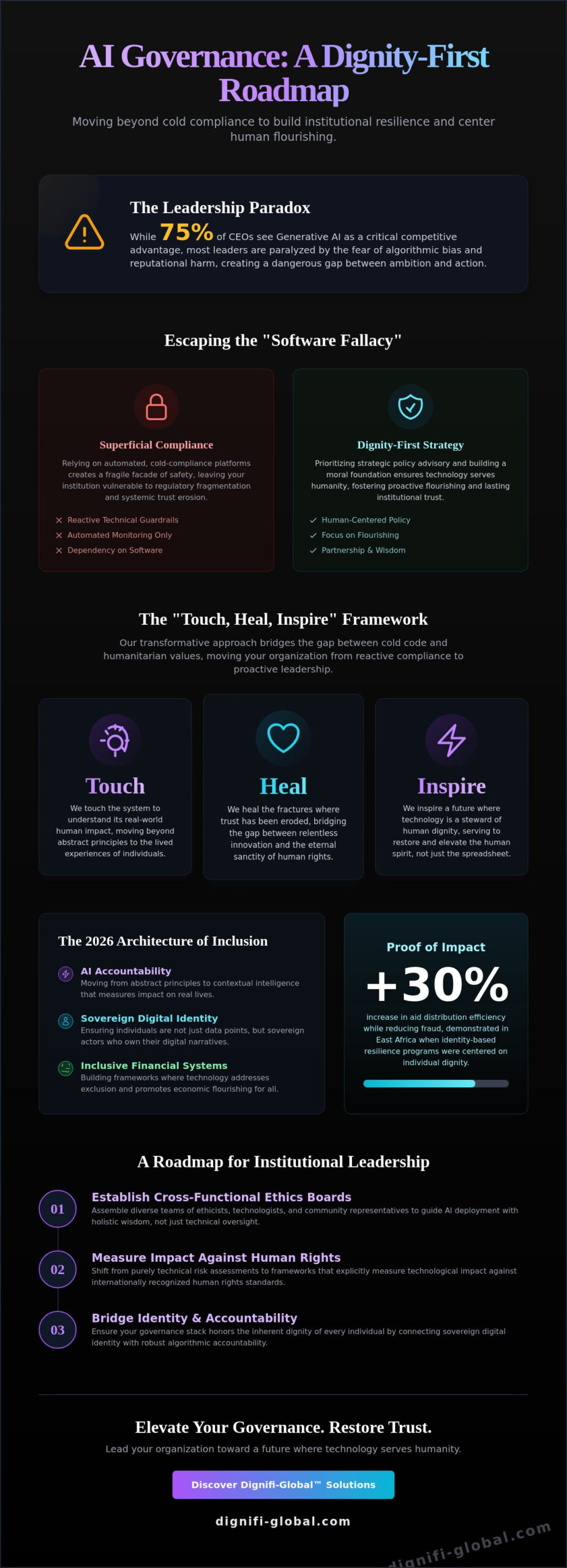
What if the greatest threat to your organization isn’t a technical glitch, but the systemic loss of human trust? In 2023, recent industry research indicates that 75% of CEOs believe competitive advantage depends on generative AI, yet most leaders remain paralyzed by the fear of algorithmic bias and reputational harm. You recognize that true leadership requires more than a software patch; it demands a moral foundation. Relying on superficial ai governance solutions often creates a facade of safety while leaving the core of your institution vulnerable to the complexities of global regulatory fragmentation.
We believe that people are not problems to be managed; they are lives to be honored. This guide offers a dignity-first roadmap designed to move your institution from reactive compliance to proactive flourishing. You’ll discover how our Touch, Heal, Inspire framework bridges the gap between cold code and humanitarian values. We’ll outline a clear strategy for building institutional resilience that centers on accountability and restores faith in the intersection of technology and human rights.
Key Takeaways
-
Learn to move beyond mere technical guardrails toward a systemic discipline that centers human flourishing as the ultimate metric of institutional success.
-
Discover why effective ai governance solutions must transcend the "Software Fallacy" by prioritizing strategic policy advisory over automated, cold-compliance platforms.
-
Understand how to bridge the gap between digital identity and algorithmic accountability, ensuring your governance stack honors the inherent dignity of every individual.
-
Gain a roadmap for operationalizing resilience through cross-functional Ethics Boards and risk assessments that measure technological impact against human rights.
-
Explore the transformative "Touch, Heal, Inspire" framework to lead your organization toward a future where technology serves to restore and elevate the human spirit.
Table of Contents
-
Defining the Horizon: What are AI Governance Solutions in 2026?
-
The Architecture of Inclusion: Core Components of Ethical Frameworks
-
Selecting the Path: Software Platforms vs. Strategic Policy Advisory
-
Operationalizing Resilience: A Roadmap for Institutional Leadership
-
Dignifi-Global™: Elevating Governance Through Dignity-First Strategy
Defining the Horizon: What are AI Governance Solutions in 2026?
By 2026, the global community has moved past the initial novelty of generative tools. Effective ai governance solutions are no longer merely technical checklists; they represent a systemic discipline of accountability and ethical conviction. We’ve shifted our gaze from simple technical guardrails toward the broader horizon of human flourishing. This transition recognizes that technology must serve the soul, not just the spreadsheet. It’s a movement that centers the individual within the digital architecture.
The 2026 landscape demands intersectional solutions that bridge the gaps between AI, digital identity, and global finance. These three pillars support the weight of modern civilization. True governance isn’t just automated monitoring or a series of software patches. It’s a foundational institutional commitment that restores trust where it’s been eroded. It’s about honoring the person behind the data point, ensuring that every deployment of code acts as a steward of human dignity.
The Evolution of AI Oversight: From Principles to Practice
High-level ethical principles, while noble, proved insufficient for building lasting institutional trust between 2023 and 2025. Modern policy now requires contextual intelligence. This means understanding how an algorithm affects a smallholder farmer differently than a corporate executive. We’ve moved from abstract ideals to lived experiences. AI governance serves as the vital bridge between the relentless pace of innovation and the eternal sanctity of human rights. We don’t just manage risks; we nurture potential. This approach allows us to Touch the system, Heal the fractures, and Inspire a future where technology elevates the human spirit.
The 2026 Regulatory Landscape: Beyond the EU AI Act
While the EU AI Act set a global benchmark when it was first proposed in 2021, the 2026 landscape is defined by a complex mosaic of regional and global standards. Organizations face a grueling test of resilience as algorithmic capabilities evolve weekly. Many leaders now turn to algorithmic governance to ensure their systems remain transparent, just, and aligned with international norms.
Global governance consulting plays a pivotal role in harmonizing these fragmented policies. It’s not about creating dependency on consultants; it’s about building internal partnership and wisdom. By centering ai governance solutions on a dignity-first framework, institutions can move beyond compliance. They begin to view their stakeholders through a lens of moral responsibility. We believe people are not problems to be managed, they are lives to be honored, and our governance structures must reflect this sacred truth.
The Architecture of Inclusion: Core Components of Ethical Frameworks
True ai governance solutions must do more than mitigate technical risk; they must center human dignity at every layer of the architectural stack. We aren’t just building code. We’re building the scaffolding for human flourishing. This shift requires us to stop viewing individuals as data points to be processed and start seeing them as lives to be honored. When we center dignity, every algorithmic decision becomes an act of stewardship. It’s a commitment to people, not just processes, and to partnership, not dependency.
Digital Identity: The Foundation of Sovereign Governance
A secure digital identity isn’t a luxury. It’s the prerequisite for sovereign governance. Without it, individuals remain invisible to the very systems designed to serve them. In the age of large-scale language models, protecting data sovereignty ensures that communities own their narratives rather than becoming fuel for extractive datasets. This alignment is reflected in global standards like the NIST AI Risk Management Framework, which emphasizes the need for trust, safety, and accountability in automated systems. In 2023, identity-based resilience programs in East Africa demonstrated that when individuals control their own digital credentials, aid distribution efficiency increases by 30 percent while reducing fraud. We must touch the system to heal the person.
Inclusive Financial System Development
Financial exclusion remains a global crisis. The World Bank reported in 2021 that 1.4 billion adults remain unbanked. Ethical AI offers a path to bridge this gap. By utilizing alternative data sets, we can mitigate algorithmic bias in credit scoring that historically marginalized entire populations. These ai governance solutions should prioritize partnership over dependency. It’s about restoring agency to the underserved. When we implement these systems, we inspire a new era of global participation. Our work at Dignifi-Global™ focuses on these foundational shifts, ensuring that technology serves as a bridge rather than a barrier. We move from managing problems to honoring the inherent potential within every community.
This transition from managing problems to honoring lives is particularly vital in humanitarian aid. Traditional models often treat recipients as passive subjects. Ethical frameworks transform them into active partners. By 2025, the integration of ethical AI in humanitarian logistics is projected to save 15 percent more lives through predictive resource allocation that respects local autonomy. We must ensure that our frameworks are not just robust, but also deeply empathetic. Achieving genuine financial inclusion through a dignity-first framework requires moving beyond the cold delivery of digital products to restore human agency at every level of the global economy. This is how we move toward a future where technology and humanity coexist in a state of mutual flourishing.
Selecting the Path: Software Platforms vs. Strategic Policy Advisory
The "Software Fallacy" is a growing risk in the global effort to regulate artificial intelligence. Many organizations believe that purchasing a dashboard equates to establishing a moral compass. It’s a dangerous assumption. While digital tools offer efficiency, they aren’t a substitute for the deep, reflective work of institutional strategy. True ai governance solutions are built on the bedrock of human values, not just the logic of an algorithm.
Technology should serve as the servant to human-led policy. When institutions prioritize software over strategy, they risk creating a hollow architecture that lacks the nuance required for complex humanitarian missions. We must center the human spirit at the heart of every technological choice, ensuring that our systems honor the inherent worth of every individual they touch.
When Software is Sufficient (and When it Fails)
Automated platforms provide essential technical monitoring for high-volume data environments. Tools like Credo AI or IBM Watsonx excel at identifying statistical bias and tracking model performance in real-time. These platforms are effective for routine audits; however, they often fall short when faced with non-routine ethical dilemmas that require cultural context or diplomatic sensitivity.
In high-stakes humanitarian contexts, relying solely on software leads to "compliance theater." This is a state where boxes are checked, yet the underlying risks to human dignity remain unaddressed. Organizations should utilize NIST’s AI Risk Management Framework to ground their technical efforts in established standards. However, a framework is a map, not the journey itself. Strategic advisory is required to interpret these standards when the path forward isn’t binary.
-
Technical Monitoring: Platforms track drift and accuracy with precision.
-
Ethical Limitations: Software cannot weigh the historical or sociopolitical consequences of a decision.
-
Humanitarian Risk: Automated systems may overlook the "invisible" populations who are often the most impacted by algorithmic bias.
The Dignifi-Global™ Methodology: Strategy Over Software
Our methodology begins with the premise that strategy must precede technology acquisition. We don’t start with a purchase order; we start with a purpose. By designing frameworks that are "top-down," we ensure that institutional transformation is led by visionaries who understand that people are not problems to be managed; they are lives to be honored. This philosophy guides our three-part heartbeat: Touch, Heal, and Inspire.
We believe in building partnerships over dependencies. This means centering dignity-first principles in every policy we craft. While software audits offer a point-in-time snapshot of technical compliance, continuous ethical leadership ensures that technology remains a vessel for human flourishing. Our approach restores the balance between innovation and accountability, bridging the gap between what is technically possible and what is morally right.
By the end of 2024, an estimated 70% of global enterprises will have some form of AI oversight, but only those with a foundational policy will achieve lasting trust. We help leaders move beyond the cold language of strategic advisory into a space of profound moral responsibility. As Gartner’s research confirms, ai transformation is a problem of governance — the majority of enterprise AI projects stall not because of technical limitations, but because they lack the structural and ethical anchor that only principled leadership can provide. This is how we build a future where technology doesn’t just process data, but honors the intersection of human rights and global progress.
Operationalizing Resilience: A Roadmap for Institutional Leadership
True resilience isn’t found in the strength of a firewall, but in the integrity of a promise. When we operationalize resilience, we move beyond the cold logic of risk mitigation to embrace a roadmap for institutional leadership that honors every person. This journey begins with the creation of a cross-functional AI Ethics Board. This body must represent a spectrum of lived experiences, ensuring that governance isn’t a siloed technical exercise but a collective moral commitment. By mapping algorithmic risk against human rights impact assessments, we ensure that ai governance solutions protect the marginalized rather than automating their exclusion. Continuous monitoring provides the contextual sight needed to see where systems fail to meet our highest ideals. We aim to foster a culture of accountability that doesn’t just manage problems, but actively restores the dignity of those we serve. Our methodology follows a sacred rhythm: we touch the pain of systemic failure, heal the breach through ethical design, and inspire a future where technology serves humanity.
The Board’s Role in AI Governance Auditing
Leadership begins with the courage to ask difficult questions during the procurement process. Boards must ask if a system upholds the inherent worth of the user or if it merely optimizes for efficiency at the cost of equity. It’s not enough to measure uptime; we must develop KPIs for human flourishing. A 2023 report from the Ada Lovelace Institute revealed that 62% of the public feels a sense of unease regarding automated decision-making. To bridge this gap, leaders must link AI transformation directly to the organization’s core mission. We don’t view stakeholders as data points to be processed; we see them as lives to be honored. By centering these values, ai governance solutions become a bridge to a more inclusive era of innovation.
Modernizing Humanitarian Aid Frameworks
In the humanitarian sector, the principle of non-refoulement must now extend to AI-driven data processing. Protecting vulnerable populations means ensuring their digital footprints aren’t weaponized to facilitate harm or displacement. We’re witnessing a shift from traditional relief to sustainable institutional resilience. This requires leveraging global standards, such as the 2021 UNESCO Recommendation on the Ethics of Artificial Intelligence, to guide aid distribution. This isn’t about dependency; it’s about partnership. By adopting these frameworks, institutions can ensure that technology acts as a restorative force. We must remain vigilant in our pursuit of justice, ensuring that every digital interaction serves to touch, heal, and inspire the communities we are privileged to support.
Discover how our visionary approach can transform your organization through dignity-first policy leadership and ethical strategy.
Dignifi-Global™: Elevating Governance Through Dignity-First Strategy
Technology often feels like a cold exchange of data; at Dignifi-Global™, we believe it’s a sacred trust. Our "Touch, Heal, Inspire" framework moves beyond standard compliance to ensure AI policy leadership honors the individual. We don’t view people as data points to be optimized; we see them as lives to be honored. This shift in perspective is the foundation of our ai governance solutions. It’s about centering the human experience in every line of code and every policy directive to ensure technology serves the spirit as much as the bottom line.
Her Excellency Roné de Beauvoir leads this charge with a vision that transcends traditional consulting. Her work focuses on shaping global inclusion by building bridges between technological capability and human rights. Dignifi-Global™ provides bespoke advisory services to multilateral partners and sovereign governments. These partnerships focus on systemic restoration rather than mere process management. We help institutions create frameworks that are both ethically sound and operationally resilient, moving from partnership over dependency to sustainable autonomy.
Our Commitment to Global Inclusion
Designing systems that restore dignity to the world’s most vulnerable is our primary directive. There’s a widening gap between rapid technological advancement and the sociological needs of diverse populations. In many developing regions, specific demographics remain digitally excluded from governance discussions, creating a rift in global progress. Dignifi-Global™ acts as a partner in building foundational institutional strength. We ensure that AI serves as a tool for elevation, not a mechanism for further marginalization. Our approach bridges the distance between the boardroom and the community, centering marginalized voices in the design of ai governance solutions. International organizations seeking to modernize their ethical frameworks can explore our comprehensive approach to global governance consulting at the intersection of ethics, AI, and human dignity.
Join the Vision: Partnership for a Resilient Future
The intersection of AI and ethics is the defining challenge of 2026. As global regulations tighten and societal expectations shift, the choice for leadership is clear. Leaders can react to change or they can define it. Taking the first step toward a comprehensive AI governance framework requires more than technical expertise; it requires moral courage. We invite you to co-create a future where technology serves humanity. By centering governance on dignity, we ensure long-term flourishing for all stakeholders. Partner with Dignifi-Global™ to design your ethical AI roadmap and lead with purpose in an evolving world.
Securing the Future of Human-Centric Leadership
The global landscape of 2026 demands a shift from passive compliance to active, ethical stewardship. Effective ai governance solutions are no longer optional for institutions seeking long-term resilience; they’re the bedrock of trust in a digital age. By centering the intersection of AI, Digital ID, and Financial Inclusion, leaders can move past traditional, process-heavy consulting toward a model that honors human rights. We don’t believe people are problems to be managed. We believe they’re lives to be honored through systemic accountability and inclusive design.
Led by Her Excellency Roné de Beauvoir, a global authority on humanitarian governance, Dignifi-Global™ brings a unique depth of wisdom to the strategic landscape. Our proprietary "Touch, Heal, Inspire" framework serves as a foundational methodology for restoring dignity within institutional structures. This approach ensures that technological growth results in flourishing for all, not just a few. It’s time to choose a path that prioritizes partnership over dependency and people over mere data sets.
Begin Your Dignity-First Governance Journey with Dignifi-Global™
The opportunity to shape a more equitable world starts with a single, principled decision to lead with conviction.
Frequently Asked Questions
What is the difference between AI governance and AI ethics?
AI ethics provides the moral compass for technology, while AI governance establishes the structural accountability required to enact those values. Ethics focuses on the philosophical "why" behind algorithmic fairness; governance builds the systemic "how" through policies and oversight. According to the IEEE 7000-2021 standard, ethical considerations must be baked into the design phase. We don’t just ponder right and wrong; we build frameworks that honor human flourishing.
How do AI governance solutions impact financial inclusion?
Robust ai governance solutions bridge the gap between technological advancement and universal financial access by eliminating algorithmic bias. These frameworks ensure that the 1.4 billion unbanked adults identified by the World Bank aren’t further marginalized by opaque credit scoring models. Our approach isn’t about managing risk; it’s about restoring opportunity. We use these tools to touch the lives of the underserved, heal systemic exclusion, and inspire economic independence. Learn how a dignity-first framework for financial inclusion can restore human agency and strengthen global institutional resilience for the world’s most vulnerable populations.
Is AI governance software enough to comply with global regulations?
Software alone can’t guarantee compliance with complex mandates like the 2024 EU AI Act because regulation requires human judgment and moral agency. While digital tools track data lineage, they can’t replicate the ethical leadership needed to navigate high-risk AI applications. Compliance isn’t a checkbox; it’s a commitment to transparency. We believe in centering people, not just processes, to ensure that technology serves the collective good rather than just meeting a legal minimum.
What are the main risks of failing to implement an AI governance framework?
Organizations that neglect formal frameworks face catastrophic legal liabilities and the irreversible erosion of public trust. Under the GDPR, non-compliance can result in fines reaching 4% of total global turnover, but the moral cost is often higher. A failure to govern is a failure to protect the dignity of the individual. Without a roadmap, AI becomes a source of harm rather than a catalyst for global healing and societal progress.
How does digital identity relate to AI governance?
Digital identity serves as the foundational layer of accountability within any ethical governance system. It ensures that every individual is recognized and protected, aligning with the UN Sustainable Development Goal 16.9 to provide legal identity for all by 2030. We don’t view identity as a data point; we see it as a human right. By anchoring AI in secure identity, we bridge the gap between digital systems and human worth.
What role does leadership play in successful AI transformation?
Leadership defines the ethical horizon of a digital transformation, acting as the primary driver of organizational integrity. Research from MIT Sloan indicates that 75% of digital transformations fail due to cultural resistance rather than technical limitations. Leaders must transition from being managers of systems to being stewards of human potential. It’s a shift from directing operations to honoring the lives of every stakeholder involved in the technological journey.
Can AI governance be automated?
You can automate technical monitoring and data logging, but you can’t automate the moral responsibility of ethical decision-making. The NIST AI Risk Management Framework 1.0 emphasizes that human oversight is vital to mitigate unpredictable algorithmic behaviors. Automation helps us scale our efforts, but it doesn’t replace the need for a "dignity-first" perspective. We use technology to support our mission, not to outsource our conscience or our accountability to humanity.
How does Dignifi-Global™ approach AI policy for humanitarian aid?
Dignifi-Global™ approaches humanitarian policy by centering the lived experiences of those in crisis through our "Touch, Heal, Inspire" methodology. We don’t treat displaced populations as problems to be managed; we treat them as lives to be honored. Our frameworks focus on restoring agency to the 110 million forcibly displaced people worldwide as reported by the UNHCR in 2023. This isn’t just policy; it’s a moral imperative to ensure technology serves the most vulnerable.