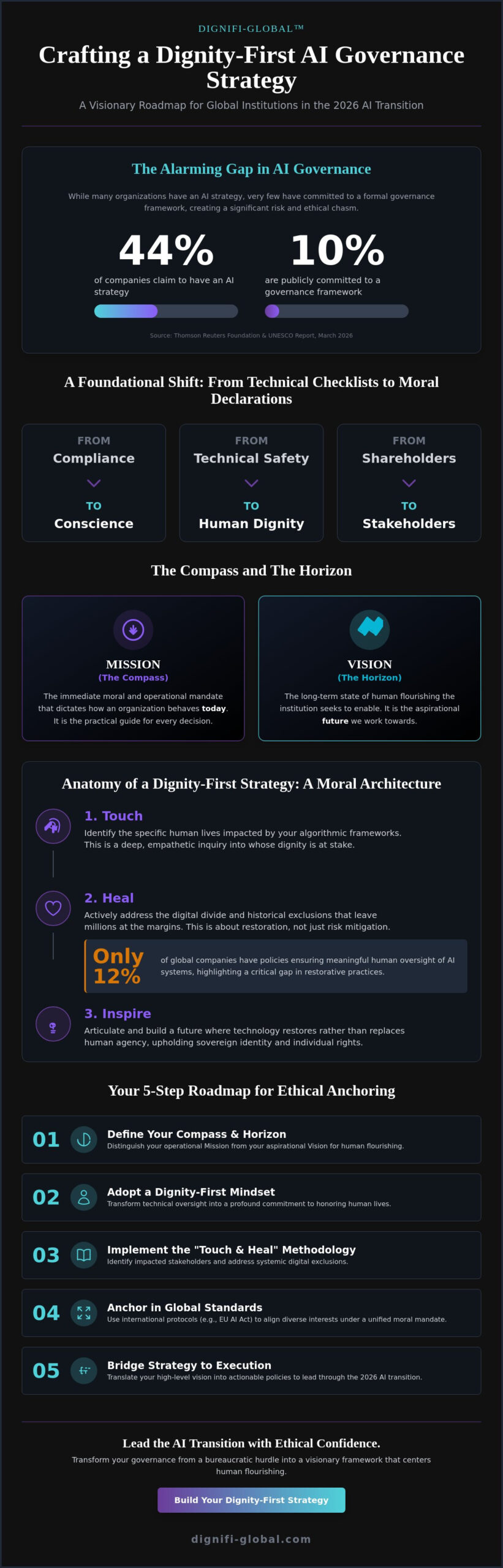
A March 2026 report by the Thomson Reuters Foundation and UNESCO reveals a startling reality: while 44% of companies claim to have an AI strategy, only 10% are publicly committed to a formal governance framework. This disconnect suggests that most organizations still view technology as a problem to be managed rather than a life to be honored. You’ve likely felt the growing tension between high-level ethical ideals and the practical reality of technical execution. It’s a gap that threatens to leave even the most prestigious organizations behind as global standards like the EU AI Act evolve toward their 2027 deadlines. Developing a robust ai governance strategy for global institutions isn’t about building a technical manual; it’s about making a moral declaration.
We believe that institutional resilience is rooted in people, not processes. This article provides a clear, actionable roadmap to help you craft a dignity-first mission and vision that aligns diverse stakeholders across the globe. You’ll learn to transform your governance from a bureaucratic hurdle into a visionary framework that centers human flourishing. We’ll preview the essential steps to bridge the intersection of technology and human rights, ensuring your institution doesn’t just survive the digital shift but leads it with steady, ethical confidence.
Key Takeaways
- Distinguish your mission as an operational compass from your vision as a horizon for human flourishing to ensure your strategy remains both practical and aspirational.
- Learn to craft a dignity-first ai governance strategy for global institutions that transforms technical oversight into a profound commitment to honoring human lives.
- Implement the “Touch” and “Heal” methodology to identify impacted stakeholders and address the systemic exclusions often hidden within digital frameworks.
- Follow a five-step roadmap for ethical anchoring, using international protocols to align diverse global interests under a single, unified moral mandate.
- Bridge the gap between strategic drafting and policy execution to lead your institution through the complex regulatory shifts of the 2026 AI transition.
What is an AI Governance Mission and Vision for Global Institutions?
In the pursuit of systemic justice, an organization’s mission and vision serve as the dual pillars of its institutional soul. We define the AI governance mission as the “Compass.” It’s the immediate moral and operational mandate that dictates how an organization behaves today. Conversely, the vision is the “Horizon.” It represents the long-term state of human flourishing that the institution seeks to enable through its presence in the world. Traditional corporate mission statements often fail in the humanitarian sector because they prioritize efficiency over equity; they focus on shareholders rather than stakeholders. In the context of global aid, optimization is not the goal; restoration is. Dignity-First AI Governance is a transformative strategy that centers the sanctity of human life over the optimization of technical processes.
Crafting a robust ai governance strategy for global institutions requires a departure from the cold, clinical language of risk management. It demands a vocabulary of responsibility. When we define our purpose, we aren’t just checking boxes for a board meeting. We’re establishing a foundational promise to the communities we serve. This process involves more than just software updates; it involves a fundamental shift in how we view the intersection of technology and human rights.
The Shift from Compliance to Conscience
By May 2026, the global landscape of AI regulation has moved decisively toward protecting fundamental rights. We can no longer settle for a “do no harm” mentality. We must strive for proactive flourishing. Global governance consulting acts as the bridge here, connecting the rapid pace of innovation with the steady pulse of ethical conviction. We must contrast “Technical Safety” with “Human Dignity” in our strategic language. Safety is about avoiding errors; dignity is about honoring lives. It’s the difference between a system that doesn’t crash and a system that empowers the vulnerable.
Institutional Resilience as a Strategic Anchor
A strong vision protects organizations from ethical drift during periods of rapid technological upheaval. It ensures that every algorithmic decision aligns with the core mandate of financial inclusion and social equity. This ai governance strategy for global institutions views the intersection of AI policy and digital identity as a foundational pillar of resilience. When we anchor our strategy in human worth, we build systems that don’t just survive the digital shift. We build systems that inspire trust, bridge the digital divide, and foster long-term global stability.
The Anatomy of a Dignity-First AI Strategy
A dignity-first ai governance strategy for global institutions is built upon a rhythmic methodology: Touch, Heal, and Inspire. This framework moves beyond the traditional, data-centric models that treat individuals as problems to be managed. Instead, it honors them as lives to be restored. This approach is not a technical manual; it is a moral architecture designed to withstand the rapid shifts of the digital age.
In the Touch phase, we identify the specific human lives impacted by our algorithmic frameworks. This isn’t a high-level demographic analysis. It’s a deep, empathetic inquiry into whose dignity is at stake when a system makes a decision. The Heal phase follows, where we actively address the digital divide and the historical exclusions that leave millions at the margins. By May 2026, the necessity for this healing is clear; reports show that only 12% of global companies currently have policies ensuring human oversight of AI systems. Finally, the Inspire phase articulates a future where technology restores rather than replaces human agency. This requires a networked approach to AI governance that balances institutional power with individual rights.
The vocabulary of 2026 reflects this shift toward ethical conviction. We must speak of sovereign identity, where individuals own and control their digital presence. We must uphold non-refoulement in digital spaces, ensuring AI isn’t used to push the vulnerable back into harm’s way. We must demand algorithmic accountability that is both transparent and auditable. These aren’t just words; they’re foundational pillars of a resilient global institution.
Centering the Vulnerable in AI Policy
True institutional resilience begins at the margins. Your vision must prioritize those least served by existing systems. By incorporating community finance principles, we ensure that AI governance doesn’t just manage risk but actively builds wealth and opportunity. We’re moving from a model of dependency to one of partnership. This shift ensures that humanitarian AI frameworks empower local communities to lead their own development rather than waiting for external intervention.
The Role of Digital Identity in AI Vision
You can’t have ethical AI without a secure foundation for the individual. This is why digital identity system design is inseparable from an effective ai governance strategy for global institutions. Our mission must protect the “sovereign self” in an increasingly automated world. We draft clauses that honor lives, ensuring that identity remains a tool for liberation, not a mechanism for surveillance. If your organization seeks to lead this transition, exploring global governance consulting can help align your policy with these high-minded ideals.
Mission vs. Vision: Distinguishing the Horizon from the Compass
To lead with ethical conviction, a global leader must distinguish between the path they walk and the destination they seek. The mission serves as the “Compass,” providing the operational mandate for the what and how of daily oversight. It centers on accountability, transparency, and the rigorous application of foundational standards. Conversely, the vision is the “Horizon,” representing the aspirational “Why” behind every algorithmic decision. While the mission governs the process, the vision honors the life. A successful ai governance strategy for global institutions requires these two elements to be parallel yet distinct, ensuring that technical execution never loses sight of humanitarian purpose.
Consider the practical divergence between institutional mandates. A non-governmental organization (NGO) might draft a mission focused on “ensuring algorithmic non-refoulement in humanitarian corridors,” while its vision paints a world where “technology restores the agency of the displaced.” In contrast, a multilateral development bank may frame its mission around “inclusive financial system development through auditable AI lending,” with a vision of “universal financial flourishing that transcends geographic borders.” Both are principled, yet their operational compasses are tuned to their specific institutional callings.
Drafting the Mission: The Operational Mandate
The mission must provide a foundational governance structure that survives rapid technology cycles. By May 2026, this requires “Contextual Intelligence,” a specific capacity to adapt AI oversight to local sociological realities. It’s not enough to follow the ISO/IEC 42001:2023 standard; the mission must define the exact intersection where your technology meets human rights. This mandate ensures that accountability isn’t a vague ideal but a daily practice of centering the vulnerable. It moves the organization from a state of passive compliance to one of active stewardship, where policy frameworks are built to protect, not just to process.
Drafting the Vision: The Aspirational North Star
Your vision must be an evocative declaration of intent. It should employ powerful verbs: Centering the marginalized, Restoring lost agency, Bridging the digital divide, and Honoring the sovereign self. This aspirational North Star is critical for overcoming the “Trust Deficit” identified by global reports in early 2026, which found that only 12% of companies have policies ensuring human oversight. A visionary ai governance strategy for global institutions looks beyond the immediate hurdles of the EU AI Act or NIST frameworks. It imagines a state of global inclusion where technology serves as a partner in human dignity rather than a tool for systemic exclusion. When the horizon is clear, the institution remains resilient, guided by a steady confidence that suggests long-term wisdom.
How to Write Your AI Governance Strategy: A 5-Step Process
Developing an ai governance strategy for global institutions requires a transition from abstract philosophy to systemic action. It’s a journey that moves from the heart to the head. We follow five deliberate steps to ensure your framework is both visionary and grounded in moral responsibility. This process ensures that your institution doesn’t just manage technology but honors the humanity at its center.
- Step 1: Stakeholder Mapping. Identify whose dignity is at stake by looking beyond the immediate user to the broader community. This is the “Touch” phase of our methodology.
- Step 2: Ethical Anchoring. Align your strategy with international protocols like the Palermo Protocol and UNESCO’s 2021 Recommendation on the Ethics of AI. As of March 2026, over 70 countries have built their national strategies upon these global standards.
- Step 3: Drafting the “Dignity-First” Core. Focus on lives to be honored; not data points to be processed. This step centers human flourishing as the primary metric of success.
- Step 4: Stress-Testing. Use the NIST Generative AI Profile to simulate failures against your mission. With only 12% of companies ensuring human oversight in early 2026, this step is vital for institutional resilience.
- Step 5: Institutional Integration. Move your high-minded vision into the hard reality of policy leadership. This is where the “Inspire” phase takes root, embedding the vision into the institutional DNA.
Gathering the Global Perspective
Top-down governance often fails because it ignores the bottom-up human experience. We must engage multilateral partners to ensure cross-border interoperability and shared accountability. Use the “Touch, Heal, Inspire” rhythm to guide stakeholder workshops, centering those at the intersection of technology and human rights. This collaborative approach builds partnership over dependency, ensuring your ai governance strategy for global institutions reflects a truly global mandate. By centering the vulnerable, we create a resilient framework that bridges the digital divide.
Refining the Language for Maximum Impact
Avoid the clinical, cold language of traditional consulting. Opt instead for institutional gravitas that reflects the weight of your humanitarian mission. Use “not/but” structures to clarify your shift in perspective. For example, your strategy should state: “We focus not on data management, but on human flourishing.” Your institution’s unique moral mandate should be a single, declarative sentence that honors the sovereign self. If you’re ready to move from vision to execution, our global governance consulting can help bridge the gap between high-level ethics and technical reality.
From Vision to Framework: Leading the 2026 AI Transition
The journey from a drafted vision to a living framework is the ultimate test of institutional leadership. It requires moving beyond the “Horizon” to implement concrete AI governance solutions that reflect your organization’s ethical soul. As we approach the December 2027 deadlines for the EU AI Act’s high-risk system requirements, the window for purely theoretical ethics is closing. We must establish moral authority before technological dominance takes hold. This transition demands the presence of a “Global Statesperson.” This is a leader who views technology not as a tool for extraction, but as a medium for restoration.
Success in this new era is not measured by traditional KPIs alone. We must look toward “Dignity Metrics.” These metrics evaluate the extent to which an algorithm preserves human agency, bridges the digital divide, and honors the sovereign self. When we prioritize these values, we transform our ai governance strategy for global institutions from a defensive posture into a proactive force for global inclusion. It’s a shift from managing risks to honoring lives.
Operationalizing the Vision
Translating aspirational goals into accountable policy frameworks requires steady, principled action. It’s about moving from the “Inspire” phase to the “Heal” phase in a practical, auditable way. This involves continuous auditing and what we call “Organizational Sight Validation.” This process ensures your algorithmic outputs remain aligned with your foundational mission even as technology evolves. Dignifi-Global™ stands as your partner in this transformative journey. We provide the strategic insights and thought leadership necessary to navigate the complex intersection of artificial intelligence and human rights with absolute clarity.
The Future of Institutional Resilience
The most resilient institutions of 2026 won’t be those with the most advanced code; they’ll be those with the clearest moral vision. True resilience is found in people, not processes. We must move from a dependency on technology to a partnership with humanity. This shift is the only way to restore trust in a landscape where, as of March 2026, only 10% of companies are publicly committed to a formal governance framework. A robust ai governance strategy for global institutions is the cornerstone of this new, humane era.
If your organization is ready to lead with ethical conviction, the time for systemic action is now. We invite you to reach out to HE Roné de Beauvoir for bespoke global governance consulting. Together, we can craft a strategy that honors every life it touches. Let’s build a future where technology serves the flourishing of all humanity, guided by a steady confidence and a long-term perspective.
Honoring Humanity in the Age of Automation
The journey toward ethical AI is not a race for technical dominance; it’s a commitment to systemic justice. You’ve learned how a mission serves as your operational compass while a vision provides the horizon for human flourishing. By following our five-step roadmap, you can move from abstract principles to an actionable ai governance strategy for global institutions that protects the vulnerable. This approach ensures that technology restores agency rather than merely managing problems. It prepares your organization for the rigorous December 2027 standards of the EU AI Act while addressing the trust deficit noted in March 2026 reports.
We stand at the nexus of technology and human rights, ready to guide your transition. Led by Her Excellency Roné de Beauvoir, our team specializes in humanitarian resilience and global inclusion. We utilize our proprietary “Touch, Heal, Inspire” methodology to transform policy into a profound declaration of human worth. Partner with Dignifi-Global™ to design your dignity-first AI governance framework and lead your institution with steady, ethical confidence. The future of humanity is not a problem to be managed; it’s a life to be honored. We look forward to building this new, humane era alongside you.
Frequently Asked Questions
How do I ensure my AI mission statement isn’t just ‘ethics washing’?
You ensure authenticity by anchoring your mission in auditable outcomes and specific international protocols. If your declaration doesn’t influence at least 25% of your procurement criteria or technical KPIs, it remains a superficial gesture. True commitment requires a shift from passive compliance to active stewardship, where every algorithmic choice is measured against its impact on human flourishing.
Should our AI vision be separate from our general institutional vision?
Your AI vision must be a specialized extension of your core institutional mandate. It acts as a digital mirror to your humanitarian values, ensuring that technology serves the same North Star as your physical operations. Siloing these visions creates a disconnect between your high-level ethics and your technical execution, which can lead to systemic institutional drift.
What are the most important ethical terms to include in AI governance in 2026?
Prioritize terms like sovereign identity, digital non-refoulement, and algorithmic accountability. These phrases move your framework beyond cold, technical safety toward a state of proactive restoration. Including “contextual intelligence” is also vital, as it reflects the requirement to adapt global standards to local sociological realities, a trend emphasized in the African Union’s 2024 Continental AI Strategy.
How often should a global institution update its AI governance strategy?
Review your strategy annually, with a deep recalibration occurring every 24 months to address the rapid pace of regulatory change. The December 2027 deadlines for high-risk systems under the EU AI Act make this frequency a requirement for institutional resilience. Regular updates allow you to integrate new guidance, such as the NIST AI 600-1 profile, while maintaining your foundational moral conviction.
Can a mission statement truly prevent algorithmic bias?
A mission statement sets the moral mandate for the technical audits and data scrubbing processes that actually reduce bias. It provides the “Compass” that empowers your teams to prioritize equity over speed. While the mission itself is not a technical fix, it creates the institutional accountability necessary to treat bias as a violation of human dignity rather than a mere data error.
What is the difference between AI ethics and AI governance in a strategy document?
AI ethics defines the “Why” and the moral principles of your organization, while AI governance provides the “How” through policy and accountability. Ethics is the soul of your framework; governance is the skeletal structure that supports it. A robust ai governance strategy for global institutions requires both to ensure that high-minded ideals are translated into concrete, systemic actions.
How do we balance ‘Innovation’ with ‘Dignity’ in our vision statement?
You balance these by defining innovation as a mechanism that serves human dignity, not as an independent goal. Your vision should state that progress is only legitimate if it restores agency and honors the sovereign self. This perspective ensures that technical advancements are viewed through a lens of partnership with humanity rather than a desire for technological dominance.
Who should be responsible for drafting the AI governance mission?
A cross-functional council led by an ethical visionary or a global statesperson should hold responsibility for drafting the mission. This group must include voices from the margins of the digital economy to ensure the ai governance strategy for global institutions is inclusive. This collaborative approach prevents the disconnect between high-level leadership and the ground-level human experience, centering lives instead of just managing problems.