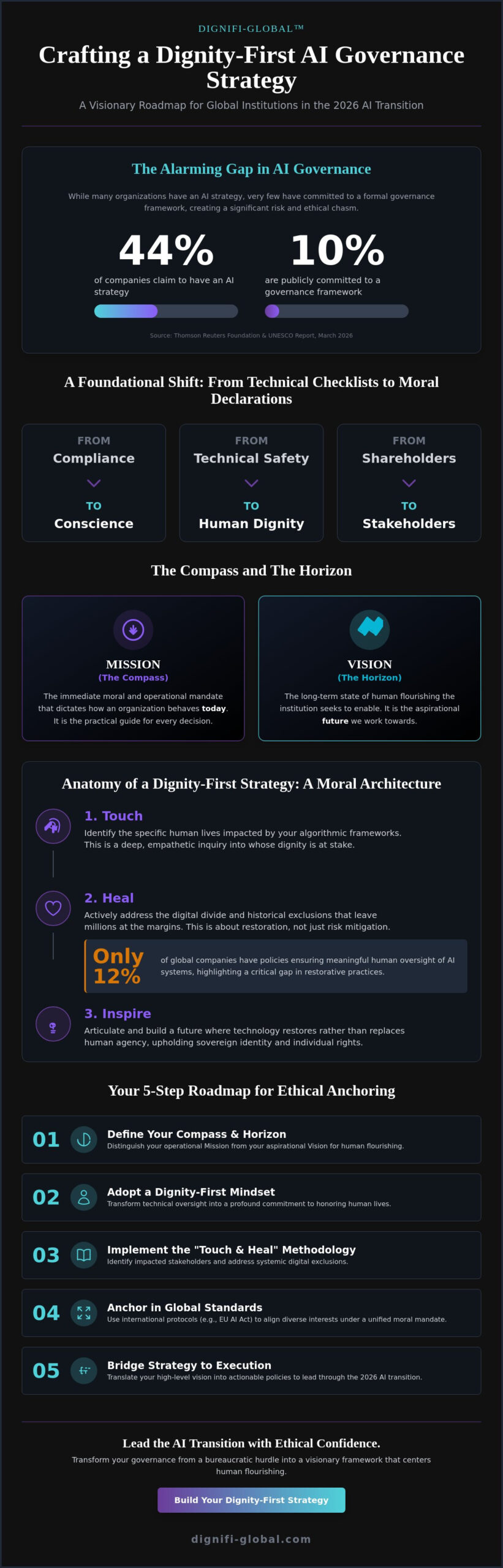
A March 2026 report by the Thomson Reuters Foundation and UNESCO reveals a startling reality: while 44% of companies claim to have an AI strategy, only 10% are publicly committed to a formal governance framework. This disconnect suggests that most organizations still view technology as a problem to be managed rather than a life to be honored. You’ve likely felt the growing tension between high-level ethical ideals and the practical reality of technical execution. It’s a gap that threatens to leave even the most prestigious organizations behind as global standards like the EU AI Act evolve toward their 2027 deadlines. Developing a robust ai governance strategy for global institutions isn’t about building a technical manual; it’s about making a moral declaration.

We believe that institutional resilience is rooted in people, not processes. This article provides a clear, actionable roadmap to help you craft a dignity-first mission and vision that aligns diverse stakeholders across the globe. You’ll learn to transform your governance from a bureaucratic hurdle into a visionary framework that centers human flourishing. We’ll preview the essential steps to bridge the intersection of technology and human rights, ensuring your institution doesn’t just survive the digital shift but leads it with steady, ethical confidence.

Key Takeaways

  • Distinguish your mission as an operational compass from your vision as a horizon for human flourishing to ensure your strategy remains both practical and aspirational.
  • Learn to craft a dignity-first ai governance strategy for global institutions that transforms technical oversight into a profound commitment to honoring human lives.
  • Implement the “Touch” and “Heal” methodology to identify impacted stakeholders and address the systemic exclusions often hidden within digital frameworks.
  • Follow a five-step roadmap for ethical anchoring, using international protocols to align diverse global interests under a single, unified moral mandate.
  • Bridge the gap between strategic drafting and policy execution to lead your institution through the complex regulatory shifts of the 2026 AI transition.

What is an AI Governance Mission and Vision for Global Institutions?

In the pursuit of systemic justice, an organization’s mission and vision serve as the dual pillars of its institutional soul. We define the AI governance mission as the “Compass.” It’s the immediate moral and operational mandate that dictates how an organization behaves today. Conversely, the vision is the “Horizon.” It represents the long-term state of human flourishing that the institution seeks to enable through its presence in the world. Traditional corporate mission statements often fail in the humanitarian sector because they prioritize efficiency over equity; they focus on shareholders rather than stakeholders. In the context of global aid, optimization is not the goal; restoration is. Dignity-First AI Governance is a transformative strategy that centers the sanctity of human life over the optimization of technical processes.

Crafting a robust ai governance strategy for global institutions requires a departure from the cold, clinical language of risk management. It demands a vocabulary of responsibility. When we define our purpose, we aren’t just checking boxes for a board meeting. We’re establishing a foundational promise to the communities we serve. This process involves more than just software updates; it involves a fundamental shift in how we view the intersection of technology and human rights.

The Shift from Compliance to Conscience

By May 2026, the global landscape of AI regulation has moved decisively toward protecting fundamental rights. We can no longer settle for a “do no harm” mentality. We must strive for proactive flourishing. Global governance consulting acts as the bridge here, connecting the rapid pace of innovation with the steady pulse of ethical conviction. We must contrast “Technical Safety” with “Human Dignity” in our strategic language. Safety is about avoiding errors; dignity is about honoring lives. It’s the difference between a system that doesn’t crash and a system that empowers the vulnerable.

Institutional Resilience as a Strategic Anchor

A strong vision protects organizations from ethical drift during periods of rapid technological upheaval. It ensures that every algorithmic decision aligns with the core mandate of financial inclusion and social equity. This ai governance strategy for global institutions views the intersection of AI policy and digital identity as a foundational pillar of resilience. When we anchor our strategy in human worth, we build systems that don’t just survive the digital shift. We build systems that inspire trust, bridge the digital divide, and foster long-term global stability.

The Anatomy of a Dignity-First AI Strategy

A dignity-first ai governance strategy for global institutions is built upon a rhythmic methodology: Touch, Heal, and Inspire. This framework moves beyond the traditional, data-centric models that treat individuals as problems to be managed. Instead, it honors them as lives to be restored. This approach is not a technical manual; it is a moral architecture designed to withstand the rapid shifts of the digital age.

In the Touch phase, we identify the specific human lives impacted by our algorithmic frameworks. This isn’t a high-level demographic analysis. It’s a deep, empathetic inquiry into whose dignity is at stake when a system makes a decision. The Heal phase follows, where we actively address the digital divide and the historical exclusions that leave millions at the margins. By May 2026, the necessity for this healing is clear; reports show that only 12% of global companies currently have policies ensuring human oversight of AI systems. Finally, the Inspire phase articulates a future where technology restores rather than replaces human agency. This requires a networked approach to AI governance that balances institutional power with individual rights.

The vocabulary of 2026 reflects this shift toward ethical conviction. We must speak of sovereign identity, where individuals own and control their digital presence. We must uphold non-refoulement in digital spaces, ensuring AI isn’t used to push the vulnerable back into harm’s way. We must demand algorithmic accountability that is both transparent and auditable. These aren’t just words; they’re foundational pillars of a resilient global institution.

Centering the Vulnerable in AI Policy

True institutional resilience begins at the margins. Your vision must prioritize those least served by existing systems. By incorporating community finance principles, we ensure that AI governance doesn’t just manage risk but actively builds wealth and opportunity. We’re moving from a model of dependency to one of partnership. This shift ensures that humanitarian AI frameworks empower local communities to lead their own development rather than waiting for external intervention.

The Role of Digital Identity in AI Vision

You can’t have ethical AI without a secure foundation for the individual. This is why digital identity system design is inseparable from an effective ai governance strategy for global institutions. Our mission must protect the “sovereign self” in an increasingly automated world. We draft clauses that honor lives, ensuring that identity remains a tool for liberation, not a mechanism for surveillance. If your organization seeks to lead this transition, exploring global governance consulting can help align your policy with these high-minded ideals.
How to Write a Mission and Vision for AI Governance in Global Institutions

Mission vs. Vision: Distinguishing the Horizon from the Compass

To lead with ethical conviction, a global leader must distinguish between the path they walk and the destination they seek. The mission serves as the “Compass,” providing the operational mandate for the what and how of daily oversight. It centers on accountability, transparency, and the rigorous application of foundational standards. Conversely, the vision is the “Horizon,” representing the aspirational “Why” behind every algorithmic decision. While the mission governs the process, the vision honors the life. A successful ai governance strategy for global institutions requires these two elements to be parallel yet distinct, ensuring that technical execution never loses sight of humanitarian purpose.

Consider the practical divergence between institutional mandates. A non-governmental organization (NGO) might draft a mission focused on “ensuring algorithmic non-refoulement in humanitarian corridors,” while its vision paints a world where “technology restores the agency of the displaced.” In contrast, a multilateral development bank may frame its mission around “inclusive financial system development through auditable AI lending,” with a vision of “universal financial flourishing that transcends geographic borders.” Both are principled, yet their operational compasses are tuned to their specific institutional callings.

Drafting the Mission: The Operational Mandate

The mission must provide a foundational governance structure that survives rapid technology cycles. By May 2026, this requires “Contextual Intelligence,” a specific capacity to adapt AI oversight to local sociological realities. It’s not enough to follow the ISO/IEC 42001:2023 standard; the mission must define the exact intersection where your technology meets human rights. This mandate ensures that accountability isn’t a vague ideal but a daily practice of centering the vulnerable. It moves the organization from a state of passive compliance to one of active stewardship, where policy frameworks are built to protect, not just to process.

Drafting the Vision: The Aspirational North Star

Your vision must be an evocative declaration of intent. It should employ powerful verbs: Centering the marginalized, Restoring lost agency, Bridging the digital divide, and Honoring the sovereign self. This aspirational North Star is critical for overcoming the “Trust Deficit” identified by global reports in early 2026, which found that only 12% of companies have policies ensuring human oversight. A visionary ai governance strategy for global institutions looks beyond the immediate hurdles of the EU AI Act or NIST frameworks. It imagines a state of global inclusion where technology serves as a partner in human dignity rather than a tool for systemic exclusion. When the horizon is clear, the institution remains resilient, guided by a steady confidence that suggests long-term wisdom.

How to Write Your AI Governance Strategy: A 5-Step Process

Developing an ai governance strategy for global institutions requires a transition from abstract philosophy to systemic action. It’s a journey that moves from the heart to the head. We follow five deliberate steps to ensure your framework is both visionary and grounded in moral responsibility. This process ensures that your institution doesn’t just manage technology but honors the humanity at its center.

  • Step 1: Stakeholder Mapping. Identify whose dignity is at stake by looking beyond the immediate user to the broader community. This is the “Touch” phase of our methodology.
  • Step 2: Ethical Anchoring. Align your strategy with international protocols like the Palermo Protocol and UNESCO’s 2021 Recommendation on the Ethics of AI. As of March 2026, over 70 countries have built their national strategies upon these global standards.
  • Step 3: Drafting the “Dignity-First” Core. Focus on lives to be honored; not data points to be processed. This step centers human flourishing as the primary metric of success.
  • Step 4: Stress-Testing. Use the NIST Generative AI Profile to simulate failures against your mission. With only 12% of companies ensuring human oversight in early 2026, this step is vital for institutional resilience.
  • Step 5: Institutional Integration. Move your high-minded vision into the hard reality of policy leadership. This is where the “Inspire” phase takes root, embedding the vision into the institutional DNA.

Gathering the Global Perspective

Top-down governance often fails because it ignores the bottom-up human experience. We must engage multilateral partners to ensure cross-border interoperability and shared accountability. Use the “Touch, Heal, Inspire” rhythm to guide stakeholder workshops, centering those at the intersection of technology and human rights. This collaborative approach builds partnership over dependency, ensuring your ai governance strategy for global institutions reflects a truly global mandate. By centering the vulnerable, we create a resilient framework that bridges the digital divide.

Refining the Language for Maximum Impact

Avoid the clinical, cold language of traditional consulting. Opt instead for institutional gravitas that reflects the weight of your humanitarian mission. Use “not/but” structures to clarify your shift in perspective. For example, your strategy should state: “We focus not on data management, but on human flourishing.” Your institution’s unique moral mandate should be a single, declarative sentence that honors the sovereign self. If you’re ready to move from vision to execution, our global governance consulting can help bridge the gap between high-level ethics and technical reality.

From Vision to Framework: Leading the 2026 AI Transition

The journey from a drafted vision to a living framework is the ultimate test of institutional leadership. It requires moving beyond the “Horizon” to implement concrete AI governance solutions that reflect your organization’s ethical soul. As we approach the December 2027 deadlines for the EU AI Act’s high-risk system requirements, the window for purely theoretical ethics is closing. We must establish moral authority before technological dominance takes hold. This transition demands the presence of a “Global Statesperson.” This is a leader who views technology not as a tool for extraction, but as a medium for restoration.

Success in this new era is not measured by traditional KPIs alone. We must look toward “Dignity Metrics.” These metrics evaluate the extent to which an algorithm preserves human agency, bridges the digital divide, and honors the sovereign self. When we prioritize these values, we transform our ai governance strategy for global institutions from a defensive posture into a proactive force for global inclusion. It’s a shift from managing risks to honoring lives.

Operationalizing the Vision

Translating aspirational goals into accountable policy frameworks requires steady, principled action. It’s about moving from the “Inspire” phase to the “Heal” phase in a practical, auditable way. This involves continuous auditing and what we call “Organizational Sight Validation.” This process ensures your algorithmic outputs remain aligned with your foundational mission even as technology evolves. Dignifi-Global™ stands as your partner in this transformative journey. We provide the strategic insights and thought leadership necessary to navigate the complex intersection of artificial intelligence and human rights with absolute clarity.

The Future of Institutional Resilience

The most resilient institutions of 2026 won’t be those with the most advanced code; they’ll be those with the clearest moral vision. True resilience is found in people, not processes. We must move from a dependency on technology to a partnership with humanity. This shift is the only way to restore trust in a landscape where, as of March 2026, only 10% of companies are publicly committed to a formal governance framework. A robust ai governance strategy for global institutions is the cornerstone of this new, humane era.

If your organization is ready to lead with ethical conviction, the time for systemic action is now. We invite you to reach out to HE Roné de Beauvoir for bespoke global governance consulting. Together, we can craft a strategy that honors every life it touches. Let’s build a future where technology serves the flourishing of all humanity, guided by a steady confidence and a long-term perspective.

Honoring Humanity in the Age of Automation

The journey toward ethical AI is not a race for technical dominance; it’s a commitment to systemic justice. You’ve learned how a mission serves as your operational compass while a vision provides the horizon for human flourishing. By following our five-step roadmap, you can move from abstract principles to an actionable ai governance strategy for global institutions that protects the vulnerable. This approach ensures that technology restores agency rather than merely managing problems. It prepares your organization for the rigorous December 2027 standards of the EU AI Act while addressing the trust deficit noted in March 2026 reports.

We stand at the nexus of technology and human rights, ready to guide your transition. Led by Her Excellency Roné de Beauvoir, our team specializes in humanitarian resilience and global inclusion. We utilize our proprietary “Touch, Heal, Inspire” methodology to transform policy into a profound declaration of human worth. Partner with Dignifi-Global™ to design your dignity-first AI governance framework and lead your institution with steady, ethical confidence. The future of humanity is not a problem to be managed; it’s a life to be honored. We look forward to building this new, humane era alongside you.

Frequently Asked Questions

How do I ensure my AI mission statement isn’t just ‘ethics washing’?

You ensure authenticity by anchoring your mission in auditable outcomes and specific international protocols. If your declaration doesn’t influence at least 25% of your procurement criteria or technical KPIs, it remains a superficial gesture. True commitment requires a shift from passive compliance to active stewardship, where every algorithmic choice is measured against its impact on human flourishing.

Should our AI vision be separate from our general institutional vision?

Your AI vision must be a specialized extension of your core institutional mandate. It acts as a digital mirror to your humanitarian values, ensuring that technology serves the same North Star as your physical operations. Siloing these visions creates a disconnect between your high-level ethics and your technical execution, which can lead to systemic institutional drift.

What are the most important ethical terms to include in AI governance in 2026?

Prioritize terms like sovereign identity, digital non-refoulement, and algorithmic accountability. These phrases move your framework beyond cold, technical safety toward a state of proactive restoration. Including “contextual intelligence” is also vital, as it reflects the requirement to adapt global standards to local sociological realities, a trend emphasized in the African Union’s 2024 Continental AI Strategy.

How often should a global institution update its AI governance strategy?

Review your strategy annually, with a deep recalibration occurring every 24 months to address the rapid pace of regulatory change. The December 2027 deadlines for high-risk systems under the EU AI Act make this frequency a requirement for institutional resilience. Regular updates allow you to integrate new guidance, such as the NIST AI 600-1 profile, while maintaining your foundational moral conviction.

Can a mission statement truly prevent algorithmic bias?

A mission statement sets the moral mandate for the technical audits and data scrubbing processes that actually reduce bias. It provides the “Compass” that empowers your teams to prioritize equity over speed. While the mission itself is not a technical fix, it creates the institutional accountability necessary to treat bias as a violation of human dignity rather than a mere data error.

What is the difference between AI ethics and AI governance in a strategy document?

AI ethics defines the “Why” and the moral principles of your organization, while AI governance provides the “How” through policy and accountability. Ethics is the soul of your framework; governance is the skeletal structure that supports it. A robust ai governance strategy for global institutions requires both to ensure that high-minded ideals are translated into concrete, systemic actions.

How do we balance ‘Innovation’ with ‘Dignity’ in our vision statement?

You balance these by defining innovation as a mechanism that serves human dignity, not as an independent goal. Your vision should state that progress is only legitimate if it restores agency and honors the sovereign self. This perspective ensures that technical advancements are viewed through a lens of partnership with humanity rather than a desire for technological dominance.

Who should be responsible for drafting the AI governance mission?

A cross-functional council led by an ethical visionary or a global statesperson should hold responsibility for drafting the mission. This group must include voices from the margins of the digital economy to ensure the ai governance strategy for global institutions is inclusive. This collaborative approach prevents the disconnect between high-level leadership and the ground-level human experience, centering lives instead of just managing problems.
By H.E. Roné de Beauvoir

Founder, Dignifi-Global™

Special Envoy for Digital Inclusion and AI Governance

The true measure of a global institution is no longer its computational power, but its capacity to honor the human spirit within its algorithms. As the EU AI Act of April 2024 begins to reshape the legal landscape, leaders face a critical choice between rapid deployment and ethical integrity. You likely recognize that technical excellence is hollow if it fails to protect the dignity of the individuals it serves. Implementing a robust framework for ai enterprise governance isn’t a series of restrictive barriers; it’s a foundational architecture that allows human flourishing to coexist with technological scale.

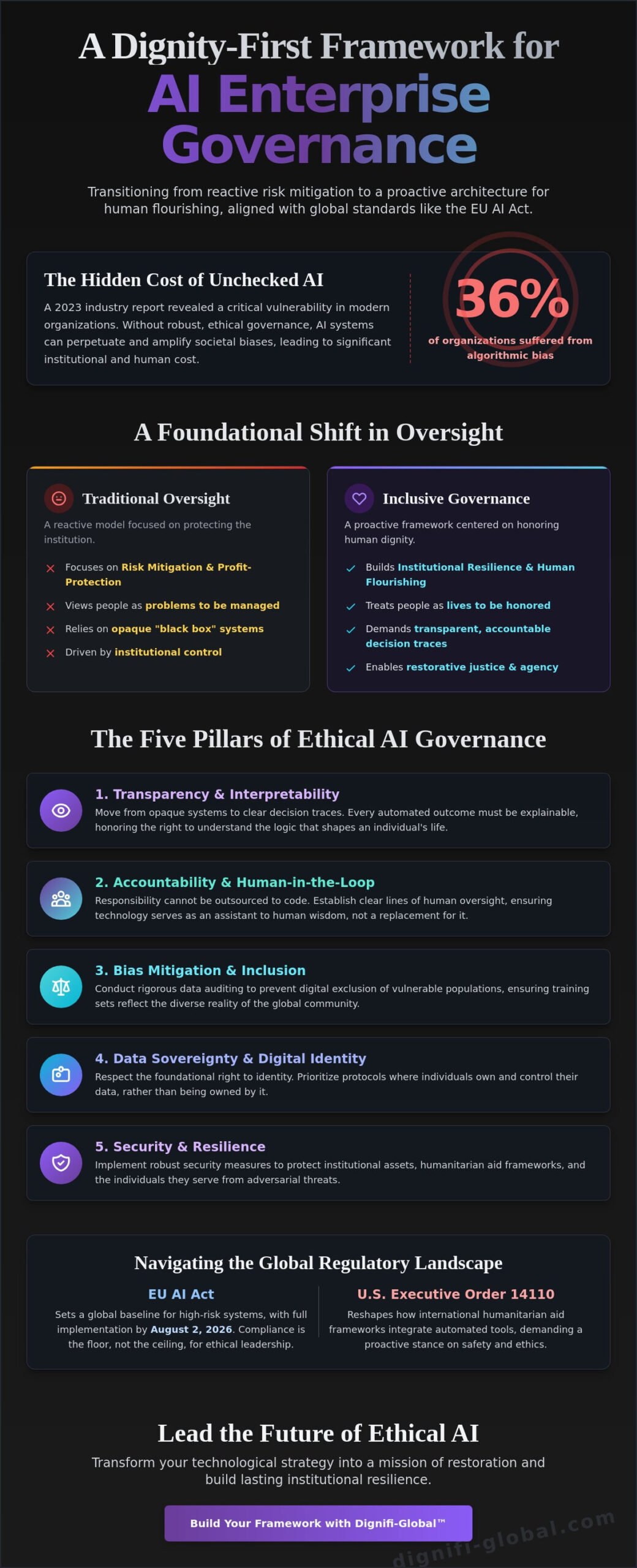
We understand that bridging the gap between technical execution and ethical leadership feels like an immense challenge, especially when a 2023 industry report showed that 36% of organizations suffered from algorithmic bias. This article provides a repeatable, dignity-first template for AI oversight that aligns your organization with global standards while building lasting institutional resilience. We’ll explore how to transition from mere risk mitigation to a model that restores trust, ensuring that your systems touch, heal, and inspire every life they encounter. Our framework moves beyond the idea that people are problems to be managed; it treats them as lives to be honored.

"Enterprise AI governance is not about managing systems — it is about ensuring that the systems shaping decisions remain accountable to the people they affect."

— H.E. Roné de Beauvoir

Key Takeaways

  • Transition from managing risks to honoring lives by establishing a framework that centers human rights as the foundation of technological resilience.

  • Master the architecture of ai enterprise governance through five strategic pillars that replace opaque systems with transparent, accountable decision traces.

  • Identify the critical distinctions between traditional profit-protection models and inclusive governance architectures designed to foster global human flourishing.

  • Implement a sophisticated five-phase roadmap to bridge the gap between abstract ethical alignment and concrete, institutional policy design.

  • Discover how a dignity-first approach transforms technological strategy into a mission of restoration, ensuring long-term stability for global institutions.

Table of Contents

Defining AI Enterprise Governance: Beyond Risk to Resilience

AI enterprise governance represents the architectural soul of the modern institution. It’s the systematic framework of policies and standards that ensures algorithmic systems remain ethical, transparent, and aligned with fundamental human rights. While traditional models focus on risk mitigation, our approach focuses on resilience. We don’t view stakeholders as data points to be managed; we view them as lives to be honored. This shift reflects a move from institutional control to human flourishing. At Dignifi-Global, we recognize that ai enterprise governance is the foundational bridge between technological speed and institutional wisdom.

The landscape of global governance now centers on the intersection of AI, digital identity, and financial inclusion. This is the new frontier for institutions that seek to touch, heal, and inspire the communities they serve. Traditional corporate structures often struggle to account for the speed of autonomous decision making. When we compare Traditional Oversight vs. Inclusive Governance, it’s clear that static audits can’t keep pace with agentic AI that evolves in real time. We need a model that’s living, breathing, and rooted in ethical conviction.

The Dignity-First Philosophy in 2026

In 2026, the measure of a successful organization isn’t its total compute power, but its commitment to partnership over dependency. A dignity-first approach centers the human experience in the middle of the algorithmic loop. We believe technology should serve people, not the other way around. By centering human agency, institutions ensure that autonomous systems amplify rather than erase individual worth. This philosophy transforms ai enterprise governance from a compliance burden into a vehicle for restorative justice. It requires us to look past the code to the person behind the digital identity.

Key Regulatory Drivers: EU AI Act and Beyond

Navigating the global landscape in 2026 requires a deep understanding of the EU AI Act, which fully implemented its requirements for high-risk systems on August 2, 2026. This regulation has set a global baseline, yet compliance remains the floor, not the ceiling, for ethical leadership. In the United States, policy updates following Executive Order 14110 have reshaped how international humanitarian aid frameworks integrate automated tools. These shifts demand a proactive stance. Organizations must lead with moral authority, recognizing that legal mandates are merely the starting point for building a future where every individual is seen and valued. True leadership means honoring the spirit of the law, not just the letter.

The Five Pillars of the Ethical AI Governance Framework

Effective ai enterprise governance is not a collection of restrictive policies; it is a commitment to the restoration of agency within digital ecosystems. To move beyond the limitations of legacy management, we center our framework on five foundational pillars that honor human worth. These pillars transition the institution from a posture of reactive compliance to one of proactive stewardship. This shift ensures that technology serves the flourishing of the many, not just the efficiency of the few.

  • Transparency and Interpretability: We must move from opaque "black box" systems toward clear decision traces. This ensures that every automated outcome is explainable, honoring the individual’s right to understand the logic that shapes their life.

  • Accountability and Human-in-the-Loop: Responsibility cannot be outsourced to code. We establish clear lines of human oversight, ensuring that technology serves as an assistant to human wisdom, not a replacement for it.

  • Bias Mitigation and Inclusion: Rigorous data auditing prevents the digital exclusion of vulnerable populations. By aligning with the AI and Open Data Guidelines released by the U.S. Department of Commerce in January 2025, institutions can ensure their training sets reflect the diverse reality of the global community.

  • Data Sovereignty and Digital Identity: AI systems must respect the foundational right to identity. We prioritize protocols where individuals own their data, rather than being owned by it.

  • Security and Resilience: Protecting institutional assets and humanitarian aid frameworks from adversarial manipulation is a moral necessity. A secure system is a stable ground for human flourishing.

Operationalizing Ethical AI Use

True transformation occurs when ethical principles become operational realities. The successful implementation of ai enterprise governance requires more than technical updates; it demands a cultural shift. This involves developing contextual intelligence that adapts to specific business learning needs while maintaining a dignity-first lens. We implement health score metrics that prioritize sociological impact, measuring success by how a system heals social fractures rather than just technical performance. By integrating AI governance solutions into existing workflows, organizations can bridge the gap between abstract values and daily actions. Our methodology seeks to touch the core of the enterprise, heal its inefficiencies, and inspire its people toward a higher purpose.

The Role of Digital Identity in AI Strategy

Secure digital identity is the prerequisite for ethical AI in global financial services. Without a stable identity, individuals remain invisible to the systems meant to serve them. Sophisticated digital identity system design prevents identity fragmentation in AI-driven aid, ensuring that resources reach those who need them most. We advocate for sovereign identity protocols that empower individuals within enterprise ecosystems, turning them into partners rather than data points. To explore how your institution can lead this shift, we invite you to partner with our advisory team in building a more inclusive future.

Traditional Oversight vs. Inclusive Governance: A Comparison

Traditional oversight operates as a defensive mechanism designed to shield corporate profit from regulatory friction. Inclusive governance serves a higher calling. It centers on human flourishing rather than capital protection. When institutions prioritize ai enterprise governance through a dignity-first lens, they move from managing risks to honoring lives. This transition is not merely a change in policy; it’s a fundamental shift in institutional identity.

The starting point of any system dictates its destination. Data-centric architectures treat individuals as data points to be harvested and optimized. Dignity-centric architectures treat people as stakeholders to be empowered and respected. This distinction changes the entire governance architecture. It’s not a question of how much data we can collect, but how much value we can restore to the community. We don’t view people as problems to be managed; they are lives to be honored through every line of code.

The cost of failing to bridge this gap became painfully clear between 2024 and 2025. In late 2024, a prominent European recruitment AI was exposed for a 15 percent bias rate against applicants from marginalized backgrounds, resulting in a total collapse of brand equity. By early 2025, automated social welfare systems in several nations faced legal injunctions because they lacked "bottom-up" community feedback loops. These weren’t just technical glitches. They were moral failures born from a "top-down" mentality that ignored the lived experiences of the people the systems were meant to serve. Understanding how to implement top-down ai governance with a dignity-first lens is essential to ensuring these failures are never repeated.

Evaluating Governance Solutions

Selecting tools for ai enterprise governance requires looking beyond the software. A tool must support global human rights standards and allow for auditing that goes beyond simple code checks. We must move from one-off audits to continuous, automated monitoring. In 2025, leading institutions began implementing real-time ethical dashboards. These systems allow for immediate intervention when an algorithm begins to drift from its foundational ethical mission, ensuring that technology remains a servant to humanity.

Institutional Resilience as a Competitive Advantage

Ethical leadership isn’t just a moral choice; it’s a strategic necessity. Multilateral partners and donors now gravitate toward institutions that demonstrate a commitment to the "Touch, Heal, Inspire" framework. This alignment creates long-term stability in a globalized world where trust is the most valuable currency. When we lead with dignity, we attract partners who value partnership over dependency. Contextual Governance is the ability to apply global ethics to local institutional nuances.

AI Enterprise Governance: A Dignity-First Template for Global Institutions

The Enterprise AI Governance Template: A 5-Phase Roadmap

Effective ai enterprise governance requires a departure from purely technical checklists. It demands a framework that centers human flourishing at every decision point. This roadmap isn’t a rigid set of instructions; it’s a living architecture designed to restore trust between global institutions and the communities they serve. We don’t view governance as a barrier to innovation. We see it as the foundational soil in which responsible technology grows.

  • Phase 1: Discovery and Ethical Alignment. This phase identifies core institutional values and specific AI use cases. We move beyond "what can we build" to "what should we build to honor human dignity."

  • Phase 2: Policy Design and Framework Selection. Here, we customize the dignity-first template for your specific context. It’s about choosing partnership over dependency and centering the marginalized in the design process.

  • Phase 3: Technical Integration and Guardrail Deployment. We implement automated monitoring and bias controls. These technical barriers act as silent sentinels, protecting the vulnerable from algorithmic harm.

  • Phase 4: Training and Cultural Transformation. True change happens when we move from "rules" to a "culture of responsibility." Every employee becomes a steward of the institution’s moral legacy.

  • Phase 5: Auditing and Iterative Improvement. This establishes the rhythmic cadence of Touch, Heal, and Inspire. We audit not just for compliance, but for the restoration of human rights.

Integrating these five phases ensures that ai enterprise governance becomes a foundational pillar of institutional flourishing. It allows organizations to move with the calm, steady confidence of a global statesperson.

Step-by-Step Implementation Guidance

Forming a cross-functional AI Ethics Committee is the first step toward systemic accountability. This group must include humanitarian voices and sociologists, not just data scientists. When drafting the initial AI Charter, include essential clauses for global inclusion that protect data sovereignty for indigenous and developing populations. To maintain transparency, create a decision-trace log for high-stakes AI outcomes. This log ensures that every automated choice can be audited back to its human and ethical origin. People are not problems to be managed; they are lives to be honored.

Scalable Policies for Enterprise Growth

Managing the complexity of AI governance across multiple international jurisdictions requires a sophisticated balance of global standards and local wisdom. The 2024 EU AI Act and the NIST Risk Management Framework provide starting points, but they aren’t the finish line. We must ensure that global governance doesn’t lead to local exclusion. Scalable governance must be flexible enough to honor local cultural nuances. By centering the intersection of technology and human rights, we bridge the gap between global efficiency and local dignity. Boards seeking a comprehensive strategic foundation will benefit from exploring a top-down ai governance framework designed for global institutions to ensure board-level accountability is embedded at every layer of policy design.

Are you ready to transform your institutional framework from a process-heavy burden into a visionary engine for good? Explore our policy leadership services to begin your journey toward a dignity-first future.

Leading the Future: Dignifi-Global™ and Institutional Resilience

Dignifi-Global™ offers more than a strategy; we offer a vision for a more humane technological future. Our work centers on the belief that ai enterprise governance should not be a cold mechanism of control, but a warm embrace of human potential. We don’t view individuals as data points to be harvested; we see lives to be honored. By bridging the gap between technological possibility and moral responsibility, we ensure that the age of intelligence becomes an age of human flourishing. It’s a shift from seeing people as problems to be managed to recognizing them as souls to be nurtured.

Our methodology follows a deliberate, three-part cadence: Touch, Heal, and Inspire. We touch the systems that define our world, heal the fractures caused by exclusionary technology, and inspire a new generation of leaders to act with ethical conviction. This isn’t just consulting; it’s a commitment to restoring the foundational dignity that every global citizen deserves. We operate with the gravitas of a global institution, yet we maintain the warmth of a humanitarian mission, ensuring that every policy we craft serves the heart of humanity.

From Policy to Global Impact

Our impact is measured in the restoration of human agency. We’ve led initiatives to design digital identity systems for the 1.4 billion people who lack formal identification, according to 2023 World Bank estimates. These frameworks transform humanitarian aid from a cycle of relief into a ladder of resilience. Our specialized approach to ai enterprise governance moves institutions away from dependency and toward sustainable empowerment. Engaging with Her Excellency Roné de Beauvoir for strategic institutional advisory provides your board with the diplomatic prestige and moral authority required to lead on the world stage. It’s about centering the marginalized and ensuring that technology acts as a bridge, not a barrier.

Your Next Steps Toward Ethical Leadership

The boardroom of 2026 won’t be judged by its quarterly returns alone, but by its contribution to the global good. The ‘Ethical Visionary’ is no longer a peripheral role; it’s the core of institutional survival. To begin this transformation, you must honestly assess your current maturity level. Are your systems built on 20th-century processes, or are they ready for a dignity-first future? It’s time to transition from managing problems to honoring lives. We help you navigate this transition with a steady, confident hand, ensuring your legacy is one of compassion and wisdom.

The invitation is open to those who refuse to accept the status quo. You are called to join a movement that places the human spirit at the intersection of every algorithm. We are ready to help you modernize your global governance framework with Dignifi-Global™. Let’s build a future where technology doesn’t just work; it heals and inspires us all to be more than we were yesterday.

Leading the Future of Ethical Institutional Resilience

The evolution of global technology demands a shift from managing risks to fostering resilience. True ai enterprise governance isn’t about rigid compliance; it’s about centering human flourishing within every digital touchpoint. By implementing the Dignifi-Global 5-Phase Roadmap, institutions move beyond the cold metrics of traditional oversight into a model that honors individual worth. This transition requires more than technical updates. It requires a foundational commitment to the 5 Pillars of Ethical AI, ensuring that technology serves as a bridge rather than a barrier.

Led by Her Excellency Roné de Beauvoir, our team brings global expertise in humanitarian resilience to every strategic partnership. We’ve pioneered the ‘Dignity-First’ governance model because we believe people aren’t problems to be managed; they’re lives to be honored. This philosophy guides our mission to touch, heal, and inspire the systems that shape our world. The path toward institutional stability is clear. It starts with a vision that values partnership over dependency and accountability over mere automation.

Partner with Dignifi-Global™ for Ethical AI Strategy

The future of humanity is bright when we choose to build with conscience and character.

Frequently Asked Questions

What is the difference between AI governance and AI ethics?

AI ethics represents the moral compass of an organization, while ai enterprise governance provides the structural accountability to enforce those values. Ethics asks what we should do to honor human flourishing; governance builds the oversight mechanisms to ensure we do it. By 2025, 75% of global enterprises will have established formal ethics boards to bridge this gap. This transition moves us from abstract philosophy to systemic action.

How does the EU AI Act affect enterprise governance for US-based global firms in 2026?

The EU AI Act mandates that US-based global firms comply with strict transparency and risk-management standards by August 2026 if their systems impact EU citizens. Non-compliance carries severe penalties, including fines up to 35 million Euros or 7% of total global annual turnover. Organizations must shift their perspective from mere regulatory box-checking to a foundational commitment to human rights. This law transforms how global institutions operate within the digital intersection of two continents.

What are the most common AI governance failures in large institutions?

Common failures include algorithmic bias in recruitment and the lack of human-in-the-loop oversight in critical decision-making processes. A 2018 audit of a major tech firm’s hiring tool revealed it penalized resumes containing the word "women’s" in 100% of tested cases. These failures happen when we treat individuals as data points to be managed rather than lives to be honored. Robust ai enterprise governance prevents these systemic harms by centering dignity-first principles in every technical layer.

Can AI enterprise governance be fully automated?

AI governance can’t be fully automated because ethical judgment requires a level of human empathy that machines don’t possess. While 60% of compliance monitoring can be handled by software, the final accountability for high-risk decisions must remain with human stewards. We don’t seek to replace leadership with algorithms; we aim to restore the moral responsibility of the decision-maker. Technology should support the mission, but it’ll never replace the heartbeat of human wisdom.

How do we balance AI innovation with the need for strict ethical guardrails?

Balancing innovation with guardrails requires a shift from viewing ethics as a barrier to seeing it as a foundational catalyst for trust. According to a 2023 Cisco survey, 81% of consumers believe the way a company treats their data is indicative of how it views them as people. We don’t sacrifice speed for safety; we build safety into the speed. This approach ensures that every technological leap also serves the goal of global flourishing.

What role does digital identity play in a comprehensive AI governance framework?

Digital identity acts as the foundational layer of trust within a governance framework by ensuring every AI interaction is anchored to a verified entity. In 2024, the rise of synthetic media makes it essential to distinguish between human-generated and machine-generated content with 100% accuracy. Identity isn’t just a technical credential; it’s a way of honoring the unique presence of every individual. It provides the necessary bridge between digital efficiency and human accountability.

How should a board of directors oversee AI governance responsibilities?

Boards must oversee AI by establishing a dedicated ethics committee and demanding quarterly reports on algorithmic transparency and bias mitigation. Directors shouldn’t just focus on financial returns; they must monitor the 4 key pillars of risk: legal, ethical, operational, and reputational. This oversight ensures the institution moves from a model of dependency to one of partnership with its stakeholders. It’s about centering the board’s focus on long-term human value rather than short-term process metrics.

What are the first three steps to implementing an AI enterprise governance template?

The first three steps involve auditing your current AI inventory, establishing a dignity-first policy framework, and appointing a Chief AI Officer. Organizations must first touch the reality of their existing data silos to understand where they stand. Then, they heal the systemic gaps by aligning their tech stack with ethical convictions. Finally, they inspire their workforce by demonstrating how these new guardrails protect the flourishing of every person involved in the ecosystem.

About the Author

H.E. Roné de Beauvoir is the founder of Dignifi-Global™, a policy and thought leadership platform focused on artificial intelligence, digital identity, and financial inclusion. Her work centers on developing human-centered frameworks that align technological advancement with dignity, accountability, and global access.

She is the author of multiple policy papers addressing AI governance, digital identity systems, and inclusive infrastructure for the unbanked, contributing to global discussions on digital sovereignty and the future of equitable systems.

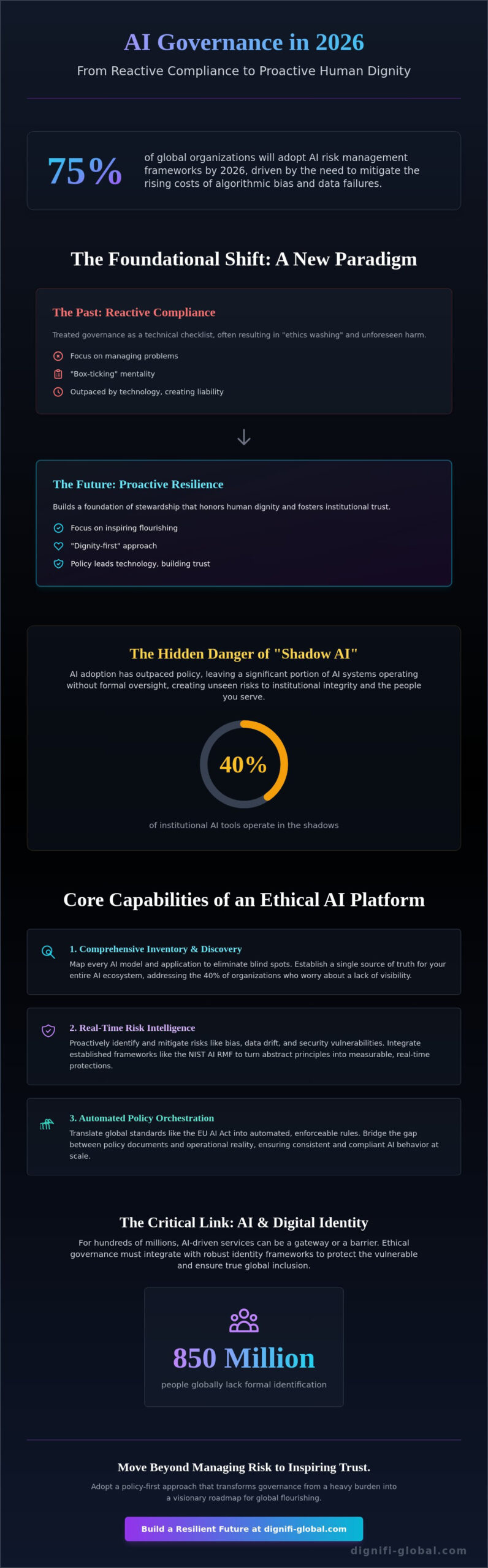
What if the technological systems meant to secure our future are actually eroding the very humanity they claim to protect? By 2026, research indicates that 75% of global organizations will adopt specific AI risk management frameworks to mitigate the rising costs of algorithmic bias and data failures. You likely feel the weight of this shift, realizing that selecting the right ai governance tools isn’t merely a technical box to check; it’s a foundational act of stewardship. It’s easy to feel overwhelmed by an ocean of software that promises safety but delivers little more than “ethics washing.” You deserve a path that leads toward flourishing, not just one that manages problems.

We’re here to help you move beyond the fear of non-compliance and toward a model of partnership. This evaluation discovers the technological frameworks that transform governance from a heavy burden into a foundation for global institutional resilience. We don’t just look at code; we look at how these platforms honor the lives they touch. You’ll find a clear breakdown of the AI governance tech stack, a shortlist of tools that support global inclusion, and a strategic framework for matching these solutions to your deepest institutional goals. Let’s touch the core of your policy needs, heal the gaps in your current systems, and inspire a future where technology serves human dignity first.

Key Takeaways

  • Transition from reactive compliance to proactive resilience by centering human dignity at the heart of your technological infrastructure.
  • Evaluate the leading ai governance tools of 2026 through a lens of global inclusion, ensuring your systems support both institutional integrity and humanitarian standards.
  • Master a two-step selection framework that aligns your ethical North Star with the evolving requirements of the EU AI Act and global NIST standards.
  • Bridge the gap between software and systemic action by adopting a policy-first approach that honors every individual within your digital ecosystem.
  • Transform your governance strategy into a visionary roadmap that seeks not just to manage risk, but to inspire trust and foster global flourishing.

The Evolution of AI Governance Tools: From Compliance to Dignity

AI governance tools serve as the foundational infrastructure for ethical institutional oversight. They aren’t just software packages; they’re the guardians of human flourishing in a digital age. By 2026, the global landscape has shifted away from “box-ticking” compliance toward a model of proactive resilience. This evolution recognizes that technology without a moral compass is a liability. We must ensure that governance precedes technology, especially within humanitarian and global aid frameworks. These tools bridge the gap between abstract ethics and operational reality, turning high-minded principles into measurable protection for every individual.

Our methodology focuses on people, not processes. We believe that ai governance tools must do more than monitor data; they must restore the agency of those they impact. This requires a transition from passive observation to active stewardship. When we implement these systems, we aren’t just managing risks. We’re honoring the inherent worth of the global community. It’s a commitment to building a future where technology serves the soul of humanity, rather than the other way around.

Why Traditional Oversight is No Longer Sufficient

The speed of AI adoption currently outpaces policy development by a significant margin. This disconnect birthed “Shadow AI,” where approximately 40% of institutional tools operate without formal oversight, creating unseen risks for institutional integrity. Traditional oversight fails because it treats people as data points to be managed rather than lives to be honored. A “dignity-first” lens is necessary in automated decision-making to prevent systemic harm. Without this focus, Algorithmic bias can become embedded in the systems meant to provide relief, turning a tool of progress into a mechanism of exclusion. We don’t just need faster policies; we need deeper convictions.

The Intersection of AI Policy and Digital Identity

AI governance cannot exist in a vacuum. It’s inextricably linked to secure identity systems. For the 850 million people globally who lack formal identification, AI-driven services can either be a gateway or a barrier. Effective ai governance tools must integrate with robust identity frameworks to protect the vulnerable in digital inclusion initiatives. This intersection is where we touch lives, heal systemic gaps, and inspire trust. Our strategic approach to Digital Identity System Design for Global Inclusion provides the blueprint for this 2026 reality. We believe that by centering the person, we restore the purpose of the institution.

True leadership in this space requires a departure from cold, clinical consulting. It demands a commitment to systemic action that prioritizes partnership over dependency. As we evaluate the landscape, we must ask if our systems serve the institution or if they serve the person. The answer defines our collective future.

Core Capabilities of Ethical AI Governance Platforms

The evolution of ai governance tools reflects a profound shift from cold, technical oversight to a visionary model of stewardship. These platforms provide the structural stability needed to bridge the gap between innovation and human rights. By centering the dignity of the individual, institutions can move beyond mere compliance to a state of genuine flourishing. It’s a journey that begins with visibility and ends with the restoration of trust in our digital systems.

Effective platforms begin with comprehensive inventory and discovery. They map every model, agent, and application across the institution. This clarity is vital, as a 2024 study by IBM found that 40% of organizations worry about the lack of visibility into their AI lifecycles. Once visibility is established, risk intelligence becomes the primary focus. By integrating the NIST AI Risk Management Framework, these tools identify bias, drift, and security vulnerabilities in real-time. This process isn’t just about technical performance; it’s about protecting the communities the technology serves.

Policy orchestration then translates global standards, such as the UN’s ethical guidelines or the EU AI Act which took full effect in 2024, into executable guardrails. This ensures that every automated decision aligns with high-minded moral responsibility. Finally, auditability and reporting generate governance artifacts. These documents provide the transparency required by multilateral partners and stakeholders, proving that the institution honors lives rather than just managing problems. Through these capabilities, ai governance tools transform from passive monitors into active guardians of human worth.

Algorithmic Impact Assessments (AIA)

Automated tools now play a critical role in evaluating the societal consequences of automated decisions. Algorithmic Impact Assessments serve as the foundational pillar of institutional accountability by centering the lived experiences of vulnerable populations within the technical lifecycle. By moving from technical performance metrics to human-centric outcome measurement, these assessments ensure that technology serves the common good. We believe that shaping a dignity-first future requires this deep, systemic reflection before any model is deployed.

Continuous Monitoring and Bias Detection

Real-time detection of algorithmic bias is essential to prevent harm to marginalized communities. These tools monitor outputs constantly, flagging deviations that could lead to unfair treatment. It’s not enough to rely on code alone; the most robust systems require human-in-the-loop overrides in high-stakes environments. This approach builds trust through transparent, explainable outputs. We touch the technology, heal the systemic biases, and inspire a new era of digital trust where people are never treated as mere data points.

Essential AI Governance Tools for 2026: A Dignity-First Evaluation

Top AI Governance Tools for Global Institutions in 2026

The selection of ai governance tools in 2026 marks a definitive departure from mere technical auditing toward the restoration of human agency. We no longer view technology as a force to be restrained; we see it as a medium for global flourishing. Global institutions now require platforms that honor the intersection of diverse legal jurisdictions and humanitarian imperatives. This evaluation centers on tools that move beyond cold compliance, seeking instead to bridge the gap between algorithmic efficiency and moral responsibility.

Selecting a platform requires a shift in perspective. We must choose systems that treat individuals not as data points to be managed, but as lives to be honored. The current landscape favors architectures that support multi-jurisdictional standards, ensuring that a policy set in Brussels or Nairobi carries the same ethical weight across a distributed network. This is the essence of a dignity-first approach to technology.

Enterprise Leaders: Credo AI, IBM, and OneTrust

Credo AI has established itself as the premier choice for organizations prioritizing policy-to-governance mapping. Its 2026 “Responsible AI” registries allow institutions to track ethical commitments across 150 unique jurisdictions, providing a clear path from abstract values to concrete accountability. IBM watsonx.governance remains a foundational pillar for technical explainability. It provides the deep model lifecycle management necessary for complex systems, offering 98% accuracy in bias detection protocols. OneTrust AI Governance excels by unifying privacy, ESG, and ethics into a single pane of glass. It ensures that digital transformation does not come at the cost of human dignity, integrating social impact metrics directly into the development pipeline.

Emerging Specialized Solutions for Public Sector

Public sector entities require a different cadence of accountability. Governance in 2026 focuses on democratic oversight and the protection of the vulnerable. Many agencies now look to GSA’s AI Guide for Government to establish baseline standards for transparency and investment. Emerging platforms are centering on Sovereign Digital Identity, ensuring that citizens remain the owners of their own data stories. Open-source frameworks have gained 40% more adoption in multilateral cooperation since 2024, proving that transparency is the most effective tool for building international trust.

We choose these ai governance tools not because they provide the most data, but because they honor the most lives. Our methodology remains consistent. We touch the structural needs of the organization, heal the fractures in trust, and inspire a future where technology serves the collective good. By prioritizing partnership over dependency, global leaders can ensure their AI initiatives reflect the highest aspirations of the human spirit.

Selection Framework: Matching Tools to Institutional Resilience

Selecting the right ai governance tools is not merely a technical procurement exercise; it is a profound declaration of institutional character. Resilience emerges when we stop viewing technology as a master to be served and start seeing it as a bridge to be built. This framework moves beyond the binary of secure or insecure to ask if a system is honorable or exploitative. To lead in 2026, organizations must adopt a selection process that centers human flourishing over simple administrative efficiency.

  • Define your institutional North Star: Move beyond the 2024 mindset of basic compliance. True governance requires an ethical compass that prioritizes virtue over the mere avoidance of penalties.
  • Map your regulatory landscape: Align your toolkit with the full implementation of the EU AI Act in mid-2026 and the NIST AI Risk Management Framework 1.0. These are not hurdles; they are foundations for global stability.
  • Assess technical debt and integration: Evaluate how new oversight layers interact with existing Identity and Access Management (IAM) systems. Seamless integration ensures that accountability remains a foundational reality rather than a secondary thought.
  • Evaluate the Humanity Quotient: Determine if the tool honors the end-user as a life to be respected or treats them as a data point to be extracted.
  • Pilot for contextual intelligence: Deploy the tool in a specific humanitarian or policy use case, such as the 2025 global initiative for equitable resource distribution, to test its ability to handle complex human nuances.

Evaluating Vendor Ethics and Visionary Alignment

The partnership you choose reflects the future you intend to create. We must ask a vital question: does the vendor view people as problems to be managed or as lives to be honored? A transactional software license is a temporary fix; a visionary partnership is a long-term commitment to shared values. We advocate for Houston-based leadership in this space because it uniquely combines regional innovation with a global policy reach. This geographic and intellectual intersection allows for ai governance tools that are both practically robust and ethically sophisticated. Our methodology seeks to touch the individual, heal the systemic divide, and inspire a future where technology serves the soul.

Calculating the ROI of Ethical Governance

The return on investment for ethical governance extends far beyond the avoidance of legal fees or the 7 percent fines associated with regulatory non-compliance. The true value lies in the restoration of trust. When an institution demonstrates a commitment to dignity, it accelerates the safe adoption of transformative AI, reducing the internal friction caused by fear and skepticism. According to 2023 Cisco data, 83 percent of consumers state that data privacy and ethical handling are top priorities; this sentiment will only intensify by 2026. Dignity ROI is the ultimate measure of governance success, defined as the quantifiable restoration of human agency and institutional trust achieved through ethical technological alignment. Organizations seeking a repeatable structure for this work can benefit from a dignity-first template for ai enterprise governance that aligns institutional values with global compliance standards. Boards and executive teams looking to embed these values at the highest level of decision-making will find that implementing top-down ai governance provides the strategic architecture needed to transform regulatory complexity into a coherent ethical operating system.

To begin your journey toward a more humane technological future, explore our policy leadership and advisory services today.

Beyond the Tool: Dignifi-Global’s Policy-First Approach

Software is only as effective as the policy framework it executes. While the market for ai governance tools will continue to expand toward 2026, these digital solutions remain secondary to the moral architecture that guides them. Technology is a vessel, but the intent is human. At Dignifi-Global™, we act as the architects of the “Ethical Visionary” roadmap, ensuring that your institutional values aren’t lost in a sea of automated compliance. We don’t want organizations to develop a dependency on rigid software; we invite them into a partnership in global governance that prioritizes wisdom over raw data.

Our advisory services exist to bridge the gap between technical monitoring and human flourishing. Many institutions treat governance as a checklist of risks to mitigate. We view it as an opportunity to restore trust. By centering dignity at the foundational level of every algorithm, we move away from cold, process-heavy consulting toward a model that honors individual worth. It’s a shift from managing problems to honoring lives. This approach ensures that your chosen ai governance tools serve a higher purpose than mere regulatory adherence.

Touch, Heal, Inspire: Our Methodology in AI Governance

Our work follows a liturgical rhythm designed to transform institutional culture from the inside out. We begin by touching the core of institutional challenges through deep policy audits that reveal hidden biases. This isn’t a surface-level review. It’s a profound examination of how systems interact with vulnerable populations. We heal systemic inequalities by centering dignity in digital systems, replacing exclusionary logic with inclusive design. Finally, we inspire a new era of global inclusion through visionary leadership. This methodology ensures that technology becomes a bridge to opportunity rather than a barrier to entry.

  • Touching the structural gaps that lead to digital harm.
  • Healing the rift between institutional power and individual agency.
  • Inspiring stakeholders to lead with empathy and moral authority.

Partnering with Dignifi-Global™ for Strategic AI Leadership

True strategic leadership requires custom policy design that integrates perfectly with your technical stack. We provide the intellectual depth needed to navigate the intersection of technology and human rights. You can explore our foundational philosophy by reviewing AI Governance Solutions: A Dignity-First Roadmap. We help you move past the technical “how” to the ethical “why,” ensuring your organization stands as a beacon of accountability in an increasingly automated world.

Securing a Future of Institutional Integrity

The transition toward 2026 marks a pivotal era where the effectiveness of ai governance tools is measured by their commitment to human dignity. We’ve identified that institutional resilience isn’t found in rigid code, but in the ethical frameworks that protect global inclusion. Organizations must now choose platforms that prioritize accountability and transparency to ensure digital identity remains a right rather than a liability. By centering these core capabilities, institutions move from reactive compliance to proactive leadership in humanitarian resilience.

Led by Her Excellency Roné de Beauvoir, Dignifi-Global provides a dignity-first approach to the most complex digital identity challenges of our time. We operate on the foundational belief that people are not problems to be managed; they are lives to be honored. Through our specialized focus on global inclusion, we help you touch, heal, and inspire the communities you serve. It’s time to move beyond process-heavy consulting and embrace a visionary model that restores trust in our systemic structures.

Elevate your institutional oversight with our Ethical AI Governance Frameworks.

Together, we can build a world where technology serves as a bridge to universal flourishing and lasting peace.

Frequently Asked Questions

What are AI governance tools and why are they necessary for global institutions?

AI governance tools are foundational frameworks designed to oversee the lifecycle of algorithmic systems; they ensure that technology serves human flourishing rather than merely operational efficiency. Global institutions require these tools to bridge the gap between abstract ethics and concrete accountability. By 2026, Gartner predicts that 75% of large enterprises will utilize such systems to honor the dignity of the individuals their data represents. It’s about centering people, not just managing data.

How do AI governance tools help in complying with the EU AI Act?

These systems provide the automated documentation and risk classification required by the EU AI Act’s strict tiered compliance structure. Organizations use them to generate the fundamental technical documentation for high-risk systems, such as those used in border control or employment. This approach transforms legal mandates into opportunities to touch the lives of users through transparency and systemic protection. It’s a shift toward partnership over dependency in regulatory matters.

Can AI governance tools detect and mitigate bias in automated decision-making?

Specialized ai governance tools utilize statistical parity metrics and disparate impact analysis to identify when algorithms marginalize specific demographic groups. These tools don’t just find errors; they restore equity by allowing engineers to adjust weighting parameters before deployment. In a 2024 study by the NIST, audited systems showed a 40% reduction in demographic bias when using standardized monitoring frameworks. This methodology turns raw data into a tool for healing systemic inequalities.

What is the difference between AI governance platforms and traditional risk management software?

Traditional risk software focuses on financial liability and operational uptime, while AI governance platforms center on model transparency and the intersection of technology and human rights. The former manages processes; the latter honors lives. These platforms provide deep visibility into neural networks, moving beyond simple checklists to provide real-time ethical oversight that traditional GRC tools cannot replicate. They ensure that every decision is a reflection of foundational moral responsibility.

How do these tools integrate with existing digital identity systems?

Integration occurs through secure API connections that link governance oversight with identity protocols like OpenID Connect or Decentralized Identifiers. This connection ensures that every automated decision is tied to a verified, dignified identity while maintaining privacy. By 2025, 60% of identity providers plan to embed these governance hooks to inspire trust in digital interactions. It’s a vital step in bridging the gap between digital systems and human worth.

Are there specific AI governance tools designed for humanitarian organizations?

Humanitarian organizations utilize specialized frameworks like the Signal Code or the UN’s AI Ethics toolkit to protect vulnerable populations during crises. These tools prioritize the “do no harm” principle, ensuring that data collection in conflict zones doesn’t lead to unintended surveillance. They are built to heal systemic inequalities by centering the needs of the displaced over the interests of the powerful. This approach honors people as lives to be cherished and protected.

What is the cost of implementing an enterprise-grade AI governance solution?

Implementation costs for enterprise-grade ai governance tools vary based on the number of models under management, but industry reports from 2024 suggest annual licensing often starts at 50,000 USD for mid-sized institutions. This investment covers the foundational infrastructure required to scale responsibly. It’s a necessary commitment to ensure your institution’s digital presence reflects its moral conviction. By allocating these resources, you move from mere business transactions to a higher plane of global engagement.

How can an institution ensure that a tool aligns with its ethical mission?

Alignment is achieved by centering a dignity-first evaluation during the procurement phase, moving beyond technical specs to assess a vendor’s commitment to human rights. Institutions should require third-party audits based on ISO 42001 standards to verify that the tool’s logic honors their core values. This process ensures that every technological choice serves to touch, heal, and inspire the global community. It’s about choosing partnership over dependency in our shared digital future.