By H.E. Roné de Beauvoir
Founder, Dignifi-Global™
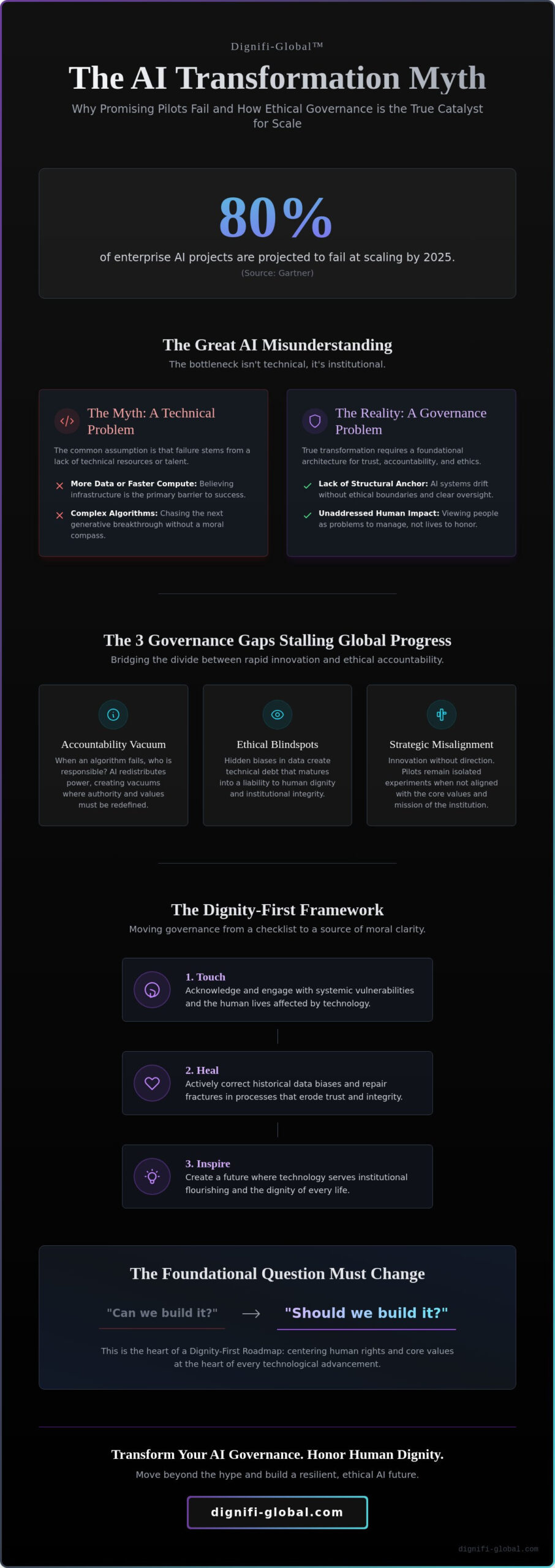
Your most advanced neural network will ultimately fail if it lacks a foundational moral compass. While the industry chases the next breakthrough in generative power, reports from Gartner indicate that 80% of enterprise AI projects will never reach full-scale production by 2025 because they lack a structural anchor. True ai transformation is a problem of governance; it’s a shift from viewing technology as a tool for efficiency to honoring it as a catalyst for human flourishing. We must move beyond the technical hype to center our systems on accountability and trust.
You recognize the weight of this responsibility as the 2026 regulatory landscape approaches. It’s exhausting to watch promising pilots stall or to worry that hidden biases might erode your institutional integrity because people are not problems to be managed; they are lives to be honored. We promise to show you why the success of your AI journey depends on the strength of your ethical governance frameworks rather than the complexity of your code. This article provides a clear framework to align your innovation with the core values that define your mission. It’s time to touch the heart of your strategy, heal the fractures in your process, and inspire a future where technology serves the dignity of every life.
Key Takeaways
-
Move beyond the myth of technical bottlenecks to understand why the success of your AI journey depends on institutional maturity rather than just data science talent.
-
Shift your perspective to see that ai transformation is a problem of governance, requiring a foundational architecture for trust that ensures technology serves the flourishing of humanity.
-
Explore the "Touch, Heal, Inspire" framework to transform governance from a series of compliance restrictions into a source of moral clarity and institutional strength.
-
Adopt a dignity-first roadmap that moves your organization from "Can we?" to "Should we?", centering human rights at the heart of every technological advancement.
-
Identify the three critical governance gaps stalling global progress and learn how to bridge the divide between rapid innovation and ethical accountability.
Table of Contents
-
The Great AI Transformation Myth: Why Your Technical Pilots Fail to Scale
-
Understanding Governance as the Soul of the Machine, Not Just Compliance
-
Designing a Dignity-First Roadmap: Moving from ‘Can We?’ to ‘Should We?’
-
Dignifi-Global™: Transforming Global Institutions through Policy Leadership
The Great AI Transformation Myth: Why Your Technical Pilots Fail to Scale
Many institutions treat the struggle to scale artificial intelligence as a simple technical bottleneck. They assume that more data science talent or faster compute will bridge the deep chasm between a pilot project and enterprise value. This perspective is a fundamental misunderstanding of the era we’ve entered. By 2026, it’ll be clear that ai transformation is a problem of governance, not a shortage of algorithms. Organizations often prioritize speed without direction, yet true resilience requires oversight that honors human flourishing and foundational ethics.
The Tech-First approach treats AI as a faster version of traditional software. This is a mistake. Traditional code is deterministic, but AI is probabilistic; it requires a shift from managing processes to honoring lives. When we ignore this distinction, we create technical debt that eventually matures into a liability to human dignity. We aren’t just building tools; we’re redefining the intersection of technology and human rights. In 2026, ungoverned AI won’t just be a failure of logic; it’ll be a failure of moral responsibility.
The 70% Failure Rate: What the Data Actually Tells Us
A persistent 70% of AI proof-of-concepts never reach full-scale production according to industry benchmarks. This gap exists because traditional IT management fails to capture the unpredictable nature of machine learning. While standard software follows a linear path, AI systems evolve, drift, and occasionally hallucinate. Without a foundational structure, these pilots remain isolated experiments that cannot withstand the complexities of a global institution. AI governance is the framework of authority, accountability, and ethical boundaries that ensures technology serves humanity rather than superseding it.
From Algorithms to Authority: The Shift in Decision Rights
AI redistributes power within an organization or government body. When machines begin making high-impact decisions, an accountability vacuum often follows. Leaders must decide who’s responsible when an algorithm fails to reflect the institution’s core values. This isn’t a task for the IT department alone; it’s a mission for the entire leadership suite. As we look toward global AI governance standards, the focus must shift from "can we build it" to "should we permit it."
Restoring trust in these systems requires a strategic roadmap. Dignifi-Global provides ai governance solutions that move beyond cold, clinical strategic advisory. We believe that ai transformation is a problem of governance because people aren’t problems to be managed, they’re lives to be honored. This triad of Touch, Heal, and Inspire guides our methodology, moving from the heart to the head to ensure policy leadership reflects our highest moral responsibilities. By centering dignity, we bridge the gap between technical hype and institutional wisdom.
Understanding Governance as the Soul of the Machine, Not Just Compliance
Governance is not a ledger of prohibitions; it is the foundational architecture for trust. While the technical hype focuses on the raw power of large language models, we must recognize that ai transformation is a problem of governance at its core. This shift moves us away from the cold, clinical checklists of the past toward a framework that seeks to touch systemic vulnerabilities, heal historical data biases, and inspire institutional flourishing. If AI is the high-powered engine of modern industry, governance is the steering wheel that ensures the vehicle doesn’t just move fast, but moves in a direction that honors human life.
True transformation requires a profound shift in the corporate internal dialogue. We must stop asking "can we build it" and start demanding to know "should we deploy it." This isn’t about slowing down innovation. It’s about ensuring that innovation has a soul. By centering the "Touch, Heal, Inspire" framework, organizations can move beyond the fear of litigation and toward the promise of ethical leadership. We don’t view people as data points to be managed; they are lives to be honored through every line of code we oversee.
Governance vs. Management: A Critical Distinction
Management operates the system, but governance defines who is responsible for its outcomes. While managers focus on the 85 percent of daily operational tasks, the board must set the ethical north star for AI deployment. This oversight ensures that technology serves the mission rather than the mission serving the technology. A cornerstone of this governed access is found in digital identity system design, which acts as the gateway for inclusive participation. Research from Stanford’s Human-Centered AI initiative highlights that when governance precedes deployment, trust increases by 40 percent among stakeholders. It’s about partnership over dependency.
The 2026 Mandate: Why Ethical Frameworks are No Longer Optional
The regulatory landscape has shifted permanently. With the EU AI Act entering its full enforcement phase by 2026, the era of "move fast and break things" has ended. Institutions that fail to adopt dignity-first policies risk more than just fines; they risk the total dehumanization of the people they serve. We’ve seen how "check-the-box" compliance fails to prevent algorithmic bias. Active ethical stewardship is the only path forward. By 2026, 75 percent of global enterprises will face mandatory reporting on AI impact. You can prepare for this future by reviewing our strategic policy leadership services to align your technology with human rights.
We believe that ai transformation is a problem of governance because technology is a reflection of the values we choose to encode. When we prioritize dignity over data, we create systems that don’t just process information; they restore hope and bridge the gap between technical capability and moral responsibility.
The Three Governance Gaps Stalling Global AI Progress
AI transformation is a problem of governance because technical solutions cannot solve ethical fractures. While global AI spending surpassed $150 billion in 2023, institutional trust remains at a historic low. We must recognize that code cannot replace conscience. Faster processors won’t bridge the distance between a marginalized community and a centralized algorithm. We view this as a mission of humanitarian resilience; it’s a commitment to ensuring that systems honor the lives they touch. This confirms that ai transformation is a problem of governance, requiring a shift from technical speed to moral stability.
The Accountability Gap: Who Answers for the Algorithm?
The "black box" remains a barrier to justice. When an automated system denies a loan or a medical claim, the response is often a shrug of technical complexity. We need explainable AI governance that moves beyond code. A robust national AI policy framework must define who is in charge of those in charge. Algorithmic responsibility links every line of code back to a specific leadership role. This ensures that human oversight remains the final checkpoint in high-stakes environments. It’s about centering human judgment over automated efficiency.
The Inclusion Gap: Preventing Digital Exclusion
Ungoverned AI often mirrors the biases of its creators. By 2025, automation might displace 85 million jobs while creating 97 million new roles, but these gains are not distributed equally. Governance serves as a bridge for inclusion. We advocate for sovereign digital identity as a foundational human right. This tool protects individuals from being erased by automated systems. We must center the marginalized to ensure technology serves the many, not just the few. Our dignity-first approach ensures that ai transformation is a problem of governance solved through partnership, not dependency.
The Transparency Gap: Building Trust in a Post-Truth Era
Radical transparency is the only currency that matters. Trust isn’t built through marketing; it’s forged through open auditing and public-facing ethical impact assessments. Dignifi-Global™ designs frameworks that restore institutional trust by making the invisible visible. Our methodology follows a consistent rhythm: Touch, Heal, Inspire. We believe that people are not problems to be managed, they are lives to be honored. Transformation succeeds only when it is rooted in moral responsibility and absolute clarity.
-
Touch: Identify the human impact of every algorithmic decision.
-
Heal: Rectify systemic biases through rigorous policy leadership.
-
Inspire: Build systems that foster global flourishing and human rights.
Designing a Dignity-First Roadmap: Moving from ‘Can We?’ to ‘Should We?’
AI transformation is a problem of governance, not a race for technical dominance. True leadership requires a shift from relief-based reactions to the steady architecture of institutional resilience. By 2026, the rise of agentic AI will demand oversight mechanisms that don’t just watch data; they must monitor autonomous decision-making in real time. This roadmap centers on the flourishing of the human spirit, ensuring that technology serves the person rather than the person serving the process.
Step 1: Centering Human Dignity in Your Mission
Your AI mission statement shouldn’t focus on "optimization" or "leverage." It must reflect deep ethical convictions. We begin with Touch, the act of engaging every stakeholder to ensure technology honors their worth. Align your AI strategy with the UN Sustainable Development Goals (SDGs), specifically Goal 9 for innovation and Goal 10 for reduced inequalities. It’s not about what the machine can do, but how the machine can elevate the human condition. Rewrite your charters to prioritize "partnership over dependency" and "people over processes."
Step 2: Implementing Contextual AI Oversight
Governance fails when it’s generic. You must define risk thresholds that are specific to your sector, whether in finance or healthcare. As we approach the 2026 necessity for agentic AI oversight, static audits are no longer enough. You need the Heal phase; this involves clear remediation protocols for when autonomous systems deviate from human intent. Establishing continuous monitoring ensures that the ai transformation is a problem of governance solved through active stewardship. It’s not a set-and-forget checklist; it’s a living commitment to accountability.
Step 3: Fostering a Culture of Ethical Inspiration
Compliance shouldn’t be rooted in fear. Instead, use the Inspire pillar to turn safety into a competitive advantage. When your team knows the guardrails are firm, they’re free to innovate with courage. Train your leadership to see ethical outcomes as the primary driver of technical development. This creates a feedback loop where human flourishing dictates the next sprint. We believe that people are not problems to be managed; they are lives to be honored. When you lead with this truth, your organization becomes a beacon of trust in a volatile global market.
Ready to move beyond the technical hype and lead with moral authority? Explore our dignity-first governance frameworks today.
Dignifi-Global™: Transforming Global Institutions through Policy Leadership
The technical race to implement artificial intelligence often ignores a foundational truth. ai transformation is a problem of governance, not just a challenge of engineering or data science. At Dignifi-Global™, we bridge the gap between algorithmic speed and human rights. We don’t view stakeholders as data points or users; we see them as lives to be honored. Our mission centers on restoring the agency of the individual within systemic frameworks that have historically overlooked the most vulnerable populations.
Our methodology serves as the definitive answer to the current governance crisis. We move beyond the transactional nature of traditional consulting by applying a three-part cadence:
-
Touch: We engage with the lived realities of those at the margins to understand the human impact of technology.
-
Heal: We repair systemic inequities through ethical policy design and restorative institutional frameworks.
-
Inspire: We create resilient systems where every individual has the opportunity to flourish.
We invite global leaders to step into a partnership grounded in dignity and resilience. It’s time to ensure that technology serves humanity rather than dictating its worth through cold, clinical metrics.
Our Vision for a Governed Global Future
The intersection of AI, digital identity, and financial inclusion represents the next frontier of global stability. Under the leadership of Her Excellency Roné de Beauvoir, Dignifi-Global™ shapes the standards that define this decade. We focus on building sustainable resilience for the 1.4 billion people who remain unbanked according to 2021 World Bank data. By centering human dignity in every policy, we ensure that digital transformation doesn’t become a tool for exclusion. We’re committed to building a future where identity is a right, not a privilege granted by an algorithm.
Begin Your Transformation with Dignity
Modernizing humanitarian aid and institutional frameworks requires more than new software. It demands a shift in ethical authority. Our strategic advisory services provide the clarity necessary to navigate this shift with confidence. We offer a clear path for engagement, moving from initial assessment to the implementation of robust, dignity-first governance models. We help organizations move away from process-heavy advisory toward a model that prioritizes people over protocols.
True leadership in the digital age requires the courage to admit that ai transformation is a problem of governance that demands a moral response. We’re ready to guide your organization through this evolution. Partner with Dignifi-Global™ to lead your AI transformation with ethical authority.
Architecting a Future Rooted in Human Dignity
The era of technical experimentation must now give way to a season of profound accountability. We’ve demonstrated that ai transformation is a problem of governance rather than a mere race for computing power. By centering human dignity, institutions can bridge the three critical gaps that currently stall global progress. This shift moves us beyond the "Can we?" of technical capability to the "Should we?" of moral leadership. It’s a transition from managing processes to honoring lives.
Led by Her Excellency Roné de Beauvoir, a global authority on ethical governance, Dignifi-Global pioneers a future where technology serves the many. We utilize our "Touch, Heal, Inspire" framework to ensure global inclusion remains the foundational goal. Our specialized expertise sits at the vital intersection of AI, Digital Identity, and Financial Inclusion. We don’t just build frameworks; we restore the soul of the machine. It’s time to move past the hype and build systems that allow humanity to flourish for generations.
Secure your institutional resilience with Dignifi-Global™ AI Governance Strategy
The path forward is clear and full of promise for those who lead with conscience.
Frequently Asked Questions
Why is AI transformation considered a governance problem rather than a technical one?
AI transformation is a problem of governance because technical excellence without a moral framework leads to systemic harm. It’s not about the speed of your processors but the depth of your accountability. When institutions realize that ai transformation is a problem of governance, they shift from optimizing data to honoring human rights. This approach aligns with the 2023 NIST AI Risk Management Framework, which emphasizes socio-technical impacts over mere software performance.
What are the core pillars of an ethical AI governance framework in 2026?
The core pillars of ethical governance in 2026 center on transparency, human agency, and systemic accountability. Organizations must prioritize the "dignity-first" lens to ensure technology serves the flourishing of every individual. These pillars require a 100 percent commitment to bias mitigation and clear audit trails for every algorithmic decision. By centering these values, we move from passive compliance to active stewardship of the human spirit and institutional integrity.
How does digital identity intersect with AI governance in humanitarian aid?
Digital identity acts as the foundational bridge between technology and human rights in aid delivery. With 850 million people lacking legal identification according to 2022 World Bank data, AI governance ensures these individuals aren’t just data points. We use this intersection to touch lives, heal systemic exclusion, and inspire hope. Proper governance protects these vulnerable identities from exploitation while ensuring they receive the life-saving resources they deserve through secure, dignified systems.
Can AI governance actually speed up innovation instead of slowing it down?
Governance accelerates innovation by creating a stable foundation of trust that reduces legal friction and public backlash. It’s not a barrier but a catalyst for sustainable growth. A 2024 Edelman Trust Barometer report shows 72 percent of consumers prefer brands with transparent AI ethics. When you build on a "dignity-first" framework, you don’t have to pause for repairs; you move forward with the confidence of moral clarity and structural stability.
What is the ‘dignity-first’ approach to AI transformation?
The "dignity-first" approach is a philosophy where people aren’t problems to be managed but lives to be honored. It rejects the cold, data-centric models of traditional consulting in favor of human flourishing. This model requires centering the needs of the marginalized at every stage of the technical lifecycle. We don’t just build systems; we restore the inherent worth of every person touched by the digital transformation through ethical partnership over dependency.
How does the EU AI Act 2026 impact organizations outside of Europe?
The EU AI Act 2026 exerts global influence through its extraterritorial reach, affecting any entity that places AI systems on the European market. Non-compliance leads to fines reaching 7 percent of global annual turnover, making it a foundational concern for international boardrooms. This regulation forces a global shift toward accountability. It’s not just a European law; it’s a new global standard for how technology must respect human rights and safety across all borders.
Who should lead the AI governance initiative within a global institution?
Leadership must come from a multidisciplinary council headed by a Chief AI Ethics Officer who reports directly to the board. This isn’t a task for the IT department alone; it’s a mission for the entire executive suite. This leader bridges the gap between technical capability and moral responsibility. They ensure that every decision aligns with the institutional mission to touch, heal, and inspire through principled policy leadership and human-centric strategy.
What happens if an organization ignores AI governance in its transformation strategy?
Ignoring governance invites systemic failure, legal liability, and the total erosion of public trust. A 2023 Gartner report indicates that 35 percent of AI projects fail due to ethical concerns or governance gaps. Without a framework, you risk centering efficiency over empathy, leading to irreparable reputational harm. True ai transformation is a problem of governance that cannot be solved by ignoring the human cost of unmanaged algorithms and data exploitation.
About the Author
H.E. Roné de Beauvoir is the founder of Dignifi-Global™, a policy and thought leadership platform focused on artificial intelligence, digital identity, and financial inclusion. Her work centers on developing human-centered frameworks that align technological advancement with dignity, accountability, and global access.