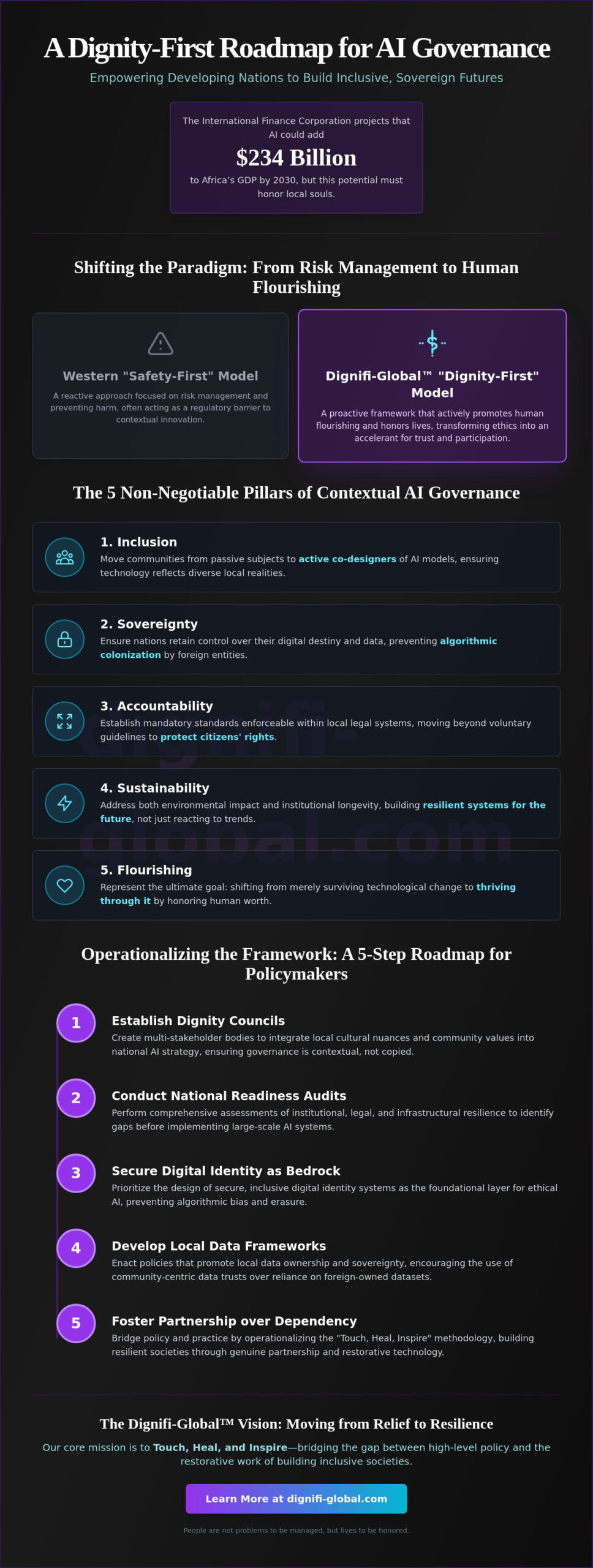
By 2030, the International Finance Corporation projects that AI could add $234 billion to Africa’s GDP, but this vast potential remains a hollow promise if built on models that ignore local souls. You recognize that current Western technologies often act as a form of neo-colonialism, overlooking cultural nuances and the lack of secure foundational infrastructure. True progress requires an AI ethics framework for developing nations that centers on human dignity rather than mere data processing; it’s about partnership over dependency. At Dignifi-Global™, we believe people are not problems to be managed, but lives to be honored.
This article provides a dignity-first roadmap for AI governance that empowers nations to build inclusive, sovereign futures. We’ll explore how the African Union’s Continental AI Strategy and Nigeria’s March 2026 national strategy are already bridging the gap between innovation and human rights. You’ll gain practical insights into integrating digital identity with governance to ensure technology doesn’t just manage problems, but restores agency through our core mission to touch, heal, and inspire.
Key Takeaways
- Understand why a dignity-first AI ethics framework for developing nations must transcend Western “risk management” to honor local cultural nuances and sovereignty.
- Identify the five non-negotiable pillars of contextual governance that shift the focus from managing technical processes to fostering holistic human flourishing.
- Uncover the critical intersection between secure digital identity system design and ethical AI, ensuring no individual is erased by algorithmic bias.
- Gain a practical five-step roadmap for policymakers to operationalize ethical standards through “Dignity Councils” and comprehensive national readiness audits.
- Discover how the “Touch, Heal, Inspire” methodology bridges the gap between high-level policy and the restorative work of building resilient, inclusive societies.
What is an AI Ethics Framework for Developing Nations?
An AI ethics framework for developing nations is a set of socio-technical guardrails designed to ensure technology serves human dignity. It’s much more than a list of technical constraints; it’s a foundational architecture that aligns innovation with national values. Many policymakers have discovered that “copy-pasting” Western frameworks, such as the EU AI Act, often fails in developing contexts because those models assume the presence of mature digital ecosystems. We must embrace a shift from “technology-first” to “people-first” governance. The AI Gap is a matter of institutional resilience, not just hardware access.
By grounding local policy in the foundational principles of AI ethics, nations can build systems that are both resilient and inclusive. This approach ensures that the intersection of technology and human rights is handled with the gravitas it deserves. It isn’t about hindering progress, but about centering the human experience in every algorithmic decision. It’s about building a future where technology honors the soul of the community.
The Unique Challenges of the Global South
Data sovereignty is the primary challenge facing nations today. If the data used to train local models is owned by foreign corporations, the risk of algorithmic colonization increases. This imports external biases that can distort local social and economic realities. There’s also a constant tension between the desire for rapid economic growth and the need for ethical slow-downs. However, the India AI RAM Report released on February 16, 2026, highlights how a structured assessment methodology can help a nation manage these risks without stifling innovation. True sovereignty requires a commitment to local data ownership and cultural nuance.
The Dignity-First Perspective
At Dignifi-Global™, we believe that people are lives to be honored, not problems to be managed. Our dignity-first perspective contrasts sharply with the “Safety-First” models prevalent in the Global North. While safety-first focuses on preventing harm, a dignity-first model actively promotes human flourishing. This philosophical shift transforms ethics from a regulatory barrier into an accelerant for trust. When citizens trust that their digital futures are being built with their worth in mind, they move from skepticism to active participation. This trust is the heartbeat of our methodology to touch, heal, and inspire.
The Core Pillars of Contextual AI Governance
A resilient AI ethics framework for developing nations rests on five non-negotiable pillars: Inclusion, Sovereignty, Accountability, Sustainability, and Flourishing. These are not mere abstract concepts; they’re the structural foundations of a future where technology serves humanity. Inclusion must go beyond providing basic connectivity. It requires that local communities move from being passive subjects to active co-designers of the models that govern their access to resources. Sovereignty ensures that nations retain control over their digital destiny, rather than becoming passive consumers of foreign software. Accountability must be enforceable within local legal systems, moving beyond voluntary guidelines to mandatory standards that protect citizens. Sustainability addresses both the environmental footprint of data centers and the institutional longevity of these systems, ensuring that policy isn’t just a reaction to current trends but a foundation for the future. Finally, Flourishing represents the shift from simply surviving technological change to thriving through it.
True governance requires a shift from universalism to contextual intelligence. While Western models often prioritize data privacy as a strictly individual right, many communities in the Global South view data as a collective asset that should benefit the group. This shift in perspective is vital for global AI governance to succeed. By centering the human experience, we ensure that innovation doesn’t just manage data, but honors lives. This dignity-first approach allows leaders to build systems that reflect the inherent worth of their people. Our specialized global governance consulting helps bridge the gap between these high-level principles and local implementation, ensuring that technology becomes a tool for restoration.
Moving from Universalism to Contextual Intelligence
Contextual intelligence is the ability to adapt ethical rules to local cultural and linguistic realities. In some contexts, fairness might mean the equal distribution of resources; in others, it might mean prioritizing the most vulnerable populations first. Decentralized governance models empower local stakeholders to lead these definitions. At Dignifi-Global™, we believe that when we honor local context, we move from dependency to true partnership. This approach ensures that the African Union’s five-year implementation plan for its Continental AI Strategy leads to lasting self-reliance rather than a cycle of external reliance. It’s about centering local voices in every algorithmic decision.
The Intersection of Ethics and Human Rights
We must link AI ethics directly to established human rights, such as the non-refoulement principle in humanitarian and border contexts. AI systems used in aid distribution must never be used to return individuals to situations of persecution. The designation of H.E. Dr. Abiy Ahmed as the African Union Champion for AI in February 2026 signals a growing commitment to this vital intersection. To protect these rights, nations should implement Algorithmic Impact Assessments for all new national technologies. These assessments act as a mirror, helping leaders see if a system will heal or harm before it’s fully deployed, ensuring our mission to touch, heal, and inspire remains at the forefront of innovation.
Digital Identity: The Bedrock of Ethical AI
An AI ethics framework for developing nations remains an abstract ideal until it’s anchored in the reality of the individual. Without a secure and verifiable way to identify the people technology aims to serve, algorithms inevitably default to exclusion. We cannot speak of ethical AI if the foundational systems of a nation cannot accurately see its citizens. Digital identity isn’t just a technical requirement; it’s a moral imperative that ensures every person is recognized as a life to be honored, not a data point to be discarded. When we prioritize digital identity system design, we create the necessary visibility for AI to function with precision and empathy.
Sovereign identity acts as the primary shield against the technological neo-colonialism that threatens emerging markets. It shifts the power dynamic from external data-harvesting entities back to the citizen. This identity-centric governance ensures that AI systems operate within a closed loop of consent and accountability. By aligning these systems with the UN Principles for the Ethical Use of AI, developing nations can establish a baseline of human rights that protects against algorithmic bias and predatory data practices. It’s about partnership over dependency, ensuring technology serves the soul of the nation.
Sovereign ID vs. Corporate ID
The choice facing emerging economies is stark: adopt state-led, dignity-first ID systems or surrender to private-sector models built on data-harvesting. Corporate identity models often view individuals as products to be sold, whereas sovereign systems treat them as participants to be protected. Secure, state-backed IDs allow for genuine “opt-in” participation in the digital economy. By utilizing privacy-preserving technologies like zero-knowledge proofs, nations can verify eligibility for services without exposing sensitive personal details. This ensures that the AI framework heals rather than harms, restoring agency to the individual.
Identity as a Tool for Financial Inclusion
A robust digital ID is the gateway to financial inclusion and systemic resilience. In regions where traditional credit histories are absent, ethical AI can use verified identity data to expand access to capital without repeating the biases of the past. This isn’t about mere financial transactions; it’s about honoring the economic potential of every citizen. Interoperable standards are essential here. They allow global aid frameworks to interact seamlessly with national systems, ensuring that humanitarian assistance is delivered with speed and dignity. Through our methodology to touch, heal, and inspire, we help nations bridge the gap between abstract policy and the concrete restoration of human worth.
Operationalizing the Framework: 5 Steps for Policymakers
Transforming a philosophical commitment into a functional reality requires more than just good intentions; it demands a systemic shift in how we view the intersection of technology and governance. To move from abstract principles to a working AI ethics framework for developing nations, leaders must adopt a tactical roadmap that prioritizes institutional resilience over mere technical adoption. This process begins with the understanding that people are not problems to be managed, but lives to be honored. By following a structured path, nations can ensure that innovation serves as a tool for restoration rather than a mechanism for exclusion.
- Establish a Multi-Stakeholder Dignity Council: Move AI oversight out of technical silos and into a diverse body that includes ethicists, community leaders, and civil society. This council ensures that deployment remains rooted in the specific cultural nuances of the nation.
- Conduct a National AI Readiness Audit: Before deploying new systems, nations must identify data infrastructure and legal gaps. Throughout January and February 2026, Trinidad and Tobago conducted these assessments to ensure their governance could support ethical innovation.
- Develop a Regulatory Sandbox: Create controlled environments for testing ethical AI in low-risk sectors like education or agriculture. Peru’s January 2026 regulatory framework utilizes a staggered implementation that allows for such testing before high-stakes sector rollouts in September 2026.
- Mandate Procurement Transparency: Require all public-sector AI acquisitions to meet strict transparency standards. This prevents the “black box” problem where foreign software dictates local policy without accountability.
- Invest in Contextual AI Literacy: Launch programs for civil servants and the public that focus on how AI impacts human rights and local dignity. Literacy is the primary defense against algorithmic colonization.
Building Institutional Resilience
Institutional resilience is the ability of a nation to govern new technologies without falling into a state of external dependency. It’s about partnership over subordination. Policy must precede technology in national development to ensure that digital tools align with sovereign goals. When we focus on people rather than processes, we create a top-down governance model that remains deeply responsive to bottom-up community needs. This ensures that the AI ethics framework for developing nations remains a living document, capable of evolving with the needs of the people it serves.
Monitoring and Auditing for Compliance
Static policies are insufficient for the dynamic nature of artificial intelligence. Nations should implement regular Dignity Audits to ensure AI systems continue to align with local values and human rights. These audits go beyond technical performance to measure the actual impact on human flourishing. Utilizing advanced AI governance solutions allows for automated policy monitoring that flags ethical drift in real-time. Furthermore, red-teaming AI models for cultural and linguistic biases is essential to prevent the import of foreign prejudices. To begin building your sovereign governance roadmap, explore our policy leadership services today.
The Dignifi-Global™ Vision: Moving from Relief to Resilience
The path toward a technological future must be paved with the restoration of human worth, not just the optimization of code. By establishing a robust AI ethics framework for developing nations, we transition from being passive recipients of global trends to becoming the architects of our own flourishing. This shift represents a move from relief, which addresses immediate digital divides, to resilience, which builds the institutional strength to govern innovation for generations. Our methodology, Touch, Heal, Inspire, serves as the heartbeat of this transition, ensuring that every policy decision is rooted in a profound moral responsibility to the individual.
We bridge the gap between high-level international standards and human-centric implementation by centering the lived experience of the communities we serve. In 2026, we see a world where developing nations lead the global conversation on ethical AI. As countries like Nigeria and Ethiopia implement their national strategies, they aren’t merely adopting technology; they’re honoring the cultural and linguistic nuances that Western models often erase. This isn’t a vision of the distant future; it’s a reality being built today through dignity-first models that prioritize partnership over dependency and people over processes.
Partnership Over Dependency
The Dignifi-Global™ approach to strategic advisory rejects the traditional, process-heavy consulting model. Instead, we offer a vision of global governance that is deeply rooted in ethical conviction and diplomatic prestige. We don’t view emerging markets as landscapes to be mined for data, but as partners in a humanitarian mission. Our policy design centers local voices in every framework, ensuring that the intersection of artificial intelligence and digital identity serves the sovereign interests of the nation. Engaging with our global governance consulting services means building a foundational structure that can withstand the pressures of rapid technological change while maintaining absolute accountability to your citizens.
A Call to Systemic Action
The urgency of this moment cannot be overstated. As the International Finance Corporation projects a $234 billion boost to Africa’s GDP by 2030, the question isn’t whether AI will arrive, but whether it will arrive with dignity. We must choose to build systems that heal rather than harm. We must remember that people are not problems to be managed; they are lives to be honored. This philosophy is the cornerstone of everything we do. It’s time to move beyond the cold, clinical language of risk management and embrace a future where technology is a catalyst for human flourishing. We invite you to take the first step in this transformative journey. Partner with Dignifi-Global™ to design your ethical AI roadmap and lead your nation toward a resilient, inclusive, and dignified technological future.
A Future Where Technology Honors Humanity
The journey toward a sovereign technological future begins with the recognition that people are not problems to be managed, but lives to be honored. We’ve explored how a contextual AI ethics framework for developing nations must move beyond Western paradigms to embrace the foundational pillars of inclusion, sovereignty, and accountability. By rooting these systems in secure digital identity, we ensure that innovation restores rather than erases the individual. This isn’t just about technical policy; it’s about building the institutional resilience that allows nations to lead with confidence and moral authority.
Led by Her Excellency Roné de Beauvoir, Dignifi-Global brings deep experience in humanitarian resilience policy to every partnership. We apply our signature “Touch, Heal, Inspire” methodology to bridge the gap between high-level governance and human flourishing. The time to act is now, ensuring that the projected $234 billion AI contribution to Africa’s GDP by 2030 is built on a foundation of human dignity. Lead with Dignity: Explore our AI Governance Advisory Services. Together, we can build a world where technology serves the soul of every nation.
Frequently Asked Questions
Why do developing nations need a different AI ethics framework than the West?
Developing nations require a unique approach because Western models often assume a level of digital infrastructure and legal stability that doesn’t reflect local realities. A tailored AI ethics framework for developing nations ensures that innovation respects cultural nuances and protects against the risk of technological neo-colonialism. It’s about building partnership over dependency through sovereign governance.
How does digital identity impact the ethics of artificial intelligence?
Digital identity acts as the essential technical bridge that allows AI systems to recognize and serve individuals with precision. Without a secure, sovereign ID system, algorithms frequently result in systemic exclusion and data exploitation. This bedrock of identity ensures that every individual is treated as a life to be honored rather than a data point to be managed.
Can ethical AI frameworks actually help economic growth in the Global South?
Ethical frameworks act as a catalyst for sustainable growth by establishing the trust required for institutional resilience. By January 2026, nations like Peru demonstrated that clear regulatory guardrails attract high-value international partnerships. These frameworks prevent the long-term costs of algorithmic bias and social friction, moving nations from relief to lasting resilience.
What are the biggest risks of using Western-trained AI models in developing countries?
The primary risks include algorithmic colonization and the erasure of local cultural identities. Models trained exclusively on Western datasets lack the linguistic diversity and sociological context needed for accurate decision-making in the Global South. This misalignment can lead to biased outcomes in healthcare, justice, and financial services, ultimately undermining national sovereignty.
How can a small nation enforce AI ethics without a massive regulatory budget?
Small nations can achieve effective oversight by participating in regional alliances like the African Union’s Continental AI Strategy. By pooling resources and utilizing shared auditing methodologies, states can enforce standards without an expansive domestic budget. Regional cooperation ensures that even smaller economies can maintain sovereign control over their digital futures through collective accountability.
What is the role of human dignity in AI policy design?
Human dignity serves as the foundational premise that guides all systemic action in policy design. Instead of focusing solely on technical safety, a dignity-first approach centers on the inherent worth and flourishing of the individual. This perspective ensures that an AI ethics framework for developing nations restores agency to the people rather than just managing technical risks.
What happens if a nation ignores AI ethics in favor of rapid development?
Ignoring ethical guardrails often leads to institutional fragility and the exploitation of vulnerable populations. While development might appear faster initially, the lack of accountability creates deep-seated social distrust and predatory data environments. Over time, this erodes the foundations of the digital economy and forces a state into long-term technological dependency.
How does Dignifi-Global™ help governments implement these frameworks?
Dignifi-Global™ provides the strategic insights and policy leadership needed to move from abstract concepts to concrete implementation. We utilize our signature “Touch, Heal, Inspire” framework to help governments design resilient systems at the intersection of technology and human rights. Our advisory focuses on restorative governance that honors lives and builds long-term institutional strength.