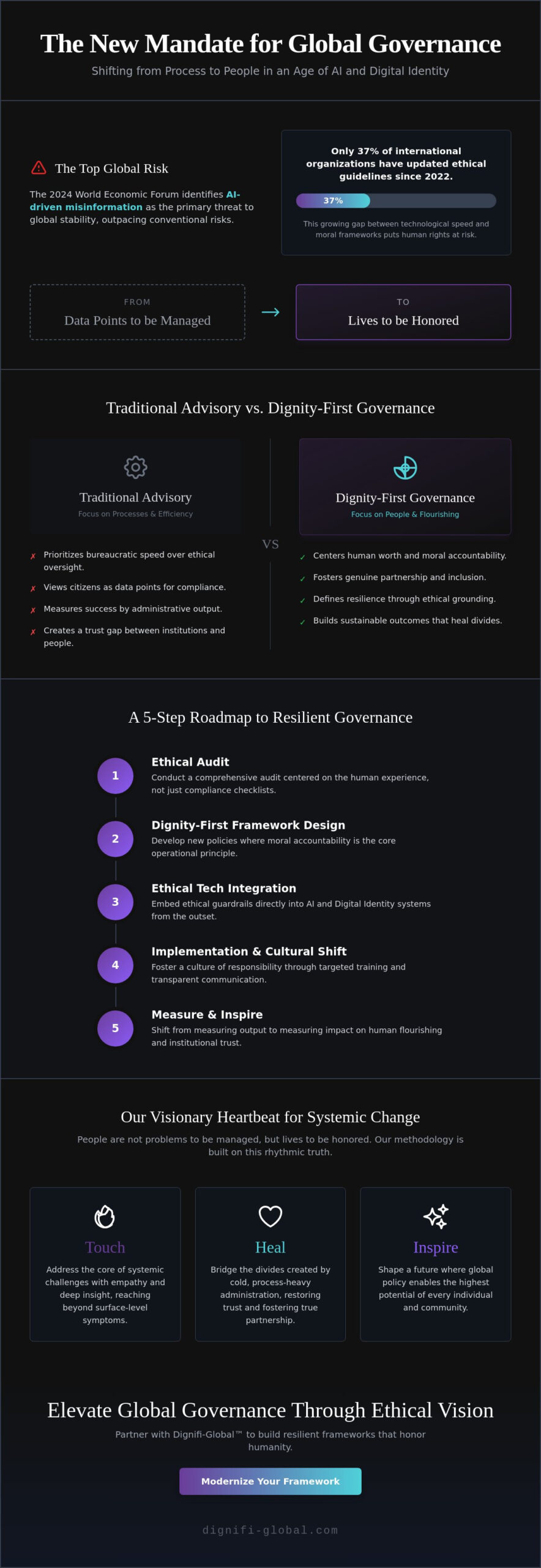
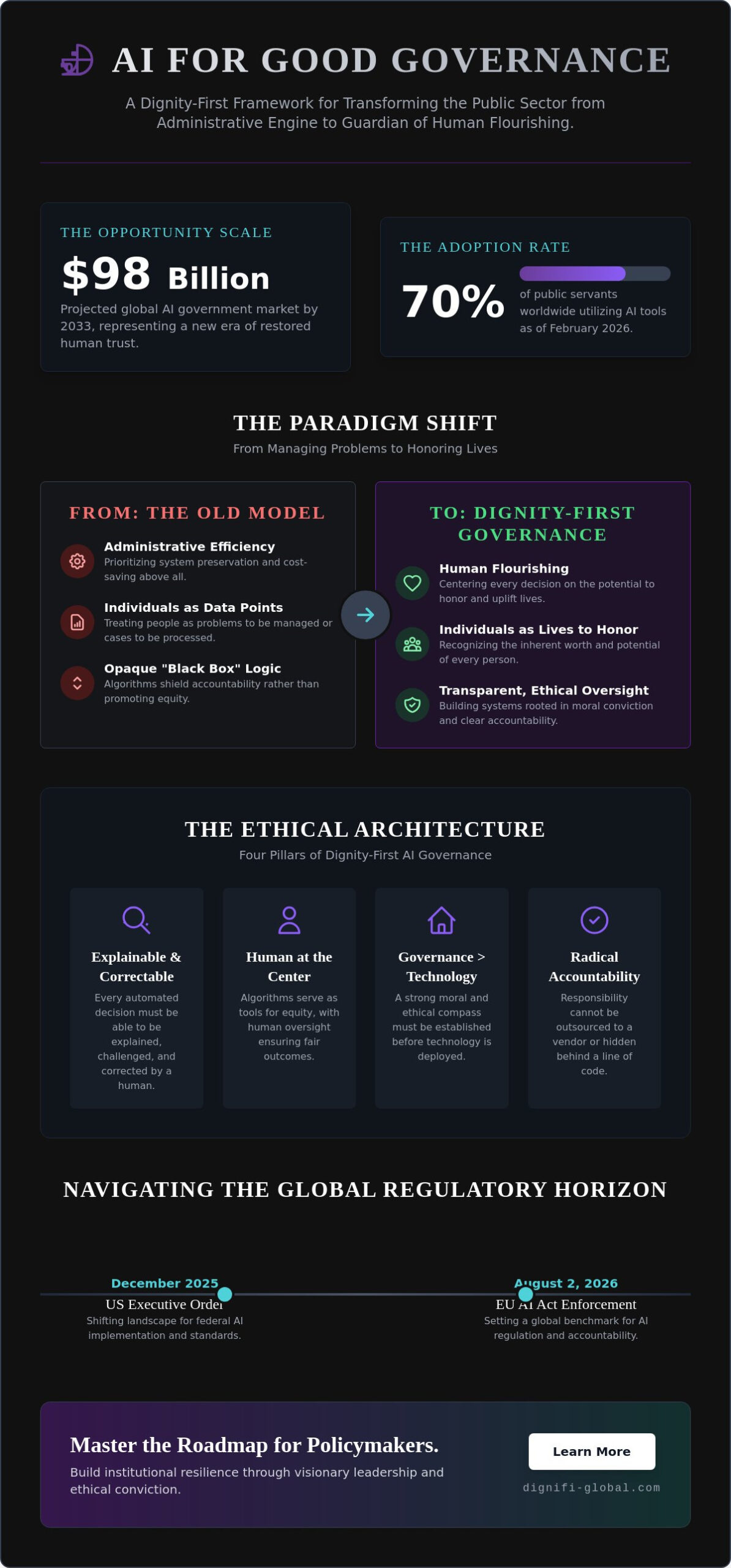
What if the $98 billion projected for the global AI government market by 2033 was not just a measure of technological scale, but a testament to restored human trust? With 70% of public servants worldwide already utilizing these tools as of February 2026, the question is no longer about adoption, but about the soul of our systems. Effective AI for good governance in public sector requires more than just managing algorithms; it demands an architectural commitment to honoring every individual.

You’re likely grappling with the August 2, 2026, enforcement of the EU AI Act and the shifting landscape of the December 2025 US Executive Order. It’s a daunting task to navigate these regulatory intersections while ensuring that efficiency doesn’t come at the cost of equity. We’ll show you how to transform your public institution from a cold administrative engine into a guardian of human flourishing. By exploring a foundational framework for ethical AI, this guide will help you bridge the gap between technical implementation and global inclusion, ensuring your agency moves from managing problems to honoring lives.

Key Takeaways

  • Understand the shift from administrative efficiency to an ethical architecture that centers human dignity in every policy decision.
  • Implement AI for good governance in public sector using a framework that transforms institutional engines into instruments of global inclusion.
  • Uncover how AI-driven digital identity systems can bridge the divide for the unbanked and restore trust in humanitarian aid delivery.
  • Navigate the complexities of algorithmic bias by adopting a “dignity-first” approach that views individuals as lives to be honored, not problems to be managed.
  • Master a strategic roadmap for policymakers designed to build institutional resilience through visionary leadership and ethical conviction.

Defining the New Era of Public Sector Intelligence

We stand at a pivotal threshold where the machinery of state meets the transformative potential of machine intelligence. AI for good governance in public sector is not merely a technical upgrade; it’s the strategic integration of intelligence to enhance institutional accountability and restore the bond between the state and the citizen. In 2026, we’ve moved past the era of experimental AI pilots that characterized the early 2020s. Today, the focus has shifted toward building foundational governance frameworks that can withstand the pressures of a rapidly evolving digital society. These frameworks ensure that intelligence is deployed with purpose, moving beyond the “black box” of automated decisions toward a model of transparent, ethical oversight.

AI governance is a moral architecture for the digital age, designed to ensure that technology serves the sanctity of human life rather than the convenience of administrative processes.

Traditional bureaucratic governance often prioritizes the preservation of the system itself, treating individuals as data points to be processed or problems to be managed. In contrast, dignity-first public service recognizes that every interaction is an opportunity to honor a life. This shift requires a departure from a rigid Government by algorithm where citizens are subjected to opaque logic. Instead, we’re building systems that are deeply rooted in ethical conviction, where the algorithm is a tool for equity, not a shield against accountability.

The Shift from Efficiency to Flourishing

While fiscal responsibility remains a fundamental duty of the public servant, cost-saving is a secondary benefit of modern intelligence, not the primary goal. We must understand that AI is not for managing processes, but for honoring lives. When public institutions prioritize human flourishing, they build a unique form of institutional resilience. This resilience isn’t found in rigid code; it’s found in the trust established when technology is used to touch the lives of the marginalized, heal systemic inequities, and inspire collective progress. By centering dignity, we transform the public sector from a cold administrative engine into a guardian of the common good.

Global Standards for AI Governance in 2026

The landscape of 2026 is defined by a maturing set of international norms. We’ve seen the evolution of OECD and UN guidelines from abstract principles into enforceable standards that demand accountability. Cross-border cooperation has become essential, particularly as we develop digital identity systems that respect the sovereignty of the individual across different jurisdictions. For leaders seeking to align their agencies with these high-minded ideals, global governance consulting provides the necessary policy insights to navigate the complex intersection of ethics and technology. This global alignment ensures that no community is left behind as we bridge the digital divide.

The Ethical Architecture of Dignity-First Governance

True leadership in the digital era isn’t found in the speed of a processor, but in the strength of an ethical foundation. At Dignifi-Global™, we view AI for good governance in public sector through a proprietary “dignity-first” lens. This perspective shifts the focus from managing data to honoring lives. We believe that governance must always precede technology; without a moral compass, even the most advanced systems risk becoming instruments of exclusion rather than tools for flourishing. By placing ethical conviction at the heart of the architecture, we ensure that the intersection of AI and public policy serves the inherent worth of every human person.

Automated decision-making systems carry a profound moral weight that can’t be ignored. When a machine determines eligibility for social services or legal status, accountability cannot be outsourced to a vendor or hidden behind a line of code. Public institutions have a responsibility to reduce risk and increase transparency by keeping the human at the center of the logic. True accountability is not a checkbox on an audit; it’s a foundational promise that every decision can be explained, challenged, and corrected. This approach transforms the relationship between the state and the citizen from one of dependency to one of partnership.

Centering the Human in the Algorithm

Effective public policy requires contextual intelligence, a nuanced understanding of local culture and history that raw data alone cannot capture. We must prevent AI from becoming a “black box” that obscures institutional responsibility. Surface-level compliance with current regulations isn’t enough to build lasting trust. Institutions need foundational ethics that guide the development of Ethical AI Governance Frameworks. These frameworks ensure that technology is used to bridge divides, not deepen them, by prioritizing the human experience over administrative convenience.

Touch, Heal, Inspire: A Methodology for Institutions

Our methodology operates with a measured, three-part cadence that acts as a heartbeat for policy development. First, we Touch by identifying the real-world needs of the most vulnerable populations, such as the estimated 1.4 billion people worldwide who still lack formal financial access. Next, we Heal by using AI to restore trust and fix broken service delivery models that have historically marginalized communities. Finally, we Inspire by setting a global benchmark for ethical leadership. This process ensures that public sector technology is not just functional, but restorative and visionary, creating a legacy of inclusion that lasts for generations.
AI for Good Governance in the Public Sector: Centering Human Dignity in 2026

Beyond Efficiency: AI Applications for Global Inclusion

The true measure of a state’s wisdom isn’t found in the complexity of its code, but in the breadth of its embrace. When we apply AI for good governance in public sector, we move beyond the mechanical pursuit of speed toward a higher purpose: global inclusion. While many administrative bodies use AI to Improve Government Performance by automating routine tasks, the visionary leader recognizes that technology must be a bridge to the forgotten. In 2026, this means leveraging predictive analytics and intelligent systems to ensure that no individual is left behind by the systems meant to serve them.

Inclusive financial system development has emerged as a central pillar of this new governance model. It’s not enough to have a stable economy if the doors to that economy remain locked for the marginalized. By integrating ethical AI into the very fabric of public finance, institutions can identify and dismantle the systemic barriers that have historically excluded rural and low-income populations. This isn’t a mere administrative adjustment; it’s a profound act of restoration that honors the economic potential of every citizen.

Digital Identity as a Human Right

Digital identity is not a privilege for the few, but a foundational right for the many. For the estimated 1.4 billion individuals globally who lack formal recognition, the absence of identity is an absence of agency. Strategic digital identity system design allows institutions to reach refugees and marginalized communities with surgical precision and profound empathy. These systems don’t just store data; they restore the dignity of recognition, allowing a displaced person to access social services, education, and legal protection regardless of where they stand on the map.

Predictive Policy for Proactive Governance

Proactive governance requires a shift from reactive relief to sustainable resilience. By the middle of 2026, predictive policy has become a cornerstone of institutional strength, allowing governments to anticipate global shocks before they fracture the social fabric. Whether responding to climate-driven migration or public health crises, AI-driven insights provide a clarity that manual processes can’t match. This foresight is especially critical in fostering financial inclusion, where predictive models identify systemic barriers to capital and help dismantle them. The result is a public sector that doesn’t just survive challenges, but thrives through them by honoring the data integrity of every citizen.

Key applications for inclusive governance in 2026 include:

  • Predictive resource allocation for humanitarian aid in conflict zones;
  • Automated bias-detection in social safety net eligibility protocols;
  • Real-time monitoring of financial service accessibility for rural populations;
  • Cross-border identity verification to ensure continuity of care for migrants.

These applications manifest our commitment to a higher plane of global engagement. They represent the heartbeat of a public sector that seeks to touch, heal, and inspire through every line of code and every policy decision.

Confronting the Governance Gap: Trust vs. Technology

The greatest risk to our collective future isn’t the machine itself, but the widening chasm between technological capability and ethical oversight. While US federal agencies reported 3,611 AI use cases in 2025, a nearly 70% increase from the previous year, the human element often feels sidelined. This leads to a critical objection: Does AI remove the “human” from public service? The answer lies in our choice of architecture. AI for good governance in public sector succeeds only when we prioritize partnership over dependency. We must refuse to view citizens as data sets to be processed; they are lives to be honored.

The “governance gap” is palpable. According to a 2026 survey, only 18% of public servants believe their governments are deploying AI effectively. This skepticism is rooted in the fear of algorithmic bias undermining public trust. Developers and policymakers share a moral responsibility to ensure that automated systems don’t replicate historical inequities. We don’t just need better code; we need a fundamental shift in how we perceive the role of technology in the state. By bridging this gap, we move from mere administrative engines to institutions that truly serve the common good.

Mitigating Bias through Inclusive Design

Inclusive design is not a feature; it’s a foundational requirement. To bridge the trust gap, AI training data must reflect the full diversity of the public it serves. This requires moving from “problem management” to “life honoring” in data science. Independent auditing plays a vital role here, maintaining institutional accountability by ensuring that high-risk systems exercise reasonable care to prevent discrimination. This is especially vital as regulations like the Colorado AI Act take effect on June 30, 2026, mandating transparency in automated decision-making.

The Myth of Neutral Technology

We must dismantle the myth that AI is a neutral tool. Technology is never neutral; it reflects the values, biases, and priorities of its governance. When institutions prioritize efficiency at any cost, they risk sacrificing the very dignity they are sworn to protect. Policymakers must act as ethical visionaries, ensuring that digital transformation serves the flourishing of all people. If your institution is ready to move beyond surface-level compliance toward a more profound ethical commitment, explore our AI governance solutions to lead with confidence.

True institutional resilience is built on the bedrock of trust. By confronting the governance gap today, we ensure that the technology of tomorrow remains an instrument of healing and inspiration for the global community.

Building Institutional Resilience: A Roadmap for Policymakers

Institutional resilience is not a byproduct of technical efficiency; it’s a result of ethical conviction. As we navigate the complexities of 2026, the demand for visionary leadership at the ministerial level has never been more urgent. Implementing AI for good governance in public sector requires a roadmap that bridges the gap between technical capability and moral responsibility. This journey transforms public agencies from mere administrators of data into guardians of human flourishing. By adopting a “dignity-first” approach, leaders can foster a culture of innovation that prioritizes people over processes and partnership over dependency.

Navigating the current regulatory landscape, particularly with the August 2, 2026, enforcement of the EU AI Act, requires more than just legal compliance. It demands strategic advisory that understands the intersection of technology and human rights. We’ve designed a structured path for institutions ready to lead this transformation through comprehensive AI governance solutions.

Step 1: Establishing the Ethical Framework

The first step is to define the core values that will govern institutional intelligence. This isn’t a technical exercise, but a philosophical one. High-level commitment to “people-first” outcomes ensures that AI is used to empower the citizen rather than simplify the bureaucracy. By integrating human rights principles directly into the technical architecture, agencies create a foundational layer of trust. This framework acts as a compass, guiding every subsequent policy decision toward the restoration of human dignity.

Step 2: Designing for Resilience and Inclusion

Resilience is built when systems are designed to include the most vulnerable. We must implement digital identity systems that empower individuals rather than surveil them. This involves developing inclusive financial frameworks that bridge the digital divide, ensuring that the 70% of public servants using AI tools in 2026 are doing so to expand access, not restrict it. Creating robust feedback loops between citizens and algorithmic systems allows for a participatory model of governance where every voice is heard and every life is honored.

Step 3: Continuous Monitoring and Moral Auditing

Governance is a living process, not a one-time policy implementation. True accountability requires continuous monitoring and moral auditing to ensure systems remain aligned with their ethical purpose. When a system fails to meet these high standards, we must have the courage to “heal” it by addressing biases and restoring equity. This iterative approach prepares institutions for the future of global strategy, ensuring they remain steady and principled amidst the shifting tides of the digital age. Through this three-part cadence—Touch, Heal, Inspire—we set a global benchmark for what it means to lead with wisdom and empathy.

Honoring Humanity Through Sovereign Intelligence

The future of public service is not a choice between technology and humanity, but a commitment to using the former to elevate the latter. We’ve explored how a dignity-first framework transforms AI for good governance in public sector from a tool of administrative control into a bridge for global inclusion. By the end of 2026, the institutions that flourish will be those that have moved beyond surface-level compliance to embrace a foundational architecture of accountability. They’ll be the ones that recognize that people are not problems to be managed; they’re lives to be honored.

Led by Her Excellency Roné de Beauvoir, Dignifi-Global™ stands at the intersection of artificial intelligence, digital identity, and financial inclusion to restore trust in our global systems. Our dignity-first approach to global institutional resilience ensures your policy leadership remains both aspirational and grounded in moral responsibility. Partner with Dignifi-Global™ to design your ethical AI governance framework and lead with the steady confidence of a global statesperson. Together, we can bridge the digital divide and inspire a future where every individual is seen, heard, and valued.

Frequently Asked Questions

What is the role of AI in good governance?

AI acts as a strategic intelligence layer that enhances institutional accountability and fosters human flourishing. It’s not just about speed; it’s about using data to touch lives and bridge the digital divide. By 2033, the global market for AI in government is expected to exceed $98 billion. This investment signifies a shift toward systems that prioritize people over processes, ensuring that AI for good governance in public sector remains rooted in ethical conviction.

How does AI improve public sector efficiency without losing human accountability?

Institutions achieve efficiency by integrating ethical frameworks that mandate meaningful human oversight at every decision point. Accountability is maintained through transparent logic and independent auditing, as seen in the Colorado AI Act taking effect June 30, 2026. This approach ensures that automated systems don’t become “black boxes.” Instead of viewing citizens as problems to be managed, these systems operate as partnerships that honor the inherent worth of every individual.

What are the main ethical risks of AI in government?

The primary risks include algorithmic bias, the loss of public trust, and the erosion of human agency. A February 2026 study found that 82% of public servants harbor concerns about the effective implementation of these tools. When governments prioritize efficiency at any cost, they risk deepening systemic inequities. Ethical governance requires a “dignity-first” lens to ensure that technology doesn’t remove the human heart from the machinery of the state.

How can AI support financial inclusion in developing nations?

AI supports financial inclusion by identifying and dismantling the systemic barriers that exclude the 1.4 billion people currently lacking formal financial access. Predictive analytics can identify creditworthiness in rural populations where traditional data is scarce. This isn’t just a technical adjustment; it’s a restorative act. By centering the needs of the marginalized, inclusive financial system development creates a pathway for economic flourishing and long-term institutional resilience.

Why is digital identity essential for AI governance in the public sector?

Digital identity provides the foundational layer of recognition that allows AI systems to serve individuals with precision and empathy. Without a secure, sovereign identity, a person lacks the agency to access social services or legal protections. For refugees and displaced communities, these systems are essential for restoring the dignity of recognition. In the context of AI for good governance in public sector, identity is the bridge between a data point and a life honored.

What does “dignity-first” AI governance look like in practice?

In practice, this governance model utilizes the “Touch, Heal, Inspire” cadence to guide all policy decisions. It begins by touching the real-world needs of the most vulnerable and proceeds to heal broken service models through restorative technology. Finally, it inspires global leadership by setting a high-minded benchmark for ethical conduct. It’s a shift from managing data to centering human dignity, ensuring that every line of code serves the common good.

How do global institutions standardize AI ethics across different regions?

Standardization occurs through the evolution of international norms like the EU AI Act, which becomes enforceable on August 2, 2026. These regulations demand cross-border cooperation to ensure that high-risk systems exercise reasonable care globally. While regional laws like the December 2025 US Executive Order vary, the trend is toward a unified framework of accountability. This global alignment prevents regulatory fragmentation and ensures that ethical standards are upheld across all jurisdictions.

Can AI help in humanitarian resilience programs?

Yes, AI is a critical tool for moving humanitarian efforts from reactive relief to sustainable resilience. Predictive models allow agencies to anticipate climate shocks or health crises before they fracture society. With civilian agencies spending over $3 billion on AI in the most recent budget cycle, the focus is now on proactive aid delivery. This foresight allows institutions to protect vulnerable populations and build a future rooted in stability and human flourishing.
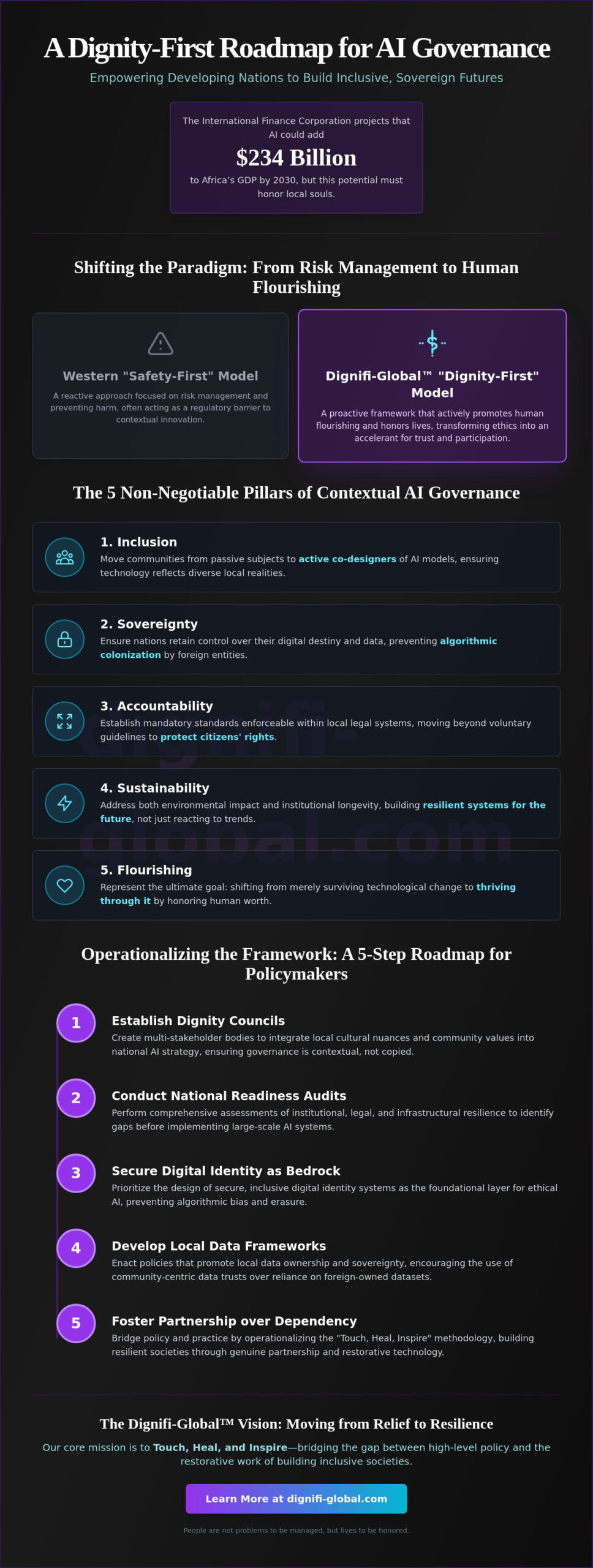
By 2030, the International Finance Corporation projects that AI could add $234 billion to Africa’s GDP, but this vast potential remains a hollow promise if built on models that ignore local souls. You recognize that current Western technologies often act as a form of neo-colonialism, overlooking cultural nuances and the lack of secure foundational infrastructure. True progress requires an AI ethics framework for developing nations that centers on human dignity rather than mere data processing; it’s about partnership over dependency. At Dignifi-Global™, we believe people are not problems to be managed, but lives to be honored.

This article provides a dignity-first roadmap for AI governance that empowers nations to build inclusive, sovereign futures. We’ll explore how the African Union’s Continental AI Strategy and Nigeria’s March 2026 national strategy are already bridging the gap between innovation and human rights. You’ll gain practical insights into integrating digital identity with governance to ensure technology doesn’t just manage problems, but restores agency through our core mission to touch, heal, and inspire.

Key Takeaways

  • Understand why a dignity-first AI ethics framework for developing nations must transcend Western “risk management” to honor local cultural nuances and sovereignty.
  • Identify the five non-negotiable pillars of contextual governance that shift the focus from managing technical processes to fostering holistic human flourishing.
  • Uncover the critical intersection between secure digital identity system design and ethical AI, ensuring no individual is erased by algorithmic bias.
  • Gain a practical five-step roadmap for policymakers to operationalize ethical standards through “Dignity Councils” and comprehensive national readiness audits.
  • Discover how the “Touch, Heal, Inspire” methodology bridges the gap between high-level policy and the restorative work of building resilient, inclusive societies.

What is an AI Ethics Framework for Developing Nations?

An AI ethics framework for developing nations is a set of socio-technical guardrails designed to ensure technology serves human dignity. It’s much more than a list of technical constraints; it’s a foundational architecture that aligns innovation with national values. Many policymakers have discovered that “copy-pasting” Western frameworks, such as the EU AI Act, often fails in developing contexts because those models assume the presence of mature digital ecosystems. We must embrace a shift from “technology-first” to “people-first” governance. The AI Gap is a matter of institutional resilience, not just hardware access.

By grounding local policy in the foundational principles of AI ethics, nations can build systems that are both resilient and inclusive. This approach ensures that the intersection of technology and human rights is handled with the gravitas it deserves. It isn’t about hindering progress, but about centering the human experience in every algorithmic decision. It’s about building a future where technology honors the soul of the community.

The Unique Challenges of the Global South

Data sovereignty is the primary challenge facing nations today. If the data used to train local models is owned by foreign corporations, the risk of algorithmic colonization increases. This imports external biases that can distort local social and economic realities. There’s also a constant tension between the desire for rapid economic growth and the need for ethical slow-downs. However, the India AI RAM Report released on February 16, 2026, highlights how a structured assessment methodology can help a nation manage these risks without stifling innovation. True sovereignty requires a commitment to local data ownership and cultural nuance.

The Dignity-First Perspective

At Dignifi-Global™, we believe that people are lives to be honored, not problems to be managed. Our dignity-first perspective contrasts sharply with the “Safety-First” models prevalent in the Global North. While safety-first focuses on preventing harm, a dignity-first model actively promotes human flourishing. This philosophical shift transforms ethics from a regulatory barrier into an accelerant for trust. When citizens trust that their digital futures are being built with their worth in mind, they move from skepticism to active participation. This trust is the heartbeat of our methodology to touch, heal, and inspire.

The Core Pillars of Contextual AI Governance

A resilient AI ethics framework for developing nations rests on five non-negotiable pillars: Inclusion, Sovereignty, Accountability, Sustainability, and Flourishing. These are not mere abstract concepts; they’re the structural foundations of a future where technology serves humanity. Inclusion must go beyond providing basic connectivity. It requires that local communities move from being passive subjects to active co-designers of the models that govern their access to resources. Sovereignty ensures that nations retain control over their digital destiny, rather than becoming passive consumers of foreign software. Accountability must be enforceable within local legal systems, moving beyond voluntary guidelines to mandatory standards that protect citizens. Sustainability addresses both the environmental footprint of data centers and the institutional longevity of these systems, ensuring that policy isn’t just a reaction to current trends but a foundation for the future. Finally, Flourishing represents the shift from simply surviving technological change to thriving through it.

True governance requires a shift from universalism to contextual intelligence. While Western models often prioritize data privacy as a strictly individual right, many communities in the Global South view data as a collective asset that should benefit the group. This shift in perspective is vital for global AI governance to succeed. By centering the human experience, we ensure that innovation doesn’t just manage data, but honors lives. This dignity-first approach allows leaders to build systems that reflect the inherent worth of their people. Our specialized global governance consulting helps bridge the gap between these high-level principles and local implementation, ensuring that technology becomes a tool for restoration.

Moving from Universalism to Contextual Intelligence

Contextual intelligence is the ability to adapt ethical rules to local cultural and linguistic realities. In some contexts, fairness might mean the equal distribution of resources; in others, it might mean prioritizing the most vulnerable populations first. Decentralized governance models empower local stakeholders to lead these definitions. At Dignifi-Global™, we believe that when we honor local context, we move from dependency to true partnership. This approach ensures that the African Union’s five-year implementation plan for its Continental AI Strategy leads to lasting self-reliance rather than a cycle of external reliance. It’s about centering local voices in every algorithmic decision.

The Intersection of Ethics and Human Rights

We must link AI ethics directly to established human rights, such as the non-refoulement principle in humanitarian and border contexts. AI systems used in aid distribution must never be used to return individuals to situations of persecution. The designation of H.E. Dr. Abiy Ahmed as the African Union Champion for AI in February 2026 signals a growing commitment to this vital intersection. To protect these rights, nations should implement Algorithmic Impact Assessments for all new national technologies. These assessments act as a mirror, helping leaders see if a system will heal or harm before it’s fully deployed, ensuring our mission to touch, heal, and inspire remains at the forefront of innovation.

AI Ethics Framework for Developing Nations: Centering Human Dignity in Global Innovation

Digital Identity: The Bedrock of Ethical AI

An AI ethics framework for developing nations remains an abstract ideal until it’s anchored in the reality of the individual. Without a secure and verifiable way to identify the people technology aims to serve, algorithms inevitably default to exclusion. We cannot speak of ethical AI if the foundational systems of a nation cannot accurately see its citizens. Digital identity isn’t just a technical requirement; it’s a moral imperative that ensures every person is recognized as a life to be honored, not a data point to be discarded. When we prioritize digital identity system design, we create the necessary visibility for AI to function with precision and empathy.

Sovereign identity acts as the primary shield against the technological neo-colonialism that threatens emerging markets. It shifts the power dynamic from external data-harvesting entities back to the citizen. This identity-centric governance ensures that AI systems operate within a closed loop of consent and accountability. By aligning these systems with the UN Principles for the Ethical Use of AI, developing nations can establish a baseline of human rights that protects against algorithmic bias and predatory data practices. It’s about partnership over dependency, ensuring technology serves the soul of the nation.

Sovereign ID vs. Corporate ID

The choice facing emerging economies is stark: adopt state-led, dignity-first ID systems or surrender to private-sector models built on data-harvesting. Corporate identity models often view individuals as products to be sold, whereas sovereign systems treat them as participants to be protected. Secure, state-backed IDs allow for genuine “opt-in” participation in the digital economy. By utilizing privacy-preserving technologies like zero-knowledge proofs, nations can verify eligibility for services without exposing sensitive personal details. This ensures that the AI framework heals rather than harms, restoring agency to the individual.

Identity as a Tool for Financial Inclusion

A robust digital ID is the gateway to financial inclusion and systemic resilience. In regions where traditional credit histories are absent, ethical AI can use verified identity data to expand access to capital without repeating the biases of the past. This isn’t about mere financial transactions; it’s about honoring the economic potential of every citizen. Interoperable standards are essential here. They allow global aid frameworks to interact seamlessly with national systems, ensuring that humanitarian assistance is delivered with speed and dignity. Through our methodology to touch, heal, and inspire, we help nations bridge the gap between abstract policy and the concrete restoration of human worth.

Operationalizing the Framework: 5 Steps for Policymakers

Transforming a philosophical commitment into a functional reality requires more than just good intentions; it demands a systemic shift in how we view the intersection of technology and governance. To move from abstract principles to a working AI ethics framework for developing nations, leaders must adopt a tactical roadmap that prioritizes institutional resilience over mere technical adoption. This process begins with the understanding that people are not problems to be managed, but lives to be honored. By following a structured path, nations can ensure that innovation serves as a tool for restoration rather than a mechanism for exclusion.

  • Establish a Multi-Stakeholder Dignity Council: Move AI oversight out of technical silos and into a diverse body that includes ethicists, community leaders, and civil society. This council ensures that deployment remains rooted in the specific cultural nuances of the nation.
  • Conduct a National AI Readiness Audit: Before deploying new systems, nations must identify data infrastructure and legal gaps. Throughout January and February 2026, Trinidad and Tobago conducted these assessments to ensure their governance could support ethical innovation.
  • Develop a Regulatory Sandbox: Create controlled environments for testing ethical AI in low-risk sectors like education or agriculture. Peru’s January 2026 regulatory framework utilizes a staggered implementation that allows for such testing before high-stakes sector rollouts in September 2026.
  • Mandate Procurement Transparency: Require all public-sector AI acquisitions to meet strict transparency standards. This prevents the “black box” problem where foreign software dictates local policy without accountability.
  • Invest in Contextual AI Literacy: Launch programs for civil servants and the public that focus on how AI impacts human rights and local dignity. Literacy is the primary defense against algorithmic colonization.

Building Institutional Resilience

Institutional resilience is the ability of a nation to govern new technologies without falling into a state of external dependency. It’s about partnership over subordination. Policy must precede technology in national development to ensure that digital tools align with sovereign goals. When we focus on people rather than processes, we create a top-down governance model that remains deeply responsive to bottom-up community needs. This ensures that the AI ethics framework for developing nations remains a living document, capable of evolving with the needs of the people it serves.

Monitoring and Auditing for Compliance

Static policies are insufficient for the dynamic nature of artificial intelligence. Nations should implement regular Dignity Audits to ensure AI systems continue to align with local values and human rights. These audits go beyond technical performance to measure the actual impact on human flourishing. Utilizing advanced AI governance solutions allows for automated policy monitoring that flags ethical drift in real-time. Furthermore, red-teaming AI models for cultural and linguistic biases is essential to prevent the import of foreign prejudices. To begin building your sovereign governance roadmap, explore our policy leadership services today.

The Dignifi-Global™ Vision: Moving from Relief to Resilience

The path toward a technological future must be paved with the restoration of human worth, not just the optimization of code. By establishing a robust AI ethics framework for developing nations, we transition from being passive recipients of global trends to becoming the architects of our own flourishing. This shift represents a move from relief, which addresses immediate digital divides, to resilience, which builds the institutional strength to govern innovation for generations. Our methodology, Touch, Heal, Inspire, serves as the heartbeat of this transition, ensuring that every policy decision is rooted in a profound moral responsibility to the individual.

We bridge the gap between high-level international standards and human-centric implementation by centering the lived experience of the communities we serve. In 2026, we see a world where developing nations lead the global conversation on ethical AI. As countries like Nigeria and Ethiopia implement their national strategies, they aren’t merely adopting technology; they’re honoring the cultural and linguistic nuances that Western models often erase. This isn’t a vision of the distant future; it’s a reality being built today through dignity-first models that prioritize partnership over dependency and people over processes.

Partnership Over Dependency

The Dignifi-Global™ approach to strategic advisory rejects the traditional, process-heavy consulting model. Instead, we offer a vision of global governance that is deeply rooted in ethical conviction and diplomatic prestige. We don’t view emerging markets as landscapes to be mined for data, but as partners in a humanitarian mission. Our policy design centers local voices in every framework, ensuring that the intersection of artificial intelligence and digital identity serves the sovereign interests of the nation. Engaging with our global governance consulting services means building a foundational structure that can withstand the pressures of rapid technological change while maintaining absolute accountability to your citizens.

A Call to Systemic Action

The urgency of this moment cannot be overstated. As the International Finance Corporation projects a $234 billion boost to Africa’s GDP by 2030, the question isn’t whether AI will arrive, but whether it will arrive with dignity. We must choose to build systems that heal rather than harm. We must remember that people are not problems to be managed; they are lives to be honored. This philosophy is the cornerstone of everything we do. It’s time to move beyond the cold, clinical language of risk management and embrace a future where technology is a catalyst for human flourishing. We invite you to take the first step in this transformative journey. Partner with Dignifi-Global™ to design your ethical AI roadmap and lead your nation toward a resilient, inclusive, and dignified technological future.

A Future Where Technology Honors Humanity

The journey toward a sovereign technological future begins with the recognition that people are not problems to be managed, but lives to be honored. We’ve explored how a contextual AI ethics framework for developing nations must move beyond Western paradigms to embrace the foundational pillars of inclusion, sovereignty, and accountability. By rooting these systems in secure digital identity, we ensure that innovation restores rather than erases the individual. This isn’t just about technical policy; it’s about building the institutional resilience that allows nations to lead with confidence and moral authority.

Led by Her Excellency Roné de Beauvoir, Dignifi-Global brings deep experience in humanitarian resilience policy to every partnership. We apply our signature “Touch, Heal, Inspire” methodology to bridge the gap between high-level governance and human flourishing. The time to act is now, ensuring that the projected $234 billion AI contribution to Africa’s GDP by 2030 is built on a foundation of human dignity. Lead with Dignity: Explore our AI Governance Advisory Services. Together, we can build a world where technology serves the soul of every nation.

Frequently Asked Questions

Why do developing nations need a different AI ethics framework than the West?

Developing nations require a unique approach because Western models often assume a level of digital infrastructure and legal stability that doesn’t reflect local realities. A tailored AI ethics framework for developing nations ensures that innovation respects cultural nuances and protects against the risk of technological neo-colonialism. It’s about building partnership over dependency through sovereign governance.

How does digital identity impact the ethics of artificial intelligence?

Digital identity acts as the essential technical bridge that allows AI systems to recognize and serve individuals with precision. Without a secure, sovereign ID system, algorithms frequently result in systemic exclusion and data exploitation. This bedrock of identity ensures that every individual is treated as a life to be honored rather than a data point to be managed.

Can ethical AI frameworks actually help economic growth in the Global South?

Ethical frameworks act as a catalyst for sustainable growth by establishing the trust required for institutional resilience. By January 2026, nations like Peru demonstrated that clear regulatory guardrails attract high-value international partnerships. These frameworks prevent the long-term costs of algorithmic bias and social friction, moving nations from relief to lasting resilience.

What are the biggest risks of using Western-trained AI models in developing countries?

The primary risks include algorithmic colonization and the erasure of local cultural identities. Models trained exclusively on Western datasets lack the linguistic diversity and sociological context needed for accurate decision-making in the Global South. This misalignment can lead to biased outcomes in healthcare, justice, and financial services, ultimately undermining national sovereignty.

How can a small nation enforce AI ethics without a massive regulatory budget?

Small nations can achieve effective oversight by participating in regional alliances like the African Union’s Continental AI Strategy. By pooling resources and utilizing shared auditing methodologies, states can enforce standards without an expansive domestic budget. Regional cooperation ensures that even smaller economies can maintain sovereign control over their digital futures through collective accountability.

What is the role of human dignity in AI policy design?

Human dignity serves as the foundational premise that guides all systemic action in policy design. Instead of focusing solely on technical safety, a dignity-first approach centers on the inherent worth and flourishing of the individual. This perspective ensures that an AI ethics framework for developing nations restores agency to the people rather than just managing technical risks.

What happens if a nation ignores AI ethics in favor of rapid development?

Ignoring ethical guardrails often leads to institutional fragility and the exploitation of vulnerable populations. While development might appear faster initially, the lack of accountability creates deep-seated social distrust and predatory data environments. Over time, this erodes the foundations of the digital economy and forces a state into long-term technological dependency.

How does Dignifi-Global™ help governments implement these frameworks?

Dignifi-Global™ provides the strategic insights and policy leadership needed to move from abstract concepts to concrete implementation. We utilize our signature “Touch, Heal, Inspire” framework to help governments design resilient systems at the intersection of technology and human rights. Our advisory focuses on restorative governance that honors lives and builds long-term institutional strength.

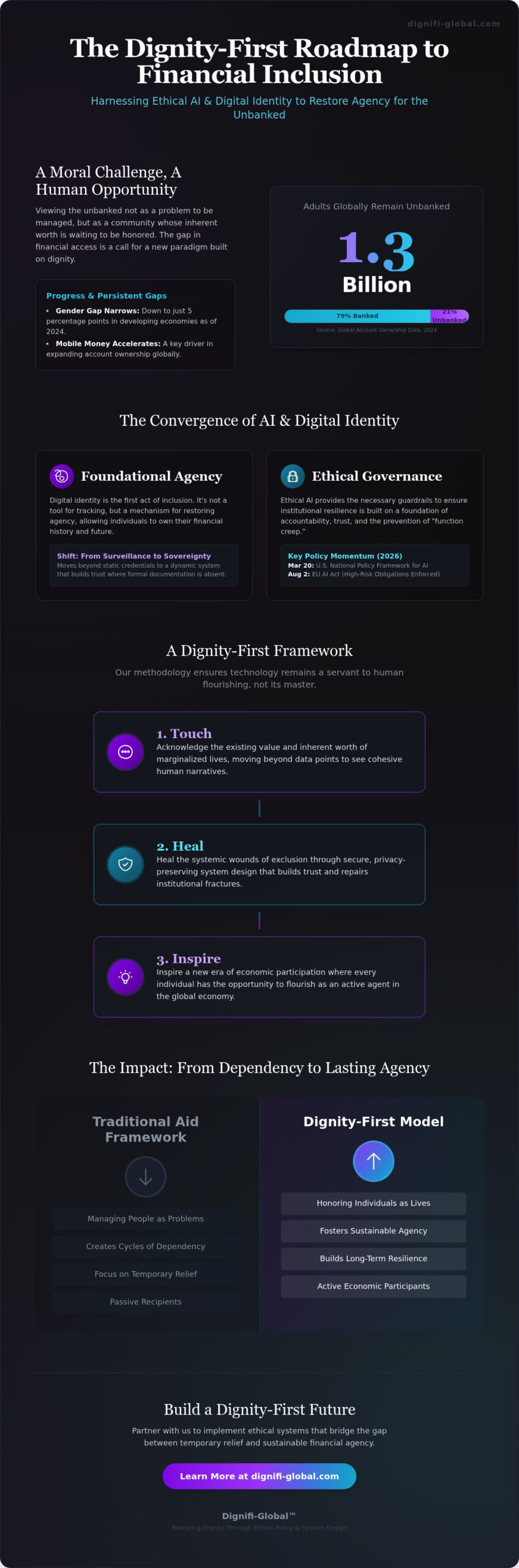
What if the 1.3 billion adults who remain unbanked today are not a problem to be managed, but a community waiting for their inherent worth to be honored? While 79 percent of adults globally held a financial account by 2024, the remaining gap represents a profound moral challenge that technology alone cannot fix. We believe the strategic implementation of AI and digital identity for financial inclusion is not about tracking individuals; it’s about centering human dignity and restoring agency. You likely recognize that existing digital ID systems often risk becoming tools for surveillance or further exclusion rather than empowerment.

This article demonstrates how the intersection of ethical AI governance and secure digital identity systems creates a foundational roadmap for global financial inclusion and institutional resilience. We will move beyond the limitations of traditional aid to explore a dignity-first framework for system design. By examining the shift toward accountability following the U.S. National Policy Framework for Artificial Intelligence released on March 20, 2026, we provide a preview of how to bridge the gap between temporary relief and sustainable financial agency. It’s time to embrace a model of partnership over dependency, ensuring every individual has the opportunity to flourish.

Key Takeaways

  • Shift the perspective from managing problems to honoring lives by adopting a visionary paradigm for inclusive technology.
  • Recognize digital identity as the foundational layer of agency, allowing marginalized populations to own their financial history and future.
  • Implement ethical governance to transform AI and digital identity for financial inclusion into a secure roadmap for institutional resilience.
  • Bridge the gap between temporary relief and sustainable agency by modernizing aid frameworks with dignity-first strategic insights.
  • Apply the “Touch, Heal, Inspire” methodology to ensure that global governance structures prioritize the flourishing of human dignity.

The Convergence of AI and Digital Identity: A New Paradigm for Inclusion

The intersection of technology and humanity is not merely a technical frontier; it’s a moral landscape where the future of global equity is decided. For too long, financial systems have viewed the 1.3 billion unbanked individuals as a data gap to be filled or a logistical hurdle to be cleared. We believe that true progress occurs when we stop managing people as problems and start honoring them as lives. By leveraging AI and digital identity for financial inclusion, we can transform fragmented data points into cohesive narratives of human potential. This year, 2026, marks a pivotal moment as high-risk obligations under the EU AI Act come into force on August 2, 2026, and the U.S. National Policy Framework for Artificial Intelligence begins to reshape how we view the intersection of ethics and innovation. It’s about agency, not just access.

Defining AI and Digital Identity in a Humanitarian Context

AI-driven identity serves as a vehicle for sovereign agency, ensuring that an individual’s digital presence is an instrument of empowerment rather than a ledger of surveillance. While a traditional digital identity often acts as a static record of government-issued credentials, AI-enhanced systems dynamically process alternative data to build trust where formal documentation is absent. Our methodology approaches this through a specific rhythm: we Touch the lives of the marginalized by acknowledging their existing value, Heal the systemic wounds of exclusion through secure design, and Inspire a new era of participation. This approach ensures that technology remains a servant to human flourishing, not its master.

The Economic and Social Case for Ethical Systems

The journey from temporary relief to sustainable resilience requires a shift in how institutions deploy capital and technology. While traditional aid frameworks often create cycles of dependency, inclusive financial systems built on ethical AI foster long-term agency. This transition is essential for meeting the UN Sustainable Development Goals, particularly those focused on eradicating poverty and reducing inequality. By 2024, the gender gap in account ownership in developing economies had already narrowed to 5 percentage points, a testament to the power of mobile technology. However, without robust governance, we risk the “function creep” identified in World Bank reports, where data collected for one purpose is used to marginalize the vulnerable in another. Ethical AI and digital identity for financial inclusion provide the necessary guardrails to ensure that institutional resilience is built on a foundation of accountability and trust.

Foundational Agency: Why Digital Identity Precedes Financial Access

Identity is the first act of inclusion. Without a recognized digital presence, an individual remains invisible to the systems that provide credit, safety, and opportunity. While 79 percent of adults globally held a financial account by 2024, the 1.3 billion who remain unbanked are often excluded simply because they lack the “foundational” credentials required by traditional institutions. We view digital identity system design not as a tool for tracking, but as a mechanism for restoring agency. It’s the essential layer that allows refugees and marginalized populations to own their financial history; this transforms them from passive recipients of aid into active participants in the global economy.

The Moral Architecture of Identity

A dignity-first approach to identity systems requires a fundamental shift from surveillance to sovereignty. Existing frameworks often prioritize the needs of the institution over the rights of the individual, leading to systems that feel like management rather than empowerment. We advocate for partnership over dependency; we believe people are not problems to be managed, but lives to be honored. By utilizing AI and digital identity for financial inclusion, we can create insights that acknowledge the inherent worth of individuals previously deemed “unbankable.” This isn’t about clinical data collection. It’s about centering the human experience to ensure that technology heals the fractures in our social fabric rather than widening them.

Bridging the Gap for the Unbanked

The traditional “know your customer” (KYC) barrier has long served as a gatekeeper that keeps the vulnerable at the margins. Secure digital identity for financial services provides a solution by automating trust in fragile contexts. Since 84 percent of adults in low- and middle-income countries now own a mobile phone, we have an unprecedented opportunity to verify creditworthiness through alternative data. The strategic deployment of AI and digital identity for financial inclusion allows models to analyze patterns of mobile usage or utility payments to build a financial footprint where none existed before. This transition toward financial inclusion acts as a stabilizer for global institutions, replacing volatile relief cycles with long-term economic resilience. If you’re ready to rethink your institutional strategy, we invite you to explore our governance consulting services to build a more humane future.

AI and Digital Identity for Financial Inclusion: Restoring Dignity in a Digital Age

The Governance Prerequisite: Why Ethical AI Must Lead Technology

Technology remains a neutral force until it’s animated by human intent. We believe that technology without governance is a risk, but governance with dignity is a solution. A common objection suggests that AI is a cold, impersonal tool that will only deepen the global divide. However, when we apply a dignity-first lens, we see that ethical policy can transform these algorithms into instruments of compassion. Engaging in global governance consulting isn’t an administrative hurdle; it’s the foundational act of building a system that recognizes human worth. We must ensure that AI and digital identity for financial inclusion are developed within a framework of accountability that precedes any technical deployment.

Governance Over Technology: A Systemic Shift

Governance must precede technology. In humanitarian contexts, the rush to innovate often leads to “automated exclusion,” where flawed algorithms replicate the very biases they were meant to solve. If we don’t establish ethical guardrails before implementation, we risk creating a digital panopticon rather than a pathway to prosperity. Our methodology requires a systemic shift toward a top-down ethical framework. This ensures that every institutional partner is held to the highest standard of transparency. By doing so, we move from a paradigm of managing problems to one of honoring lives, ensuring that institutional resilience is rooted in moral responsibility.

The Ethics of Inference and Profiling

The traditional data-centric model of banking often fails the 1.3 billion unbanked by reducing complex human experiences to binary data points. We advocate for a model that centers meaningful human intervention within AI decision-making processes. It’s vital to uphold the digital equivalent of non-refoulement; we must ensure that the data collected to provide AI and digital identity for financial inclusion is never weaponized against the vulnerable. Our three-part cadence, Touch, Heal, Inspire, guides this transition. We touch the system with ethical policy, heal the scars of exclusion through transparent inferences, and inspire a future where every individual can flourish. This is the essence of restoring dignity in a digital age.

From Relief to Resilience: Strategic Implementation for Institutions

Institutional resilience isn’t built on the efficiency of a transaction; it’s forged in the fires of trust and accountability. For multilateral partners, the path forward requires a departure from traditional aid frameworks that often prioritize process over people. We propose a strategic shift where relief serves as a bridge to long-term flourishing. By integrating AI governance solutions into existing humanitarian programs, organizations can ensure that technological adoption honors the individual. This is how AI and digital identity for financial inclusion moves from a theoretical concept to a foundational reality for the world’s most vulnerable. It’s about agency, not just access.

Modernizing Humanitarian Aid Frameworks

Modernizing aid means moving from short-term relief to long-term agency. In 2024, 62 percent of adults in low- and middle-income economies made or received digital payments, marking a 28 percent increase over the last decade. This surge highlights the potential for secure cash-transfer programs powered by digital identity. To ensure these systems remain dignity-first, institutions should follow a rigorous technological audit checklist:

  • Does the system treat the individual as a life to be honored rather than a problem to be managed?
  • Is the digital footprint sovereign, ensuring the user owns their financial history?
  • Are there transparent mechanisms for human accountability in every AI-driven inference?

The Role of Policymakers in 2026

The role of the global statesperson in 2026 is to bridge the gap between innovation and ethics. The White House released its National Policy Framework for Artificial Intelligence on March 20, 2026, signaling a move toward consolidated federal oversight. For policymakers, this represents a call to action. We must move beyond a patchwork of regulations to a unified vision that centers human flourishing. It’s not enough to manage risks; we must actively create the conditions for partnership-based ecosystems. This involves aligning government mandates with technology providers who share a commitment to moral responsibility. This systemic policy change is the heartbeat of our methodology. Strengthen your humanitarian strategy with our humanitarian resilience programs to ensure no community is left behind.

Restoring Dignity through Ethical Policy: The Dignifi-Global™ Methodology

The architecture of our digital future must be built on the bedrock of human worth. We believe technology is a mirror of our collective values; if we design systems for efficiency alone, we risk building a world that is efficient but hollow. The Dignifi-Global™ Methodology rejects the clinical reduction of individuals into binary data sets. Instead, we center the human experience at the very heart of AI and identity strategy. By embracing the strategic deployment of AI and digital identity for financial inclusion, we can move beyond the systemic failures of the past. We don’t see data points; we see destinies waiting to be fulfilled.

The Dignity-First Approach to Global Inclusion

Our unique policy frameworks are rooted in the visionary leadership of Her Excellency Roné de Beauvoir. Her vision for a more humane future is built on the conviction that people are lives to be honored, not problems to be managed. This philosophy informs every aspect of our work, from policy leadership to strategic advisory. We provide a specific framework for AI and digital identity for financial inclusion that prioritizes the flourishing of the individual above the convenience of the institution. It’s a shift from dependency to partnership. This ensures that the digital tools of tomorrow are used to restore the agency that was stripped away yesterday.

Partnering for a Sustainable Future

The urgency of this mission cannot be overstated. As we approach the full implementation of high-risk AI obligations on August 2, 2026, the window for building ethical systems is narrowing. We invite global leaders, institutional stakeholders, and humanitarian pioneers to join us in this transformation. Building resilient systems is not a task for the next crisis; it’s a responsibility for today. Our methodology provides the cadence needed to navigate this complexity. We Touch the lives of the marginalized with empathy, Heal the systemic wounds of exclusion through ethical governance, and Inspire a global community to reach for a higher plane of engagement. Dignifi-Global™ stands as your visionary partner in this journey, bridging the gap between technological potential and human dignity. Let’s build a future where every life is honored and every voice is heard.

Honoring the Future of Global Agency

The path toward a more equitable world requires us to look beyond the code and see the faces of the 1.3 billion individuals still waiting for an invitation to participate. We have established that digital identity serves as the foundational layer of agency and that ethical governance must lead every technological advancement. By centering human dignity, we transform AI and digital identity for financial inclusion from a mere technical objective into a moral imperative. This systemic shift moves institutions from providing temporary relief to fostering sustainable resilience, ensuring every individual has the opportunity to flourish in our digital age.

Led by Her Excellency Roné de Beauvoir, our visionary approach is designed to bridge the gap between global policy and human worth. We invite you to partner with Dignifi-Global™ to design the future of ethical inclusion and witness the power of our Touch, Heal, Inspire methodology. Together, we can restore the agency of the marginalized and build a global financial system that honors every life. The future of humanity is not a problem to be managed; it’s a legacy we are building together with calm, steady confidence. Let’s create a world where technology serves the heart.

Frequently Asked Questions

How does AI improve financial inclusion for the unbanked?

AI improves inclusion by analyzing alternative data points, such as mobile phone usage and utility payments, to establish creditworthiness for the 1.3 billion adults who remain unbanked. By 2024, digital payment adoption in low-income economies reached 62 percent, providing a rich narrative of financial behavior that traditional systems often ignore. It’s about recognizing inherent value where legacy institutions see only a data void.

What are the risks of using digital identity in humanitarian aid?

The primary risks involve “function creep” and automated exclusion, where data intended for relief is weaponized for surveillance or biased algorithms marginalize the vulnerable. Without a dignity-first framework, these systems can inadvertently replicate the systemic fractures they aim to heal. We must ensure that digital footprints remain sovereign and protected against unauthorized profiling.

Why is governance more important than technology in AI implementation?

Governance provides the moral intent that technology lacks; technology is a neutral force, but governance is a solution. As the high-risk obligations of the EU AI Act come into force on August 2, 2026, it’s clear that policy must precede deployment to prevent systemic harm. Governance ensures we are honoring lives rather than merely managing data points.

Can digital identity systems protect individual privacy?

Yes, secure systems protect privacy through decentralized architectures and sovereign identity models where the individual retains ownership of their data. Implementing AI and digital identity for financial inclusion requires a commitment to transparency and accountability. This approach prevents the invasive profiling common in traditional, data-dense institutional models.

What is the “dignity-first” approach to financial system design?

A dignity-first approach centers the human experience by treating individuals as lives to be honored rather than problems to be managed. It utilizes our “Touch, Heal, Inspire” framework to ensure that every technological adoption restores personal agency. This philosophy moves the conversation from clinical transactions to a higher plane of human flourishing.

How does Dignifi-Global™ support global institutions in AI policy?

Dignifi-Global™ provides ethical AI governance frameworks and strategic insights that help institutions navigate the complex intersection of technology and human rights. We bridge the gap between innovation and ethics through visionary policy leadership. Our methodology empowers partners to move from temporary relief cycles toward sustainable, partnership-based institutional resilience.

What role does AI play in humanitarian resilience programs?

AI strengthens resilience by automating trust and optimizing secure cash-transfer programs in fragile or conflict-affected contexts. Since 84 percent of adults in low-income countries now own a mobile phone, AI can verify identities and assess needs with unprecedented precision. This allows institutions to build long-term agency instead of fostering perpetual dependency.

How can policymakers ensure AI governance is ethical and inclusive?

Policymakers must adopt unified frameworks, such as the U.S. National Policy Framework for Artificial Intelligence released on March 20, 2026, that prioritize accountability and transparency. They should mandate meaningful human intervention in every AI-led financial inference. Governance remains truly inclusive only when it protects the digital sovereignty of the marginalized.

As of January 2026, a staggering 75% of humanitarian workers engage with artificial intelligence every single week; however, only 23% of organizations have established a formal policy to govern these interactions. This “Humanitarian AI Paradox” reveals a world where innovation outpaces our ethical infrastructure, leaving the most vulnerable at the mercy of unverified algorithms. At Dignifi-Global™, we believe that people are not problems to be managed; they are lives to be honored. The urgent need for accountable AI in humanitarian aid is no longer a technical debate, but a moral imperative to ensure that every digital touchpoint restores rather than diminishes human dignity.

You’ve likely felt the growing unease as “black box” systems begin making life-or-death decisions without a clear framework for transparency. We agree that the current reliance on fragmented commercial platforms for sensitive data is unsustainable and risks breaking the sacred bond of trust between aid providers and recipients. This article promises to illuminate the path forward by detailing how the SAFE AI framework, launching May 19, 2026, provides the governance we need to bridge this gap. We’ll preview a roadmap for institutional resilience that moves beyond traditional relief to foster true flourishing as we touch the heart of the crisis, heal the systemic divide, and inspire a future rooted in dignity.

Key Takeaways

  • Bridge the “Humanitarian AI Paradox” by aligning rapid technological adoption with foundational governance that restores trust between providers and the lives they honor.
  • Move beyond abstract ethical concepts to establish accountable AI in humanitarian aid through measurable frameworks that center human dignity in every algorithmic decision.
  • Evaluate the critical risks of “black box” commercial platforms and learn why purpose-built institutional governance is essential for sensitive humanitarian contexts.
  • Operationalize a dignity-first roadmap by integrating secure digital identity system design and continuous auditing to eliminate systemic algorithmic bias.
  • Transition from traditional emergency response to sustainable institutional resilience by leveraging AI to build inclusive financial systems for displaced communities.

The Humanitarian AI Paradox: Why Adoption Outpaces Accountability in 2026

In the early months of 2026, the global aid sector faces a profound contradiction. We call this the Humanitarian AI Paradox. It’s the widening chasm between the ubiquitous use of algorithmic tools and the systemic distrust that follows their deployment. While 93% of aid practitioners report using AI tools in their daily workflows, only 38% believe these systems actually improve the quality of their decision-making. This gap isn’t just a technical glitch; it’s a moral crisis. When innovation moves faster than our ethical guardrails, we risk turning the act of mercy into a cold, automated transaction. We believe that people are not problems to be managed; they are lives to be honored. Restoring this perspective requires a fundamental shift toward accountable AI in humanitarian aid.

High-stakes environments like conflict zones don’t leave room for error. Yet, the current governance vacuum allows “shadow AI” to flourish. These are unmanaged, unvetted tools used by well-meaning staff to process sensitive data without institutional oversight. While the global community discusses broader AI regulation, the humanitarian sector remains particularly vulnerable. We must transition from these ad-hoc experiments to robust, institutionalized frameworks. This isn’t about slowing down progress. It’s about ensuring that our progress is rooted in the foundational values of human rights and dignity.

The Gap Between Innovation and Infrastructure

Commercial platforms currently dominate the humanitarian landscape because they’re accessible and fast. However, tools like ChatGPT weren’t designed to handle the nuanced protection data of displaced populations. Using general-purpose AI for specialized humanitarian needs creates expert-level risks handled with beginner-level knowledge. As of January 2026, only 23% of organizations have a formal policy in place, even though 75% of their staff use AI weekly. This lack of infrastructure means we’re building on sand. We need purpose-built systems that prioritize safety over speed and honor the specific contexts of the Global South.

The Trust Deficit in Aid Delivery

The psychological impact of algorithmic aid on vulnerable populations is significant. When a machine determines who receives food or shelter, the recipient feels like a data point rather than a human being. Data summarization and translation require deep cultural accountability that code simply cannot replicate. We must restore the “Human in the Loop” as an ethical guardian. This role isn’t about being a data editor; it’s about being a witness to human suffering. By centering dignity-first principles, we can bridge the trust deficit and ensure that technology serves to touch, heal, and inspire those in the greatest need.

Defining Accountable AI: Centering Human Dignity in Algorithmic Aid

Ethics is a philosophy, but accountability is a practice. While many institutions speak of ethical principles in the abstract, true transformation requires a shift toward measurable, transparent standards. To implement accountable AI in humanitarian aid is to move beyond vague promises and into the realm of concrete architecture. It’s about building AI governance solutions that provide a foundational structure for every digital interaction. This approach doesn’t view individuals as data points to be managed; it sees them as lives to be honored. By centering dignity-first principles, we ensure that technology serves as a bridge to restoration rather than a barrier to human rights.

Our methodology operates through a rhythmic cadence: we Touch the immediate crisis, Heal the systemic fractures, and Inspire a future where technology and humanity coexist in harmony. This framework acknowledges the humanitarian AI paradox, where the rush for efficiency often bypasses the need for human oversight. When we ignore this tension, we risk the “black box” failures documented in the 2026 AI Index Report, which noted 362 AI incidents in 2025 alone. True accountability requires us to reclaim the narrative, moving from a model of technical dependency to one of institutional partnership. For organizations ready to lead this shift, our global governance consulting provides the strategic clarity needed to align innovation with moral responsibility.

From Data Points to Honored Lives

In the sensitive context of refugee reintegration, the moral responsibility of algorithmic transparency cannot be overstated. Accountable AI protects the flourishing of the individual over the cold efficiency of the system, ensuring that automated processes don’t strip away a person’s agency. We’re not merely sorting files; we’re witnessing stories. Accountability is the institutional promise to answer for algorithmic outcomes, ensuring that every automated decision remains tethered to human responsibility and moral oversight.

The Intersection of AI and Non-Refoulement

The intersection of artificial intelligence and displacement data is a high-stakes frontier for human rights. AI-driven border systems must strictly honor the principle of non-refoulement, ensuring that no individual is returned to a territory where they face persecution. We must prevent “automated” refoulement by implementing rigorous policy frameworks that subject algorithmic suggestions to intense human scrutiny. Global governance isn’t a constraint on innovation, but a guardian of the digital aid systems that protect the most vulnerable among us. By centering these legal protections, we transform AI from a tool of exclusion into a mechanism for profound inclusion.

Accountable AI in Humanitarian Aid: Centering Human Dignity in the Algorithmic Age

The current reliance on “off-the-shelf” commercial platforms represents a dangerous compromise in the humanitarian sector. Statistics from the Humanitarian Leadership Academy indicate that 69% of practitioners currently depend on commercial AI tools to manage their daily workloads. This widespread adoption happens within a governance vacuum; the speed of innovation outpaces the depth of institutional oversight. While these tools offer immediate efficiency, they often lack the transparency required for high-stakes aid delivery. True accountable AI in humanitarian aid requires a shift from technical convenience to purpose-built institutional frameworks that honor local context and data sovereignty.

The inherent opacity of “black box” algorithms poses a significant threat to the sacred trust between aid providers and recipients. When we use proprietary systems to manage sensitive displacement data, we risk subordinating human rights to the logic of data extraction. According to the UN OCHA on AI in the Humanitarian Sector, issues such as algorithmic bias and system opacity aren’t just technical hurdles; they are foundational challenges to safe and ethical aid. Bridging this gap requires specialized global governance consulting that prioritizes dignity-first principles over mere operational output. We don’t need faster processing; we need deeper understanding.

The Risk of ‘Black Box’ Aid

Proprietary algorithms are frequently incompatible with the transparency standards that define humanitarian work. These systems often operate as closed loops, making it impossible for aid organizations to audit how decisions are reached or where data might be leaked. This creates a fertile ground for surveillance capitalism to enter the aid ecosystem, turning vulnerable individuals into data points for commercial profit. Vetting commercial partners must involve a rigorous assessment of their ethical alignment. We must ensure their technology serves to touch and heal rather than extract and exploit.

Strategic Policy vs. Ad-hoc Implementation

We must move from individual, ad-hoc adoption to sustainable institutional resilience through top-down policy leadership. A dignity-first procurement strategy ensures that governance precedes technology, signaling that we value people over processes. This transition requires a visionary commitment to building systems that honor lives. When leadership establishes that accountability is non-negotiable, they inspire a culture where innovation serves humanity. It’s not about rejecting commercial progress, but about ensuring that every tool we use is anchored in a foundational promise to answer for its outcomes.

The Dignity-First Roadmap: Operationalizing Accountability in Aid Delivery

Operationalizing ethics requires more than a statement of intent; it demands a structured roadmap that translates philosophical values into systemic action. For accountable AI in humanitarian aid to be realized, we must transition from reactive crisis management to proactive, dignity-first governance. This shift begins with the recognition that technology should never be a barrier between the provider and the recipient. By the launch of the SAFE AI framework on May 19, 2026, global institutions will have a verified standard to follow. This roadmap is designed to ensure that every algorithmic touchpoint serves to touch the heart of human need, heal systemic fractures, and inspire long-term resilience.

A foundational pillar of this roadmap is the implementation of robust digital identity system design. Traditional aid models often rely on biometric data that can feel like surveillance rather than support. We advocate for sovereign, user-owned identity frameworks that allow individuals to manage their own data. This approach protects the flourishing of the person while ensuring they can access essential services without fear of digital tracking. When we center the individual’s agency, we move from managing populations to honoring lives.

Accountability also requires continuous auditing to monitor for algorithmic bias. We cannot simply deploy a tool and walk away. The 362 AI incidents documented in 2025 serve as a stark reminder that without real-time oversight, systems can quickly drift into harmful patterns. We must establish clear pathways for redress, allowing aid recipients to provide direct feedback and challenge automated decisions. If your organization is ready to move beyond ad-hoc tools toward a sustainable, ethical architecture, partner with us for policy leadership to build a future rooted in dignity.

Establishing Sovereign Digital Identity

Secure, user-owned identity systems form the backbone of accountable aid. By moving beyond simple biometrics toward dignity-based frameworks, we ensure that aid access doesn’t come at the cost of personal privacy. These systems must be designed to protect the most vulnerable from predatory data extraction while facilitating seamless inclusion in financial and social safety nets. This isn’t just about security; it’s about restoring a sense of ownership to those who have lost everything.

Continuous Auditing and Human-in-the-Loop (HITL)

The role of the human in the loop must evolve from a clerical data editor to a strategic ethical guardian. Before any deployment, organizations should conduct Algorithmic Impact Assessments to map potential risks to human rights. This proactive stance ensures that technology remains a tool for empowerment rather than a source of unintended harm. Real-time monitoring is indispensable to prevent algorithmic drift in crisis zones where conditions change by the hour and the stakes are life and death.

Beyond Relief: Building Sustainable Institutional Resilience through Accountable AI

The true measure of our progress is found in the transition from mere emergency response to the creation of sustainable institutional resilience. While traditional aid focuses on the immediate delivery of resources, accountable AI in humanitarian aid offers a path toward long-term empowerment. This evolution is best realized through financial inclusion, where technology serves to integrate displaced populations into the global economy rather than keeping them in a state of perpetual dependency. By architecting high-minded governance frameworks, we ensure that digital systems provide the stability necessary for human flourishing. It’s not about managing a crisis; it’s about honoring a life.

Dignifi-Global™ operates at the vital intersection of technological innovation and human rights, providing the policy leadership required to modernize aid for 2026 and beyond. We don’t just solve technical problems; we build ethical architectures that honor the sanctity of life. Our role is to act as a visionary partner for global institutions, helping them bridge the gap between algorithmic capability and moral responsibility. This isn’t a task for the distant future; it’s an urgent necessity today, as individual AI adoption among humanitarians has reached 75% while organizational readiness remains at a mere 23%. We must bridge this gap to ensure technology serves humanity, not the other way around.

Bridging Technology and Human Rights

The future of aid is a landscape where AI serves as a bridge, not a barrier, to human rights and individual flourishing. When we align AI governance with the UN Sustainable Development Goals (SDGs), we transform data-driven tools into instruments of restoration. Visionary leadership recognizes that technology is a means to an end, not an end in itself. By centering dignity-first principles, we can ensure that every automated decision contributes to a world where the displaced are no longer seen as “problems to be managed” but as lives to be honored. This is the path to restoring the soul of humanitarian mission in the algorithmic age.

Partnering for Global Inclusion

Multilateral partnerships are essential for establishing the global AI standards that will define the next decade of humanitarian work. As we look toward the implementation of the SAFE AI framework on May 19, 2026, the importance of collective accountability becomes clear. Dignifi-Global™ helps institutions modernize their frameworks to meet these new standards, ensuring that resilience is built into the very foundation of their digital strategy. This is the essence of dignity-first global governance: a steady, confident commitment to a future where technology touches the heart, heals the divide, and inspires the soul. Let’s bridge the gap between the head’s innovation and the heart’s mission, building a world where every life is honored with the respect it deserves.

Architecting a Future of Honored Lives

The journey toward accountable AI in humanitarian aid is not a technical constraint but a visionary commitment to the flourishing of every individual. We’ve established that the SAFE AI framework, launching May 19, 2026, provides the foundational architecture required to bridge the gap between rapid innovation and ethical responsibility. By transitioning from unvetted commercial platforms to purpose-built institutional resilience, global leaders ensure that technology serves as a bridge to restoration rather than a barrier to human rights. It’s time to choose partnership over dependency and people over processes to ensure every algorithmic decision honors the life it touches.

Led by Her Excellency Roné de Beauvoir, Dignifi-Global™ operates at the vital intersection of artificial intelligence, digital identity, and global governance. Our “Touch, Heal, Inspire” methodology provides a steady, confident roadmap for institutions ready to move beyond traditional relief toward sustainable, dignity-first frameworks. We invite you to partner with Dignifi-Global™ to architect your Ethical AI Governance Framework and join a movement dedicated to building a more humane digital age. Together, we can restore the soul of humanitarian mission and inspire a future where every life is honored with the prestige it deserves.

Frequently Asked Questions

What is the ‘Humanitarian AI Paradox’ and how does it affect aid delivery?

The Humanitarian AI Paradox is the dangerous tension between the widespread individual use of technology and the lack of institutional governance. As of January 2026, 75% of humanitarian workers use AI weekly, yet only 23% of organizations have a formal policy to guide them. This gap creates a landscape where life-altering decisions are made through unverified “shadow AI” tools, potentially compromising the safety of vulnerable populations and eroding the sacred trust essential for effective aid delivery.

How can AI in humanitarian aid be made truly accountable to the people it serves?

True accountability requires moving beyond abstract ethical statements to implement measurable, transparent governance frameworks. We achieve accountable AI in humanitarian aid by establishing an institutional promise to answer for every algorithmic outcome. This means centering the individual as a life to be honored rather than a problem to be managed. By building systems that prioritize human agency over technical efficiency, we ensure that innovation remains tethered to moral responsibility and human rights.

Is it safe to use commercial AI tools like ChatGPT for humanitarian data analysis?

Using general-purpose commercial platforms for sensitive humanitarian data carries significant risks regarding data sovereignty and “black box” opacity. While 69% of humanitarians currently rely on these tools, they often lack the specialized protection standards required for displacement data. These platforms prioritize data extraction and commercial profit, which can lead to unintended surveillance. We advocate for purpose-built institutional frameworks that offer the transparency and security necessary to protect the flourishing of those in crisis.

What are the primary risks of algorithmic bias in refugee and displacement programs?

The primary risks include automated exclusion from essential services and the potential for “automated” refoulement. The 2026 AI Index Report documented 362 AI incidents in 2025, highlighting how biased algorithms can perpetuate systemic inequalities. When a machine determines eligibility for aid without cultural context, it risks stripping agency from individuals. We must implement rigorous impact assessments to ensure that technology serves as a tool for restoration rather than a mechanism for further marginalization.

How does digital identity intersect with accountable AI in aid delivery?

Sovereign digital identity serves as the foundational backbone of an accountable aid ecosystem. By shifting from intrusive biometrics to user-owned, dignity-based identity frameworks, we empower individuals to control their own digital presence. This intersection ensures that aid access doesn’t require the sacrifice of privacy. It’s a “dignity-first” approach that facilitates inclusive financial system development while protecting the vulnerable from predatory tracking and data exploitation in the algorithmic age.

What role does human oversight (HITL) play in ensuring ethical AI outcomes?

Human-in-the-loop (HITL) must function as a strategic ethical guardian rather than a simple data editor. This role provides the “Contextual Intelligence” that algorithms lack, ensuring that automated suggestions are filtered through a lens of empathy and cultural nuance. Real-time human oversight is indispensable for preventing algorithmic drift in crisis zones. It restores the human touch to the heart of the mission, ensuring that technology heals systemic divides instead of deepening them.

How can institutions build resilience through AI without sacrificing human dignity?

Institutions build resilience by viewing technology as a bridge to long-term flourishing rather than a temporary relief measure. This involves transitioning from emergency response to sustainable models like inclusive financial system development for displaced populations. When we align AI governance with the UN Sustainable Development Goals, we create a future where innovation honors lives. We don’t just manage data; we inspire hope by bridging the gap between technical capability and the warmth of a humanitarian mission.

What are the key components of a ‘Dignity-First’ AI governance framework?

A dignity-first framework includes foundational policy leadership, continuous auditing for bias, and clear pathways for recipient redress. The upcoming launch of the SAFE AI framework on May 19, 2026, provides a verified roadmap for this transition. Key components involve establishing sovereign identity systems and implementing rigorous algorithmic impact assessments before any deployment. These elements work together to ensure that accountable AI in humanitarian aid remains a steady, confident guardian of human worth and global inclusion.

By H.E. Roné de Beauvoir

Founder, Dignifi-Global™ | Diplomatic Envoy for Human-Centered Technology

What if the very structures built to ensure stability are now the walls preventing us from seeing the human beings behind the data? The 2024 World Economic Forum Global Risks Report identifies AI-driven misinformation as the top global risk, yet only 37% of international organizations have updated their ethical guidelines since 2022. In this climate, global governance consulting cannot remain a cold exercise in strategic advisory; it must become a mission of restoration. We’ve reached a critical intersection where technological speed has outpaced our moral frameworks. It’s time to stop viewing global citizens as data points to be managed and start seeing them as lives to be honored.

You likely feel the growing disconnect between high-level policies and their actual humanitarian impact on the ground. This guide provides a comprehensive roadmap for international organizations to modernize their frameworks through a dignity-first lens. We’ll explore how to build institutional resilience through ethical AI and digital identity systems that prioritize global inclusion. This shift isn’t about adding more bureaucracy; it’s about fostering a partnership that values people over processes. We invite you to explore a methodology designed to touch, heal, and inspire the future of global leadership.

Key Takeaways

  • Understand why modern global governance consulting is evolving into a strategic necessity for institutional resilience, moving beyond administrative management toward deep ethical oversight.

  • Analyze the critical intersection of AI policy and digital identity to ensure technological deployment serves as a foundation for global inclusion rather than a risk to human rights.

  • Contrast traditional process-heavy advisory models with a "dignity-first" framework that shifts the institutional focus from mere efficiency to long-term human flourishing.

  • Follow a strategic five-step roadmap to modernize your governance frameworks, starting with a comprehensive ethical audit centered on the human experience.

  • Discover the "Touch, Heal, Inspire" methodology as a visionary heartbeat for systemic change, proving that people are not problems to be managed but lives to be honored.

Table of Contents

Redefining Global Governance Consulting for the 2026 Landscape

In the 2026 landscape, global governance consulting functions as the vital bridge between technological acceleration and the preservation of human rights. We’ve moved past an era where institutional success was measured by bureaucratic output. Today, resilience is defined by an organization’s ability to remain ethically grounded in a fragmented world. This requires a shift from traditional administrative oversight to a model of policy innovation that prioritizes moral accountability. At Dignifi-Global, we believe that Global Governance must be reimagined through a dignity-first lens. Our approach isn’t built on rigid checklists; it’s built on the understanding that systems should serve humanity, not the other way around. By 2026, the intersection of AI and human dignity will be the primary battleground for institutional legitimacy. We must touch the structural inequities of the past, heal the trust gap between citizens and states, and inspire a new era of principled leadership.

The Shift from Bureaucracy to Human-Centric Policy

Old paradigms often prioritized bureaucratic speed, yet this focus frequently resulted in ethical oversights that eroded public trust. A 2024 report by the Edelman Trust Barometer indicated that 63% of citizens believe government leaders are purposely trying to mislead them. This crisis of confidence stems from prioritizing processes over people. When institutions focus on "flourishing" rather than just "compliance," they create sustainable outcomes that survive political cycles. Our methodology emphasizes that people are not problems to be managed, but lives to be honored. By centering human worth, we help institutions move from a state of dependency to one of genuine partnership.

"Enterprise AI governance is not about managing systems — it is about ensuring that the systems shaping decisions remain accountable to the people they affect."

— H.E. Roné de Beauvoir

The Role of Ethical Visionaries in Multilateral Strategy

The modern global governance consulting professional acts as an ethical visionary, blending diplomatic prestige with a deep commitment to moral authority. In this role, we don’t just offer strategic advice; we provide a vision for multilateral cooperation that centers on human worth. This shift is essential as we navigate the complexities of 2026, where the implementation of the EU AI Act and similar global regulations creates new friction points between innovation and rights. Strategic recommendations must be rooted in a "dignity-first" philosophy to ensure they resonate across diverse cultures and political climates. This moral clarity allows for the creation of policy frameworks that are both aspirational and grounded in the practical realities of a changing world.

Our commitment to this new era of governance is defined by a simple, rhythmic truth. We seek to:

  • Touch the core of systemic challenges with empathy and insight.

  • Heal the divides created by cold, process-heavy administration.

  • Inspire a future where global policy serves the highest potential of every individual.

The Intersection of AI Policy and Digital Identity in Institutional Governance

Artificial intelligence and digital identity are not merely tools for technical optimization; they are the foundational infrastructure of global inclusion in the twenty-first century. When we provide global governance consulting, we recognize that these systems determine who exists in the eyes of the law and who remains invisible. Deploying these technologies without a robust ethical framework creates a landscape of risk where efficiency replaces empathy. True institutional resilience is not built on the speed of a processor, but on the strength of the moral architecture surrounding it. We believe that technology should serve the soul of the community, restoring agency to those long sidelined by traditional bureaucratic structures.

Ethical AI Governance: Beyond Algorithmic Efficiency

Organizations often prioritize algorithmic speed over human impact. Ethical AI governance requires a shift in perspective where accountability is designed into the system from the first line of code. We must address the persistent challenge of bias in automated decision-making, which can entrench historical inequalities if left unchecked. A 2023 report from the United Nations University emphasizes the growing importance of corporate responsibility in AI ethics, noting that private sector actors now hold the keys to public welfare. Governance must precede technology. It is about centering the human experience, ensuring that every automated choice honors the individual rather than reducing them to a data point. This process ensures that we touch the lives of the vulnerable with care, heal the fractures in our social contracts, and inspire a future where technology is a partner in human flourishing.

Digital Identity as a Human Right

Identity is the gateway to dignity. For the 850 million people globally who lack official identification as of 2023, access to financial systems and humanitarian aid is a distant hope. We view digital ID not as a surveillance tool, but as a catalyst for flourishing. To prevent exclusion, we advocate for a digital identity system design that prioritizes sovereign identity, giving individuals control over their own narratives. Within the realm of global governance consulting, this approach transforms aid delivery from a top-down transaction into a partnership based on mutual respect. When identity is protected, access to global financial systems becomes a bridge to restoration. We must remember that people are not problems to be managed; they are lives to be honored. If you are ready to lead with conviction, explore how our policy leadership services can help your organization bridge the gap between technology and human rights.

Traditional Advisory vs. Dignity-First Governance: A Comparative Framework

The traditional paradigm of global governance consulting focuses on the cold machinery of efficiency. It prioritizes the process over the person; it seeks the optimization of systems while often neglecting the souls within them. We offer a different path. Our dignity-first model seeks not mere compliance, but the foundational flourishing of every individual involved. This shift represents a move from transactional management to transformational partnership.

  • Traditional Advisory: Focuses on efficiency, risk mitigation, and short-term compliance metrics. It views stakeholders as data points.

  • Dignity-First Governance: Prioritizes institutional resilience, human flourishing, and ethical accountability. It views stakeholders as partners.

In this modern framework, we replace dependency with partnership. We don’t arrive with pre-packaged solutions that ignore local wisdom. Instead, we bridge the gap between high-level policy and the lived experience of the community. This transforms the ROI of AI governance and inclusion from abstract technical benchmarks into tangible human impact. When we center dignity, we move beyond spreadsheets to measure how many lives are restored and how many futures are secured.

Evaluating Institutional Resilience and Accountability

Institutional resilience is the capacity of a system to maintain its moral core during global shocks. The 2023 Global Risks Report highlights that systemic fragility is often a result of ignoring social cohesion. True resilience requires accountability frameworks that evolve beyond financial audits to include ethical metrics. We advocate for long-term strategies that prepare institutions for technological disruption by anchoring them in human rights. It’s not about surviving a crisis; it’s about building a structure strong enough to protect the vulnerable during one. Foundational legal protections such as the non refoulement principle represent exactly this kind of moral anchor that institutions must integrate into their resilience frameworks.

Moving Beyond the "Problem Management" Paradigm

For too long, international aid and policy have viewed people as problems to be managed. This clinical perspective strips individuals of their agency and ignores existing community strengths. We operate under a different conviction: people are not problems to be managed, they are lives to be honored. By adopting this lens, global governance consulting can trigger profound psychological and sociological benefits. When policy design honors a person’s inherent worth, it fosters trust and encourages civic participation. We follow a rhythmic methodology to Touch, Heal, and Inspire, ensuring that every strategic decision serves to elevate the human condition rather than merely balance a ledger.

Global Governance Consulting: Navigating the Intersection of Ethics, AI, and Human Dignity

Implementing Resilient Policy Frameworks: A Strategic Roadmap

True institutional resilience isn’t found in rigid rules; it’s forged through the alignment of technology with the immutable value of the human person. Effective global governance consulting recognizes that policy is a living document. It’s a commitment to the flourishing of every individual it touches. We guide organizations through a five-step transformation that moves from abstract ethics to concrete systemic action, centering the human experience at every turn.

  • Step 1: Ethical Audit. We begin by evaluating existing systems through a human-centric lens. This process goes beyond a mere checklist. It’s a deep inquiry into how current protocols impact the most vulnerable, identifying where systems have prioritized processes over people.

  • Step 2: Framework Design. We integrate ai contextual governance framework principles into the core strategy alongside our ai governance solutions. This ensures that innovation serves humanity rather than displacing it, creating a "dignity-first" roadmap for institutional growth.

  • Step 3: Stakeholder Alignment. We bridge the divide between high-level policymakers and the communities they serve. This step focuses on partnership over dependency, ensuring those impacted by policy have a seat at the table.

  • Step 4: Pilot and Iterate. Frameworks are tested in real-world contexts, such as the 2023 humanitarian initiatives in the Horn of Africa. We learn, adjust, and refine based on lived experiences, not just theoretical models.

  • Step 5: Scaling Resilience. Successful models are expanded across global networks. This ensures that dignity becomes the foundational standard for every institutional interaction, creating a ripple effect of stability and trust.

Modernizing Humanitarian Aid Frameworks

The 2021 World Bank report on financial inclusion highlighted that 1.7 billion adults remain unbanked. We shift the focus from dependency-based relief to sustainable community autonomy. By developing financial inclusion frameworks grounded in dignity-first principles, we empower local leaders to manage their own resources. This transition honors the agency of individuals; it moves beyond the mindset that people are problems to be managed. Our frameworks foster community autonomy, allowing aid to Touch, Heal, and Inspire rather than merely sustain.

Operationalizing Ethics in Digital Transformation

Ethics must live in the daily operations of an institution, not just in its mission statement. We help organizations build "organizational sight," a continuous monitoring capability that detects bias and restores equity in real-time. This requires building internal capacity for ethical decision-making. We train leaders to see the human face behind the data point, ensuring that global governance consulting remains a tool for systemic restoration. When we honor the life behind the data, we build systems that are truly resilient.

Our "dignity-first" approach transforms institutional policy into a catalyst for global flourishing. It’s time to build systems that honor the lives they serve. Partner with us to redefine your governance framework today.

Dignifi-Global™: Elevating Global Governance through Ethical Vision

Dignifi-Global™ stands as the definitive partner for institutions that recognize the limitations of traditional advisory models. We don’t offer mere strategic adjustments; we facilitate a "dignity-first" transformation that reshapes how power is exercised and how policy is felt. This is global governance consulting evolved, moving beyond the cold metrics of efficiency toward a model centered on the inherent worth of the individual. Most firms prioritize processes; we prioritize people. This distinction defines our identity as the premier partner for leaders who refuse to separate policy from morality.

The leadership of Her Excellency Roné de Beauvoir provides a foundational bridge between high-level diplomacy and ground-level impact. Her extensive work in shaping global humanitarian policy ensures that our strategies aren’t just theoretical frameworks. They’re grounded in the reality of human suffering and the potential for human flourishing. By centering her vision, Dignifi-Global™ invites leaders to move beyond the transaction-heavy nature of consulting toward a partnership rooted in profound moral responsibility.

The Dignifi-Global™ Methodology: Touch, Heal, Inspire

The "Touch, Heal, Inspire" framework serves as the rhythmic core of every engagement, providing a consistent heartbeat for systemic change. This triad creates a comforting flow through abstract policy and concrete action, ensuring that no institutional shift leaves the human element behind. Each phase addresses a specific need within the humanitarian and institutional landscape:

  • Touch: This initial phase focuses on presence and identification. We meet the institution where it’s at, acknowledging the specific human lives affected by its governance. It’s the moment where data becomes a face and a story.

  • Heal: Here, we address the fractures. Whether it’s a lack of trust in AI systems or the exclusion of marginalized voices in financial policy, this phase restores the ethical integrity of the system.

  • Inspire: The final movement creates a roadmap for the future. We move the institution toward a state of visionary leadership, where policy doesn’t just manage problems but actively fosters a flourishing society.

This methodology ensures that global governance consulting remains a tool for restoration. It provides a stable structure for navigating the complexities of the 21st century without losing sight of the foundational goal: honoring human dignity.

Partnering for a Flourishing Global Future

Dignifi-Global™ operates at the vital nexus of technology and human rights. We believe that people aren’t problems to be managed; they’re lives to be honored. This philosophy dictates our approach to every challenge, from the implementation of ethical AI to the development of inclusive financial systems that restore human agency. Our commitment is to build systems that recognize the sacred nature of the human experience rather than reducing it to a data point.

The future of governance requires more than just technical expertise. It demands a soul. By choosing a partnership with Dignifi-Global™, you’re choosing to lead with wisdom and long-term perspective. It’s time to modernize your institution’s governance with a dignity-first roadmap that secures a legacy of justice and equity. Let’s build a world where technology serves humanity, and where every policy reflects our collective responsibility to one another.

Restoring Human Value in the Age of Artificial Intelligence

The journey toward the 2026 landscape requires more than technical compliance; it demands a fundamental restoration of human worth within our digital systems. We’ve explored how the intersection of AI policy and digital identity creates a new mandate for institutional leadership. This transition from traditional advisory to a dignity-first framework ensures that technology serves humanity. By centering the 1.4 billion people who currently lack formal identification, we move toward a world where financial inclusion is a foundational right. Global governance consulting must evolve to meet these ethical complexities with both gravitas and empathy.

Led by Her Excellency Roné de Beauvoir, our approach leverages the proprietary "Touch, Heal, Inspire" methodology to navigate the high-stakes terrain of AI and digital ID. We don’t view individuals as problems to be managed; we see them as lives to be honored through resilient policy frameworks. This methodology bridges the gap between abstract innovation and concrete human rights. Partner with Dignifi-Global™ to build your dignity-first governance roadmap. It’s time to lead with a vision that honors every life. The future of global stability depends on the ethical foundations we build today.

Frequently Asked Questions

What is the primary role of global governance consulting in 2026?

In 2026, the primary role of global governance consulting is to bridge the gap between emerging AI capabilities and the preservation of human rights. This isn’t just about regulatory compliance; it’s about building foundational trust. By 2026, 75% of global enterprises will require ethical frameworks to operate across borders. Consultants now serve as architects of accountability. They ensure that technology serves the flourish of humanity rather than its displacement or dehumanization.

How does a dignity-first approach differ from traditional management consulting?

A dignity-first approach centers on the inherent worth of the individual rather than the mechanical efficiency of the process. Traditional consulting often prioritizes quarterly ROI or logistical throughput. In contrast, our model seeks to restore agency to the marginalized. We don’t just optimize systems; we honor the people within them. This shift ensures that 100% of policy outcomes are measured by their impact on human flourishing and long-term institutional stability.

Why is AI governance a critical component of institutional resilience?

AI governance is critical because it mitigates the 40% increase in algorithmic bias incidents reported by the AI Incident Database since 2021. Resilience isn’t just about surviving a crisis; it’s about building systems that are transparent and accountable. When institutions implement robust ethical oversight, they protect themselves against systemic failure. Effective global governance consulting ensures these digital tools reinforce the social contract. It builds a bridge between technological power and moral responsibility.

What are the ethical risks of implementing digital identity systems in aid programs?

The primary risks include data exploitation and the permanent exclusion of vulnerable populations from essential services. Digital identity systems carry the risk of creating a permanent digital underclass if they aren’t designed with privacy-by-design principles. A 2023 report by the World Bank highlighted that without proper safeguards, biometric data can be misused for surveillance. We focus on centering the individual’s right to privacy to prevent the weaponization of personal data.

How can global organizations transition from relief to sustainable resilience?

Organizations must move from short-term aid cycles to long-term economic and social empowerment. Transitioning requires a shift from dependency-based relief to partnership-driven resilience. Statistics from 2024 show that programs focusing on local capacity building are 3 times more likely to survive after international funding ends. It’s about creating foundational structures that allow communities to thrive independently. We help organizations move beyond the emergency mindset to foster enduring stability for every person.

What does it mean to honor lives instead of managing problems in policy design?

Honoring lives means recognizing that every person is a unique story with inherent value, not a metric to be improved. Policy design often treats citizens as problems to be solved through technical intervention. We believe people aren’t problems to be managed; they’re lives to be honored. This perspective changes how we design healthcare access and financial inclusion. It ensures that dignity is the starting point, not an afterthought, of every global policy.

How does Dignifi-Global™ integrate AI ethics into humanitarian frameworks?

Dignifi-Global integrates AI ethics by centering the human experience at every stage of the digital lifecycle. We utilize a framework that ensures 100% of automated decisions are subject to human-in-the-loop oversight. This isn’t about slowing down innovation. It’s about grounding it in moral responsibility. Our approach bridges the gap between technical logic and ethical conviction. We ensure that AI becomes a tool for global restoration and the protection of human rights.

What is the "Touch, Heal, Inspire" framework and how is it applied?

The "Touch, Heal, Inspire" framework is our signature rhythm for creating meaningful change. We touch the immediate need, heal the underlying systemic fracture, and inspire a vision for future flourishing. This isn’t a linear process but a holistic cycle applied to every engagement. By following this cadence, we’ve helped institutions move from fragmented crisis management to a state of visionary leadership. It’s a methodology that transforms how organizations view their global responsibility.

Without governance, enterprise AI does not create efficiency — it creates risk at scale."

— H.E. Roné de Beauvoir

About the Author

H.E. Roné de Beauvoir is the founder of Dignifi-Global™, a policy and thought leadership platform focused on artificial intelligence, digital identity, and financial inclusion. Her work centers on developing human-centered frameworks that align technological advancement with dignity, accountability, and global access.

She is the author of multiple policy papers addressing AI governance, digital identity systems, and inclusive infrastructure for the unbanked, contributing to global discussions on digital sovereignty and the future of equitable systems.