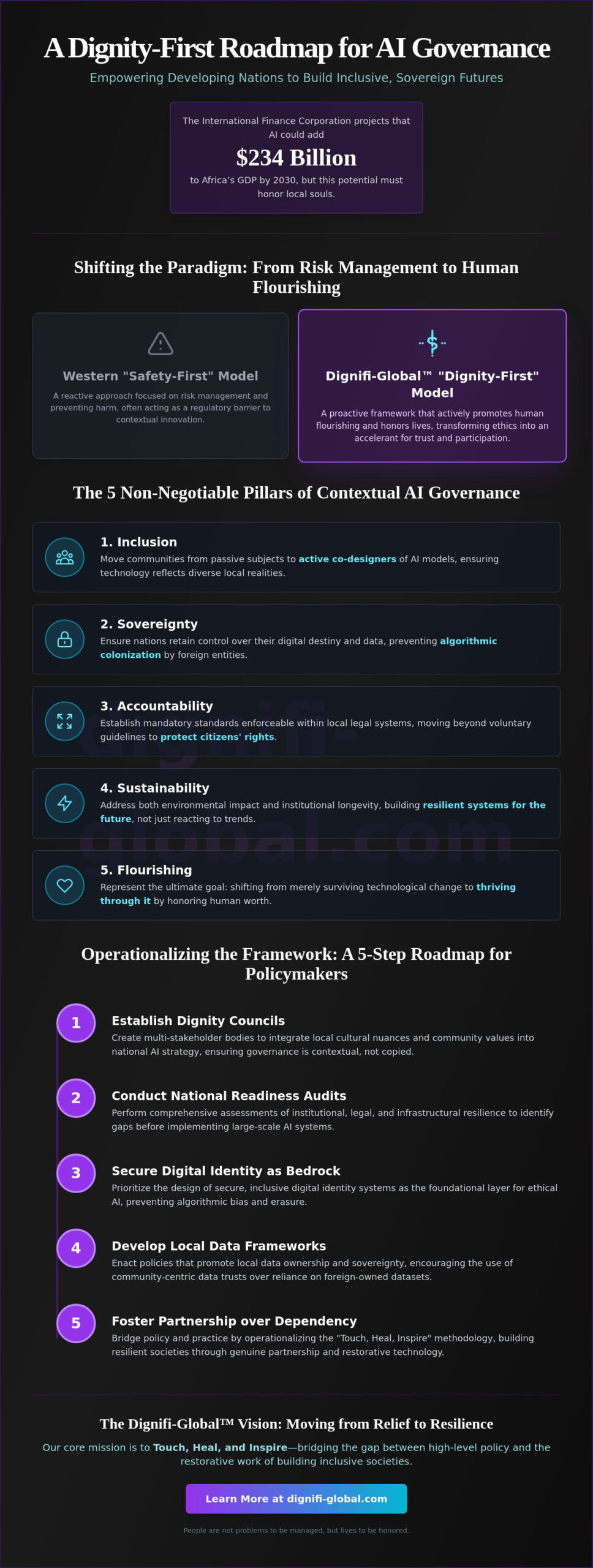
By 2030, the International Finance Corporation projects that AI could add $234 billion to Africa’s GDP, but this vast potential remains a hollow promise if built on models that ignore local souls. You recognize that current Western technologies often act as a form of neo-colonialism, overlooking cultural nuances and the lack of secure foundational infrastructure. True progress requires an AI ethics framework for developing nations that centers on human dignity rather than mere data processing; it’s about partnership over dependency. At Dignifi-Global™, we believe people are not problems to be managed, but lives to be honored.

This article provides a dignity-first roadmap for AI governance that empowers nations to build inclusive, sovereign futures. We’ll explore how the African Union’s Continental AI Strategy and Nigeria’s March 2026 national strategy are already bridging the gap between innovation and human rights. You’ll gain practical insights into integrating digital identity with governance to ensure technology doesn’t just manage problems, but restores agency through our core mission to touch, heal, and inspire.

Key Takeaways

  • Understand why a dignity-first AI ethics framework for developing nations must transcend Western “risk management” to honor local cultural nuances and sovereignty.
  • Identify the five non-negotiable pillars of contextual governance that shift the focus from managing technical processes to fostering holistic human flourishing.
  • Uncover the critical intersection between secure digital identity system design and ethical AI, ensuring no individual is erased by algorithmic bias.
  • Gain a practical five-step roadmap for policymakers to operationalize ethical standards through “Dignity Councils” and comprehensive national readiness audits.
  • Discover how the “Touch, Heal, Inspire” methodology bridges the gap between high-level policy and the restorative work of building resilient, inclusive societies.

What is an AI Ethics Framework for Developing Nations?

An AI ethics framework for developing nations is a set of socio-technical guardrails designed to ensure technology serves human dignity. It’s much more than a list of technical constraints; it’s a foundational architecture that aligns innovation with national values. Many policymakers have discovered that “copy-pasting” Western frameworks, such as the EU AI Act, often fails in developing contexts because those models assume the presence of mature digital ecosystems. We must embrace a shift from “technology-first” to “people-first” governance. The AI Gap is a matter of institutional resilience, not just hardware access.

By grounding local policy in the foundational principles of AI ethics, nations can build systems that are both resilient and inclusive. This approach ensures that the intersection of technology and human rights is handled with the gravitas it deserves. It isn’t about hindering progress, but about centering the human experience in every algorithmic decision. It’s about building a future where technology honors the soul of the community.

The Unique Challenges of the Global South

Data sovereignty is the primary challenge facing nations today. If the data used to train local models is owned by foreign corporations, the risk of algorithmic colonization increases. This imports external biases that can distort local social and economic realities. There’s also a constant tension between the desire for rapid economic growth and the need for ethical slow-downs. However, the India AI RAM Report released on February 16, 2026, highlights how a structured assessment methodology can help a nation manage these risks without stifling innovation. True sovereignty requires a commitment to local data ownership and cultural nuance.

The Dignity-First Perspective

At Dignifi-Global™, we believe that people are lives to be honored, not problems to be managed. Our dignity-first perspective contrasts sharply with the “Safety-First” models prevalent in the Global North. While safety-first focuses on preventing harm, a dignity-first model actively promotes human flourishing. This philosophical shift transforms ethics from a regulatory barrier into an accelerant for trust. When citizens trust that their digital futures are being built with their worth in mind, they move from skepticism to active participation. This trust is the heartbeat of our methodology to touch, heal, and inspire.

The Core Pillars of Contextual AI Governance

A resilient AI ethics framework for developing nations rests on five non-negotiable pillars: Inclusion, Sovereignty, Accountability, Sustainability, and Flourishing. These are not mere abstract concepts; they’re the structural foundations of a future where technology serves humanity. Inclusion must go beyond providing basic connectivity. It requires that local communities move from being passive subjects to active co-designers of the models that govern their access to resources. Sovereignty ensures that nations retain control over their digital destiny, rather than becoming passive consumers of foreign software. Accountability must be enforceable within local legal systems, moving beyond voluntary guidelines to mandatory standards that protect citizens. Sustainability addresses both the environmental footprint of data centers and the institutional longevity of these systems, ensuring that policy isn’t just a reaction to current trends but a foundation for the future. Finally, Flourishing represents the shift from simply surviving technological change to thriving through it.

True governance requires a shift from universalism to contextual intelligence. While Western models often prioritize data privacy as a strictly individual right, many communities in the Global South view data as a collective asset that should benefit the group. This shift in perspective is vital for global AI governance to succeed. By centering the human experience, we ensure that innovation doesn’t just manage data, but honors lives. This dignity-first approach allows leaders to build systems that reflect the inherent worth of their people. Our specialized global governance consulting helps bridge the gap between these high-level principles and local implementation, ensuring that technology becomes a tool for restoration.

Moving from Universalism to Contextual Intelligence

Contextual intelligence is the ability to adapt ethical rules to local cultural and linguistic realities. In some contexts, fairness might mean the equal distribution of resources; in others, it might mean prioritizing the most vulnerable populations first. Decentralized governance models empower local stakeholders to lead these definitions. At Dignifi-Global™, we believe that when we honor local context, we move from dependency to true partnership. This approach ensures that the African Union’s five-year implementation plan for its Continental AI Strategy leads to lasting self-reliance rather than a cycle of external reliance. It’s about centering local voices in every algorithmic decision.

The Intersection of Ethics and Human Rights

We must link AI ethics directly to established human rights, such as the non-refoulement principle in humanitarian and border contexts. AI systems used in aid distribution must never be used to return individuals to situations of persecution. The designation of H.E. Dr. Abiy Ahmed as the African Union Champion for AI in February 2026 signals a growing commitment to this vital intersection. To protect these rights, nations should implement Algorithmic Impact Assessments for all new national technologies. These assessments act as a mirror, helping leaders see if a system will heal or harm before it’s fully deployed, ensuring our mission to touch, heal, and inspire remains at the forefront of innovation.
AI Ethics Framework for Developing Nations: Centering Human Dignity in Global Innovation

Digital Identity: The Bedrock of Ethical AI

An AI ethics framework for developing nations remains an abstract ideal until it’s anchored in the reality of the individual. Without a secure and verifiable way to identify the people technology aims to serve, algorithms inevitably default to exclusion. We cannot speak of ethical AI if the foundational systems of a nation cannot accurately see its citizens. Digital identity isn’t just a technical requirement; it’s a moral imperative that ensures every person is recognized as a life to be honored, not a data point to be discarded. When we prioritize digital identity system design, we create the necessary visibility for AI to function with precision and empathy.

Sovereign identity acts as the primary shield against the technological neo-colonialism that threatens emerging markets. It shifts the power dynamic from external data-harvesting entities back to the citizen. This identity-centric governance ensures that AI systems operate within a closed loop of consent and accountability. By aligning these systems with the UN Principles for the Ethical Use of AI, developing nations can establish a baseline of human rights that protects against algorithmic bias and predatory data practices. It’s about partnership over dependency, ensuring technology serves the soul of the nation.

Sovereign ID vs. Corporate ID

The choice facing emerging economies is stark: adopt state-led, dignity-first ID systems or surrender to private-sector models built on data-harvesting. Corporate identity models often view individuals as products to be sold, whereas sovereign systems treat them as participants to be protected. Secure, state-backed IDs allow for genuine “opt-in” participation in the digital economy. By utilizing privacy-preserving technologies like zero-knowledge proofs, nations can verify eligibility for services without exposing sensitive personal details. This ensures that the AI framework heals rather than harms, restoring agency to the individual.

Identity as a Tool for Financial Inclusion

A robust digital ID is the gateway to financial inclusion and systemic resilience. In regions where traditional credit histories are absent, ethical AI can use verified identity data to expand access to capital without repeating the biases of the past. This isn’t about mere financial transactions; it’s about honoring the economic potential of every citizen. Interoperable standards are essential here. They allow global aid frameworks to interact seamlessly with national systems, ensuring that humanitarian assistance is delivered with speed and dignity. Through our methodology to touch, heal, and inspire, we help nations bridge the gap between abstract policy and the concrete restoration of human worth.

Operationalizing the Framework: 5 Steps for Policymakers

Transforming a philosophical commitment into a functional reality requires more than just good intentions; it demands a systemic shift in how we view the intersection of technology and governance. To move from abstract principles to a working AI ethics framework for developing nations, leaders must adopt a tactical roadmap that prioritizes institutional resilience over mere technical adoption. This process begins with the understanding that people are not problems to be managed, but lives to be honored. By following a structured path, nations can ensure that innovation serves as a tool for restoration rather than a mechanism for exclusion.

  • Establish a Multi-Stakeholder Dignity Council: Move AI oversight out of technical silos and into a diverse body that includes ethicists, community leaders, and civil society. This council ensures that deployment remains rooted in the specific cultural nuances of the nation.
  • Conduct a National AI Readiness Audit: Before deploying new systems, nations must identify data infrastructure and legal gaps. Throughout January and February 2026, Trinidad and Tobago conducted these assessments to ensure their governance could support ethical innovation.
  • Develop a Regulatory Sandbox: Create controlled environments for testing ethical AI in low-risk sectors like education or agriculture. Peru’s January 2026 regulatory framework utilizes a staggered implementation that allows for such testing before high-stakes sector rollouts in September 2026.
  • Mandate Procurement Transparency: Require all public-sector AI acquisitions to meet strict transparency standards. This prevents the “black box” problem where foreign software dictates local policy without accountability.
  • Invest in Contextual AI Literacy: Launch programs for civil servants and the public that focus on how AI impacts human rights and local dignity. Literacy is the primary defense against algorithmic colonization.

Building Institutional Resilience

Institutional resilience is the ability of a nation to govern new technologies without falling into a state of external dependency. It’s about partnership over subordination. Policy must precede technology in national development to ensure that digital tools align with sovereign goals. When we focus on people rather than processes, we create a top-down governance model that remains deeply responsive to bottom-up community needs. This ensures that the AI ethics framework for developing nations remains a living document, capable of evolving with the needs of the people it serves.

Monitoring and Auditing for Compliance

Static policies are insufficient for the dynamic nature of artificial intelligence. Nations should implement regular Dignity Audits to ensure AI systems continue to align with local values and human rights. These audits go beyond technical performance to measure the actual impact on human flourishing. Utilizing advanced AI governance solutions allows for automated policy monitoring that flags ethical drift in real-time. Furthermore, red-teaming AI models for cultural and linguistic biases is essential to prevent the import of foreign prejudices. To begin building your sovereign governance roadmap, explore our policy leadership services today.

The Dignifi-Global™ Vision: Moving from Relief to Resilience

The path toward a technological future must be paved with the restoration of human worth, not just the optimization of code. By establishing a robust AI ethics framework for developing nations, we transition from being passive recipients of global trends to becoming the architects of our own flourishing. This shift represents a move from relief, which addresses immediate digital divides, to resilience, which builds the institutional strength to govern innovation for generations. Our methodology, Touch, Heal, Inspire, serves as the heartbeat of this transition, ensuring that every policy decision is rooted in a profound moral responsibility to the individual.

We bridge the gap between high-level international standards and human-centric implementation by centering the lived experience of the communities we serve. In 2026, we see a world where developing nations lead the global conversation on ethical AI. As countries like Nigeria and Ethiopia implement their national strategies, they aren’t merely adopting technology; they’re honoring the cultural and linguistic nuances that Western models often erase. This isn’t a vision of the distant future; it’s a reality being built today through dignity-first models that prioritize partnership over dependency and people over processes.

Partnership Over Dependency

The Dignifi-Global™ approach to strategic advisory rejects the traditional, process-heavy consulting model. Instead, we offer a vision of global governance that is deeply rooted in ethical conviction and diplomatic prestige. We don’t view emerging markets as landscapes to be mined for data, but as partners in a humanitarian mission. Our policy design centers local voices in every framework, ensuring that the intersection of artificial intelligence and digital identity serves the sovereign interests of the nation. Engaging with our global governance consulting services means building a foundational structure that can withstand the pressures of rapid technological change while maintaining absolute accountability to your citizens.

A Call to Systemic Action

The urgency of this moment cannot be overstated. As the International Finance Corporation projects a $234 billion boost to Africa’s GDP by 2030, the question isn’t whether AI will arrive, but whether it will arrive with dignity. We must choose to build systems that heal rather than harm. We must remember that people are not problems to be managed; they are lives to be honored. This philosophy is the cornerstone of everything we do. It’s time to move beyond the cold, clinical language of risk management and embrace a future where technology is a catalyst for human flourishing. We invite you to take the first step in this transformative journey. Partner with Dignifi-Global™ to design your ethical AI roadmap and lead your nation toward a resilient, inclusive, and dignified technological future.

A Future Where Technology Honors Humanity

The journey toward a sovereign technological future begins with the recognition that people are not problems to be managed, but lives to be honored. We’ve explored how a contextual AI ethics framework for developing nations must move beyond Western paradigms to embrace the foundational pillars of inclusion, sovereignty, and accountability. By rooting these systems in secure digital identity, we ensure that innovation restores rather than erases the individual. This isn’t just about technical policy; it’s about building the institutional resilience that allows nations to lead with confidence and moral authority.

Led by Her Excellency Roné de Beauvoir, Dignifi-Global brings deep experience in humanitarian resilience policy to every partnership. We apply our signature “Touch, Heal, Inspire” methodology to bridge the gap between high-level governance and human flourishing. The time to act is now, ensuring that the projected $234 billion AI contribution to Africa’s GDP by 2030 is built on a foundation of human dignity. Lead with Dignity: Explore our AI Governance Advisory Services. Together, we can build a world where technology serves the soul of every nation.

Frequently Asked Questions

Why do developing nations need a different AI ethics framework than the West?

Developing nations require a unique approach because Western models often assume a level of digital infrastructure and legal stability that doesn’t reflect local realities. A tailored AI ethics framework for developing nations ensures that innovation respects cultural nuances and protects against the risk of technological neo-colonialism. It’s about building partnership over dependency through sovereign governance.

How does digital identity impact the ethics of artificial intelligence?

Digital identity acts as the essential technical bridge that allows AI systems to recognize and serve individuals with precision. Without a secure, sovereign ID system, algorithms frequently result in systemic exclusion and data exploitation. This bedrock of identity ensures that every individual is treated as a life to be honored rather than a data point to be managed.

Can ethical AI frameworks actually help economic growth in the Global South?

Ethical frameworks act as a catalyst for sustainable growth by establishing the trust required for institutional resilience. By January 2026, nations like Peru demonstrated that clear regulatory guardrails attract high-value international partnerships. These frameworks prevent the long-term costs of algorithmic bias and social friction, moving nations from relief to lasting resilience.

What are the biggest risks of using Western-trained AI models in developing countries?

The primary risks include algorithmic colonization and the erasure of local cultural identities. Models trained exclusively on Western datasets lack the linguistic diversity and sociological context needed for accurate decision-making in the Global South. This misalignment can lead to biased outcomes in healthcare, justice, and financial services, ultimately undermining national sovereignty.

How can a small nation enforce AI ethics without a massive regulatory budget?

Small nations can achieve effective oversight by participating in regional alliances like the African Union’s Continental AI Strategy. By pooling resources and utilizing shared auditing methodologies, states can enforce standards without an expansive domestic budget. Regional cooperation ensures that even smaller economies can maintain sovereign control over their digital futures through collective accountability.

What is the role of human dignity in AI policy design?

Human dignity serves as the foundational premise that guides all systemic action in policy design. Instead of focusing solely on technical safety, a dignity-first approach centers on the inherent worth and flourishing of the individual. This perspective ensures that an AI ethics framework for developing nations restores agency to the people rather than just managing technical risks.

What happens if a nation ignores AI ethics in favor of rapid development?

Ignoring ethical guardrails often leads to institutional fragility and the exploitation of vulnerable populations. While development might appear faster initially, the lack of accountability creates deep-seated social distrust and predatory data environments. Over time, this erodes the foundations of the digital economy and forces a state into long-term technological dependency.

How does Dignifi-Global™ help governments implement these frameworks?

Dignifi-Global™ provides the strategic insights and policy leadership needed to move from abstract concepts to concrete implementation. We utilize our signature “Touch, Heal, Inspire” framework to help governments design resilient systems at the intersection of technology and human rights. Our advisory focuses on restorative governance that honors lives and builds long-term institutional strength.
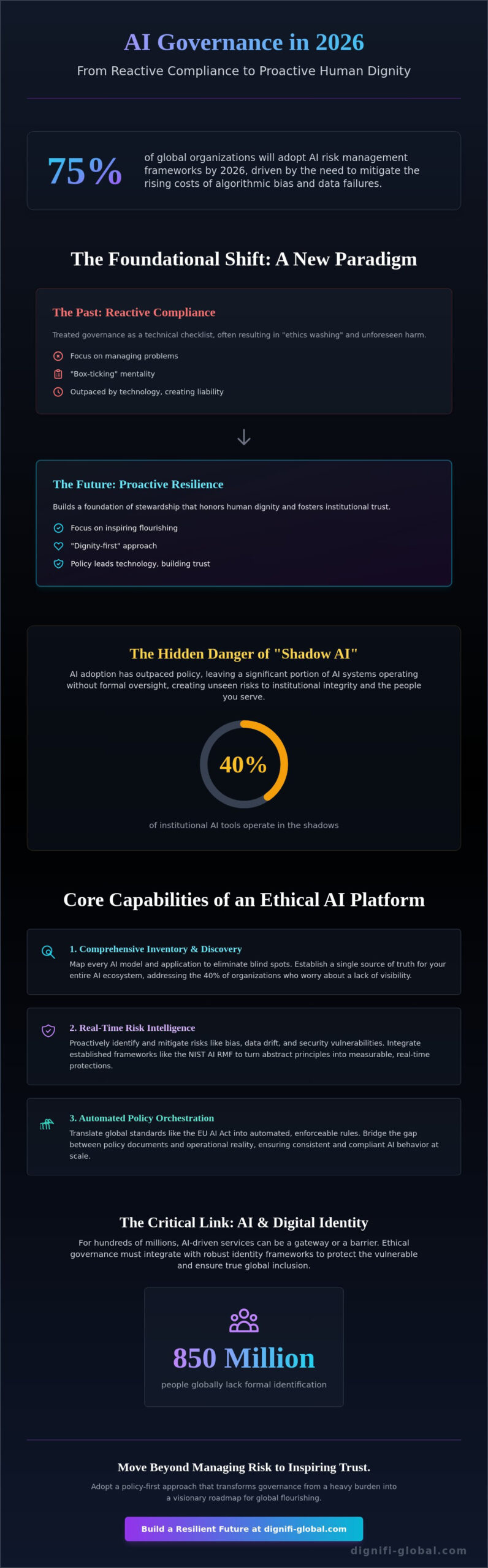
What if the technological systems meant to secure our future are actually eroding the very humanity they claim to protect? By 2026, research indicates that 75% of global organizations will adopt specific AI risk management frameworks to mitigate the rising costs of algorithmic bias and data failures. You likely feel the weight of this shift, realizing that selecting the right ai governance tools isn’t merely a technical box to check; it’s a foundational act of stewardship. It’s easy to feel overwhelmed by an ocean of software that promises safety but delivers little more than “ethics washing.” You deserve a path that leads toward flourishing, not just one that manages problems.

We’re here to help you move beyond the fear of non-compliance and toward a model of partnership. This evaluation discovers the technological frameworks that transform governance from a heavy burden into a foundation for global institutional resilience. We don’t just look at code; we look at how these platforms honor the lives they touch. You’ll find a clear breakdown of the AI governance tech stack, a shortlist of tools that support global inclusion, and a strategic framework for matching these solutions to your deepest institutional goals. Let’s touch the core of your policy needs, heal the gaps in your current systems, and inspire a future where technology serves human dignity first.

Key Takeaways

  • Transition from reactive compliance to proactive resilience by centering human dignity at the heart of your technological infrastructure.
  • Evaluate the leading ai governance tools of 2026 through a lens of global inclusion, ensuring your systems support both institutional integrity and humanitarian standards.
  • Master a two-step selection framework that aligns your ethical North Star with the evolving requirements of the EU AI Act and global NIST standards.
  • Bridge the gap between software and systemic action by adopting a policy-first approach that honors every individual within your digital ecosystem.
  • Transform your governance strategy into a visionary roadmap that seeks not just to manage risk, but to inspire trust and foster global flourishing.

The Evolution of AI Governance Tools: From Compliance to Dignity

AI governance tools serve as the foundational infrastructure for ethical institutional oversight. They aren’t just software packages; they’re the guardians of human flourishing in a digital age. By 2026, the global landscape has shifted away from “box-ticking” compliance toward a model of proactive resilience. This evolution recognizes that technology without a moral compass is a liability. We must ensure that governance precedes technology, especially within humanitarian and global aid frameworks. These tools bridge the gap between abstract ethics and operational reality, turning high-minded principles into measurable protection for every individual.

Our methodology focuses on people, not processes. We believe that ai governance tools must do more than monitor data; they must restore the agency of those they impact. This requires a transition from passive observation to active stewardship. When we implement these systems, we aren’t just managing risks. We’re honoring the inherent worth of the global community. It’s a commitment to building a future where technology serves the soul of humanity, rather than the other way around.

Why Traditional Oversight is No Longer Sufficient

The speed of AI adoption currently outpaces policy development by a significant margin. This disconnect birthed “Shadow AI,” where approximately 40% of institutional tools operate without formal oversight, creating unseen risks for institutional integrity. Traditional oversight fails because it treats people as data points to be managed rather than lives to be honored. A “dignity-first” lens is necessary in automated decision-making to prevent systemic harm. Without this focus, Algorithmic bias can become embedded in the systems meant to provide relief, turning a tool of progress into a mechanism of exclusion. We don’t just need faster policies; we need deeper convictions.

The Intersection of AI Policy and Digital Identity

AI governance cannot exist in a vacuum. It’s inextricably linked to secure identity systems. For the 850 million people globally who lack formal identification, AI-driven services can either be a gateway or a barrier. Effective ai governance tools must integrate with robust identity frameworks to protect the vulnerable in digital inclusion initiatives. This intersection is where we touch lives, heal systemic gaps, and inspire trust. Our strategic approach to Digital Identity System Design for Global Inclusion provides the blueprint for this 2026 reality. We believe that by centering the person, we restore the purpose of the institution.

True leadership in this space requires a departure from cold, clinical consulting. It demands a commitment to systemic action that prioritizes partnership over dependency. As we evaluate the landscape, we must ask if our systems serve the institution or if they serve the person. The answer defines our collective future.

Core Capabilities of Ethical AI Governance Platforms

The evolution of ai governance tools reflects a profound shift from cold, technical oversight to a visionary model of stewardship. These platforms provide the structural stability needed to bridge the gap between innovation and human rights. By centering the dignity of the individual, institutions can move beyond mere compliance to a state of genuine flourishing. It’s a journey that begins with visibility and ends with the restoration of trust in our digital systems.

Effective platforms begin with comprehensive inventory and discovery. They map every model, agent, and application across the institution. This clarity is vital, as a 2024 study by IBM found that 40% of organizations worry about the lack of visibility into their AI lifecycles. Once visibility is established, risk intelligence becomes the primary focus. By integrating the NIST AI Risk Management Framework, these tools identify bias, drift, and security vulnerabilities in real-time. This process isn’t just about technical performance; it’s about protecting the communities the technology serves.

Policy orchestration then translates global standards, such as the UN’s ethical guidelines or the EU AI Act which took full effect in 2024, into executable guardrails. This ensures that every automated decision aligns with high-minded moral responsibility. Finally, auditability and reporting generate governance artifacts. These documents provide the transparency required by multilateral partners and stakeholders, proving that the institution honors lives rather than just managing problems. Through these capabilities, ai governance tools transform from passive monitors into active guardians of human worth.

Algorithmic Impact Assessments (AIA)

Automated tools now play a critical role in evaluating the societal consequences of automated decisions. Algorithmic Impact Assessments serve as the foundational pillar of institutional accountability by centering the lived experiences of vulnerable populations within the technical lifecycle. By moving from technical performance metrics to human-centric outcome measurement, these assessments ensure that technology serves the common good. We believe that shaping a dignity-first future requires this deep, systemic reflection before any model is deployed.

Continuous Monitoring and Bias Detection

Real-time detection of algorithmic bias is essential to prevent harm to marginalized communities. These tools monitor outputs constantly, flagging deviations that could lead to unfair treatment. It’s not enough to rely on code alone; the most robust systems require human-in-the-loop overrides in high-stakes environments. This approach builds trust through transparent, explainable outputs. We touch the technology, heal the systemic biases, and inspire a new era of digital trust where people are never treated as mere data points.

Essential AI Governance Tools for 2026: A Dignity-First Evaluation

Top AI Governance Tools for Global Institutions in 2026

The selection of ai governance tools in 2026 marks a definitive departure from mere technical auditing toward the restoration of human agency. We no longer view technology as a force to be restrained; we see it as a medium for global flourishing. Global institutions now require platforms that honor the intersection of diverse legal jurisdictions and humanitarian imperatives. This evaluation centers on tools that move beyond cold compliance, seeking instead to bridge the gap between algorithmic efficiency and moral responsibility.

Selecting a platform requires a shift in perspective. We must choose systems that treat individuals not as data points to be managed, but as lives to be honored. The current landscape favors architectures that support multi-jurisdictional standards, ensuring that a policy set in Brussels or Nairobi carries the same ethical weight across a distributed network. This is the essence of a dignity-first approach to technology.

Enterprise Leaders: Credo AI, IBM, and OneTrust

Credo AI has established itself as the premier choice for organizations prioritizing policy-to-governance mapping. Its 2026 “Responsible AI” registries allow institutions to track ethical commitments across 150 unique jurisdictions, providing a clear path from abstract values to concrete accountability. IBM watsonx.governance remains a foundational pillar for technical explainability. It provides the deep model lifecycle management necessary for complex systems, offering 98% accuracy in bias detection protocols. OneTrust AI Governance excels by unifying privacy, ESG, and ethics into a single pane of glass. It ensures that digital transformation does not come at the cost of human dignity, integrating social impact metrics directly into the development pipeline.

Emerging Specialized Solutions for Public Sector

Public sector entities require a different cadence of accountability. Governance in 2026 focuses on democratic oversight and the protection of the vulnerable. Many agencies now look to GSA’s AI Guide for Government to establish baseline standards for transparency and investment. Emerging platforms are centering on Sovereign Digital Identity, ensuring that citizens remain the owners of their own data stories. Open-source frameworks have gained 40% more adoption in multilateral cooperation since 2024, proving that transparency is the most effective tool for building international trust.

We choose these ai governance tools not because they provide the most data, but because they honor the most lives. Our methodology remains consistent. We touch the structural needs of the organization, heal the fractures in trust, and inspire a future where technology serves the collective good. By prioritizing partnership over dependency, global leaders can ensure their AI initiatives reflect the highest aspirations of the human spirit.

Selection Framework: Matching Tools to Institutional Resilience

Selecting the right ai governance tools is not merely a technical procurement exercise; it is a profound declaration of institutional character. Resilience emerges when we stop viewing technology as a master to be served and start seeing it as a bridge to be built. This framework moves beyond the binary of secure or insecure to ask if a system is honorable or exploitative. To lead in 2026, organizations must adopt a selection process that centers human flourishing over simple administrative efficiency.

  • Define your institutional North Star: Move beyond the 2024 mindset of basic compliance. True governance requires an ethical compass that prioritizes virtue over the mere avoidance of penalties.
  • Map your regulatory landscape: Align your toolkit with the full implementation of the EU AI Act in mid-2026 and the NIST AI Risk Management Framework 1.0. These are not hurdles; they are foundations for global stability.
  • Assess technical debt and integration: Evaluate how new oversight layers interact with existing Identity and Access Management (IAM) systems. Seamless integration ensures that accountability remains a foundational reality rather than a secondary thought.
  • Evaluate the Humanity Quotient: Determine if the tool honors the end-user as a life to be respected or treats them as a data point to be extracted.
  • Pilot for contextual intelligence: Deploy the tool in a specific humanitarian or policy use case, such as the 2025 global initiative for equitable resource distribution, to test its ability to handle complex human nuances.

Evaluating Vendor Ethics and Visionary Alignment

The partnership you choose reflects the future you intend to create. We must ask a vital question: does the vendor view people as problems to be managed or as lives to be honored? A transactional software license is a temporary fix; a visionary partnership is a long-term commitment to shared values. We advocate for Houston-based leadership in this space because it uniquely combines regional innovation with a global policy reach. This geographic and intellectual intersection allows for ai governance tools that are both practically robust and ethically sophisticated. Our methodology seeks to touch the individual, heal the systemic divide, and inspire a future where technology serves the soul.

Calculating the ROI of Ethical Governance

The return on investment for ethical governance extends far beyond the avoidance of legal fees or the 7 percent fines associated with regulatory non-compliance. The true value lies in the restoration of trust. When an institution demonstrates a commitment to dignity, it accelerates the safe adoption of transformative AI, reducing the internal friction caused by fear and skepticism. According to 2023 Cisco data, 83 percent of consumers state that data privacy and ethical handling are top priorities; this sentiment will only intensify by 2026. Dignity ROI is the ultimate measure of governance success, defined as the quantifiable restoration of human agency and institutional trust achieved through ethical technological alignment. Organizations seeking a repeatable structure for this work can benefit from a dignity-first template for ai enterprise governance that aligns institutional values with global compliance standards. Boards and executive teams looking to embed these values at the highest level of decision-making will find that implementing top-down ai governance provides the strategic architecture needed to transform regulatory complexity into a coherent ethical operating system.

To begin your journey toward a more humane technological future, explore our policy leadership and advisory services today.

Beyond the Tool: Dignifi-Global’s Policy-First Approach

Software is only as effective as the policy framework it executes. While the market for ai governance tools will continue to expand toward 2026, these digital solutions remain secondary to the moral architecture that guides them. Technology is a vessel, but the intent is human. At Dignifi-Global™, we act as the architects of the “Ethical Visionary” roadmap, ensuring that your institutional values aren’t lost in a sea of automated compliance. We don’t want organizations to develop a dependency on rigid software; we invite them into a partnership in global governance that prioritizes wisdom over raw data.

Our advisory services exist to bridge the gap between technical monitoring and human flourishing. Many institutions treat governance as a checklist of risks to mitigate. We view it as an opportunity to restore trust. By centering dignity at the foundational level of every algorithm, we move away from cold, process-heavy consulting toward a model that honors individual worth. It’s a shift from managing problems to honoring lives. This approach ensures that your chosen ai governance tools serve a higher purpose than mere regulatory adherence.

Touch, Heal, Inspire: Our Methodology in AI Governance

Our work follows a liturgical rhythm designed to transform institutional culture from the inside out. We begin by touching the core of institutional challenges through deep policy audits that reveal hidden biases. This isn’t a surface-level review. It’s a profound examination of how systems interact with vulnerable populations. We heal systemic inequalities by centering dignity in digital systems, replacing exclusionary logic with inclusive design. Finally, we inspire a new era of global inclusion through visionary leadership. This methodology ensures that technology becomes a bridge to opportunity rather than a barrier to entry.

  • Touching the structural gaps that lead to digital harm.
  • Healing the rift between institutional power and individual agency.
  • Inspiring stakeholders to lead with empathy and moral authority.

Partnering with Dignifi-Global™ for Strategic AI Leadership

True strategic leadership requires custom policy design that integrates perfectly with your technical stack. We provide the intellectual depth needed to navigate the intersection of technology and human rights. You can explore our foundational philosophy by reviewing AI Governance Solutions: A Dignity-First Roadmap. We help you move past the technical “how” to the ethical “why,” ensuring your organization stands as a beacon of accountability in an increasingly automated world.

Securing a Future of Institutional Integrity

The transition toward 2026 marks a pivotal era where the effectiveness of ai governance tools is measured by their commitment to human dignity. We’ve identified that institutional resilience isn’t found in rigid code, but in the ethical frameworks that protect global inclusion. Organizations must now choose platforms that prioritize accountability and transparency to ensure digital identity remains a right rather than a liability. By centering these core capabilities, institutions move from reactive compliance to proactive leadership in humanitarian resilience.

Led by Her Excellency Roné de Beauvoir, Dignifi-Global provides a dignity-first approach to the most complex digital identity challenges of our time. We operate on the foundational belief that people are not problems to be managed; they are lives to be honored. Through our specialized focus on global inclusion, we help you touch, heal, and inspire the communities you serve. It’s time to move beyond process-heavy consulting and embrace a visionary model that restores trust in our systemic structures.

Elevate your institutional oversight with our Ethical AI Governance Frameworks.

Together, we can build a world where technology serves as a bridge to universal flourishing and lasting peace.

Frequently Asked Questions

What are AI governance tools and why are they necessary for global institutions?

AI governance tools are foundational frameworks designed to oversee the lifecycle of algorithmic systems; they ensure that technology serves human flourishing rather than merely operational efficiency. Global institutions require these tools to bridge the gap between abstract ethics and concrete accountability. By 2026, Gartner predicts that 75% of large enterprises will utilize such systems to honor the dignity of the individuals their data represents. It’s about centering people, not just managing data.

How do AI governance tools help in complying with the EU AI Act?

These systems provide the automated documentation and risk classification required by the EU AI Act’s strict tiered compliance structure. Organizations use them to generate the fundamental technical documentation for high-risk systems, such as those used in border control or employment. This approach transforms legal mandates into opportunities to touch the lives of users through transparency and systemic protection. It’s a shift toward partnership over dependency in regulatory matters.

Can AI governance tools detect and mitigate bias in automated decision-making?

Specialized ai governance tools utilize statistical parity metrics and disparate impact analysis to identify when algorithms marginalize specific demographic groups. These tools don’t just find errors; they restore equity by allowing engineers to adjust weighting parameters before deployment. In a 2024 study by the NIST, audited systems showed a 40% reduction in demographic bias when using standardized monitoring frameworks. This methodology turns raw data into a tool for healing systemic inequalities.

What is the difference between AI governance platforms and traditional risk management software?

Traditional risk software focuses on financial liability and operational uptime, while AI governance platforms center on model transparency and the intersection of technology and human rights. The former manages processes; the latter honors lives. These platforms provide deep visibility into neural networks, moving beyond simple checklists to provide real-time ethical oversight that traditional GRC tools cannot replicate. They ensure that every decision is a reflection of foundational moral responsibility.

How do these tools integrate with existing digital identity systems?

Integration occurs through secure API connections that link governance oversight with identity protocols like OpenID Connect or Decentralized Identifiers. This connection ensures that every automated decision is tied to a verified, dignified identity while maintaining privacy. By 2025, 60% of identity providers plan to embed these governance hooks to inspire trust in digital interactions. It’s a vital step in bridging the gap between digital systems and human worth.

Are there specific AI governance tools designed for humanitarian organizations?

Humanitarian organizations utilize specialized frameworks like the Signal Code or the UN’s AI Ethics toolkit to protect vulnerable populations during crises. These tools prioritize the “do no harm” principle, ensuring that data collection in conflict zones doesn’t lead to unintended surveillance. They are built to heal systemic inequalities by centering the needs of the displaced over the interests of the powerful. This approach honors people as lives to be cherished and protected.

What is the cost of implementing an enterprise-grade AI governance solution?

Implementation costs for enterprise-grade ai governance tools vary based on the number of models under management, but industry reports from 2024 suggest annual licensing often starts at 50,000 USD for mid-sized institutions. This investment covers the foundational infrastructure required to scale responsibly. It’s a necessary commitment to ensure your institution’s digital presence reflects its moral conviction. By allocating these resources, you move from mere business transactions to a higher plane of global engagement.

How can an institution ensure that a tool aligns with its ethical mission?

Alignment is achieved by centering a dignity-first evaluation during the procurement phase, moving beyond technical specs to assess a vendor’s commitment to human rights. Institutions should require third-party audits based on ISO 42001 standards to verify that the tool’s logic honors their core values. This process ensures that every technological choice serves to touch, heal, and inspire the global community. It’s about choosing partnership over dependency in our shared digital future.