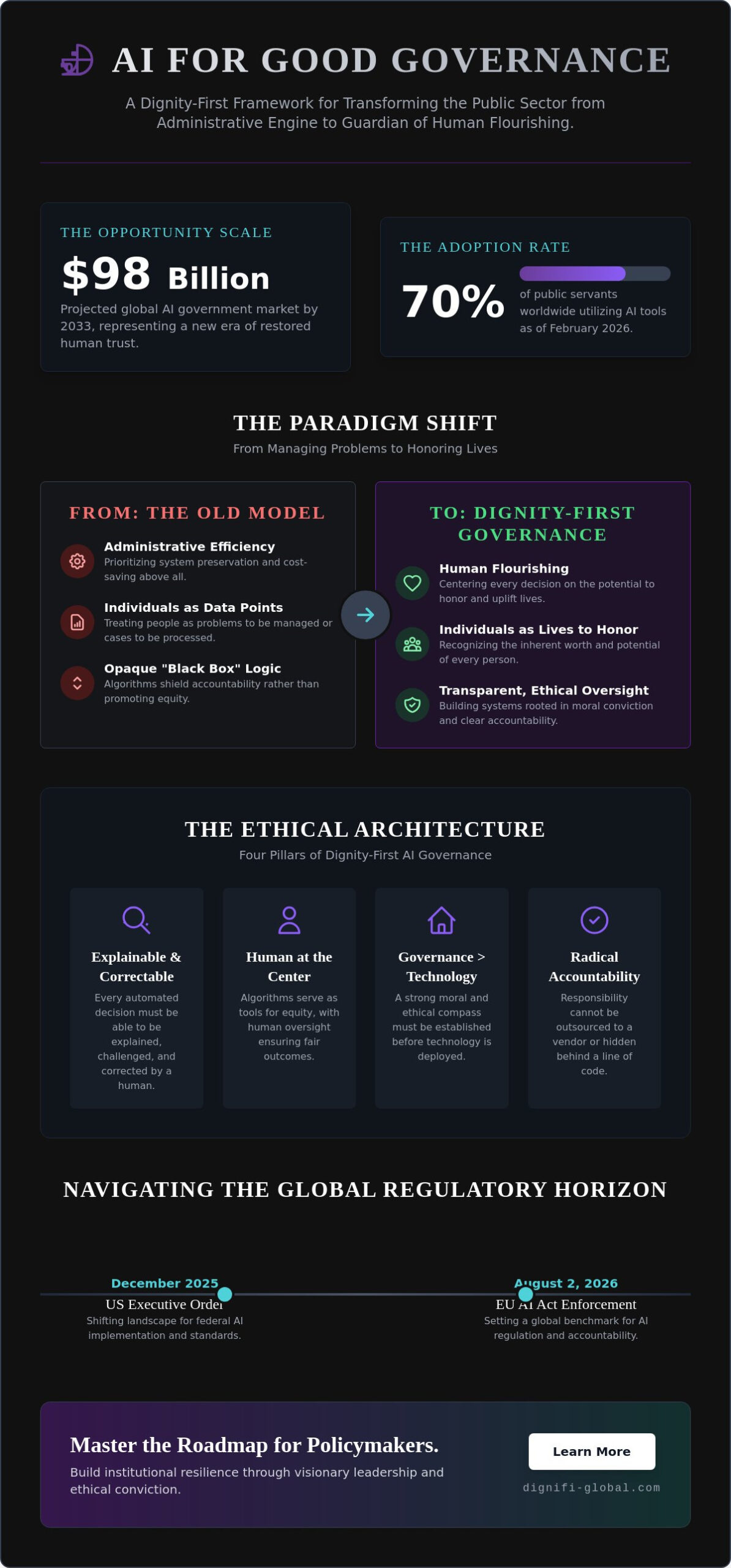
What if the $98 billion projected for the global AI government market by 2033 was not just a measure of technological scale, but a testament to restored human trust? With 70% of public servants worldwide already utilizing these tools as of February 2026, the question is no longer about adoption, but about the soul of our systems. Effective AI for good governance in public sector requires more than just managing algorithms; it demands an architectural commitment to honoring every individual.
You’re likely grappling with the August 2, 2026, enforcement of the EU AI Act and the shifting landscape of the December 2025 US Executive Order. It’s a daunting task to navigate these regulatory intersections while ensuring that efficiency doesn’t come at the cost of equity. We’ll show you how to transform your public institution from a cold administrative engine into a guardian of human flourishing. By exploring a foundational framework for ethical AI, this guide will help you bridge the gap between technical implementation and global inclusion, ensuring your agency moves from managing problems to honoring lives.
Key Takeaways
- Understand the shift from administrative efficiency to an ethical architecture that centers human dignity in every policy decision.
- Implement AI for good governance in public sector using a framework that transforms institutional engines into instruments of global inclusion.
- Uncover how AI-driven digital identity systems can bridge the divide for the unbanked and restore trust in humanitarian aid delivery.
- Navigate the complexities of algorithmic bias by adopting a “dignity-first” approach that views individuals as lives to be honored, not problems to be managed.
- Master a strategic roadmap for policymakers designed to build institutional resilience through visionary leadership and ethical conviction.
Defining the New Era of Public Sector Intelligence
We stand at a pivotal threshold where the machinery of state meets the transformative potential of machine intelligence. AI for good governance in public sector is not merely a technical upgrade; it’s the strategic integration of intelligence to enhance institutional accountability and restore the bond between the state and the citizen. In 2026, we’ve moved past the era of experimental AI pilots that characterized the early 2020s. Today, the focus has shifted toward building foundational governance frameworks that can withstand the pressures of a rapidly evolving digital society. These frameworks ensure that intelligence is deployed with purpose, moving beyond the “black box” of automated decisions toward a model of transparent, ethical oversight.
AI governance is a moral architecture for the digital age, designed to ensure that technology serves the sanctity of human life rather than the convenience of administrative processes.
Traditional bureaucratic governance often prioritizes the preservation of the system itself, treating individuals as data points to be processed or problems to be managed. In contrast, dignity-first public service recognizes that every interaction is an opportunity to honor a life. This shift requires a departure from a rigid Government by algorithm where citizens are subjected to opaque logic. Instead, we’re building systems that are deeply rooted in ethical conviction, where the algorithm is a tool for equity, not a shield against accountability.
The Shift from Efficiency to Flourishing
While fiscal responsibility remains a fundamental duty of the public servant, cost-saving is a secondary benefit of modern intelligence, not the primary goal. We must understand that AI is not for managing processes, but for honoring lives. When public institutions prioritize human flourishing, they build a unique form of institutional resilience. This resilience isn’t found in rigid code; it’s found in the trust established when technology is used to touch the lives of the marginalized, heal systemic inequities, and inspire collective progress. By centering dignity, we transform the public sector from a cold administrative engine into a guardian of the common good.
Global Standards for AI Governance in 2026
The landscape of 2026 is defined by a maturing set of international norms. We’ve seen the evolution of OECD and UN guidelines from abstract principles into enforceable standards that demand accountability. Cross-border cooperation has become essential, particularly as we develop digital identity systems that respect the sovereignty of the individual across different jurisdictions. For leaders seeking to align their agencies with these high-minded ideals, global governance consulting provides the necessary policy insights to navigate the complex intersection of ethics and technology. This global alignment ensures that no community is left behind as we bridge the digital divide.
The Ethical Architecture of Dignity-First Governance
True leadership in the digital era isn’t found in the speed of a processor, but in the strength of an ethical foundation. At Dignifi-Global™, we view AI for good governance in public sector through a proprietary “dignity-first” lens. This perspective shifts the focus from managing data to honoring lives. We believe that governance must always precede technology; without a moral compass, even the most advanced systems risk becoming instruments of exclusion rather than tools for flourishing. By placing ethical conviction at the heart of the architecture, we ensure that the intersection of AI and public policy serves the inherent worth of every human person.
Automated decision-making systems carry a profound moral weight that can’t be ignored. When a machine determines eligibility for social services or legal status, accountability cannot be outsourced to a vendor or hidden behind a line of code. Public institutions have a responsibility to reduce risk and increase transparency by keeping the human at the center of the logic. True accountability is not a checkbox on an audit; it’s a foundational promise that every decision can be explained, challenged, and corrected. This approach transforms the relationship between the state and the citizen from one of dependency to one of partnership.
Centering the Human in the Algorithm
Effective public policy requires contextual intelligence, a nuanced understanding of local culture and history that raw data alone cannot capture. We must prevent AI from becoming a “black box” that obscures institutional responsibility. Surface-level compliance with current regulations isn’t enough to build lasting trust. Institutions need foundational ethics that guide the development of Ethical AI Governance Frameworks. These frameworks ensure that technology is used to bridge divides, not deepen them, by prioritizing the human experience over administrative convenience.
Touch, Heal, Inspire: A Methodology for Institutions
Our methodology operates with a measured, three-part cadence that acts as a heartbeat for policy development. First, we Touch by identifying the real-world needs of the most vulnerable populations, such as the estimated 1.4 billion people worldwide who still lack formal financial access. Next, we Heal by using AI to restore trust and fix broken service delivery models that have historically marginalized communities. Finally, we Inspire by setting a global benchmark for ethical leadership. This process ensures that public sector technology is not just functional, but restorative and visionary, creating a legacy of inclusion that lasts for generations.
Beyond Efficiency: AI Applications for Global Inclusion
The true measure of a state’s wisdom isn’t found in the complexity of its code, but in the breadth of its embrace. When we apply AI for good governance in public sector, we move beyond the mechanical pursuit of speed toward a higher purpose: global inclusion. While many administrative bodies use AI to Improve Government Performance by automating routine tasks, the visionary leader recognizes that technology must be a bridge to the forgotten. In 2026, this means leveraging predictive analytics and intelligent systems to ensure that no individual is left behind by the systems meant to serve them.
Inclusive financial system development has emerged as a central pillar of this new governance model. It’s not enough to have a stable economy if the doors to that economy remain locked for the marginalized. By integrating ethical AI into the very fabric of public finance, institutions can identify and dismantle the systemic barriers that have historically excluded rural and low-income populations. This isn’t a mere administrative adjustment; it’s a profound act of restoration that honors the economic potential of every citizen.
Digital Identity as a Human Right
Digital identity is not a privilege for the few, but a foundational right for the many. For the estimated 1.4 billion individuals globally who lack formal recognition, the absence of identity is an absence of agency. Strategic digital identity system design allows institutions to reach refugees and marginalized communities with surgical precision and profound empathy. These systems don’t just store data; they restore the dignity of recognition, allowing a displaced person to access social services, education, and legal protection regardless of where they stand on the map.
Predictive Policy for Proactive Governance
Proactive governance requires a shift from reactive relief to sustainable resilience. By the middle of 2026, predictive policy has become a cornerstone of institutional strength, allowing governments to anticipate global shocks before they fracture the social fabric. Whether responding to climate-driven migration or public health crises, AI-driven insights provide a clarity that manual processes can’t match. This foresight is especially critical in fostering financial inclusion, where predictive models identify systemic barriers to capital and help dismantle them. The result is a public sector that doesn’t just survive challenges, but thrives through them by honoring the data integrity of every citizen.
Key applications for inclusive governance in 2026 include:
- Predictive resource allocation for humanitarian aid in conflict zones;
- Automated bias-detection in social safety net eligibility protocols;
- Real-time monitoring of financial service accessibility for rural populations;
- Cross-border identity verification to ensure continuity of care for migrants.
These applications manifest our commitment to a higher plane of global engagement. They represent the heartbeat of a public sector that seeks to touch, heal, and inspire through every line of code and every policy decision.
Confronting the Governance Gap: Trust vs. Technology
The greatest risk to our collective future isn’t the machine itself, but the widening chasm between technological capability and ethical oversight. While US federal agencies reported 3,611 AI use cases in 2025, a nearly 70% increase from the previous year, the human element often feels sidelined. This leads to a critical objection: Does AI remove the “human” from public service? The answer lies in our choice of architecture. AI for good governance in public sector succeeds only when we prioritize partnership over dependency. We must refuse to view citizens as data sets to be processed; they are lives to be honored.
The “governance gap” is palpable. According to a 2026 survey, only 18% of public servants believe their governments are deploying AI effectively. This skepticism is rooted in the fear of algorithmic bias undermining public trust. Developers and policymakers share a moral responsibility to ensure that automated systems don’t replicate historical inequities. We don’t just need better code; we need a fundamental shift in how we perceive the role of technology in the state. By bridging this gap, we move from mere administrative engines to institutions that truly serve the common good.
Mitigating Bias through Inclusive Design
Inclusive design is not a feature; it’s a foundational requirement. To bridge the trust gap, AI training data must reflect the full diversity of the public it serves. This requires moving from “problem management” to “life honoring” in data science. Independent auditing plays a vital role here, maintaining institutional accountability by ensuring that high-risk systems exercise reasonable care to prevent discrimination. This is especially vital as regulations like the Colorado AI Act take effect on June 30, 2026, mandating transparency in automated decision-making.
The Myth of Neutral Technology
We must dismantle the myth that AI is a neutral tool. Technology is never neutral; it reflects the values, biases, and priorities of its governance. When institutions prioritize efficiency at any cost, they risk sacrificing the very dignity they are sworn to protect. Policymakers must act as ethical visionaries, ensuring that digital transformation serves the flourishing of all people. If your institution is ready to move beyond surface-level compliance toward a more profound ethical commitment, explore our AI governance solutions to lead with confidence.
True institutional resilience is built on the bedrock of trust. By confronting the governance gap today, we ensure that the technology of tomorrow remains an instrument of healing and inspiration for the global community.
Building Institutional Resilience: A Roadmap for Policymakers
Institutional resilience is not a byproduct of technical efficiency; it’s a result of ethical conviction. As we navigate the complexities of 2026, the demand for visionary leadership at the ministerial level has never been more urgent. Implementing AI for good governance in public sector requires a roadmap that bridges the gap between technical capability and moral responsibility. This journey transforms public agencies from mere administrators of data into guardians of human flourishing. By adopting a “dignity-first” approach, leaders can foster a culture of innovation that prioritizes people over processes and partnership over dependency.
Navigating the current regulatory landscape, particularly with the August 2, 2026, enforcement of the EU AI Act, requires more than just legal compliance. It demands strategic advisory that understands the intersection of technology and human rights. We’ve designed a structured path for institutions ready to lead this transformation through comprehensive AI governance solutions.
Step 1: Establishing the Ethical Framework
The first step is to define the core values that will govern institutional intelligence. This isn’t a technical exercise, but a philosophical one. High-level commitment to “people-first” outcomes ensures that AI is used to empower the citizen rather than simplify the bureaucracy. By integrating human rights principles directly into the technical architecture, agencies create a foundational layer of trust. This framework acts as a compass, guiding every subsequent policy decision toward the restoration of human dignity.
Step 2: Designing for Resilience and Inclusion
Resilience is built when systems are designed to include the most vulnerable. We must implement digital identity systems that empower individuals rather than surveil them. This involves developing inclusive financial frameworks that bridge the digital divide, ensuring that the 70% of public servants using AI tools in 2026 are doing so to expand access, not restrict it. Creating robust feedback loops between citizens and algorithmic systems allows for a participatory model of governance where every voice is heard and every life is honored.
Step 3: Continuous Monitoring and Moral Auditing
Governance is a living process, not a one-time policy implementation. True accountability requires continuous monitoring and moral auditing to ensure systems remain aligned with their ethical purpose. When a system fails to meet these high standards, we must have the courage to “heal” it by addressing biases and restoring equity. This iterative approach prepares institutions for the future of global strategy, ensuring they remain steady and principled amidst the shifting tides of the digital age. Through this three-part cadence—Touch, Heal, Inspire—we set a global benchmark for what it means to lead with wisdom and empathy.
Honoring Humanity Through Sovereign Intelligence
The future of public service is not a choice between technology and humanity, but a commitment to using the former to elevate the latter. We’ve explored how a dignity-first framework transforms AI for good governance in public sector from a tool of administrative control into a bridge for global inclusion. By the end of 2026, the institutions that flourish will be those that have moved beyond surface-level compliance to embrace a foundational architecture of accountability. They’ll be the ones that recognize that people are not problems to be managed; they’re lives to be honored.
Led by Her Excellency Roné de Beauvoir, Dignifi-Global™ stands at the intersection of artificial intelligence, digital identity, and financial inclusion to restore trust in our global systems. Our dignity-first approach to global institutional resilience ensures your policy leadership remains both aspirational and grounded in moral responsibility. Partner with Dignifi-Global™ to design your ethical AI governance framework and lead with the steady confidence of a global statesperson. Together, we can bridge the digital divide and inspire a future where every individual is seen, heard, and valued.
Frequently Asked Questions
What is the role of AI in good governance?
AI acts as a strategic intelligence layer that enhances institutional accountability and fosters human flourishing. It’s not just about speed; it’s about using data to touch lives and bridge the digital divide. By 2033, the global market for AI in government is expected to exceed $98 billion. This investment signifies a shift toward systems that prioritize people over processes, ensuring that AI for good governance in public sector remains rooted in ethical conviction.
How does AI improve public sector efficiency without losing human accountability?
Institutions achieve efficiency by integrating ethical frameworks that mandate meaningful human oversight at every decision point. Accountability is maintained through transparent logic and independent auditing, as seen in the Colorado AI Act taking effect June 30, 2026. This approach ensures that automated systems don’t become “black boxes.” Instead of viewing citizens as problems to be managed, these systems operate as partnerships that honor the inherent worth of every individual.
What are the main ethical risks of AI in government?
The primary risks include algorithmic bias, the loss of public trust, and the erosion of human agency. A February 2026 study found that 82% of public servants harbor concerns about the effective implementation of these tools. When governments prioritize efficiency at any cost, they risk deepening systemic inequities. Ethical governance requires a “dignity-first” lens to ensure that technology doesn’t remove the human heart from the machinery of the state.
How can AI support financial inclusion in developing nations?
AI supports financial inclusion by identifying and dismantling the systemic barriers that exclude the 1.4 billion people currently lacking formal financial access. Predictive analytics can identify creditworthiness in rural populations where traditional data is scarce. This isn’t just a technical adjustment; it’s a restorative act. By centering the needs of the marginalized, inclusive financial system development creates a pathway for economic flourishing and long-term institutional resilience.
Why is digital identity essential for AI governance in the public sector?
Digital identity provides the foundational layer of recognition that allows AI systems to serve individuals with precision and empathy. Without a secure, sovereign identity, a person lacks the agency to access social services or legal protections. For refugees and displaced communities, these systems are essential for restoring the dignity of recognition. In the context of AI for good governance in public sector, identity is the bridge between a data point and a life honored.
What does “dignity-first” AI governance look like in practice?
In practice, this governance model utilizes the “Touch, Heal, Inspire” cadence to guide all policy decisions. It begins by touching the real-world needs of the most vulnerable and proceeds to heal broken service models through restorative technology. Finally, it inspires global leadership by setting a high-minded benchmark for ethical conduct. It’s a shift from managing data to centering human dignity, ensuring that every line of code serves the common good.
How do global institutions standardize AI ethics across different regions?
Standardization occurs through the evolution of international norms like the EU AI Act, which becomes enforceable on August 2, 2026. These regulations demand cross-border cooperation to ensure that high-risk systems exercise reasonable care globally. While regional laws like the December 2025 US Executive Order vary, the trend is toward a unified framework of accountability. This global alignment prevents regulatory fragmentation and ensures that ethical standards are upheld across all jurisdictions.
Can AI help in humanitarian resilience programs?
Yes, AI is a critical tool for moving humanitarian efforts from reactive relief to sustainable resilience. Predictive models allow agencies to anticipate climate shocks or health crises before they fracture society. With civilian agencies spending over $3 billion on AI in the most recent budget cycle, the focus is now on proactive aid delivery. This foresight allows institutions to protect vulnerable populations and build a future rooted in stability and human flourishing.