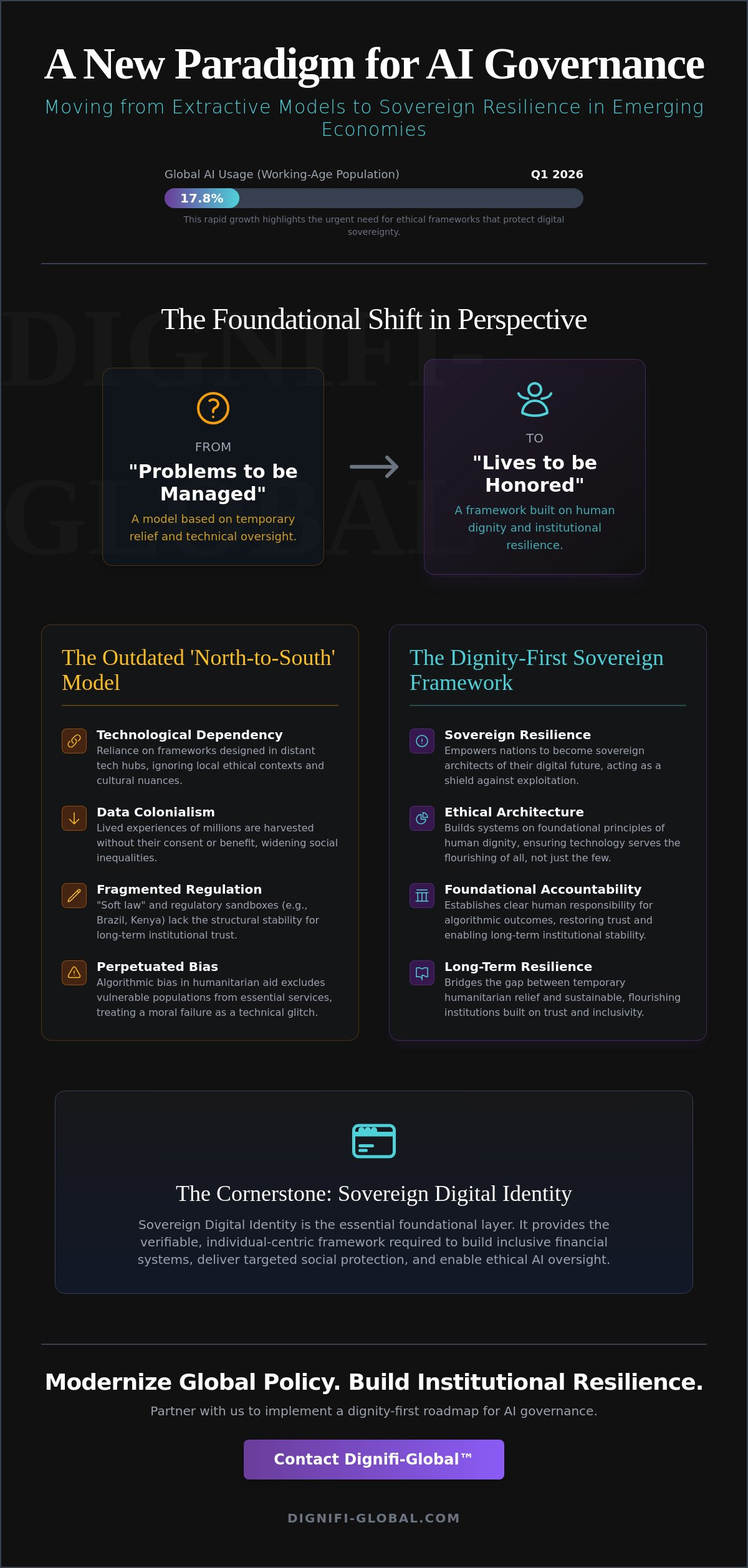
As of the first quarter of 2026, global AI usage has reached 17.8% of the world’s working-age population, yet this rapid growth often masks a crisis of digital sovereignty. You likely feel the weight of a landscape where dependency on Global North technology models threatens to overshadow local agency and widen social inequalities. It’s a challenge to balance the arrival of powerful infrastructure, like the 38,000 GPUs onboarded by the IndiaAI Mission as of February 2026, with the need for protections that truly honor the individual. Effective AI governance in emerging economies is not about mere technical compliance; it’s about the fundamental restoration of human worth within our digital foundations.

This article provides a strategic framework to move beyond the fragmented regulatory approaches seen in the various bills introduced in Brazil and Kenya in early 2026. You’ll discover how to implement a dignity-first roadmap that integrates digital identity with ethical accountability, shifting your focus from temporary humanitarian relief to long-term institutional resilience. We will explore how to build sovereign systems that treat people not as problems to be managed, but as lives to be honored, ensuring that the intersection of technology and policy serves the flourishing of all humanity.

Key Takeaways

  • Learn to move beyond passive technology adoption by establishing a sovereign paradigm for AI governance in emerging economies that centers on local ethical contexts.
  • Discover how to transition from viewing individuals as “problems to be managed” to honoring them as lives through a dignity-first strategic framework.
  • Understand why sovereign digital identity serves as the essential foundational layer for building inclusive financial systems and ethical AI oversight.
  • Identify the core pillars of accountability needed to bridge the gap between humanitarian relief and long-term institutional resilience.
  • Gain a roadmap for modernizing global policy frameworks that prioritize human flourishing and systemic stability over mere technical compliance.

Beyond the Digital Divide: Why AI Governance in Emerging Economies Requires a New Paradigm

The traditional digital divide is no longer defined by a simple lack of hardware; it’s defined by the power to shape the rules of the digital mind. For years, the Global South has been expected to adopt frameworks designed in distant tech hubs, a “North-to-South” model that frequently ignores local ethical contexts and cultural nuances. This dynamic treats nations as mere recipients of technology rather than sovereign architects of their own future. True AI governance in emerging economies must serve as a tool for sovereign resilience, acting as a shield against data colonialism where the lived experiences of millions are harvested without their consent or benefit. AI governance is the ethical architecture that ensures technology serves the flourishing of the many, not the few.

The Shift from Fragmented Adoption to Strategic Sovereignty

While “soft law” or regulatory sandboxes might offer temporary flexibility, these measures often lack the structural stability required for long-term institutional trust. Recent data from the first quarter of 2026 shows that global AI usage has risen to 17.8%, yet this growth is often accompanied by a “trust deficit” that stalls innovation when citizens don’t feel their fundamental rights are protected. Instead of reactive regulation, we advocate for a shift toward global governance consulting that centers on partnership, not dependency. By establishing foundational ethical principles in AI, nations can build systems that are both innovative and profoundly human, moving from passive participation to strategic leadership.

Addressing the Humanitarian Intersection

Governance is the heartbeat of modern aid and social protection. Without clear frameworks, humanitarian resilience programs risk perpetuating the very biases they aim to solve. Algorithmic bias isn’t just a technical glitch; it’s a moral failure that can exclude vulnerable populations from essential services. We must remember that people are not problems to be managed, but lives to be honored. In February 2026, as the IndiaAI Mission reached its milestone of onboarding 38,000 GPUs, the need for inclusive oversight became even more apparent. Effective AI governance in emerging economies acts as the foundational requirement for sustainable aid, ensuring technology heals rather than harms and bridges the gap between relief and long-term flourishing.

The Pillars of Ethical AI Policy: Centering Human Dignity in Global South Frameworks

Foundational policy is not a collection of restrictive rules; it is a declaration of what we value as a society. While traditional models focus on technical benchmarks, effective AI governance in emerging economies begins with the recognition that people are not problems to be managed, but lives to be honored. This shift in perspective moves us away from the cold, clinical oversight found in many Global North frameworks toward a model rooted in moral responsibility. By centering human dignity, we ensure that automated systems don’t just process data but actively protect the inherent worth of every individual they touch.

Building this ethical architecture requires establishing clear lines of foundational accountability. It’s not enough to deploy an algorithm; there must be a human responsible for its outcomes. This is particularly vital in the Global South, where the impact of an automated decision can determine a family’s access to healthcare or financial stability. We must also prioritize inclusive design by training systems on diverse, locally relevant datasets. When we use data that reflects the actual communities being served, we bridge the gap between abstract technology and lived reality. Transparency and explainability then act as the final pillars, making complex systems accessible and ensuring that no community is left in the dark about how decisions are made.

The “Touch, Heal, Inspire” Framework for Policy

Our methodology follows a rhythmic three-part cadence designed to ground policy in the human experience. First, we Touch the immediate social reality by identifying how AI impacts the daily lives of local communities. Next, we Heal the trust deficit by using governance to restore confidence in public and financial institutions that may have historically marginalized certain groups. Finally, we Inspire a new vision for national flourishing, where technology drives economic independence and honors the cultural heritage of the people. This cycle ensures that policy is a living instrument of progress, not just a static document.

Operationalizing Ethics in Local Contexts

Translating high-minded principles into action requires sophisticated ai governance solutions that are tailored to regional needs. This process often involves the creation of community-led oversight boards that can interpret AI governance strategies through the lens of local customs and legal traditions. We must also uphold the principle of non-refoulement in digital spaces, ensuring that no individual is harmed or excluded by the very systems meant to support them. By balancing rapid innovation with these ethical safeguards, nations can build a future that is both technologically advanced and profoundly humane. If you are ready to lead this transformation, consider how policy leadership can restore dignity to your digital infrastructure.
AI Governance in Emerging Economies: A Dignity-First Strategic Framework for 2026

Comparing Regulatory Models: From Fragmented Adoption to Sovereign Resilience

The path to sovereign resilience is not paved with the mirrored laws of other nations, but with the courage to define one’s own ethical boundaries. For many nations, the temptation to “copy-paste” the EU AI Act or US Executive Orders is strong, yet these frameworks often reflect the priorities of mature, capital-heavy markets rather than the specific needs of the Global South. True AI governance in emerging economies requires a move away from fragmented adoption toward a unified, dignity-first model. We see a tension between “Growth-First” models that risk social safeguards and “Ethics-First” models that can stifle local innovation. The goal is a synthesis where regulation doesn’t act as a barrier, but as a foundational layer for trust and national flourishing.

India and Kenya provide compelling examples of this evolution. On February 15, 2026, India launched its “India AI Governance Guidelines,” a principle-based framework that builds upon the techno-legal foundations laid out in their January 23, 2026 Whitepaper. This model leverages large-scale digital public infrastructure (DPI) to democratize access while maintaining oversight. Similarly, the Kenyan Senate introduced the Artificial Intelligence Bill in March 2026, proposing a risk-based regulatory framework that seeks to balance rapid technological diffusion with the protection of civic rights. These nations aren’t just following trends; they’re aligning their digital evolution with the OECD framework for AI in government while asserting their unique cultural and economic sovereignty.

Building a Cooperative Intelligence Constitution

A national AI strategy must act as a digital constitution that protects borders while inviting partnership. This involves aligning private sector innovation with social safeguards that prevent the exploitation of local data. A critical element of this architecture is the integration of interoperability within digital identity system design. When identity systems and AI frameworks speak the same language of accountability, the result is a seamless environment where citizens can access services without sacrificing their privacy or dignity. This alignment ensures that AI governance in emerging economies serves as a catalyst for institutional strength rather than a source of regulatory friction.

Case Studies in Institutional Resilience

Resilience is often forged in the most challenging environments. In post-conflict settings like Somalia, there is a unique opportunity to build ethical AI systems from the ground up, leapfrogging the legacy bureaucracies that often slow down more established economies. By centering human worth at the start of the digital journey, these markets can create aid frameworks that are more transparent and responsive. Multilateral dialogue remains essential to prevent a new global AI divide, ensuring that the “Touch, Heal, Inspire” methodology can be applied across borders. This collaborative approach allows nations to share lessons on restoring trust and honoring lives through technology, turning potential vulnerabilities into pillars of systemic stability.

Operationalizing Inclusion: Integrating Digital Identity with AI Governance

Most discussions regarding artificial intelligence focus heavily on the “brain” of the system, yet they often ignore the “body,” which is the digital identity that connects an algorithm to a living person. In the context of AI governance in emerging economies, this integration is not merely a technical choice; it’s a foundational necessity. Without a secure digital identity, AI governance remains a theoretical exercise without a human anchor. By centering the individual through sovereign identity, we ensure that public service delivery is not just a matter of efficiency, but a commitment to protecting the privacy and agency of the citizens it serves. This approach transforms the relationship between the state and the individual, moving from a model of surveillance to one of digital empowerment.

The intersection of sovereign digital identity and financial inclusion is where the most profound shifts in human flourishing occur. When an AI system can verify an individual’s identity without relying on predatory third-party data brokers, it restores power to the marginalized. This creates a bridge between abstract policy and the lived reality of those who have historically been excluded from formal systems. Effective AI governance in emerging economies must therefore treat identity and intelligence as a single, unified architecture designed to honor human worth rather than exploit it for data extraction.

Designing Inclusive Financial Systems

AI-driven credit scoring and aid distribution offer immense promise for closing the wealth gap, provided they’re anchored in robust identity frameworks. We advocate for financial inclusion models that prioritize partnership over dependency. Instead of viewing individuals as risk profiles to be mitigated, these systems should treat them as lives to be honored through economic opportunity. By leveraging sovereign digital IDs, nations can deploy AI that identifies needs and distributes resources without the algorithmic bias that often plagues “copy-paste” Western models. This shift ensures that technology serves as a tool for healing systemic inequality rather than deepening it.

Governance of Digital Public Infrastructure

The governance of Digital Public Infrastructure requires a delicate balance between the promise of empowerment and the risk of mass surveillance. Policymakers must move beyond process-heavy consulting toward a dignity-first roadmap that respects democratic values. Practical steps for auditing AI-integrated ID systems include:

  • Implementing data minimization practices to ensure only essential information is processed.
  • Establishing clear algorithmic transparency for all automated eligibility decisions.
  • Creating accessible redress mechanisms that allow citizens to challenge automated outcomes.

These actions ensure that digital infrastructure remains a public good. If you are ready to build a foundation that restores human worth, explore our policy leadership and identity strategy services.

Partnering for the Future: How Dignifi-Global™ Strengthens Institutional Resilience

The journey toward a dignified digital future is not one that any nation should walk alone. While many advisory firms focus on the clinical implementation of software or the rigid enforcement of processes, Dignifi-Global™ operates at the profound intersection of technology and human rights. We don’t just offer strategic advice; we provide a sanctuary for sovereign leaders who recognize that AI governance in emerging economies is the most critical moral challenge of our time. By centering our work on the inherent worth of every individual, we help nations move away from dependency on external models and toward a state of self-determined, institutional resilience.

Our “dignity-first” roadmap is designed to modernize policy frameworks so they can withstand the rapid shifts of the mid-2020s. We’ve seen global AI usage climb to 17.8% of the working-age population as of the first quarter of 2026, yet many systems remain reactive rather than restorative. We help you transition from the old paradigm of humanitarian relief, which often treats people as problems to be managed, to a new model of sustainable resilience where citizens are honored as the architects of their own flourishing. This shift ensures that the digital evolution heals existing social wounds rather than deepening them through algorithmic exclusion.

Strategic Advisory for Sovereign Leaders

We provide bespoke strategic advisory that respects the unique cultural and institutional contexts of the Global South. Rather than applying a generic template, we design AI policy frameworks that align with local legal traditions while meeting international standards of accountability. This includes modernizing humanitarian frameworks to protect vulnerable populations from the risks identified in the March 2026 Kenyan AI Bill and Brazil’s recent legislative updates. Under the visionary leadership of Her Excellency Roné de Beauvoir, our team offers a level of diplomatic prestige and moral authority that traditional, data-centric firms cannot replicate. We bridge the gap between high-level global engagement and the practical necessity of restoring trust in public institutions.

Building the Future of Humanity Together

Centering dignity in every technological leap is not just an ethical choice; it is a strategic advantage that fosters long-term stability and economic independence. When you choose to partner with us, you are choosing a methodology that follows the rhythmic cadence of Touch, Heal, and Inspire. We begin by touching the reality of your current digital landscape, healing the trust deficits within your systems, and inspiring a vision for a future where technology serves the many. This holistic approach ensures that your national AI and identity strategy is both foundational and aspirational. We invite you to contact Dignifi-Global™ to lead your institutional transformation and join us in building a world where every life is honored and every system is resilient.

Leading the Global Restoration of Human Worth

The transition from fragmented regulatory adoption to sovereign resilience marks a pivotal moment in history. We’ve established that AI governance in emerging economies must be more than a technical hurdle; it’s a moral imperative to protect digital borders and honor local contexts. By integrating digital identity with ethical intelligence, nations can bridge the gap between temporary humanitarian relief and long-term institutional stability. This approach ensures that technology serves as a tool for flourishing, not a mechanism for exclusion.

As pioneers of the dignity-first strategic roadmap, Dignifi-Global™ stands ready to guide this transformation. Led by Her Excellency Roné de Beauvoir, our organization operates at the essential intersection of artificial intelligence, digital identity, and financial inclusion. We remain committed to the belief that people are not problems to be managed, but lives to be honored. Partner with Dignifi-Global™ to design your dignity-first AI governance framework. The future of humanity is not a challenge to be feared, but a masterpiece to be built together with wisdom and steady confidence.

Frequently Asked Questions

What is the primary challenge of AI governance in emerging economies?

The primary challenge of AI governance in emerging economies is the “regulatory lag” where technical speed outpaces the development of ethical safeguards. This gap often forces nations into a reactive stance, trying to manage the consequences of technologies designed without their specific social contexts in mind. Without a proactive framework, there is a risk that institutional trust will erode, leaving citizens vulnerable to systems that do not respect their local agency or sovereignty.

How does digital identity relate to AI governance frameworks?

Digital identity provides the essential “human anchor” that connects an algorithm to a recognized individual with inherent rights. It ensures that automated systems are not just processing data points, but are interacting with lives that must be honored. By integrating sovereign identity into governance, we create a feedback loop where decisions can be traced back to a person, ensuring that accountability is foundational to every technological interaction.

Can emerging economies afford to prioritize ethics over rapid AI adoption?

Nations cannot afford to bypass ethics, as foundational trust is the bedrock of any digital market. While rapid adoption is often prioritized for short-term gains, history shows that systems built without moral safeguards suffer from public rejection and institutional collapse. Prioritizing human dignity creates a stable environment that attracts high-quality global investment and ensures that national progress is not derailed by social instability or the erosion of civic rights.

What are the risks of using Global North AI policies in the Global South?

The risk of adopting Global North policies is the unintended facilitation of “contextual blindness,” where foreign frameworks ignore the unique socio-economic realities of the Global South. These models often prioritize capital efficiency over the restoration of human worth, which can deepen existing inequalities. Without a dignity-first lens, imported regulation fails to address the specific intersection of financial exclusion and civic rights that define the lived reality of billions.

How can AI governance improve humanitarian aid resilience?

AI governance improves humanitarian resilience by shifting the focus from immediate relief to long-term institutional stability. Effective frameworks ensure that predictive models for aid distribution are transparent and free from the algorithmic bias that often excludes the most vulnerable. This structural stability allows organizations to move from managing crisis to healing communities, ensuring that technology serves as a bridge toward future economic independence and national flourishing.

What role does Dignifi-Global™ play in national policy design?

Dignifi-Global™ acts as a visionary partner that bridges the gap between high-level policy and human rights. We design bespoke frameworks that center on the intersection of artificial intelligence, digital identity, and financial inclusion. Our team provides the strategic leadership necessary to restore institutional trust and modernize aid frameworks for the challenges of 2026 and beyond, always centering the flourishing of humanity through a dignity-first approach.

Is there a global standard for AI governance in emerging markets?

There is no single global standard, as nations are increasingly developing “hybrid” models that combine regulatory sandboxes with specific sector-based laws. For example, Brazil’s ongoing review of Bill No. 2338/2023 in early 2026 demonstrates a move toward a national legal framework that balances innovation with rights protection. This movement allows for a diverse global landscape where each nation asserts its own sovereignty while maintaining interoperability with international ethical standards.

How do we ensure AI systems do not deepen existing social inequalities?

Ensuring that AI doesn’t deepen inequality requires a commitment to inclusive design and constant algorithmic recalibration. We must move beyond viewing people as data sets to be managed and instead treat them as lives to be honored. By implementing rigorous audits for bias and prioritizing local datasets, we can build AI governance in emerging economies that restores equity and ensures that the benefits of intelligence are diffused across all sectors of society.
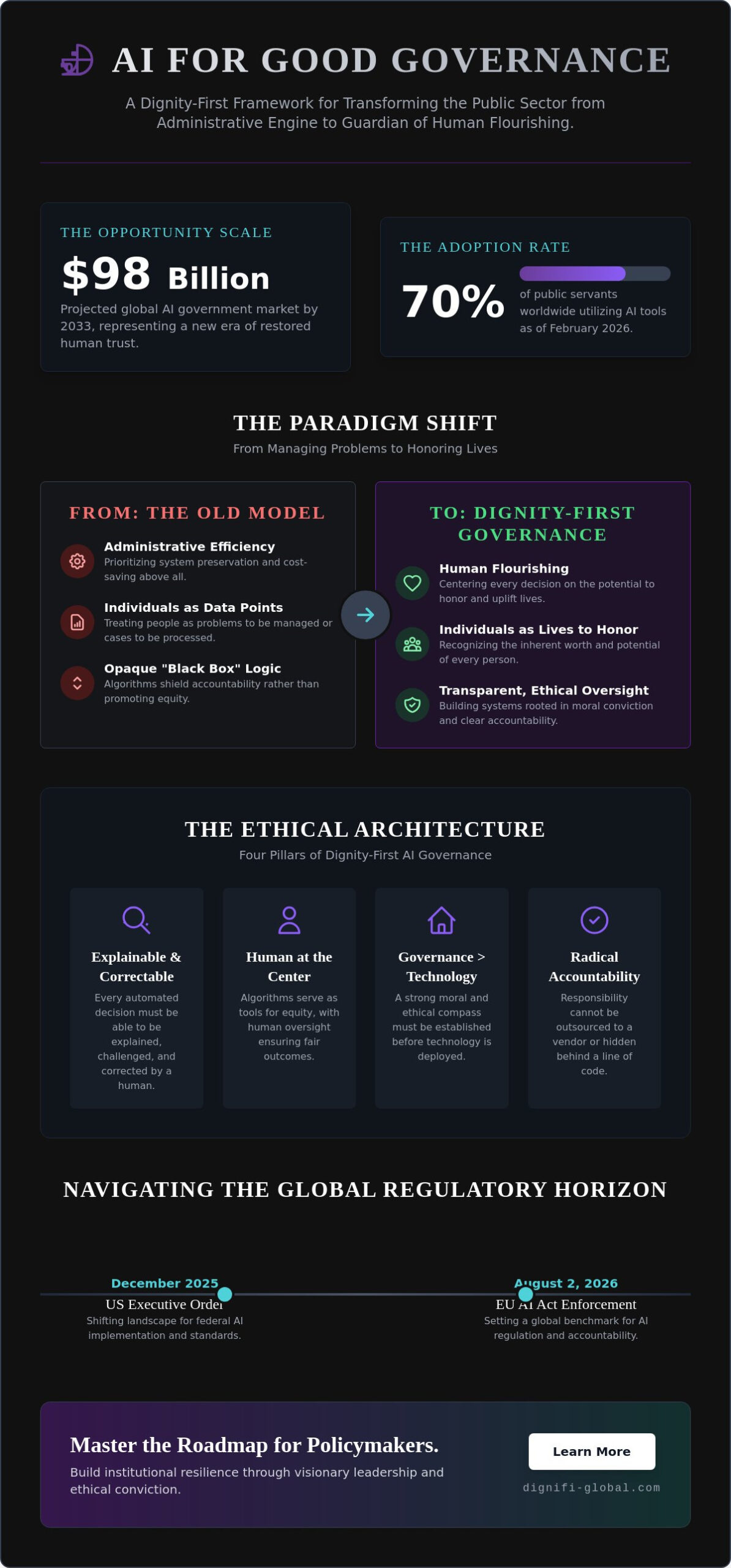
What if the $98 billion projected for the global AI government market by 2033 was not just a measure of technological scale, but a testament to restored human trust? With 70% of public servants worldwide already utilizing these tools as of February 2026, the question is no longer about adoption, but about the soul of our systems. Effective AI for good governance in public sector requires more than just managing algorithms; it demands an architectural commitment to honoring every individual.

You’re likely grappling with the August 2, 2026, enforcement of the EU AI Act and the shifting landscape of the December 2025 US Executive Order. It’s a daunting task to navigate these regulatory intersections while ensuring that efficiency doesn’t come at the cost of equity. We’ll show you how to transform your public institution from a cold administrative engine into a guardian of human flourishing. By exploring a foundational framework for ethical AI, this guide will help you bridge the gap between technical implementation and global inclusion, ensuring your agency moves from managing problems to honoring lives.

Key Takeaways

  • Understand the shift from administrative efficiency to an ethical architecture that centers human dignity in every policy decision.
  • Implement AI for good governance in public sector using a framework that transforms institutional engines into instruments of global inclusion.
  • Uncover how AI-driven digital identity systems can bridge the divide for the unbanked and restore trust in humanitarian aid delivery.
  • Navigate the complexities of algorithmic bias by adopting a “dignity-first” approach that views individuals as lives to be honored, not problems to be managed.
  • Master a strategic roadmap for policymakers designed to build institutional resilience through visionary leadership and ethical conviction.

Defining the New Era of Public Sector Intelligence

We stand at a pivotal threshold where the machinery of state meets the transformative potential of machine intelligence. AI for good governance in public sector is not merely a technical upgrade; it’s the strategic integration of intelligence to enhance institutional accountability and restore the bond between the state and the citizen. In 2026, we’ve moved past the era of experimental AI pilots that characterized the early 2020s. Today, the focus has shifted toward building foundational governance frameworks that can withstand the pressures of a rapidly evolving digital society. These frameworks ensure that intelligence is deployed with purpose, moving beyond the “black box” of automated decisions toward a model of transparent, ethical oversight.

AI governance is a moral architecture for the digital age, designed to ensure that technology serves the sanctity of human life rather than the convenience of administrative processes.

Traditional bureaucratic governance often prioritizes the preservation of the system itself, treating individuals as data points to be processed or problems to be managed. In contrast, dignity-first public service recognizes that every interaction is an opportunity to honor a life. This shift requires a departure from a rigid Government by algorithm where citizens are subjected to opaque logic. Instead, we’re building systems that are deeply rooted in ethical conviction, where the algorithm is a tool for equity, not a shield against accountability.

The Shift from Efficiency to Flourishing

While fiscal responsibility remains a fundamental duty of the public servant, cost-saving is a secondary benefit of modern intelligence, not the primary goal. We must understand that AI is not for managing processes, but for honoring lives. When public institutions prioritize human flourishing, they build a unique form of institutional resilience. This resilience isn’t found in rigid code; it’s found in the trust established when technology is used to touch the lives of the marginalized, heal systemic inequities, and inspire collective progress. By centering dignity, we transform the public sector from a cold administrative engine into a guardian of the common good.

Global Standards for AI Governance in 2026

The landscape of 2026 is defined by a maturing set of international norms. We’ve seen the evolution of OECD and UN guidelines from abstract principles into enforceable standards that demand accountability. Cross-border cooperation has become essential, particularly as we develop digital identity systems that respect the sovereignty of the individual across different jurisdictions. For leaders seeking to align their agencies with these high-minded ideals, global governance consulting provides the necessary policy insights to navigate the complex intersection of ethics and technology. This global alignment ensures that no community is left behind as we bridge the digital divide.

The Ethical Architecture of Dignity-First Governance

True leadership in the digital era isn’t found in the speed of a processor, but in the strength of an ethical foundation. At Dignifi-Global™, we view AI for good governance in public sector through a proprietary “dignity-first” lens. This perspective shifts the focus from managing data to honoring lives. We believe that governance must always precede technology; without a moral compass, even the most advanced systems risk becoming instruments of exclusion rather than tools for flourishing. By placing ethical conviction at the heart of the architecture, we ensure that the intersection of AI and public policy serves the inherent worth of every human person.

Automated decision-making systems carry a profound moral weight that can’t be ignored. When a machine determines eligibility for social services or legal status, accountability cannot be outsourced to a vendor or hidden behind a line of code. Public institutions have a responsibility to reduce risk and increase transparency by keeping the human at the center of the logic. True accountability is not a checkbox on an audit; it’s a foundational promise that every decision can be explained, challenged, and corrected. This approach transforms the relationship between the state and the citizen from one of dependency to one of partnership.

Centering the Human in the Algorithm

Effective public policy requires contextual intelligence, a nuanced understanding of local culture and history that raw data alone cannot capture. We must prevent AI from becoming a “black box” that obscures institutional responsibility. Surface-level compliance with current regulations isn’t enough to build lasting trust. Institutions need foundational ethics that guide the development of Ethical AI Governance Frameworks. These frameworks ensure that technology is used to bridge divides, not deepen them, by prioritizing the human experience over administrative convenience.

Touch, Heal, Inspire: A Methodology for Institutions

Our methodology operates with a measured, three-part cadence that acts as a heartbeat for policy development. First, we Touch by identifying the real-world needs of the most vulnerable populations, such as the estimated 1.4 billion people worldwide who still lack formal financial access. Next, we Heal by using AI to restore trust and fix broken service delivery models that have historically marginalized communities. Finally, we Inspire by setting a global benchmark for ethical leadership. This process ensures that public sector technology is not just functional, but restorative and visionary, creating a legacy of inclusion that lasts for generations.

AI for Good Governance in the Public Sector: Centering Human Dignity in 2026

Beyond Efficiency: AI Applications for Global Inclusion

The true measure of a state’s wisdom isn’t found in the complexity of its code, but in the breadth of its embrace. When we apply AI for good governance in public sector, we move beyond the mechanical pursuit of speed toward a higher purpose: global inclusion. While many administrative bodies use AI to Improve Government Performance by automating routine tasks, the visionary leader recognizes that technology must be a bridge to the forgotten. In 2026, this means leveraging predictive analytics and intelligent systems to ensure that no individual is left behind by the systems meant to serve them.

Inclusive financial system development has emerged as a central pillar of this new governance model. It’s not enough to have a stable economy if the doors to that economy remain locked for the marginalized. By integrating ethical AI into the very fabric of public finance, institutions can identify and dismantle the systemic barriers that have historically excluded rural and low-income populations. This isn’t a mere administrative adjustment; it’s a profound act of restoration that honors the economic potential of every citizen.

Digital Identity as a Human Right

Digital identity is not a privilege for the few, but a foundational right for the many. For the estimated 1.4 billion individuals globally who lack formal recognition, the absence of identity is an absence of agency. Strategic digital identity system design allows institutions to reach refugees and marginalized communities with surgical precision and profound empathy. These systems don’t just store data; they restore the dignity of recognition, allowing a displaced person to access social services, education, and legal protection regardless of where they stand on the map.

Predictive Policy for Proactive Governance

Proactive governance requires a shift from reactive relief to sustainable resilience. By the middle of 2026, predictive policy has become a cornerstone of institutional strength, allowing governments to anticipate global shocks before they fracture the social fabric. Whether responding to climate-driven migration or public health crises, AI-driven insights provide a clarity that manual processes can’t match. This foresight is especially critical in fostering financial inclusion, where predictive models identify systemic barriers to capital and help dismantle them. The result is a public sector that doesn’t just survive challenges, but thrives through them by honoring the data integrity of every citizen.

Key applications for inclusive governance in 2026 include:

  • Predictive resource allocation for humanitarian aid in conflict zones;
  • Automated bias-detection in social safety net eligibility protocols;
  • Real-time monitoring of financial service accessibility for rural populations;
  • Cross-border identity verification to ensure continuity of care for migrants.

These applications manifest our commitment to a higher plane of global engagement. They represent the heartbeat of a public sector that seeks to touch, heal, and inspire through every line of code and every policy decision.

Confronting the Governance Gap: Trust vs. Technology

The greatest risk to our collective future isn’t the machine itself, but the widening chasm between technological capability and ethical oversight. While US federal agencies reported 3,611 AI use cases in 2025, a nearly 70% increase from the previous year, the human element often feels sidelined. This leads to a critical objection: Does AI remove the “human” from public service? The answer lies in our choice of architecture. AI for good governance in public sector succeeds only when we prioritize partnership over dependency. We must refuse to view citizens as data sets to be processed; they are lives to be honored.

The “governance gap” is palpable. According to a 2026 survey, only 18% of public servants believe their governments are deploying AI effectively. This skepticism is rooted in the fear of algorithmic bias undermining public trust. Developers and policymakers share a moral responsibility to ensure that automated systems don’t replicate historical inequities. We don’t just need better code; we need a fundamental shift in how we perceive the role of technology in the state. By bridging this gap, we move from mere administrative engines to institutions that truly serve the common good.

Mitigating Bias through Inclusive Design

Inclusive design is not a feature; it’s a foundational requirement. To bridge the trust gap, AI training data must reflect the full diversity of the public it serves. This requires moving from “problem management” to “life honoring” in data science. Independent auditing plays a vital role here, maintaining institutional accountability by ensuring that high-risk systems exercise reasonable care to prevent discrimination. This is especially vital as regulations like the Colorado AI Act take effect on June 30, 2026, mandating transparency in automated decision-making.

The Myth of Neutral Technology

We must dismantle the myth that AI is a neutral tool. Technology is never neutral; it reflects the values, biases, and priorities of its governance. When institutions prioritize efficiency at any cost, they risk sacrificing the very dignity they are sworn to protect. Policymakers must act as ethical visionaries, ensuring that digital transformation serves the flourishing of all people. If your institution is ready to move beyond surface-level compliance toward a more profound ethical commitment, explore our AI governance solutions to lead with confidence.

True institutional resilience is built on the bedrock of trust. By confronting the governance gap today, we ensure that the technology of tomorrow remains an instrument of healing and inspiration for the global community.

Building Institutional Resilience: A Roadmap for Policymakers

Institutional resilience is not a byproduct of technical efficiency; it’s a result of ethical conviction. As we navigate the complexities of 2026, the demand for visionary leadership at the ministerial level has never been more urgent. Implementing AI for good governance in public sector requires a roadmap that bridges the gap between technical capability and moral responsibility. This journey transforms public agencies from mere administrators of data into guardians of human flourishing. By adopting a “dignity-first” approach, leaders can foster a culture of innovation that prioritizes people over processes and partnership over dependency.

Navigating the current regulatory landscape, particularly with the August 2, 2026, enforcement of the EU AI Act, requires more than just legal compliance. It demands strategic advisory that understands the intersection of technology and human rights. We’ve designed a structured path for institutions ready to lead this transformation through comprehensive AI governance solutions.

Step 1: Establishing the Ethical Framework

The first step is to define the core values that will govern institutional intelligence. This isn’t a technical exercise, but a philosophical one. High-level commitment to “people-first” outcomes ensures that AI is used to empower the citizen rather than simplify the bureaucracy. By integrating human rights principles directly into the technical architecture, agencies create a foundational layer of trust. This framework acts as a compass, guiding every subsequent policy decision toward the restoration of human dignity.

Step 2: Designing for Resilience and Inclusion

Resilience is built when systems are designed to include the most vulnerable. We must implement digital identity systems that empower individuals rather than surveil them. This involves developing inclusive financial frameworks that bridge the digital divide, ensuring that the 70% of public servants using AI tools in 2026 are doing so to expand access, not restrict it. Creating robust feedback loops between citizens and algorithmic systems allows for a participatory model of governance where every voice is heard and every life is honored.

Step 3: Continuous Monitoring and Moral Auditing

Governance is a living process, not a one-time policy implementation. True accountability requires continuous monitoring and moral auditing to ensure systems remain aligned with their ethical purpose. When a system fails to meet these high standards, we must have the courage to “heal” it by addressing biases and restoring equity. This iterative approach prepares institutions for the future of global strategy, ensuring they remain steady and principled amidst the shifting tides of the digital age. Through this three-part cadence—Touch, Heal, Inspire—we set a global benchmark for what it means to lead with wisdom and empathy.

Honoring Humanity Through Sovereign Intelligence

The future of public service is not a choice between technology and humanity, but a commitment to using the former to elevate the latter. We’ve explored how a dignity-first framework transforms AI for good governance in public sector from a tool of administrative control into a bridge for global inclusion. By the end of 2026, the institutions that flourish will be those that have moved beyond surface-level compliance to embrace a foundational architecture of accountability. They’ll be the ones that recognize that people are not problems to be managed; they’re lives to be honored.

Led by Her Excellency Roné de Beauvoir, Dignifi-Global™ stands at the intersection of artificial intelligence, digital identity, and financial inclusion to restore trust in our global systems. Our dignity-first approach to global institutional resilience ensures your policy leadership remains both aspirational and grounded in moral responsibility. Partner with Dignifi-Global™ to design your ethical AI governance framework and lead with the steady confidence of a global statesperson. Together, we can bridge the digital divide and inspire a future where every individual is seen, heard, and valued.

Frequently Asked Questions

What is the role of AI in good governance?

AI acts as a strategic intelligence layer that enhances institutional accountability and fosters human flourishing. It’s not just about speed; it’s about using data to touch lives and bridge the digital divide. By 2033, the global market for AI in government is expected to exceed $98 billion. This investment signifies a shift toward systems that prioritize people over processes, ensuring that AI for good governance in public sector remains rooted in ethical conviction.

How does AI improve public sector efficiency without losing human accountability?

Institutions achieve efficiency by integrating ethical frameworks that mandate meaningful human oversight at every decision point. Accountability is maintained through transparent logic and independent auditing, as seen in the Colorado AI Act taking effect June 30, 2026. This approach ensures that automated systems don’t become “black boxes.” Instead of viewing citizens as problems to be managed, these systems operate as partnerships that honor the inherent worth of every individual.

What are the main ethical risks of AI in government?

The primary risks include algorithmic bias, the loss of public trust, and the erosion of human agency. A February 2026 study found that 82% of public servants harbor concerns about the effective implementation of these tools. When governments prioritize efficiency at any cost, they risk deepening systemic inequities. Ethical governance requires a “dignity-first” lens to ensure that technology doesn’t remove the human heart from the machinery of the state.

How can AI support financial inclusion in developing nations?

AI supports financial inclusion by identifying and dismantling the systemic barriers that exclude the 1.4 billion people currently lacking formal financial access. Predictive analytics can identify creditworthiness in rural populations where traditional data is scarce. This isn’t just a technical adjustment; it’s a restorative act. By centering the needs of the marginalized, inclusive financial system development creates a pathway for economic flourishing and long-term institutional resilience.

Why is digital identity essential for AI governance in the public sector?

Digital identity provides the foundational layer of recognition that allows AI systems to serve individuals with precision and empathy. Without a secure, sovereign identity, a person lacks the agency to access social services or legal protections. For refugees and displaced communities, these systems are essential for restoring the dignity of recognition. In the context of AI for good governance in public sector, identity is the bridge between a data point and a life honored.

What does “dignity-first” AI governance look like in practice?

In practice, this governance model utilizes the “Touch, Heal, Inspire” cadence to guide all policy decisions. It begins by touching the real-world needs of the most vulnerable and proceeds to heal broken service models through restorative technology. Finally, it inspires global leadership by setting a high-minded benchmark for ethical conduct. It’s a shift from managing data to centering human dignity, ensuring that every line of code serves the common good.

How do global institutions standardize AI ethics across different regions?

Standardization occurs through the evolution of international norms like the EU AI Act, which becomes enforceable on August 2, 2026. These regulations demand cross-border cooperation to ensure that high-risk systems exercise reasonable care globally. While regional laws like the December 2025 US Executive Order vary, the trend is toward a unified framework of accountability. This global alignment prevents regulatory fragmentation and ensures that ethical standards are upheld across all jurisdictions.

Can AI help in humanitarian resilience programs?

Yes, AI is a critical tool for moving humanitarian efforts from reactive relief to sustainable resilience. Predictive models allow agencies to anticipate climate shocks or health crises before they fracture society. With civilian agencies spending over $3 billion on AI in the most recent budget cycle, the focus is now on proactive aid delivery. This foresight allows institutions to protect vulnerable populations and build a future rooted in stability and human flourishing.

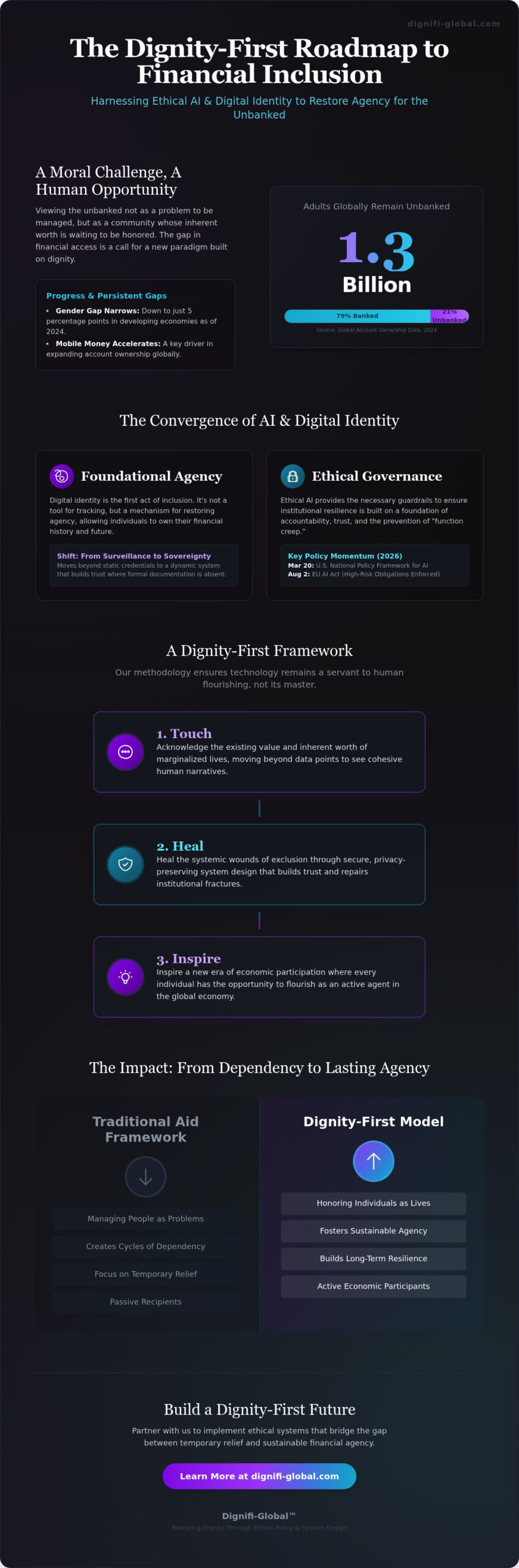
What if the 1.3 billion adults who remain unbanked today are not a problem to be managed, but a community waiting for their inherent worth to be honored? While 79 percent of adults globally held a financial account by 2024, the remaining gap represents a profound moral challenge that technology alone cannot fix. We believe the strategic implementation of AI and digital identity for financial inclusion is not about tracking individuals; it’s about centering human dignity and restoring agency. You likely recognize that existing digital ID systems often risk becoming tools for surveillance or further exclusion rather than empowerment.

This article demonstrates how the intersection of ethical AI governance and secure digital identity systems creates a foundational roadmap for global financial inclusion and institutional resilience. We will move beyond the limitations of traditional aid to explore a dignity-first framework for system design. By examining the shift toward accountability following the U.S. National Policy Framework for Artificial Intelligence released on March 20, 2026, we provide a preview of how to bridge the gap between temporary relief and sustainable financial agency. It’s time to embrace a model of partnership over dependency, ensuring every individual has the opportunity to flourish.

Key Takeaways

  • Shift the perspective from managing problems to honoring lives by adopting a visionary paradigm for inclusive technology.
  • Recognize digital identity as the foundational layer of agency, allowing marginalized populations to own their financial history and future.
  • Implement ethical governance to transform AI and digital identity for financial inclusion into a secure roadmap for institutional resilience.
  • Bridge the gap between temporary relief and sustainable agency by modernizing aid frameworks with dignity-first strategic insights.
  • Apply the “Touch, Heal, Inspire” methodology to ensure that global governance structures prioritize the flourishing of human dignity.

The Convergence of AI and Digital Identity: A New Paradigm for Inclusion

The intersection of technology and humanity is not merely a technical frontier; it’s a moral landscape where the future of global equity is decided. For too long, financial systems have viewed the 1.3 billion unbanked individuals as a data gap to be filled or a logistical hurdle to be cleared. We believe that true progress occurs when we stop managing people as problems and start honoring them as lives. By leveraging AI and digital identity for financial inclusion, we can transform fragmented data points into cohesive narratives of human potential. This year, 2026, marks a pivotal moment as high-risk obligations under the EU AI Act come into force on August 2, 2026, and the U.S. National Policy Framework for Artificial Intelligence begins to reshape how we view the intersection of ethics and innovation. It’s about agency, not just access.

Defining AI and Digital Identity in a Humanitarian Context

AI-driven identity serves as a vehicle for sovereign agency, ensuring that an individual’s digital presence is an instrument of empowerment rather than a ledger of surveillance. While a traditional digital identity often acts as a static record of government-issued credentials, AI-enhanced systems dynamically process alternative data to build trust where formal documentation is absent. Our methodology approaches this through a specific rhythm: we Touch the lives of the marginalized by acknowledging their existing value, Heal the systemic wounds of exclusion through secure design, and Inspire a new era of participation. This approach ensures that technology remains a servant to human flourishing, not its master.

The Economic and Social Case for Ethical Systems

The journey from temporary relief to sustainable resilience requires a shift in how institutions deploy capital and technology. While traditional aid frameworks often create cycles of dependency, inclusive financial systems built on ethical AI foster long-term agency. This transition is essential for meeting the UN Sustainable Development Goals, particularly those focused on eradicating poverty and reducing inequality. By 2024, the gender gap in account ownership in developing economies had already narrowed to 5 percentage points, a testament to the power of mobile technology. However, without robust governance, we risk the “function creep” identified in World Bank reports, where data collected for one purpose is used to marginalize the vulnerable in another. Ethical AI and digital identity for financial inclusion provide the necessary guardrails to ensure that institutional resilience is built on a foundation of accountability and trust.

Foundational Agency: Why Digital Identity Precedes Financial Access

Identity is the first act of inclusion. Without a recognized digital presence, an individual remains invisible to the systems that provide credit, safety, and opportunity. While 79 percent of adults globally held a financial account by 2024, the 1.3 billion who remain unbanked are often excluded simply because they lack the “foundational” credentials required by traditional institutions. We view digital identity system design not as a tool for tracking, but as a mechanism for restoring agency. It’s the essential layer that allows refugees and marginalized populations to own their financial history; this transforms them from passive recipients of aid into active participants in the global economy.

The Moral Architecture of Identity

A dignity-first approach to identity systems requires a fundamental shift from surveillance to sovereignty. Existing frameworks often prioritize the needs of the institution over the rights of the individual, leading to systems that feel like management rather than empowerment. We advocate for partnership over dependency; we believe people are not problems to be managed, but lives to be honored. By utilizing AI and digital identity for financial inclusion, we can create insights that acknowledge the inherent worth of individuals previously deemed “unbankable.” This isn’t about clinical data collection. It’s about centering the human experience to ensure that technology heals the fractures in our social fabric rather than widening them.

Bridging the Gap for the Unbanked

The traditional “know your customer” (KYC) barrier has long served as a gatekeeper that keeps the vulnerable at the margins. Secure digital identity for financial services provides a solution by automating trust in fragile contexts. Since 84 percent of adults in low- and middle-income countries now own a mobile phone, we have an unprecedented opportunity to verify creditworthiness through alternative data. The strategic deployment of AI and digital identity for financial inclusion allows models to analyze patterns of mobile usage or utility payments to build a financial footprint where none existed before. This transition toward financial inclusion acts as a stabilizer for global institutions, replacing volatile relief cycles with long-term economic resilience. If you’re ready to rethink your institutional strategy, we invite you to explore our governance consulting services to build a more humane future.

AI and Digital Identity for Financial Inclusion: Restoring Dignity in a Digital Age

The Governance Prerequisite: Why Ethical AI Must Lead Technology

Technology remains a neutral force until it’s animated by human intent. We believe that technology without governance is a risk, but governance with dignity is a solution. A common objection suggests that AI is a cold, impersonal tool that will only deepen the global divide. However, when we apply a dignity-first lens, we see that ethical policy can transform these algorithms into instruments of compassion. Engaging in global governance consulting isn’t an administrative hurdle; it’s the foundational act of building a system that recognizes human worth. We must ensure that AI and digital identity for financial inclusion are developed within a framework of accountability that precedes any technical deployment.

Governance Over Technology: A Systemic Shift

Governance must precede technology. In humanitarian contexts, the rush to innovate often leads to “automated exclusion,” where flawed algorithms replicate the very biases they were meant to solve. If we don’t establish ethical guardrails before implementation, we risk creating a digital panopticon rather than a pathway to prosperity. Our methodology requires a systemic shift toward a top-down ethical framework. This ensures that every institutional partner is held to the highest standard of transparency. By doing so, we move from a paradigm of managing problems to one of honoring lives, ensuring that institutional resilience is rooted in moral responsibility.

The Ethics of Inference and Profiling

The traditional data-centric model of banking often fails the 1.3 billion unbanked by reducing complex human experiences to binary data points. We advocate for a model that centers meaningful human intervention within AI decision-making processes. It’s vital to uphold the digital equivalent of non-refoulement; we must ensure that the data collected to provide AI and digital identity for financial inclusion is never weaponized against the vulnerable. Our three-part cadence, Touch, Heal, Inspire, guides this transition. We touch the system with ethical policy, heal the scars of exclusion through transparent inferences, and inspire a future where every individual can flourish. This is the essence of restoring dignity in a digital age.

From Relief to Resilience: Strategic Implementation for Institutions

Institutional resilience isn’t built on the efficiency of a transaction; it’s forged in the fires of trust and accountability. For multilateral partners, the path forward requires a departure from traditional aid frameworks that often prioritize process over people. We propose a strategic shift where relief serves as a bridge to long-term flourishing. By integrating AI governance solutions into existing humanitarian programs, organizations can ensure that technological adoption honors the individual. This is how AI and digital identity for financial inclusion moves from a theoretical concept to a foundational reality for the world’s most vulnerable. It’s about agency, not just access.

Modernizing Humanitarian Aid Frameworks

Modernizing aid means moving from short-term relief to long-term agency. In 2024, 62 percent of adults in low- and middle-income economies made or received digital payments, marking a 28 percent increase over the last decade. This surge highlights the potential for secure cash-transfer programs powered by digital identity. To ensure these systems remain dignity-first, institutions should follow a rigorous technological audit checklist:

  • Does the system treat the individual as a life to be honored rather than a problem to be managed?
  • Is the digital footprint sovereign, ensuring the user owns their financial history?
  • Are there transparent mechanisms for human accountability in every AI-driven inference?

The Role of Policymakers in 2026

The role of the global statesperson in 2026 is to bridge the gap between innovation and ethics. The White House released its National Policy Framework for Artificial Intelligence on March 20, 2026, signaling a move toward consolidated federal oversight. For policymakers, this represents a call to action. We must move beyond a patchwork of regulations to a unified vision that centers human flourishing. It’s not enough to manage risks; we must actively create the conditions for partnership-based ecosystems. This involves aligning government mandates with technology providers who share a commitment to moral responsibility. This systemic policy change is the heartbeat of our methodology. Strengthen your humanitarian strategy with our humanitarian resilience programs to ensure no community is left behind.

Restoring Dignity through Ethical Policy: The Dignifi-Global™ Methodology

The architecture of our digital future must be built on the bedrock of human worth. We believe technology is a mirror of our collective values; if we design systems for efficiency alone, we risk building a world that is efficient but hollow. The Dignifi-Global™ Methodology rejects the clinical reduction of individuals into binary data sets. Instead, we center the human experience at the very heart of AI and identity strategy. By embracing the strategic deployment of AI and digital identity for financial inclusion, we can move beyond the systemic failures of the past. We don’t see data points; we see destinies waiting to be fulfilled.

The Dignity-First Approach to Global Inclusion

Our unique policy frameworks are rooted in the visionary leadership of Her Excellency Roné de Beauvoir. Her vision for a more humane future is built on the conviction that people are lives to be honored, not problems to be managed. This philosophy informs every aspect of our work, from policy leadership to strategic advisory. We provide a specific framework for AI and digital identity for financial inclusion that prioritizes the flourishing of the individual above the convenience of the institution. It’s a shift from dependency to partnership. This ensures that the digital tools of tomorrow are used to restore the agency that was stripped away yesterday.

Partnering for a Sustainable Future

The urgency of this mission cannot be overstated. As we approach the full implementation of high-risk AI obligations on August 2, 2026, the window for building ethical systems is narrowing. We invite global leaders, institutional stakeholders, and humanitarian pioneers to join us in this transformation. Building resilient systems is not a task for the next crisis; it’s a responsibility for today. Our methodology provides the cadence needed to navigate this complexity. We Touch the lives of the marginalized with empathy, Heal the systemic wounds of exclusion through ethical governance, and Inspire a global community to reach for a higher plane of engagement. Dignifi-Global™ stands as your visionary partner in this journey, bridging the gap between technological potential and human dignity. Let’s build a future where every life is honored and every voice is heard.

Honoring the Future of Global Agency

The path toward a more equitable world requires us to look beyond the code and see the faces of the 1.3 billion individuals still waiting for an invitation to participate. We have established that digital identity serves as the foundational layer of agency and that ethical governance must lead every technological advancement. By centering human dignity, we transform AI and digital identity for financial inclusion from a mere technical objective into a moral imperative. This systemic shift moves institutions from providing temporary relief to fostering sustainable resilience, ensuring every individual has the opportunity to flourish in our digital age.

Led by Her Excellency Roné de Beauvoir, our visionary approach is designed to bridge the gap between global policy and human worth. We invite you to partner with Dignifi-Global™ to design the future of ethical inclusion and witness the power of our Touch, Heal, Inspire methodology. Together, we can restore the agency of the marginalized and build a global financial system that honors every life. The future of humanity is not a problem to be managed; it’s a legacy we are building together with calm, steady confidence. Let’s create a world where technology serves the heart.

Frequently Asked Questions

How does AI improve financial inclusion for the unbanked?

AI improves inclusion by analyzing alternative data points, such as mobile phone usage and utility payments, to establish creditworthiness for the 1.3 billion adults who remain unbanked. By 2024, digital payment adoption in low-income economies reached 62 percent, providing a rich narrative of financial behavior that traditional systems often ignore. It’s about recognizing inherent value where legacy institutions see only a data void.

What are the risks of using digital identity in humanitarian aid?

The primary risks involve “function creep” and automated exclusion, where data intended for relief is weaponized for surveillance or biased algorithms marginalize the vulnerable. Without a dignity-first framework, these systems can inadvertently replicate the systemic fractures they aim to heal. We must ensure that digital footprints remain sovereign and protected against unauthorized profiling.

Why is governance more important than technology in AI implementation?

Governance provides the moral intent that technology lacks; technology is a neutral force, but governance is a solution. As the high-risk obligations of the EU AI Act come into force on August 2, 2026, it’s clear that policy must precede deployment to prevent systemic harm. Governance ensures we are honoring lives rather than merely managing data points.

Can digital identity systems protect individual privacy?

Yes, secure systems protect privacy through decentralized architectures and sovereign identity models where the individual retains ownership of their data. Implementing AI and digital identity for financial inclusion requires a commitment to transparency and accountability. This approach prevents the invasive profiling common in traditional, data-dense institutional models.

What is the “dignity-first” approach to financial system design?

A dignity-first approach centers the human experience by treating individuals as lives to be honored rather than problems to be managed. It utilizes our “Touch, Heal, Inspire” framework to ensure that every technological adoption restores personal agency. This philosophy moves the conversation from clinical transactions to a higher plane of human flourishing.

How does Dignifi-Global™ support global institutions in AI policy?

Dignifi-Global™ provides ethical AI governance frameworks and strategic insights that help institutions navigate the complex intersection of technology and human rights. We bridge the gap between innovation and ethics through visionary policy leadership. Our methodology empowers partners to move from temporary relief cycles toward sustainable, partnership-based institutional resilience.

What role does AI play in humanitarian resilience programs?

AI strengthens resilience by automating trust and optimizing secure cash-transfer programs in fragile or conflict-affected contexts. Since 84 percent of adults in low-income countries now own a mobile phone, AI can verify identities and assess needs with unprecedented precision. This allows institutions to build long-term agency instead of fostering perpetual dependency.

How can policymakers ensure AI governance is ethical and inclusive?

Policymakers must adopt unified frameworks, such as the U.S. National Policy Framework for Artificial Intelligence released on March 20, 2026, that prioritize accountability and transparency. They should mandate meaningful human intervention in every AI-led financial inference. Governance remains truly inclusive only when it protects the digital sovereignty of the marginalized.