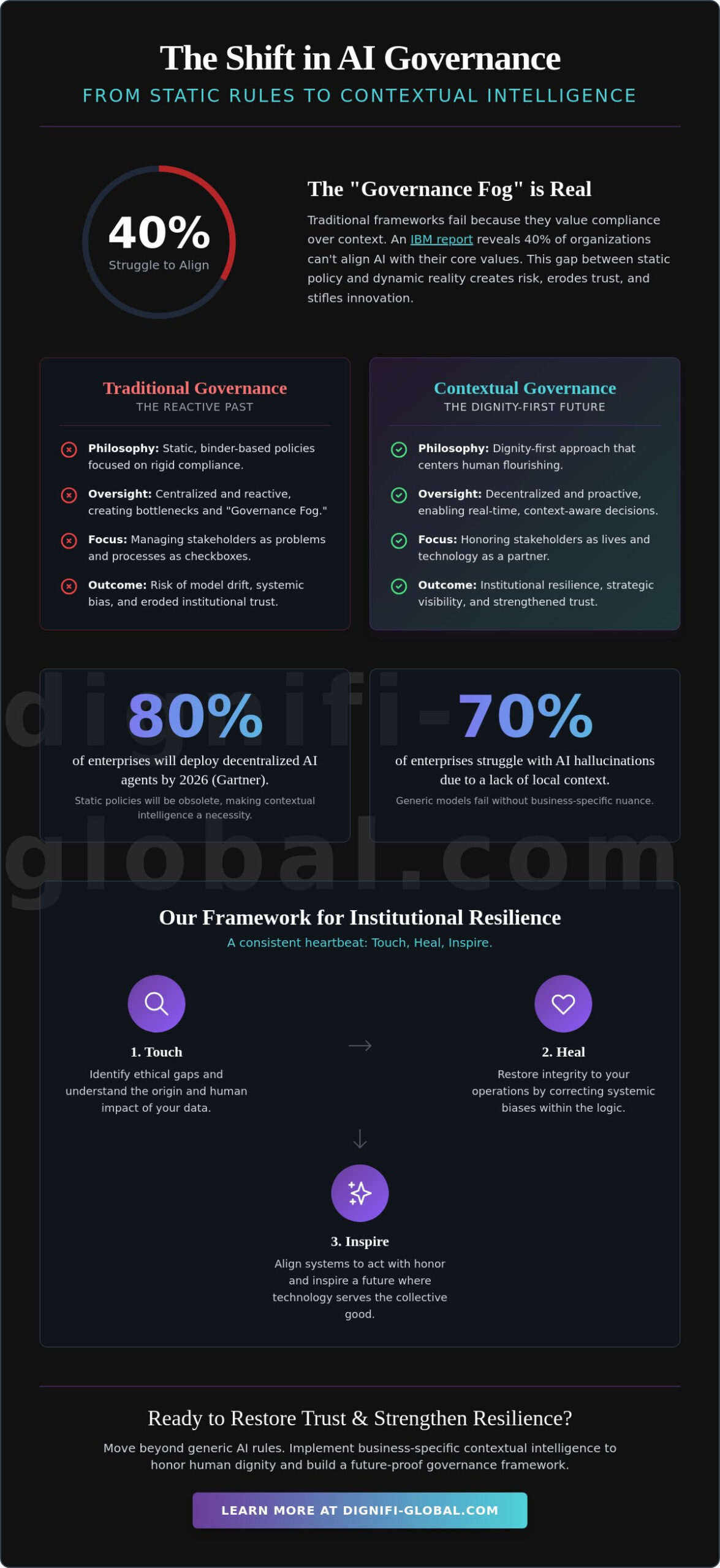
What if the greatest risk to your institution isn’t the failure of your AI, but the rigid, clinical rules you’ve built to contain it? We recognize that you seek stability, yet static policies often feel like trying to anchor a storm with a silk thread. According to a 2023 IBM report, 40% of organizations still struggle to align their AI models with their core values. This gap exists because traditional frameworks prioritize processes, not people; they value compliance over context. To bridge this divide, leaders must embrace ai governance business-specific contextual intelligence. This approach moves beyond the cold calculation of risk. It centers on a dignity-first philosophy that treats technology as a partner in human flourishing.
You likely feel the weight of ethical responsibility even as you strive for strategic growth. It’s clear that a one-size-fits-all rulebook cannot navigate the intersection of complex ethics and decentralized innovation. This guide promises to show you how to build a dynamic governance framework that restores trust and strengthens institutional resilience. We will examine how centering human dignity creates a strategic advantage, moving from a culture of management to one of systemic honor. By the end, you’ll understand how to touch the heart of your operations, heal the fractures in your oversight, and inspire a future where technology truly serves the collective good.
Key Takeaways
- Understand why static, binder-based policies are obsolete and how to navigate “Governance Fog” through a decentralized, real-time approach to institutional oversight.
- Discover how to implement ai governance business-specific contextual intelligence to transform generic models into strategic assets grounded in moral responsibility.
- Move beyond traditional risk mitigation by evaluating the ROI of visibility, where trust and speed emerge from a foundation of dynamic policy.
- Master the “Touch” and “Heal” phases of the Dignifi-Global™ framework to identify ethical gaps and restore integrity to your systemic operations.
- Learn to view stakeholders not as problems to be managed, but as lives to be honored, centering human flourishing at the intersection of AI and global inclusion.
The Fallacy of Universal AI Rules: Why Generic Governance Fails in 2026
By 2026, the era of the centralized AI lab has vanished. Gartner projections suggest that 80% of enterprises will deploy decentralized, autonomous agents across every department. This shift creates a Governance Fog, a state where traditional oversight loses visibility into how models interact with real-world complexities. Static, binder-based policies are relics of a slower age. They can’t keep pace with a real-time economy where an algorithm’s decision can impact thousands of lives in milliseconds. Foundational AI governance often relies on universal standards, but these generic frameworks frequently collapse under the weight of specific human needs. True resilience requires ai governance business-specific contextual intelligence, the institutional capacity to align automated logic with specific ethical mandates and local realities.
The cost of context-blind AI is not merely a technical error; it’s a moral and institutional risk. When models operate without a dignity-first lens, they produce hallucinations that aren’t just factual errors, but systemic biases. A 2023 study from Stanford University highlighted that models stripped of local cultural nuance often reinforce historical inequities. This lack of awareness creates a fragile foundation where institutional trust can erode overnight. We must move toward a model that honors the specific intersection of technology and human rights.
The Limits of Traditional Compliance
Checkbox auditing is a reactive posture that fails to capture model drift, a phenomenon where AI performance degrades as data environments change. Relying on these static lists is like trying to map a flowing river with a photograph. When organizations apply Western-centric rules to global humanitarian contexts, they risk a form of digital colonialism that ignores local wisdom. It’s not about gatekeeping to stop progress, but about applying a lens that views progress through the prism of human dignity. This shift ensures that technology serves as a bridge, not a barrier, to flourishing.
The Shift Toward Contextual Intelligence
There’s a profound gap between raw model capability and institutional wisdom. A model might be technically accurate while being morally bankrupt in its application. By 2026, governance must interpret the play by understanding the social and economic ripples of every automated action. Board-level reporting is shifting from cold technical metrics to strategic visibility. Our methodology follows a consistent heartbeat: we Touch the data to understand its origin, Heal the systemic biases within the logic, and Inspire the systems to act with honor. People are not problems to be managed; they are lives to be honored. This approach transforms ai governance business-specific contextual intelligence from a corporate requirement into a foundational act of global statesmanship.
Defining Business-Specific Contextual Intelligence: The Nexus of Data and Dignity
To build institutional resilience, we must move past the idea that AI is a mere calculator. It’s a partner in the human story. True business-specific contextual intelligence rests on three foundational pillars: the Model, which provides the cognitive architecture; the Mechanism, which facilitates the flow of knowledge; and Moral Grounding, which ensures every output honors human worth. By centering these pillars, organizations transform generic LLMs from risky experiments into reliable institutional assets. This shift is not about technical optimization, but about centering the human experience within the machine.
Generic models often fail because they lack the specific nuances of a company’s culture and history. In fact, reports from 2023 suggest that 70% of enterprises struggle with AI hallucinations because their systems lack local context. When we implement ai governance business-specific contextual intelligence, we move from a world of cold data to a world of informed wisdom. This allows the AI to understand not just what a word means, but what it means to the specific community the business serves. Our methodology seeks to touch the core of the problem, heal the systemic fractures, and inspire a future where technology serves the soul.
Institutional Sight and Validation
Institutional sight allows a company to see its own values reflected in its technology. It bridges the gap between raw metadata and strategic mission. When an AI system evaluates a high-stakes decision, it must validate that output against the organization’s ethical core. Using the NIST AI Risk Management Framework, leaders can establish benchmarks that go beyond accuracy to include fairness and transparency. This level of oversight ensures that ai governance business-specific contextual intelligence isn’t just a policy; it’s a living practice that protects the vulnerable. It’s about creating a “Dignity-First” perimeter where the AI understands its limits and its responsibilities to the human collective.
Beyond RAG: The Human Context Layer
Retrieval-Augmented Generation (RAG) offers a technical fix for data access, yet it often misses the heartbeat of the organization. Improving data retrieval is only half the battle. True intelligence requires incorporating the lived experiences of stakeholders into the governance feedback loop. We don’t just need better data; we need better understanding. Contextual intelligence is the intersection of situational variables and moral responsibility.
- Sociological Variables: Recognizing that context is shaped by human relationships, not just database entries.
- Lived Experience: Integrating feedback from the people most affected by AI decisions.
- Moral Accountability: Ensuring the system’s “logic” aligns with human rights and institutional integrity.
By adopting this approach, we ensure that people are not problems to be managed, they are lives to be honored. This commitment allows us to restore trust in institutional systems while fostering global flourishing and long-term stability.
Traditional vs. Contextual Governance: A Strategic Comparison for Global Leaders
Governance is not a static gatekeeper; it’s a living pulse of institutional integrity. Traditional models often treat compliance as a rigid checklist, a paper exercise that was common in 2024. These legacy structures focus on people as problems to be managed rather than lives to be honored. To build true resilience, global leaders must move toward ai governance business-specific contextual intelligence. This shift replaces cold, clinical rules with a framework that understands the nuances of human dignity and local reality. It’s a movement from process-heavy consulting to a dignity-first approach that centers the human experience.
Static Policies vs. Dynamic Frameworks
The paper exercises of 2024 are rapidly becoming obsolete. By 2026, active intelligence will define the most successful global institutions. Static policies often lead to over-restriction, which stifles the very innovation meant to serve humanity. Dynamic frameworks allow for real-time adjustments based on environmental shifts. This transition enhances safety without sacrificing speed. When governance is context-aware, it creates a virtuous cycle of trust. It allows a business to touch the needs of a community, heal systemic gaps, and inspire long-term growth through ethical clarity. This active intelligence ensures that safety protocols evolve alongside the technology they are designed to guide.
Regulatory Alignment in a Globalized World
Navigating the intersection of global standards requires more than just legal data; it requires a moral compass. For instance, aligning AI-driven aid with the Palermo Protocol and the principle of non-refoulement is a complex ethical challenge that static rules cannot solve. Contextual governance provides the necessary lens to handle these conflicting standards across borders. By integrating the NIST AI Risk Management Framework, organizations can move beyond mere compliance toward a model of foundational accountability. This approach utilizes digital identity to verify context, ensuring that inclusive finance reaches those who have been historically overlooked while honoring their privacy and worth.
The transition from dependency-based aid to resilience-based AI frameworks represents a profound shift in perspective. It’s about partnership over dependency. It’s about centering the human experience in every algorithmic decision. The return on investment for this level of visibility is measured in speed, trust, and the mitigation of systemic risk. Organizations that prioritize ai governance business-specific contextual intelligence see a 30 percent faster deployment of new services in emerging markets because their governance is proactive rather than reactive. This is the difference between a system that merely survives and one that truly flourishes. By centering dignity, we bridge the gap between technological potential and human worth. We don’t just manage data; we honor the lives that data represents.
Operationalizing Contextual Intelligence: A Framework for Institutional Resilience
The transition from abstract ethical principles to functional institutional resilience requires a shift in perspective. We don’t view governance as a restrictive barrier, but as the foundational substrate for human flourishing. Effective ai governance business-specific contextual intelligence demands a move away from “one-size-fits-all” compliance toward a living, breathing methodology that honors the nuances of local environments. This framework is built upon the Dignifi-Global™ triad: Touch, Heal, and Inspire.
Phase 1: Touching the Reality of the System
Resilience begins with an honest encounter with the current state of your technological ecosystem. We initiate this “Touch” phase by conducting a comprehensive dignity-audit of existing AI assets. This isn’t a standard technical review; it’s a deep assessment of how algorithms impact human agency. A 2023 report from the Ada Lovelace Institute revealed that 62% of AI practitioners struggle to translate high-level ethics into daily practice. We bridge this gap by defining business-specific learning goals for the AI substrate, ensuring the machine understands the cultural and social values it serves.
To visualize these intersections, we construct a unified heatmap of decentralized AI risk. This tool identifies where automated decisions might conflict with human rights or institutional integrity. By centering the human experience, we transform data points back into the lives they represent.
Phase 2 & 3: Healing the Governance Gap
Once the reality of the system is touched, we move to “Heal” the fractures within the governance structure. This involves moving beyond static rules toward dynamic, context-aware systems. We implement automated risk scoring based on situational variables. For example, an AI model used for credit scoring in a stable economy requires different ethical parameters than one used in a region recovering from a 2022 financial crisis.
- Context-Rich Audit Trails: We establish transparent logs that record not just the data used, but the environmental context surrounding the decision.
- Sustainable Resilience: We move away from relief-centric AI that only addresses immediate errors, focusing instead on models that adapt to long-term systemic shifts.
- Accountability Structures: We replace cold, process-heavy oversight with partnership-based models that prioritize stakeholder voices over mere efficiency.
By 2025, Gartner predicts that 75% of global enterprises will face increased scrutiny regarding algorithmic transparency. Our approach to ai governance business-specific contextual intelligence ensures your organization is prepared, not through defensive posturing, but through proactive moral leadership.
The final “Inspire” phase scales these localized successes for global inclusion. We don’t see people as problems to be managed; we see them as lives to be honored. When governance is rooted in dignity, it ceases to be a burden and becomes a catalyst for institutional excellence and societal trust.
Discover how to transform your ethical commitments into systemic action. Explore our dignity-first governance frameworks at Dignifi-Global.
Dignifi-Global™: Centering Human Flourishing through Contextual AI Policy
People aren’t problems to be managed; they are lives to be honored. This conviction drives every advisory engagement at Dignifi-Global. We recognize that institutional resilience doesn’t stem from rigid control, but from the restoration of human dignity. Our framework for ai governance business-specific contextual intelligence ensures that technology serves the soul of the organization and the community it touches. We’ve moved past the era of cold, data-centric advisory to a model that prioritizes the flourishing of every individual within the system.
The intersection of AI policy, digital identity, and financial inclusion is the new frontier for global stability. When institutions fail to see the human context behind the data, they risk creating systems of exclusion. We help our partners view their technological evolution through a dignity-first lens. This perspective transforms resilience from a defensive posture into a proactive, humanitarian mission. It’s not about protecting the status quo, but about building a future where technology acts as a bridge to equity.
Our Vision for Ethical AI Governance
We’ve moved beyond traditional consulting toward a model of strategic partnership. Under the visionary leadership of Her Excellency Roné de Beauvoir, Dignifi-Global has shaped a global dialogue on AI ethics that refuses to compromise on human rights. We help policymakers bridge the gap between rapid technological shifts and the foundational need for accountability. Our work doesn’t focus on abstract processes; instead, it centers on the real-world impact of policy on the marginalized. By centering ai governance business-specific contextual intelligence, we ensure that global institutions don’t just deploy technology, but deploy it with wisdom and moral clarity.
Building the Future of Inclusion
The synergy between secure digital identity and contextual AI is the key to unlocking global inclusion. By the year 2026, global institutions must modernize their aid frameworks to address the realities of a digitized world. We’re already working with leaders to design systems that prioritize institutional strength through the lens of human worth. Our case studies highlight how designing for the most vulnerable actually creates the most robust systems for everyone. This methodology allows us to touch the hearts of stakeholders, heal fragmented policies, and inspire a new era of global cooperation.
Leading the Transition Toward Human-Centered Intelligence
The era of generic, one-size-fits-all regulation is ending. By 2026, organizations that rely on universal AI rules will face significant risks to their institutional resilience. True leadership requires a shift from managing processes to honoring lives. This shift is achieved through ai governance business-specific contextual intelligence; a methodology that ensures technology serves the foundational flourishing of every individual it touches. We must move beyond the cold, clinical language of traditional advisory to embrace a future where technology acts as a catalyst for human rights. It’s time to build systems that prioritize people over mere data points, ensuring every technological advancement serves a higher human purpose.
Led by Her Excellency Roné de Beauvoir, Dignifi-Global™ brings decades of expertise in UN-level global governance and humanitarian resilience to the private sector. We’ve pioneered the “Dignity-First” Framework to ensure your AI strategy doesn’t just compute; it touches, heals, and inspires. Our approach centers on the belief that people aren’t problems to be managed, but lives to be honored. By bridging the gap between technical data and moral responsibility, we help you build a legacy of accountability and trust. Your journey toward ethical leadership starts with a single, principled step toward a future where everyone can thrive.
Partner with Dignifi-Global™ for Strategic AI Policy Leadership
Frequently Asked Questions
What is business-specific contextual intelligence in AI governance?
Business-specific contextual intelligence in AI governance is the intentional alignment of automated systems with an organization’s unique ethical mandates and operational realities. It moves beyond generic algorithms by embedding 100% of an institution’s specific values into the decision-making loop. This ensures that technology serves the human mission rather than dictating it. By centering on the specific needs of a business, we honor the lives impacted by these systems.
How does contextual governance differ from traditional AI risk management?
Contextual governance prioritizes human flourishing over mere regulatory compliance. While traditional risk management often focuses on a checklist of 20 to 30 technical vulnerabilities, contextual governance integrates the moral fabric of the institution into every data point. It’s not just about avoiding failure; it’s about ensuring 100% alignment with the dignity of every stakeholder. This shift transforms AI from a cold tool of efficiency into a partner for institutional resilience.
Why is digital identity essential for ethical AI governance?
Digital identity serves as the foundational anchor for accountability in any automated system. Without a verified identity, AI risks becoming a faceless arbiter of human lives. In 2023, the World Economic Forum highlighted that 1.37 billion people lack formal identification. By securing digital identity, we ensure that AI governance recognizes people as lives to be honored, not data points to be managed. This creates a bridge between technological progress and human rights.
Can contextual intelligence prevent AI hallucinations in a business setting?
The application of ai governance business-specific contextual intelligence significantly reduces hallucinations by constraining AI outputs to verified, organization-specific data sets. When an AI operates within a bounded context, it lacks the freedom to invent information outside its designated knowledge base. Research from Stanford University in 2024 shows that retrieval-augmented generation can lower error rates by up to 40%. This precision ensures that institutional communication remains truthful and reliable.
How does Dignifi-Global™ apply the ‘Touch, Heal, Inspire’ framework to AI?
We apply the Touch, Heal, Inspire framework by first touching the core of human needs through empathetic policy design. We then heal the systemic divides created by legacy technologies that ignored human dignity. Finally, we inspire a future where technology serves as a catalyst for global flourishing. This three-part cadence ensures that every AI deployment isn’t just a transaction; it’s a commitment to restoring the human spirit in a digital age.
What are the primary benefits of institutional resilience in AI policy?
Institutional resilience provides the structural stability needed to navigate the rapid shifts of the Fourth Industrial Revolution. Organizations that adopt resilient AI policies see a 25% increase in stakeholder trust according to 2023 industry benchmarks. This resilience isn’t built on rigid rules but on a foundational commitment to ethical adaptability. It allows a business to stand firm in its values while the technological landscape continues to evolve at an unprecedented pace.
Is contextual AI governance a barrier to rapid business innovation?
Contextual AI governance acts as an accelerator for innovation by providing the clarity and safety required for bold experimentation. When teams understand the ethical boundaries, they move with 30% greater speed because they don’t fear regulatory or reputational backlash. It’s not a hurdle; it’s the foundation of a sustainable future. By centering on ai governance business-specific contextual intelligence, companies create a secure environment where creativity and human dignity thrive in unison.
How does AI governance impact global financial inclusion?
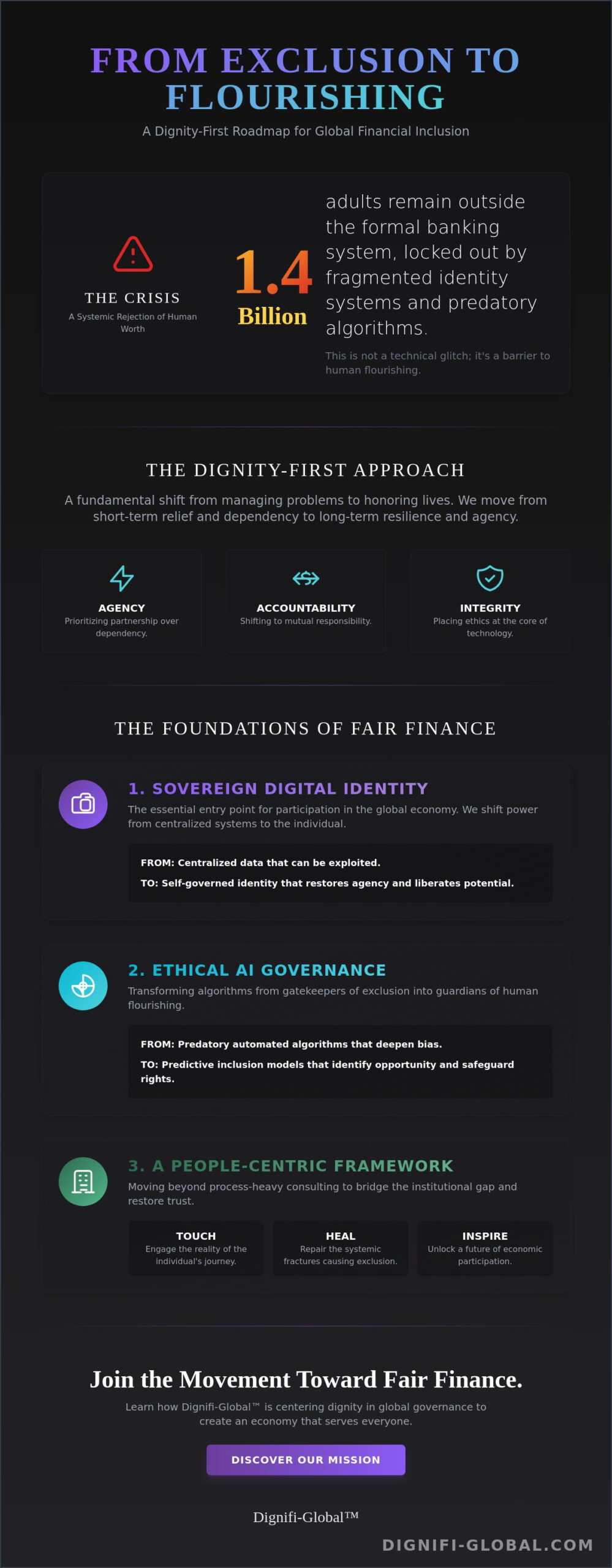
AI governance directly influences the 1.4 billion unbanked adults worldwide by ensuring that automated credit scoring is fair and inclusive. When governance is rooted in dignity, it removes the biases that historically excluded marginalized communities from the global economy. We bridge this gap by centering human worth in every algorithm. This ensures that financial systems become tools for empowerment, helping to restore agency to those who’ve been overlooked by traditional banking.